Cardinal George Pell leads Eucharistic adoration and a Eucharistic procession at the Pontifical University of St. Thomas Aquinas (the Angelicum) in Rome on May 18, 2021. / Daniel Ibanez/CNA
Vatican City, Jan 12, 2023 / 03:38 am (CNA).
The funer… […]
Washington, D.C. Newsroom, Jan 11, 2023 / 08:30 am (CNA).
Australian Cardinal George Pell died Tuesday in Rome at age 81 after suffering a cardiac arrest following a routine hip replacement surgery, his … […]
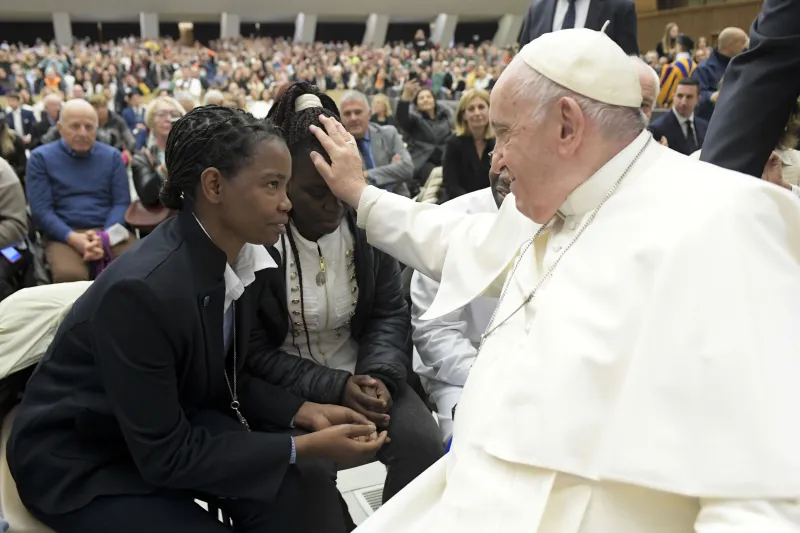
Pope Francis blesses a young woman during a general audience in the Vatican’s Paul VI Hall in December 2022. / Vatican Media.
Rome Newsroom, Jan 10, 2023 / 05:00 am (CNA).
Sickness and vulnerability is scary because it is a threat to the culture of efficiency, Pope Francis said on Tuesday, in a message published ahead of the World Day of the Sick.
“We are rarely prepared for illness. Oftentimes, we fail even to admit that we are getting older,” the pope said Jan. 10. “Our vulnerability frightens us and the pervasive culture of efficiency pushes us to sweep it under the carpet, leaving no room for our human frailty.”
“We are all fragile and vulnerable, and need that compassion which knows how to pause, approach, heal, and raise up. Thus, the plight of the sick is a call that cuts through indifference and slows the pace of those who go on their way as if they had no sisters and brothers,” he said.
The Catholic Church will mark the 31st annual World Day of the Sick on Feb. 11, the Feast of Our Lady of Lourdes. The Sanctuary of Our Lady of Lourdes in southwestern France is associated with the sick because of the presence of a miraculous spring from which many people have obtained physical healing.
This year’s papal message is titled “Take care of him: Compassion as a synodal exercise of healing.”
“It is not only what functions well or those who are productive that matter,” Pope Francis said. “Sick people, in fact, are at the center of God’s people, and the Church advances together with them as a sign of a humanity in which everyone is precious and no one should be discarded or left behind.”
He said it is crucial that the whole Church strive to follow the example of the Good Samaritan.
Just as the Samaritan asked the innkeeper to take care of the wounded man, “Jesus addresses the same call to each of us,” Francis said.
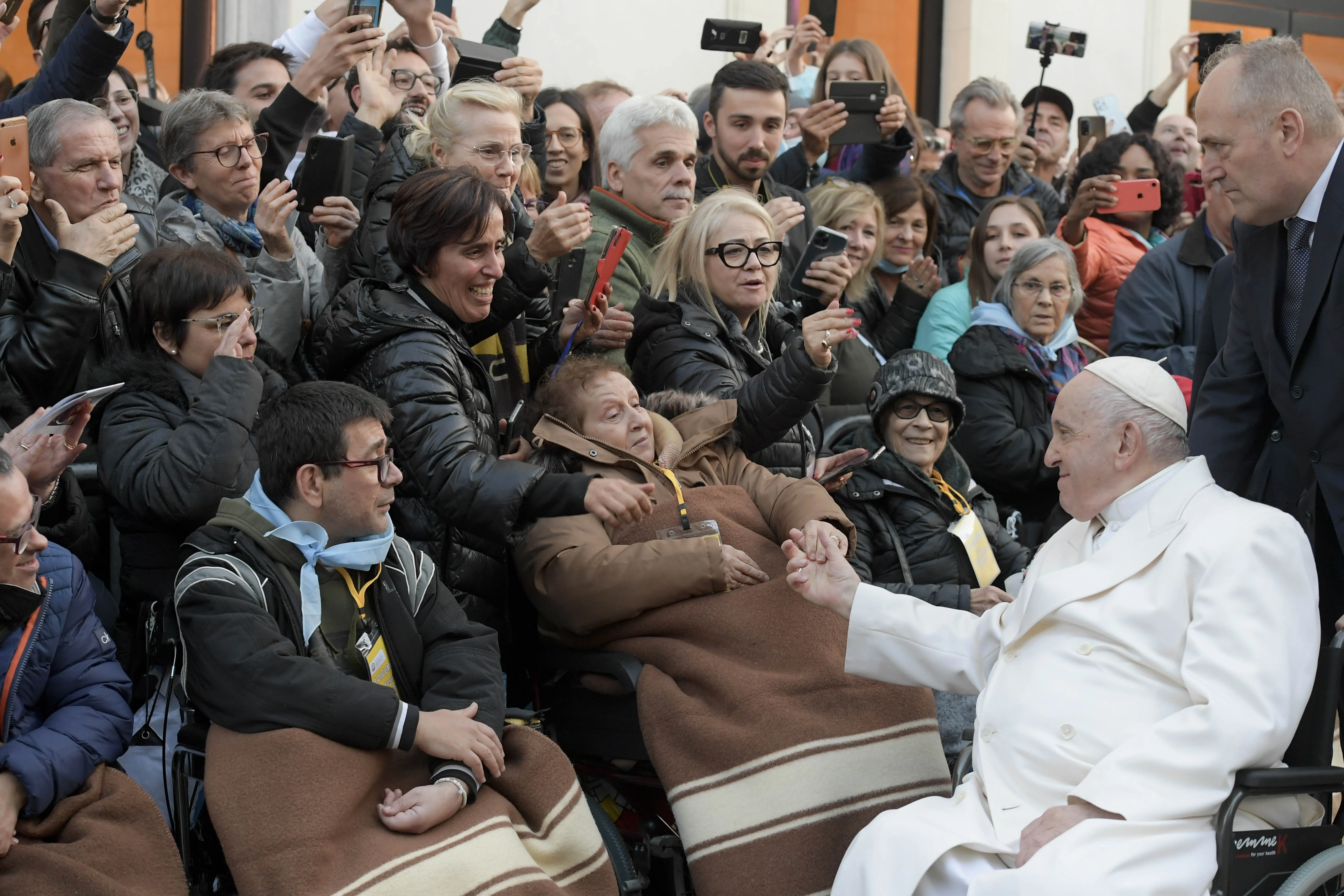
Pope Francis greets a woman in a wheelchair in Rome’s Piazza di Spagna on Dec. 8, 2022. Vatican Media
“As I noted in Fratelli Tutti, ‘The parable shows us how a community can be rebuilt by men and women who identify with the vulnerability of others, who reject the creation of a society of exclusion, and act instead as neighbors, lifting up and rehabilitating the fallen for the sake of the common good’ (No. 67),” he said.
“Indeed,” the pope continued, “‘we were created for a fulfillment that can only be found in love. We cannot be indifferent to suffering’ (No. 68).”
Pope Francis also noted that sickness and weakness are part of the human journey, thus, it can be an act of synodality to walk together in community with those who are suffering.
“I invite all of us to reflect on the fact that it is especially through the experience of vulnerability and illness that we can learn to walk together according to the style of God, which is closeness, compassion, and tenderness,” he said.
Pope Francis also addressed the role injustice plays in the lack of access to adequate medical care which many people experience.
The COVID-19 pandemic, he said, showed the limits of existing public welfare systems.
“It is no longer easy to distinguish the assaults on human life and dignity that arise from natural causes from those caused by injustice and violence,” he said.
“In fact,” he continued, “increasing levels of inequality and the prevailing interests of the few now affect every human environment to the extent that it is difficult to consider any experience as having solely ‘natural’ causes. All suffering takes place in the context of a ‘culture’ and its various contradictions.”
“Gratitude, then, needs to be matched by actively seeking, in every country, strategies and resources in order to guarantee each person’s fundamental right to basic and decent healthcare,” the pope said.
Archbishop Georg Gänswein and Pope Francis / Daniel Ibanez/CNA
Vatican City, Jan 9, 2023 / 09:24 am (CNA).
Archbishop Georg Gänswein, the longtime personal secretary of the late Pope Benedict XVI, met with Pope Francis this morning, according t… […]
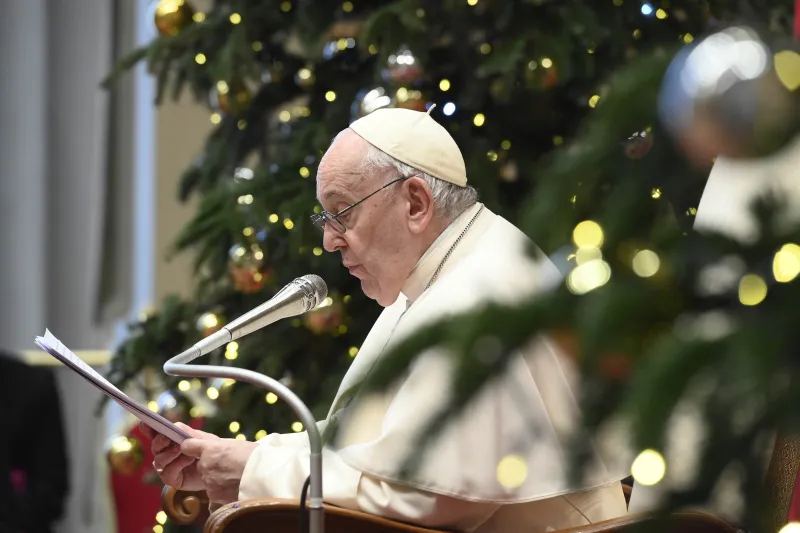
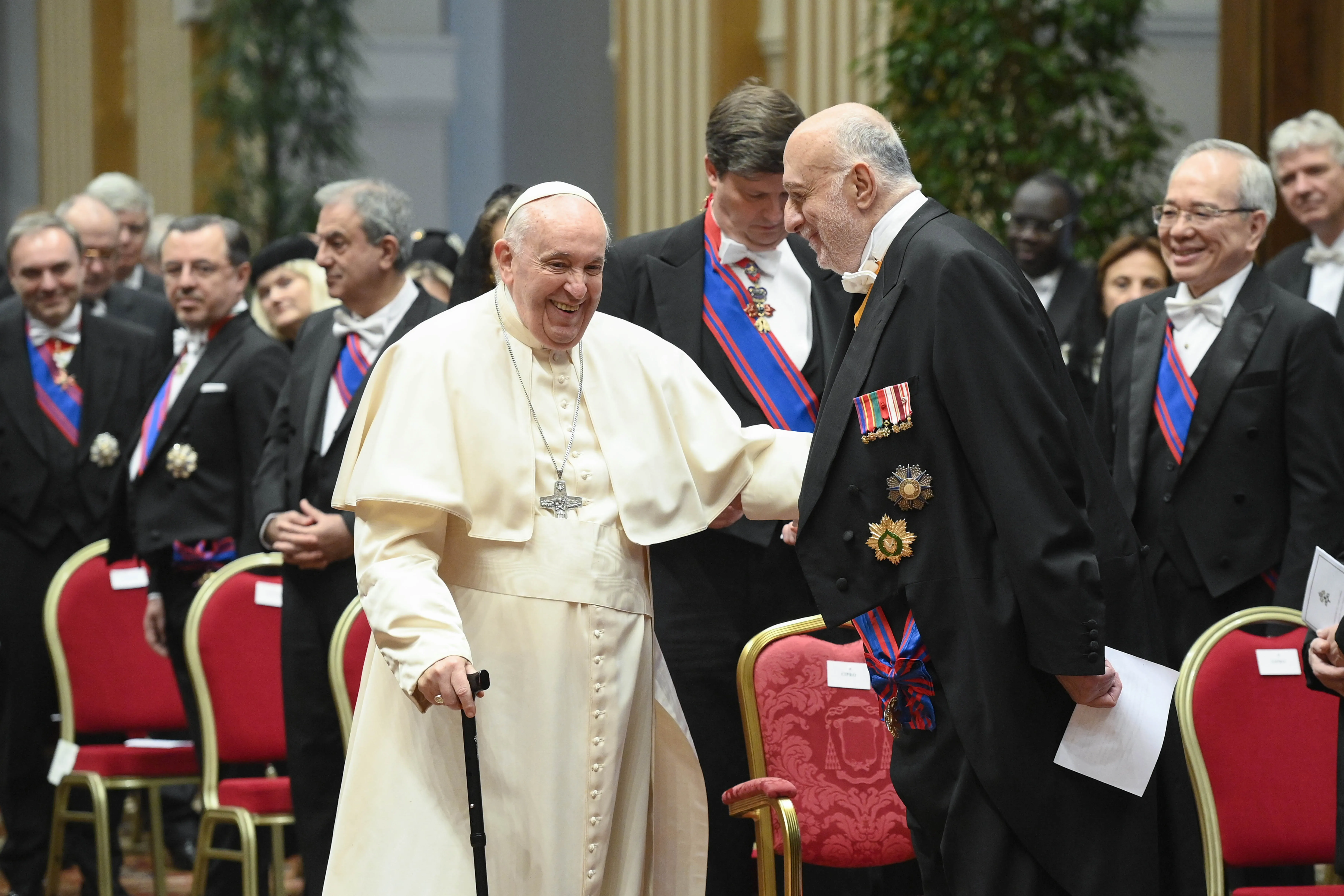
Pope Francis addresses international diplomats to the Holy See on Jan. 9, 2023, in the Vatican’s Blessing Hall. / Vatican Media
Rome Newsroom, Jan 9, 2023 / 06:28 am (CNA).
The global community is engaged in a “third world war” marked by heightened fear, conflict, and risk of nuclear violence, but a recommitment to “truth, justice, solidarity and freedom” can provide a pathway to peace, Pope Francis told international diplomats Monday.
Citing the ongoing war in Ukraine, but also drawing on conflicts in places such as Syria, West Africa, Ethiopia, Israel, Myanmar, and the Korean Peninsula, the Holy Father said this global struggle is being “fought piecemeal,” but is nonetheless interconnected.
“Today the third world war is taking place in a globalized world where conflicts involve only certain areas of the planet direct, but in fact involve them all,” said Pope Francis, speaking in the Vatican’s apostolic palace.
The pope made these remarks as part of his annual address to the diplomatic corps accredited to the Holy See. Pope Francis characterized this speech as “a call for peace in a world that is witnessing heightened divisions and war.”
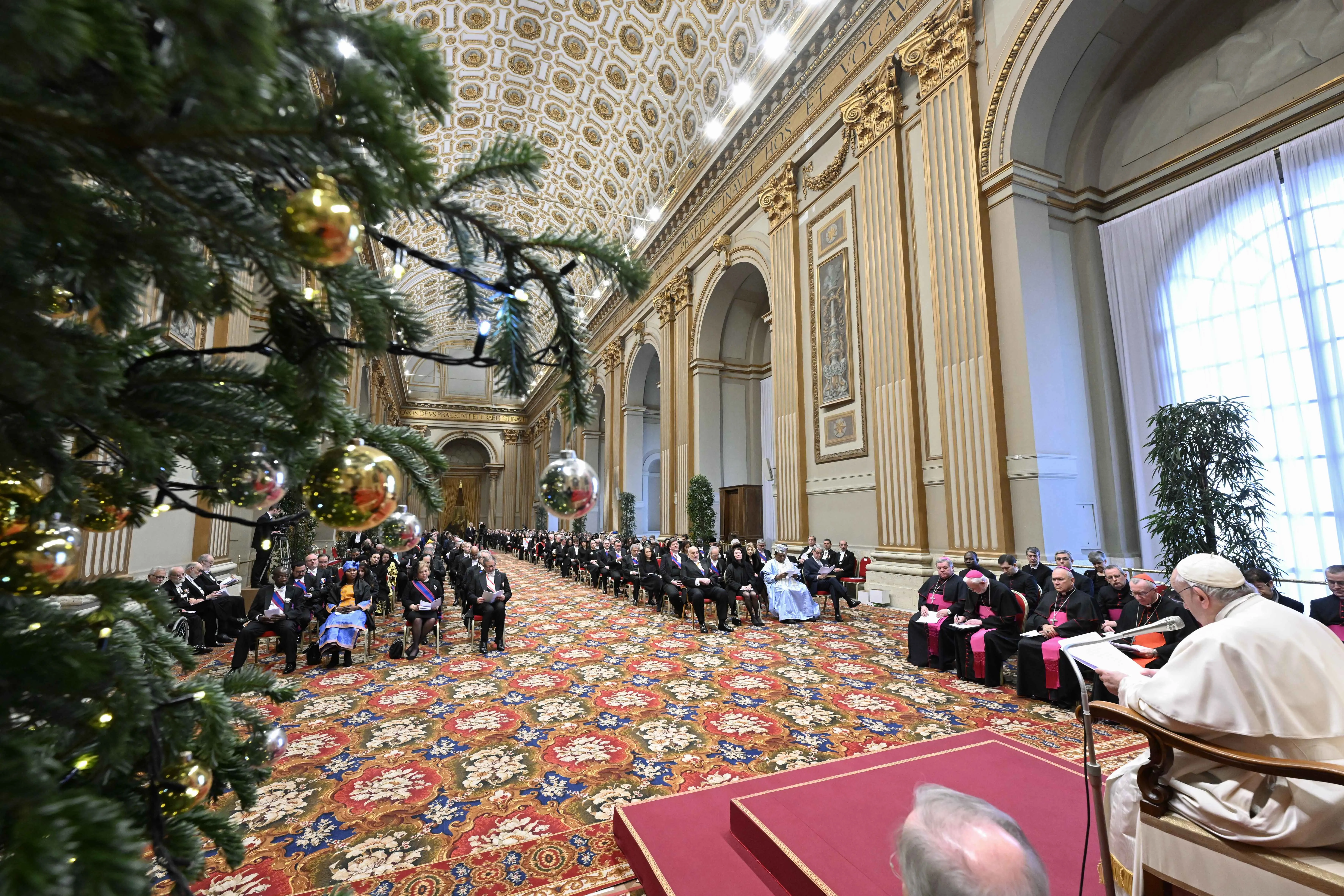
Pope Francis addresses diplomats to the Holy See in the Blessing Hall at the Vatican on Jan. 9, 2023. Vatican Media
As part of this heightening of tensions, the Pope warned about the increased threat of nuclear warfare, drawing particular concern to the stall in negotiations for the Iran nuclear deal. He told the gathered diplomats that the possession of nuclear weapons is “immoral” and called for an end to a mentality that pursues conflict deterrence through the development of ever-more lethal means of warfare.
“There is a need to change this way of thinking and move toward an integral disarmament, since no peace is possible when instruments of death are proliferating,” the pope said.
In proposing a path towards global peace, the Holy Father drew heavily from Pacem in Terris (“Peace on Earth”), the papal encyclical promulgated by St. John XXIII in 1962. Pope Francis said the conditions which prompted the “good Pope” to issue Pacem in Terris 60 years ago bear a striking similarity to the state of the world today.
In particular, the Holy Father drew from what John XXIII described as the “four fundamental goods” necessary for peace: truth, justice, solidarity, and freedom, values that “serve as the pillars that regulate relationships between individuals and political communities alike.”
Regarding “peace in truth,” the Holy Father underscored the “primary duty” of governments to protect the right to life at every stage of human life.
“Peace requires before all else the defense of life, a good that today is jeopardized not only by conflicts, hunger, and diseases, but all too often in the mother’s womb, through promotion of an alleged ‘right to abortion,’” said Pope Francis, also calling for an end to the death penalty and violence against women.
Speaking of the necessity of religious freedom for peace, the Holy Father noted widespread religious persecution against Christian minorities, but also discrimination in countries where Christianity is a majority religion.
“Religious freedom is also endangered wherever believers see their ability to express their convictions in the life of society restricted in the name of a misguided understanding of inclusiveness,” he said.
Regarding justice, the Holy Father called for a “profound rethinking” of multilateral systems such as the United Nations to make them more effective at responding to conflicts like the war in Ukraine. But he also criticized international bodies for “imposing forms of ideological colonization, especially on poorer countries” and warned of the growing risk of “ideological totalitarianism” that promotes intolerance towards those who dissent from certain positions claimed to represent ‘progress.’”
Pope Francis visits with international diplomats accredited to the Holy See on Jan. 9, 2023, at the Vatican. Vatican Media
The Holy Father also spoke of the need to deepen a sense of global solidarity, citing four areas of interconnectedness: immigration, the economy and work, and care for creation,
“The paths of peace are paths of solidarity, for no one can be saved alone. We live in a world interconnected that, in the end, the actions of each have consequences for all.”
Finally, regarding “peace in freedom,” Pope Francis warned of the “weakening of democracy” in many parts of the world, and an increase in political polarization. He said peace is only possible if “in every single community, there does not prevail that culture of oppression and aggression in which our neighbor is regarded as an enemy to attack, rather than a brother or sister to welcome and embrace.”
The Holy Father’s address to the diplomatic corps, which includes representatives of the 91 countries and entities with an embassy chancellery accredited to the Holy See, also served as an opportunity to review diplomatic highlights of the past year and expectations for the year to come.
Milestones included the signing of new bilateral accords with both the Democratic Republic of São Tomé and Príncipe and with the Republic of Kazakhstan. The Holy Father also briefly mentioned the provisional agreement between the Holy See and the People’s Republic of China, first agreed to in 2018 and renewed in 2022 for an additional two years.
“It is my hope that this collaborative relationship can increase, for the benefit of the life of the Catholic Church and that of the Chinese people.”
The next significant marker on the pope’s diplomatic docket: His trip to the Democratic Republic of Congo at the end of the month as a “pilgrim of peace,” followed by a joint visit to South Sudan with the Archbishop of Canterbury and the head of the Presbyterian Church of Scotland.