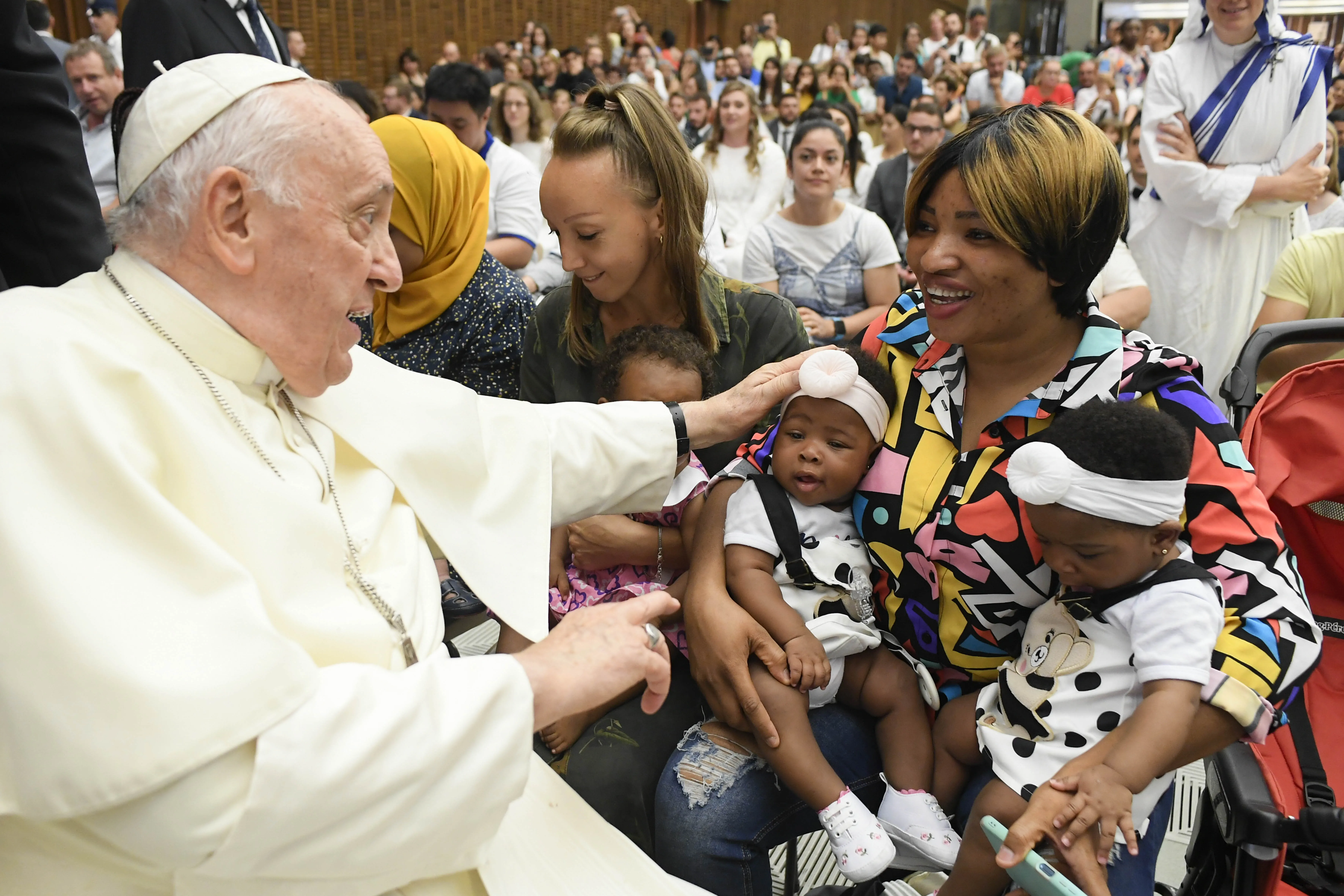
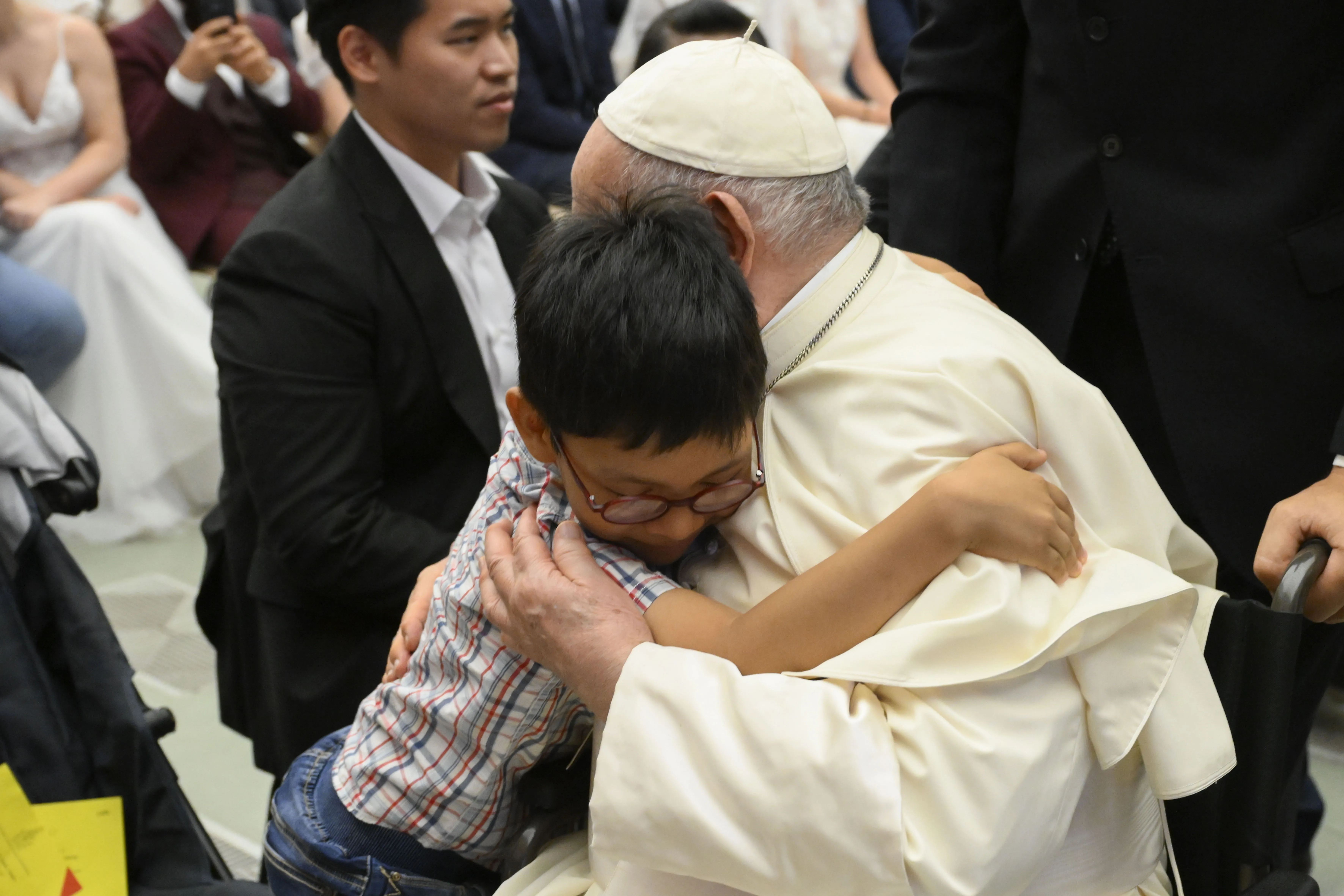
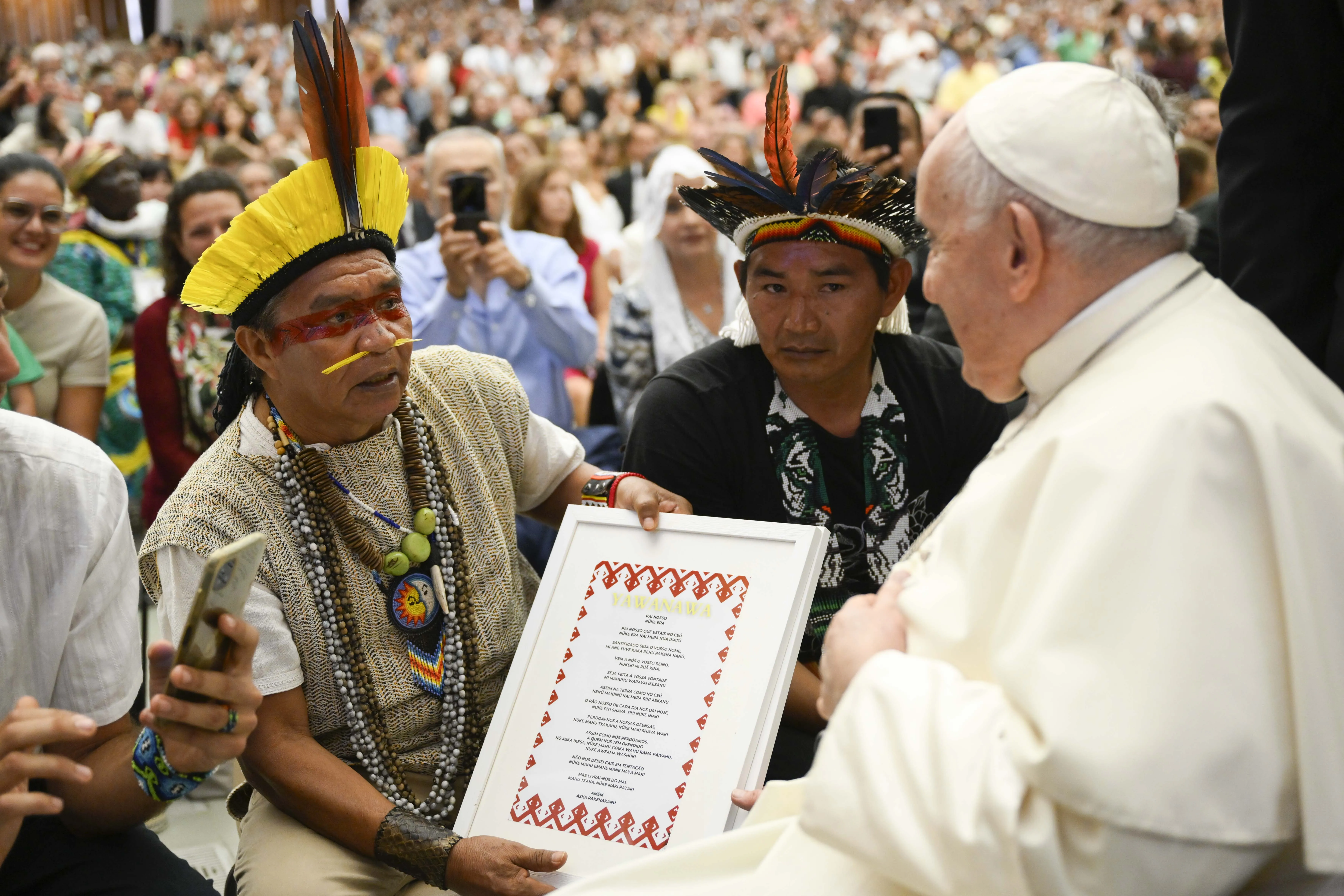
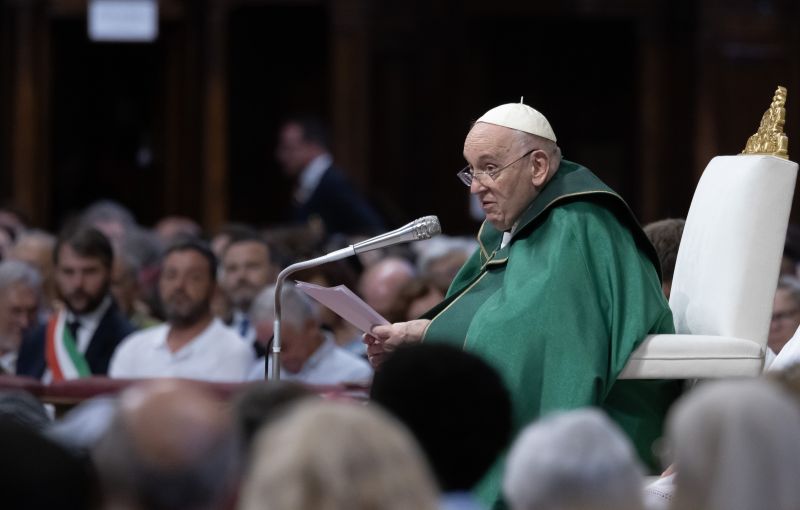
Pope Francis gives the weekly Angelus address on Aug. 27, 2023. / Vatican Media
Vatican City, Aug 27, 2023 / 05:35 am (CNA).
Christ is with us and walking beside us in our daily journey through life, including our struggles to be holy, Pope Fra… […]
Pope Francis speaks at the general audience on Aug. 23, 2023. / Vatican Media
Vatican City, Aug 26, 2023 / 09:30 am (CNA).
Pope Francis acknowledged Saturday that the upcoming Synod on Synodality may be “of little interest to the general public… […]
Eucharistic adoration following the pope’s Corpus Christi Mass June 14, 2020. / Vatican Media/CNA.
Vatican City, Aug 25, 2023 / 05:57 am (CNA).
Jesus’ healing presence in the Eucharist can “fill with tenderness” the voids and wounds produced by sin in individual lives and in society, Pope Francis said on Friday.
In a meeting at the Vatican with a pilgrimage group led by the Sister Disciples of Jesus in the Eucharist on Aug. 25, the pope noted that in the eyes of the world, it might appear “absurd” to begin confronting societal problems by prayers on one’s knees of “adoration and reparation,” but that it is always effective.
Pope Francis pointed out that the story behind the founding of the sisters’ religious order and the revival it sparked gives witness to this reality. The Sister Disciples of Jesus in the Eucharist were founded in one of the poorest dioceses in southern Italy by Servant of God Bishop Raffaello Delle Nocche in the wake of World War I and the devastating Spanish flu pandemic.
The sisters were to be “poor servants of a poor people.” Pope Francis explained: “At the center of their lives was the Eucharist, ‘a sacrament of love, a sign of unity, a bond of charity,’ as the Second Vatican Council teaches us (Sacrosanctum Concilium, 47).”
“Love, unity, and charity. What does this mean? To adore, to serve, and to repair, that is, to fill with tenderness … to fill with tenderness the wounds and voids produced by sin in man and society, beginning by kneeling before Jesus in the Consecrated Host, and remaining there for a long time,” he said.
Bishop Nocche recommended that the sisters remain in prayer before the Eucharist “even when we seem to feel nothing, in quiet and trusting abandonment, because ‘Magister adest,’ (‘the Master is here’ (Jn. 11:28).”
“By the world’s standards this strategy of action seemed absurd: in the face of immense needs and with almost no resources available, what sense could there be in telling the sisters to get down on their knees for ‘adoration and reparation’? Yet, as always, the way of faith and self-offering worked in this case too,” Pope Francis said.
“The prayers of those courageous women indeed generated a contagious force, which soon led them to undertake and promote works of material, cultural, and spiritual redemption far exceeding all expectations.”
“They awakened the faith and commitment of parish communities and families, founded schools of various levels and grades, and rekindled devotion and a sense of their own dignity in so many people, men and women, young people, adults and the elderly, who were too often and for too long oppressed by inhumane living conditions and the contempt and indifference of the surrounding world, which saw in them nothing but rejects of society. … They unleashed a different ‘war’ — that against poverty and injustice, and they spread a different ‘epidemic’ — that of love.”
Today, the Sister Disciples of Jesus in the Eucharist have about 400 professed sisters, as well as postulants in houses of formation in Brazil, the Philippines, Rwanda, and Italy. The congregation continues to have a strong presence in southern Italy with 38 communities.
“Dear sisters, you are the witnesses and heirs of all this … with your presence in the five continents, with the Eucharistic Centers, schools, missions, and all the services you carry out,” Pope Francis said.
“Therefore, starting from pausing before Jesus in the Eucharist, the Bread broken and the Master who washes the disciples’ feet (cf. Jn. 13:3-15), may you also learn to look at your brothers and sisters through the magnifying glass of the consecrated Host.”
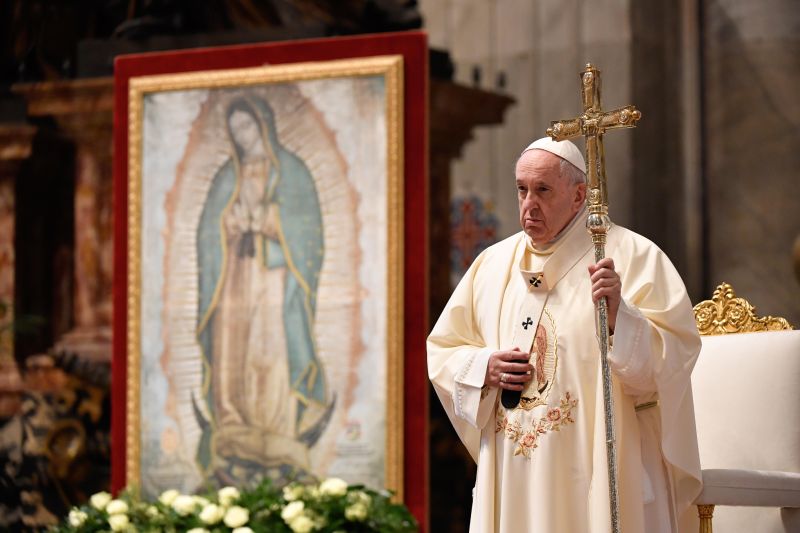
Pope Francis offers Mass on the feast of Our Lady of Guadalupe in St. Peter’s Basilica on Dec. 12, 2020. / Vatican Media
Vatican City, Aug 23, 2023 / 04:30 am (CNA).
Our Lady of Guadalupe proclaimed the Gospel in “mother tongue,” Pope Francis said Wednesday in a message that highlighted the important role mothers play in passing on the faith to the next generation.
In his catechesis on evangelization on Aug. 23, the pope spoke about how the apparition of Our Lady of Guadalupe in 1531 helped to spread the Gospel across the Americas, praising her as an inspired model of motherhood and inculturation.
“The Virgin of Guadalupe … appears dressed in the clothing of the native peoples, she speaks their language, she welcomes and loves the local culture. Mary is Mother, and under her mantle, every child finds a place. In her, God became flesh and, through Mary, He continues to incarnate Himself in the lives of peoples,” Pope Francis said in his general audience in Paul VI Hall.
“Our Lady, in fact, proclaims God in the most suitable language, the mother tongue. And to us too Our Lady speaks in our mother tongue, the one we understand well. … And I would like to say thank you to the many mothers and grandmothers who pass the Gospel on to their children and grandchildren: faith is passed on with life; this is why mothers and grandmothers are the first evangelizers.”
Pope Francis at his general audience in Paul VI Hall on Aug. 23, 2023. Vatican Media
When Our Lady of Guadalupe appeared to Juan Diego on Tepeyac hill in Mexico City on Dec. 12, 1531, she told him: “Let nothing frighten you or trouble your heart: […] Am I not here, I who am your mother?”
Pope Francis highlighted this quote as an example of how the Virgin Mary always “consoles us, makes us go forward and thus allows us to grow, like a good mother who, while following in her son’s steps, launches him into the world’s challenges.”
“Our Lady always chooses those who are simple, on the hill of Tepeyac in Mexico, as at Lourdes and Fatima: speaking to them, she speaks to everyone, in a language suitable for all, comprehensible, like that of Jesus,” Francis said.
Pope Francis at his general audience in Paul VI Hall on Aug. 23, 2023. Vatican Media
In the apparition on December 9, Our Lady of Guadalupe entrusted Juan Diego with a mission to go to the bishop to ask him to build a church where she had appeared. Juan Diego was met with great difficulty when the bishop did not believe him and turned him away, the pope explained, making a joke about bishops.
“Here is the difficulty, the trial of proclamation: despite zeal, the unexpected arrives, sometimes from the Church itself. To proclaim, in fact, it is not enough to bear witness to the good, it is necessary to know how to endure evil,” Pope Francis said.
“A Christian does good but endures evil. Both go together; life is like that. Even today, in so many places, inculturating the Gospel and evangelizing cultures requires constancy and patience, not being afraid of conflict, not losing heart. I am thinking of countries where Christians are persecuted because they are Christians and cannot practice their religion in peace.”
Pope Francis pointed out that it was the Blessed Virgin Mary who encouraged St. Juan Diego to persevere in this moment of trial. And his obedience to her message led to the miraculous image on his tilma that can be seen today in the Basilica of Our Lady of Guadalupe in Mexico City, a shrine that receives more than 10 million pilgrims each year.
Pope Francis at his general audience in Paul VI Hall on Aug. 23, 2023. Vatican Media
The Virgin Mary asked Juan Diego to go to the arid hilltop to pick flowers, he explained. “It was winter, but, nevertheless, Juan Diego found some beautiful flowers, put them in his cloak, and offered them to the Mother of God, who invited him to take them to the bishop as proof.”
“He goes, waits his turn patiently, and finally, in the presence of the bishop, opened his tilma … to show the flowers—and behold! The image of Our Lady appeared on the fabric of the cloak, the extraordinary and living image that we are familiar with.”
“This is God’s surprise. When there is willingness and obedience, he can accomplish something unexpected, at the time and in ways we cannot foresee. And so, the shrine requested by the Virgin was built.”
Pope Francis underscored the importance of Marian shrines and pilgrimage destinations, like the Shrine of Our Lady of Guadalupe, as places where the Gospel continues to be proclaimed today.
“We need to go to these oases of consolation and mercy, where faith is expressed in a maternal language; where we lay down the labors of life in Our Lady’s arms and return to life with peace in our hearts, perhaps with the peace of children,” Pope Francis said.
Bishop Michael Warfel. His resignation as bishop of the Diocese of Great Falls-Billings was accepted by Pope Francis on Aug. 22, 2023. / Diocese of Great Falls-Billings, Montana.
Vatican City, Aug 22, 2023 / 04:41 am (CNA).
Pope Francis on Tues… […]
Pope Francis meets with U.S. Gen. Mark Milley, chairman of the Joint Chiefs of Staff, for a private audience at the Vatican on Aug. 21, 2023. / Credit: Vatican Media
Rome Newsroom, Aug 21, 2023 / 12:15 pm (CNA).
Pope Francis had a private audie… […]
Pope Francis presides over a Mass in St. Peter’s Basilica in Rome on July 23, 2023, for the World Day for Grandparents and the Elderly. / Pablo Esparza/EWTN
Vatican City, Aug 21, 2023 / 03:45 am (CNA).
Pope Francis announced during an audience with lawyers Monday that he is writing a second part to his 2015 environmental encyclical Laudato si’.
The pope said with this new writing he is updating Laudato si’ to cover current issues.
He made the statement on the morning of Aug. 21, at the end of a speech to lawyers from the Council of Europe member states that signed the Vienna Declaration on the Support of the Rule of Law in 2022.
Pope Francis told the lawyers he is sensitive to their care for the common home and commitment to the development of regulatory frameworks for environmental protection.
“We must never forget that the younger generations are entitled to receive from us a beautiful and livable world, and that this invests us with grave duties towards the creation we have received from God’s generous hands,” he said.
Laudato si’ is the second of three encyclicals published in Pope Francis’ pontificate thus far. It was released in June 2015.
The title, which means “Praise be to you,” was taken from St. Francis of Assisi’s medieval Italian prayer “Canticle of the Sun,” which praises God through elements of creation like Brother Sun, Sister Moon, and “our Sister Mother Earth.”
The theme of the encyclical is human ecology, a phrase first used by Pope Benedict XVI. The document addresses issues such as climate change, care for the environment, and the defense of human life and dignity.
In Laudato si’, Francis wrote that human ecology implies the profound reality of “the relationship between human life and the moral law, which is inscribed in our nature and is necessary for the creation of a more dignified environment.”