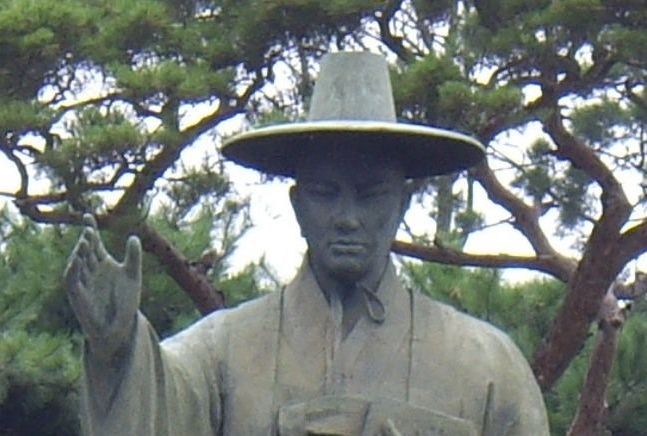
 A statue of St. Andrew Kim Tae-gŏn at the Jeoldu-san martyrs’ shrine in Seoul, South Korea / Rabanus Flavus|Wikipedia|CC BY-SA 3.0
Washington, D.C. Newsroom, Sep 11, 2023 / 14:15 pm (CNA).
The Vatican will dedicate a new statue of the patron saint of Korea, St. Andrew Kim Tae-gŏn, in St. Peter’s Basilica this Saturday.
Born in 1821, Tae-gŏn was the first native Korean priest and one of the country’s earliest martyrs.
The statue of the Korean martyr was proposed by Cardinal Lazzaro You Heung-sik, a Korean prelate and prefect of the Dicastery for the Clergy, and approved by Pope Francis, according to the Holy See’s news arm, Vatican News.
The pope has pointed to Tae-gŏn’s missionary zeal as a model for all Christians to follow.
“The Christian is by nature a witness of Jesus,” Vatican News reported Francis saying in a May 24 homily. “St. Andrew Kim and the other Korean faithful have demonstrated that the testimony of the Gospel given in times of persecution can bear many fruits for the faith.”
The statue’s dedication will take place on Sept. 16, the anniversary of Tae-gŏn’s beheading by the Korean Joseon Dynasty.
Pope Francis will welcome a delegation of 300 clergy and lay members of the Korean Church who will be coming for the dedication of the statue in a private audience on Saturday.
Cardinal You will then celebrate a Mass at St. Peter’s Basilica in Korean at 3 p.m. on Saturday.
The 6-ton marble statue of the Korean martyr, which will be permanently installed in a niche in the walls of St. Peter’s Basilica, will then be blessed by Cardinal Mauro Gambetti, archpriest of St. Peter’s Basilica, at 4:30 p.m.
Speaking to Rome’s Agenzia Fides, You said that the statue’s dedication at the Vatican has brought great joy to the Church in Korea.
“We were very happy that Pope Francis wanted to accept our proposal,” You said. “It is a great honor for our Korean Church, which is very linked to the figure of this saint.”
“We believe and hope that he can be increasingly loved and his intercession invoked by the faithful from all over the world,” You added.
After converting to Catholicism at the age of 15, Tae-gŏn trained for the priesthood in Macao and was ordained in 1836 by French Bishop Jean Joseph Jean-Baptiste Ferréol, the first bishop of Seoul.
Despite an ongoing vicious persecution, Tae-gŏn returned to Korea to evangelize his homeland. He was only 25 years old when he was tortured and ultimately beheaded during the persecution by the Joseon Dynasty for the crime of being a Catholic.
Writing to his fellow Christians shortly before his death, Tae-gŏn encouraged them to stay true to the faith. He said: “We have received baptism, entrance into the Church, and the honor of being called Christians. Yet what good will this do us if we are Christians in name only and not in fact?”
In Tae-gŏn’s last words before his execution, according to research by Macao News, he gave a final exhortation for his compatriots to convert to the one true faith.
“This is the last hour of my life,” Tae-gŏn reportedly said. “Listen to me attentively. If I have held communication with foreigners, it has been for my religion and for my God. It is for him that I die. My immortal life is on the point of beginning. Become Christians if you wish to be happy after death, because God has eternal punishments in store for those who have refused to know him.”
Along with 102 other Korean martyrs, whose executions were documented, Tae-gŏn was canonized as a saint on May 6, 1984, by Pope John Paul II during a visit to Korea.
Though most executions were not well documented, it is estimated that approximately 10,000 Korean Christians were martyred for the faith before Christianity became tolerated in 1884.
The more than 12-foot-tall statue depicts Tae-gŏn with his arms outstretched and wearing traditional Korean dopo and a flat hat.
Created by Korean Catholic artist Han Jin-seop, the statue is made entirely of Carrara marble and weighs about 6 tons.
Speaking to a reporter for the Catholic Korean news source Catholic Peace Broadcasting Corporation, Jin-seop said: “More than anything, I sincerely pray that Father Kim Dae-geon’s [Tae-gŏn’s] bold, merciful, benevolent, yet Korean-like image will be expressed well in formative ways, so that his meaning and spirit will be known to the world.”
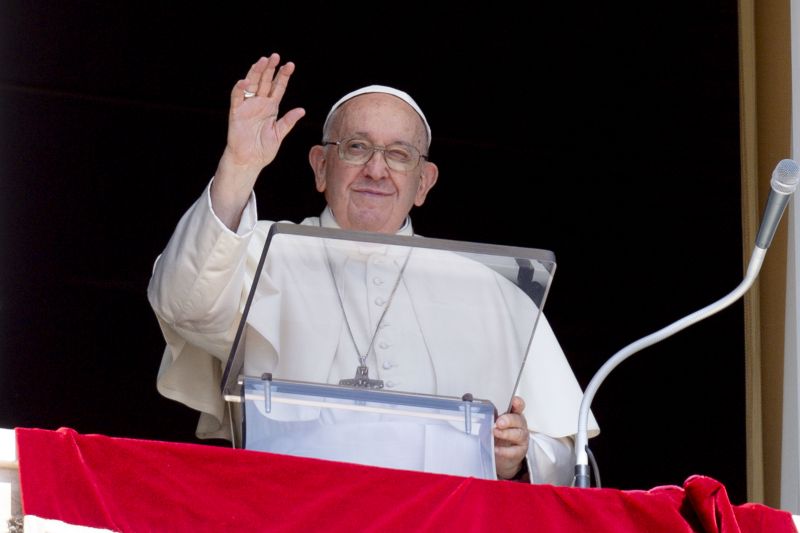
Asia has been a major focus for the pope recently. Francis just completed a four-day trip to Mongolia after which he said: “I have been to the heart of Asia, and it did me good.”
At the conclusion of this year’s World Youth Day, in Lisbon, Portugal, Francis announced that the next event would take place in Seoul, South Korea, in 2027.
There are currently more than 5 million Catholics in South Korea, making up about 11.3% of the country’s total population, according to Agenzia Fides.
Though widely practiced in the southern portion of the peninsula, Christianity remains brutally repressed in North Korea under the dictatorship of Kim Jong Un.
According to the United States Commission on International Religious Freedom: “Anyone caught practicing religion or even suspected of harboring religious views in private [in North Korea] is subject to severe punishment, including arrest, torture, imprisonment, and execution.”
[…]