No Picture
News Briefs

The remarkable life and papacy of Blessed Pope Pius IX
February 7, 2024 Catholic News Agency 2
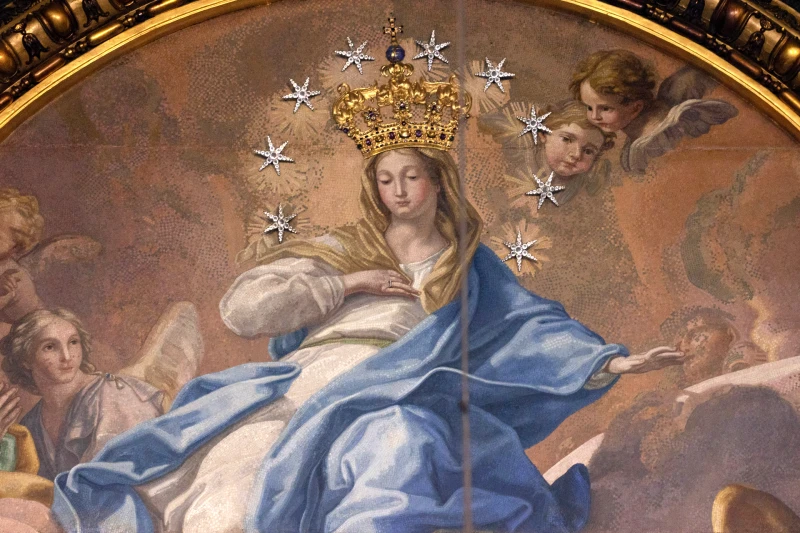
When Pope Pius IX declared the doctrine of the Immaculate Conception of the Virgin Mary on Dec. 8, 1854, he had a golden crown added to the mosaic of Mary, Virgin Immaculate, in the Chapel of the Choir in St. Peter’s Basilica. / Credit: Daniel Ibañez/CNA

ACI Prensa Staff, Feb 7, 2024 / 10:30 am (CNA).

On Feb. 7, the Catholic Church remembers Blessed Pius IX, “Pius Nono,” the 255th pope. His pontificate is the second longest in history — a total of 31 years, seven months, and 22 days (June 16, 1846–Feb. 7, 1878). He was beatified together with Pope John XXIII (now canonized) on Sept. 3, 2000, by Pope John Paul II.

The future Pope Pius IX was born Giovanni Maria Battista Pellegrino Isidoro Mastai Ferretti in Senigallia, Italy — then part of the Papal States — on May 13, 1792. His parents were Don Gerolamo Mastai Ferretti, a member of a local noble and prestigious family, and Donna Caterina Solazzi, who had him baptized on the same day of his birth. 

In 1809 he traveled to Rome to continue the studies he had begun in his native city. Even without a clear orientation toward the priesthood, he lived in an exemplary way, evidenced by some resolutions made in 1810 after a spiritual retreat when he spoke of his spiritual commitment “to fight against sin, to avoid any dangerous occasion, to study not for the ambition of knowledge but for the good of others, to abandon himself into the hands of God.” 

The future pope stopped his studies in 1812 because of an illness and was exempted from military service. In 1815 he was accepted into the Pontifical Noble Guard but had to abandon the idea because of health problems. Ferretti suffered from epilepsy from a young age — a condition that eventually subsided and then completely disappeared, according to Ferretti himself, which he credited to the intercession of Our Lady of Loreto.

At the service of God and the Church

Ferretti began studies for the priesthood in 1816 and received minor orders in 1817, the subdiaconate in 1818, and the diaconate in 1819. That same year he was ordained a priest. He celebrated his first Mass in the Church of St. Anne of the Carpenters, of the Tata Giovanni Institute, of which he was appointed rector — a position he held until 1823. 

Pius VII, who supported Ferretti’s early career, at first required him to have a concelebrant because of his epilepsy, but the requirement was lifted as his health improved. 

Ferretti had already left clear evidence of his personality: a man of constant prayer, consecrated to the ministry of the Word and the sacrament of reconciliation, always close to the most humble and needy. He knew how to combine admirably both the active and contemplative life. Very dedicated to pastoral and social work, he was also recollected and had an intense devotion to the Eucharist and to the Virgin Mary. 

In 1823 he left the Tata Giovanni Institute and traveled to Chile, accompanying the apostolic nuncio, Archbishop Giovanni Muzi. He remained there until 1825.

On his return to Italy that same year, he was appointed director of the St. Michael Home, an important ecclesial work in Rome at the service of the community, which he reformed in an effective manner. At the age of 35 he was appointed archbishop of Spoleto. This was a very hard stage of his life given his youth and inexperience, and the immense responsibility that was placed on his shoulders. During his brief time, he also contended with an abortive political revolution, using his influence to secure a pardon for the misguided revolutionaries.

In 1832, Ferretti was transferred to another diocese — this time to Imola, where he continued to be revered for his preaching, his care of his diocesan priests, clergy, and seminarians, his support of education in the diocese, and his pastoral visits to prisoners. In 1840, at the age of 48, he was named a cardinal.

Under the sign of the cross

On the afternoon of June 16, 1846, Cardinal Ferretti was elected pope and took the name Pius IX.

During his pontificate, due to the political circumstances caused by the unification of Italy — the Risorgimento — and the loss of the Papal States, his task became extremely difficult. He is said to have faced the hard times with great wisdom and prudence. For this very reason, Pope Pius IX is recognized as one of the greatest pontiffs, forced to play a political role in times of open anticlericalism encouraged by “modernist” currents. 

Pius IX’s doctrinal work involved a programmatic vision aimed at addressing the main problems and threats to both the Church and Western Christian civilization: He condemned secret societies such as Freemasonry as well as fashionable ideologies like liberalism and socialism, among others. Pius IX published the “Syllabus Errorum” (“Catalogue of Errors”), in which he warned about the errors and dangers of modernism.

This made him the initiator of the development of the social doctrine of the Church. His century was marked by the Industrial Revolution and the struggle of the working class for better conditions — issues the Church would begin to address, most notably under his successor, Pope Leo XIII.

Among the most outstanding pastoral actions or measures of Pius IX’s papacy are the reestablishment of the Catholic hierarchy in England, Holland, and Scotland; the solemn definition, on Dec. 8, 1854, of the dogma of the Immaculate Conception; the sending of missionaries to the Nordic zones of America and Europe as well as to India, Burma, China, and Japan; and the celebration of the 80th centenary of the martyrdom of the apostles Peter and Paul.

Pius IX convened the First Vatican Ecumenical Council, which began in 1869 and was suspended in October 1870 after Rome fell to the forces of Italian unification. During this council, the dogma of papal infallibility was defined. That same year Pope Pius IX declared St. Joseph patron of the Church.

Back home

After the fall of Rome and the subsequent end of the “temporal power of the pope,” Pius IX locked himself in the Vatican, declaring himself a “prisoner.” His action became an example of dignity and detachment from the temporal order for his exercise of religious freedom and firmness in the face of secular power.    

Upon his death on Feb. 7, 1878, Pope Pius IX’s impressive pontificate came to an end.

This story was first published by ACI Prensa, CNA’s Spanish-language news partner. It has been translated and adapted by CNA.

[…]

No Picture
News Briefs

Pope Francis: ‘God is always close to us’ 

February 4, 2024 Catholic News Agency 5
Pope Francis delivers his Sunday Angelus address at St. Peter’s on Feb. 4, 2024. / Credit: Vatican Media

Vatican City, Feb 4, 2024 / 09:22 am (CNA).

Pope Francis reminded the faithful during the Sunday Angelus that Jesus’ example of being “on the move,” in his preaching and in performing miracles, is a reminder that God is never distant, but “always close to us.”

Reflecting on today’s Gospel reading from Mark 1:29-39, the pope observed in his exegesis that Jesus, “after teaching in the synagogue, comes out so that the Word he preached can reach, touch and heal people.” 

While acknowledging that the idea of a God that “is distant, cold, indifferent to our fate” is prevalent, the pope underscored that today’s reading dispels this notion, revealing to us instead that Jesus shows “to us that God is not a detached master who speaks to us from on high.” 

“On the contrary, he is a Father filled with love who makes himself close to us, who visits our homes, who wants to save and liberate, heal from every ill of the body and spirit,” the pope said to the faithful gathered in St. Peter’s Square on Feb. 4. 

Summarizing God’s attitude in three key words, “closeness, compassion, and tenderness,” the Holy Father reiterated that God is made known to us and comes “close to accompany us, tenderly, and to forgive us.”

The pope then called upon the faithful to undertake an interior reflection by asking the following questions: “Does faith instill in us the restlessness of journeying or is it an intimist consolation, that calms us? Do we pray just to feel at peace, or does the Word we listen to and preach make us go out, like Jesus, towards others, to spread God’s consolation?”

Though acknowledging that this literal and metaphorical walking of Jesus “challenges us,” it is our “spiritual task” to answer these questions, which, in turn, will lead us to “convert every day to the God Jesus presents to us in the Gospel, the Father of love and compassion.”

“When we discover the true face of the Father, our faith matures, we no longer remain ‘sacristy Christians, or ‘parlor Christians,’ but rather we feel called to become bearers of God’s hope and healing,” the pope added. 

Following the recitation of the papal blessing, Pope Francis expressed his closeness to all those in China, Southeast Asia, and around the world who are celebrating the Lunar New Year, observing that “this celebration be an opportunity to experience relationships of affection and gestures of attention, which contribute to creating a supportive and fraternal society, where every person is recognized and welcomed in their inalienable dignity.” 

The Lunar New Year, also known as the Chinese New Year or the Spring Festival, is a celebration of the new year according to the lunisolar Chinese calendar. The holiday commences on the new moon that falls between the end of January and early February and concludes on the subsequent full moon. This year the celebration runs from Feb. 10 to Feb. 15 and ushers in the year of the Dragon. 

On Friday, Feb. 2 Pope Francis received a Delegation of the Italy-China National Federation in the Apostolic Palace, where the pontiff was greeted by a folkloric dance by the Chinese Martial Arts Academy of Vercelli. 

The pope congratulated the group for their work in spearheading “a number of initiatives aimed at fostering dialogue between Italy and China, and seeking to respond to the challenges posed by cultural integration, education and the promotion of shared social values.”

[…]

No Picture
News Briefs

Pope Francis urges consecrated men and women to cultivate ‘an intense interior life’

February 2, 2024 Catholic News Agency 1
Pope Francis speaks at a Mass on the World Day of Consecrated Life, the feast of the Presentation of the Lord, on Feb. 2, 2024, in St. Peter’s Basilica at the Vatican. / Credit: Daniel Ibañez/CNA

Rome Newsroom, Feb 2, 2024 / 13:55 pm (CNA).

On the 28th World Day of Consecrated Life, Pope Francis spoke about the importance of cultivating “an intense spiritual life” that is nourished by Eucharistic adoration, intercessory prayer, and silence.

Pope Francis presided over Mass on Feb. 2 for the feast of the Presentation of the Lord, a feast that coincides each year with a day of prayer established by John Paul II for men and women with consecrated vocations in the Church.

“Ours is a world that often runs at great speed, that exalts ‘everything and now,’” Francis said.

“In such a context, where silence is banished and lost, waiting is not easy, for it requires … the courage to slow our pace, to not be overwhelmed by activities, to make room within ourselves for God’s action.”

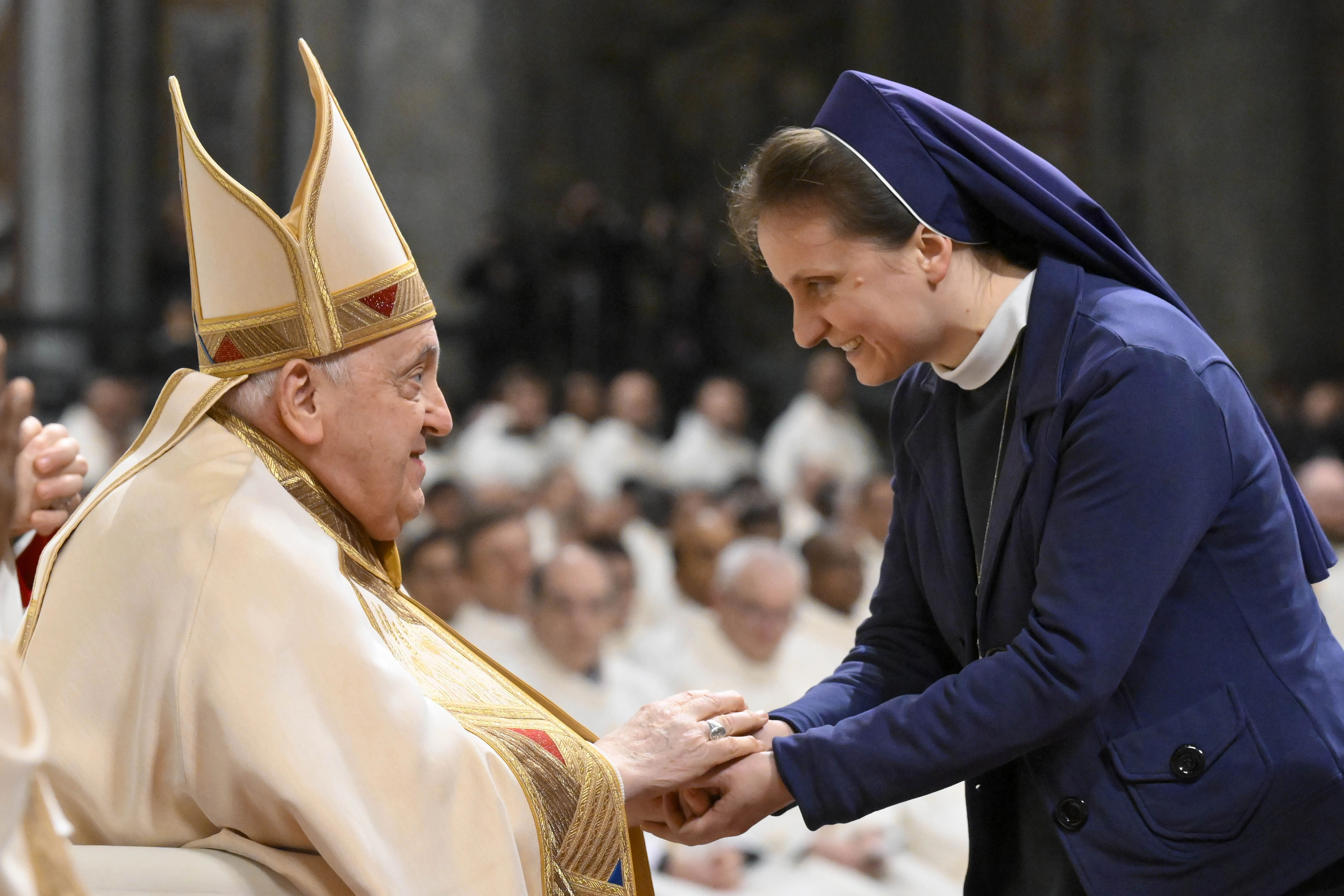
Pope Francis greets a woman religious at a Mass on the World Day of Consecrated Life, the feast of the Presentation of the Lord, on Feb. 2, 2024, in St. Peter's Basilica at the Vatican. Credit: Vatican Media
Pope Francis greets a woman religious at a Mass on the World Day of Consecrated Life, the feast of the Presentation of the Lord, on Feb. 2, 2024, in St. Peter’s Basilica at the Vatican. Credit: Vatican Media

The pope underlined that modern society has “lost the ability to wait,” which he said poses a problem because “waiting for God” is an important part of the journey of faith.

“It is necessary then to recover the lost grace: to return, through an intense interior life, to the spirit of joyful humility, of silent gratitude,” he said.

“This is nourished by adoration, by the work of the knees and the heart, by concrete prayer that struggles and intercedes, capable of reawakening a longing for God, that initial love, that amazement of the first day, that taste of waiting.”

Francis reflected on the importance of cultivating an interior life on the feast of the Presentation of the Lord, which is also called Candlemas. On this day, many Christians bring candles to church to be blessed. They can then light these candles at home during prayer or difficult times as a symbol of Jesus Christ, the Light of the World.

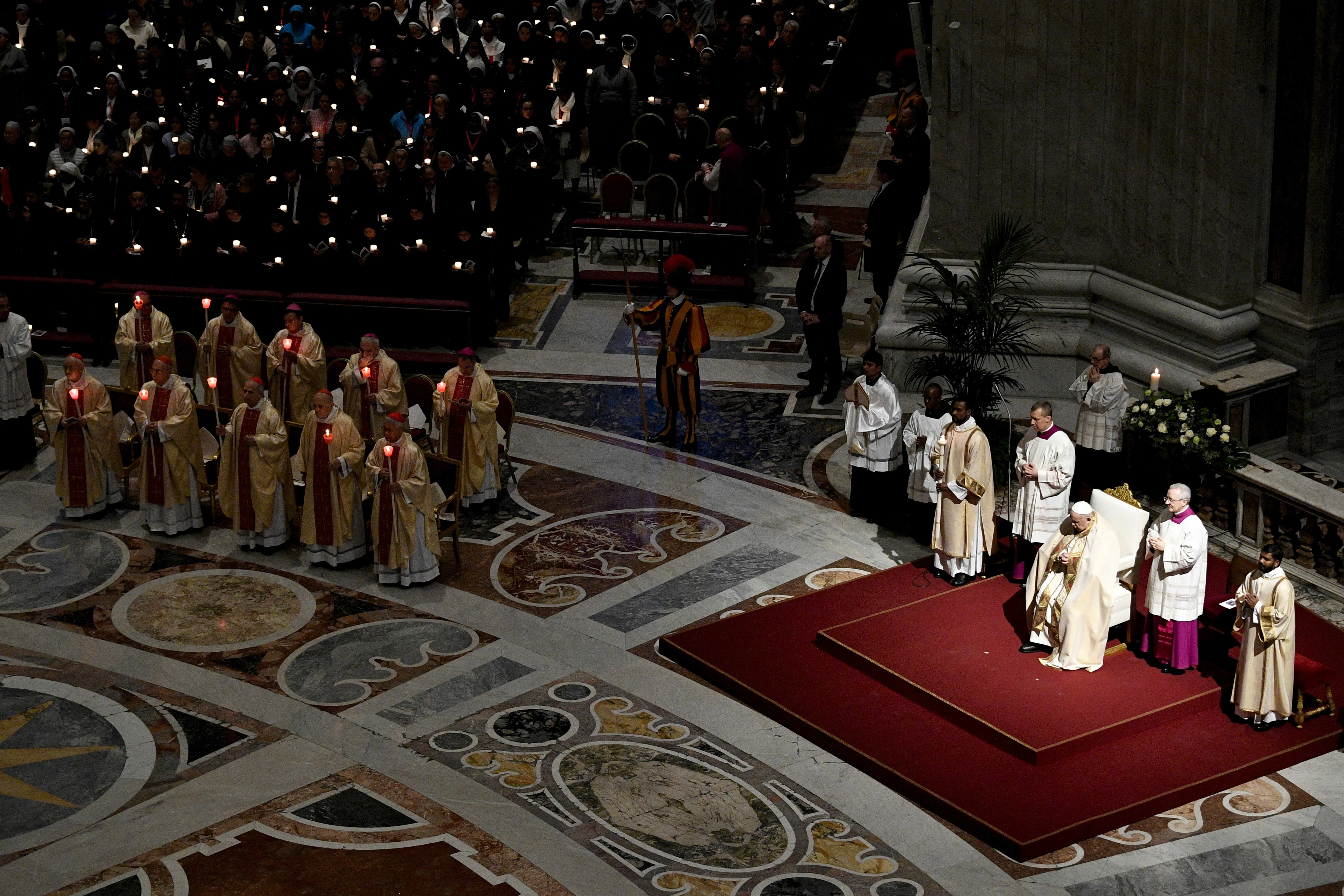
The Mass in St. Peter’s Basilica began in candlelight with priests, bishops, and cardinals carrying lit candles in procession through the darkened church. Men and women present in the congregation also held small candles.

Pope Francis celebrates Mass on the World Day of Consecrated Life, the feast of the Presentation of the Lord, on Feb. 2, 2024, in St. Peter's Basilica at the Vatican. Credit: Vatican Media
Pope Francis celebrates Mass on the World Day of Consecrated Life, the feast of the Presentation of the Lord, on Feb. 2, 2024, in St. Peter’s Basilica at the Vatican. Credit: Vatican Media

Addressing consecrated men and women, Pope Francis warned against “turning even religious and Christian life into having ‘many things to do’ and neglecting the daily search for the Lord.”

“Let us be careful, then, that the spirit of the world does not enter our religious communities, ecclesial life, and our individual journey, otherwise we will not bear fruit,” Pope Francis said.

Brazilian Cardinal João Braz de Aviz, the prefect of the Vatican Dicastery for Institutes of Consecrated Life and Societies of Apostolic Life, was the celebrant of the Mass at the basilica’s main altar.

More than 300 consecrated men and women from over 60 countries met in Rome this week for a conference organized by the dicastery to coordinate their preparations for the Catholic Church’s 2025 Jubilee.

“The Christian life and apostolic mission need the experience of waiting. Matured in prayer and daily fidelity, waiting frees us from the myth of efficiency, from the obsession with performance and, above all, from the pretense of pigeonholing God, because he always comes in unpredictable ways, at times that we do not choose and in ways that we do not expect,” Pope Francis told men and women religious.

“Every day the Lord visits us, speaks to us, reveals himself in unexpected ways and, at the end of life and time, he will come,” he said.

[…]