No Picture
News Briefs

‘A willingness to start with ‘yes’’: How one Catholic school graduated its first student with Down syndrome
September 13, 2021 Catholic News Agency 1
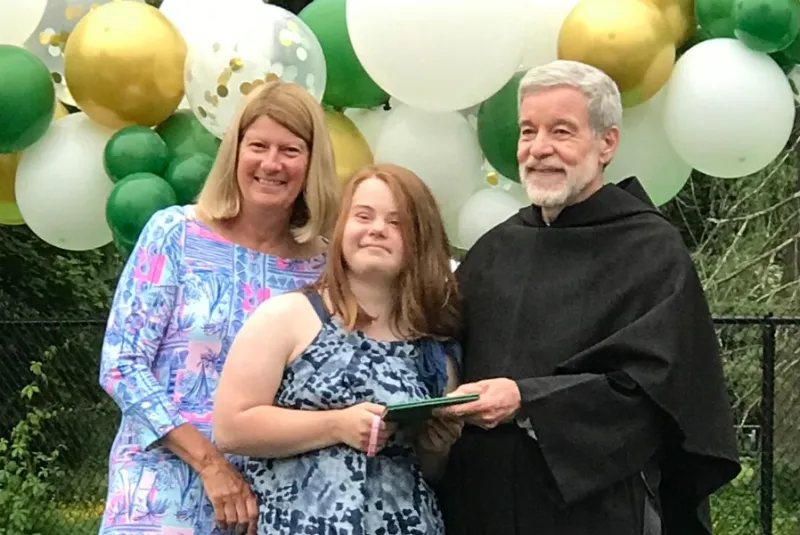
Pastor of St. Augustine’s, Fr. Peter Gori O.S.A. (right) and admissions director Paula O’Dea (left) hand Abby Aguedelo her diploma on graduation day. / Wendy Agudelo

Washington D.C., Sep 13, 2021 / 15:01 pm (CNA).

Tears flowed down the faces of Abigail “Abby” Agudelo’s classmates, as earlier this year she became the first student with Down syndrome to graduate from St. Augustine’s School in Andover, Massachusetts. 

“We know other parochial schools in Massachusetts are striving to do the same today,” Abby’s mother, Wendy Agudelo, told CNA in an interview in August. “And because of Abby’s experience, other families who desire a Catholic school education for all of their children, including those containing a family member with special needs, are now looking at parochial school education as opportunistic.”

Because of her own mother’s strong Catholic faith, Wendy Agudelo had always wanted a Catholic education for all of her children. She also hoped Abby would have an academic path with “full inclusion,” and would not be placed in a classroom separate from other students. 

After Abby’s time in public preschool, however, her mother was not certain of a combination of Catholic education and full classroom inclusion.

“We noticed a divide between what we wanted for Abigail and what the school felt she should receive given her diagnosis,” she said in an email to CNA. 

It was during Agudelo’s search for a school that then-St. Augustine principal Paula O’Dea and pastor Fr. Peter Gori O.S.A. stepped into the breach, and decided that St. Augustine’s would accommodate Abby’s needs. 

“When Abby and her wonderful parents first made their inquiry to us at St. Augustine School about enrolling, the principal and I were concerned that we might not have available all that Abby would need for a successful experience,” Gori told CNA in an email. “We and Abby’s parents all agreed to give it a try and that there would be no hard feelings if things didn’t work out.” 

Gori said that Abby’s parents were “right all along” in believing that Abby would thrive at St. Augustine’s. “We received from her as much or more than she did from us,” Gori said. “It was a delight and a blessing every day and every year to have Abby at St. Augustine School.”  

Wendy Agudelo told CNA that, in general, parochial schools may not have a significant amount of resources. She noted organizations that exist to educate and support parochial schools interested in broadening their demographics. She named the National Catholic Board on Full Inclusion and the FIRE Foundation as a few examples of these groups.

“Not every parochial school, or administrator for that matter, is interested in this path,” Wendy Agudelo said. “It comes with its set of challenges, but also great reward.”

She said that those who choose the path that St. Augustine’s School chose “ultimately earn the greatest return on investment.” 

“Nine years ago,” Paula O’Dea told CNA, “we didn’t have any teachers with a moderate disabilities certification. Now, we have a lot of teachers with that as their second degree, and we’ll have two full-time special ed teachers on site.” O’Dea is currently admissions director for St. Augustine’s.

O’Dea, who was the school’s principal at the time of Abby’s entrance, believes that St. Augustine’s was the only elementary school in the Archdiocese of Boston to accept a student with Down syndrome.

She told CNA that in Abby’s time at public school, her parents observed her in the corner of the classroom with a special education teacher, “not really being included in anything in the classroom.”

When Abby first arrived at the school, O’Dea said the school decided that, in order to properly live out its Catholic mission, it needed to find ways to support any student who wanted to attend. 

The school partnered with local Merrimack College to hire a student studying moderate disabilities as a subsidized, full-time teacher to support Abby. O’Dea said the school’s decision was a success, because it was affordable and effective for Abby. St. Augustine continues to have a “Merrimack Fellow” today.

O’Dea said that hiring the Merrimack Fellow was “a very small investment financially for us to have such a great outcome in the end.” She says she would recommend it as an alternative to hiring a full-time special education teacher for the classroom. 

Abby’s parents said that they stood “shoulder to shoulder” with the administration and staff throughout Abby’s schooling. They encouraged teachers at every grade level to gain more professional development and experience with special needs through local conferences and workshops. 

While working full time, both of Abby’s parents spent much of their time at St. Augustine’s volunteering at Kindergarten centers, the lunchroom, as a chaperone on numerous field trips, and as active guild members helping to run events and fundraisers.

Wendy Agudelo said that partnering and collaborating with the school “every step of the way” bore amazing results.  

“In my opinion,” Agudelo said, “it’s not about available resources as much as it is a willingness to start with ‘yes’ and work together towards a shared goal.” 

“We’re not alone and believe that the more families know, the more armed with opportunity they become,” she said. “We’re very, very fortunate to have found such great academic partners for our children, but pepper in some serious faith and a sprinkling of compassion, and nothing is impossible!” 

“Abby’s achievement is very impressive,” said Thomas Carroll, superintendent of schools for the Archdiocese of Boston, to CNA. “But the biggest impact is the effect she had on the entire school community.  They all were blessed to have her as a classmate or student.”


[…]

No Picture
News Briefs

Cardinal Gregory ‘embarrassed’ at McCarrick abuse charges

September 9, 2021 Catholic News Agency 9
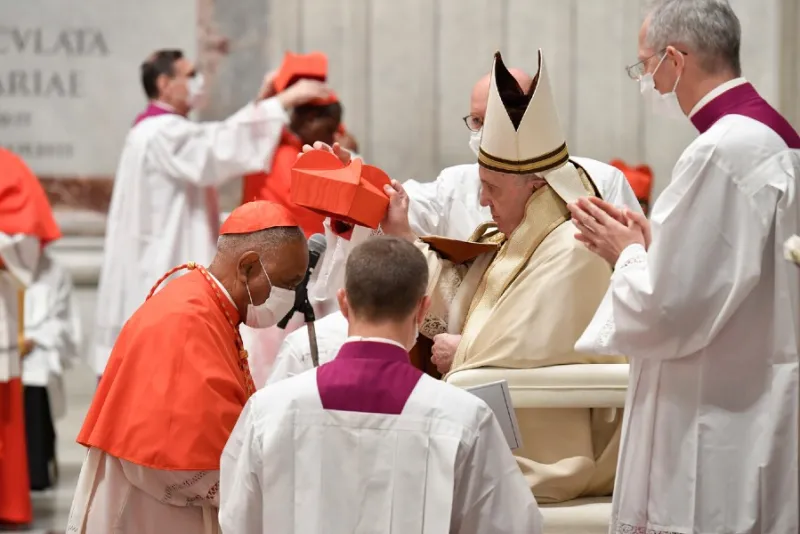
Cardinal Wilton Gregory receives the red hat from Pope Francis in St. Peter’s Basilica on Nov. 28, 2020. / Vatican Media/Catholic News Agency

Washington D.C., Sep 9, 2021 / 15:02 pm (CNA).

The Archbishop of Washington on Wednesday said he was “embarrassed” at the charges of sex abuse recently filed against his predecessor, and emphasized that the Church’s primary concern in such cases should be caring for victims.

Addressing a National Press Club luncheon on Wednesday, Cardinal Wilton Gregory answered questions on a wide range of issues including the clergy sex abuse crisis, COVID-19 vaccines, and becoming the first African-American cardinal in the United States.

The former archbishop of Washington, Theodore McCarrick, last week pleaded not guilty in a Massachusetts court to criminal charges of sex assault against a 16 year-old male; the acts allegedly took place in the 1970s while McCarrick was a priest.

McCarrick, a former cardinal who retired as Washington archbishop in 2006, was laicized in 2019 following a Vatican investigation that found him guilty of “sins against the Sixth Commandment with minors and with adults” and solicitation in the confessional.

“I’m embarrassed,” Gregory said of his predecessor’s alleged acts. “I’m embarrassed not with the discovery – although that’s certainly a part of my embarrassment. But I’m embarrassed because it’s absolutely contrary to everything that I as a priest – my brother priests and bishops – should be pursuing, in terms of serving our people.”

“My first thought was about the people that he [McCarrick] had hurt,” Gregory said of seeing images of the 91-year-old McCarrick appearing at his Sept. 3 arraignment in Massachusetts.

From the beginning of the clerical sex abuse crisis, he said, the Church has been focused on the wrong questions – rather than on the victims.

“We’re trying to make sure that the proper attention is put in the proper place. The people who should get our sorrow and our concern and our compassion are those that were hurt,” Gregory insisted.

Gregory led the U.S. Conference of Catholic Bishops from 2001 to 2004, a tenure which included the 2002 revelations of widespread clergy sex abuse. The conference in the fall of 2002 drafted its response, the Dallas Charter, which established norms for dealing with alleged abuse by priests and deacons. McCarrick, then the archbishop of Washington, had a role in drafting the charter.

“We also took this position: that no one with a credible [abuse] allegation should ever be in public ministry,” Gregory said on Wednesday.

He added that bishops can only act on clergy abuse accusations that are credible, and that they have knowledge of.

“I can only act on that which I know,” he said.

Back in January, Cardinal Gregory delivered an invocation at a national memorial service for COVID-19 victims, held on the eve of President Biden’s inauguration.

Regarding Catholics who have “religious” concerns about taking COVID-19 vaccines, Gregory on Wednesday pointed to Pope Francis and Pope Emeritus Benedict XVI having both received a vaccine.

“It’s difficult to say that ‘I have a religious concern’ when the last two pontiffs have already been vaccinated, and where Pope Francis has so clearly, and may I say with great insistence, urged Catholics to take the vaccine,” Gregory said.

“It doesn’t diminish their concern, but it certainly puts their concern on a pretty shaky platform.”

Some Catholics have voiced objections to receiving the three COVID-19 vaccines approved for use in the United States. Two of the vaccines, produced by Pfizer and Moderna, have been tested with cell lines derived from abortions committed decades ago. The Johnson & Johnson vaccine was not only tested on the controversial cell lines, but was also produced using the cell lines.

The Vatican’s Congregation for the Doctrine of the Faith in December 2020 issued a note stating that Catholics may receive a COVID-19 vaccine with a connection to the cell lines, if no ethical option is available, due to the gravity of the pandemic.

For Catholics objecting out of “conscience,” they should take other precautions to prevent transmission of the virus, the Vatican stated.

On the topic of racial reconciliation, Gregory on Wednesday was asked by moderator Lisa Matthews, president of the National Press Club, what role the Church could play to bring Black Americans back to the faith.

Catholics “have a responsibility because of our faith to be on the forefront of the justice movement,” Gregory said. “It’s not something that should be foreign to any of us.”

He noted a generational decline in religious practice that is not unique to Catholicism.

“We have a problem – and it’s not just a Catholic problem,” he said, “of passing on the faith to the next generation.” For too many Catholics, he said, Catholicism “is a description rather than a practice or lived reality.”

Gregory also answered questions on immigration, labor, abortion, the death penalty, and the ordination of women.

He said that President Biden was “not demonstrating Catholic teaching” on when life begins, in response to Biden’s claim last week that life does not begin at conception. Gregory also called the death penalty “flawed,” before the Supreme Court on Wednesday stayed the execution of a Texas inmate.

Asked about the Church’s discipline on priestly celibacy and its connection to the clerical sex abuse crisis, Gregory said that celibacy is not the central problem at hand. Married priests, as well as married rabbis and ministers of other denominations have also abused children, he noted.

“The Catholic Church – we are the 800-pound gorilla. But we’ve got some other small relatives that have also demonstrated that same type of incredibly sick personality, behavior,” he said.

Reflecting on becoming the first Black cardinal in the United States in November 2020, Gregory pointed to his Chicago roots.

“Having been raised in an urban environment, like many African-American Catholics, the schools were a primary vehicle for entering the Catholic Church. And so it is with me,” Gregory said.

“When I knelt in front of Pope Francis to receive the biretta, the ring, and the sign, titular church – a lot of that heritage was running through my head at that time,” he recalled.

“We’ve had Italian cardinals, Polish cardinals, German cardinals, Irish cardinals. Now we have a Black cardinal. What is that going to do to the heart of the Church? What benefit will that bring to our Church? I’m still trying to figure that out.”


[…]