Can laity preach at Mass? Chicago parish offers pulpit to same-sex couple
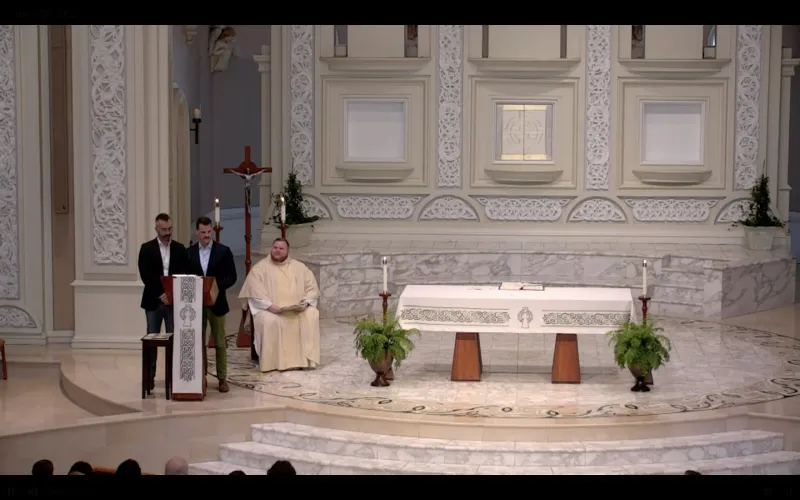 Alex Shingleton and Landon Duyka deliver a ‘Gospel reflection’ during Mass at Old St. Patrick’s in Chicago, Ill., June 19, 2022. / Old St. Patrick’s/vimeo.
Denver Newsroom, Jun 22, 2022 / 12:00 pm (CNA).
A Chicago Catholic parish is facing questions after the pastor allowed a couple in a same-sex marriage to offer a “reflection” in lieu of the homily at a June 19 Mass.
The parish, Old St. Patrick’s, is a historic and prominent parish on Chicago’s west loop. The priest celebrating the Mass, Father Joe Roccasalva, introduced the two men immediately after proclaiming the Gospel and said they were to give a Father’s Day “Gospel reflection.” According to canon law, laypeople are not allowed to preach homilies during Mass — only the ordained, meaning priests, bishops, and deacons, are allowed to do so.
Upon taking the lectern, Alex Shingleton and Landon Duyka — who say they have been members of the parish for a decade — described their same-sex marriage as a “blessing” and the adoption of their two children as “miracles.”
“Let’s be honest, there are probably not too many gay dads speaking on Father’s Day at many Catholic Churches on the planet today,” one of the men said.
Later in the presentation, one of the men stated: “We wanted to raise our children in the Catholic Church…On the other hand, we didn’t want to expose our children to bigotry and have them feel any shame or intolerance about their family.”
The men described as a “miracle” the fact that they had found an LGBT-affirming community at the self-described “radically inclusive” Old St. Patrick’s parish, as they said they had experienced rejection and a lack of welcome at other Catholic parishes.
The Catholic Church teaches that people who identify as LGBT should be treated with dignity and respect, but also that homosexual acts are sinful and that homosexual unions — even if recognized as marriage by governments or society — cannot be approved by the Church under any circumstance.
The Catechism of the Catholic Church teaches that “‘homosexual acts are intrinsically disordered. They are contrary to the natural law. They close the sexual act to the gift of life. They do not proceed from a genuine affective and sexual complementarity. Under no circumstances can they be approved.” At the same time, the Catechism and popes have drawn a clear distinction between homosexual acts and homosexual inclinations, the latter of which, while objectively disordered, are not sinful.
“Homosexual persons are called to chastity. By the virtues of self-mastery that teach them inner freedom, at times by the support of disinterested friendship, by prayer and sacramental grace, they can and should gradually and resolutely approach Christian perfection,” the Catechism adds.
In terms of the question of laypeople giving homilies, Father Pius Pietrzyk OP, a canon lawyer, told CNA in written responses that although the allowance of the reflection was technically a clear violation of the law, Catholics should not merely be concerned with the letter of the law, but also the reasons behind it.
“[The law] expresses the Church’s understanding of the role of the priest in the life of the parish community,” Pietrzyk explained.
“More importantly, it expresses the essential link between the munus sanctificandi [duty to sanctify, or consecrate] and the munus docendi [the duty to teach], which is rooted in the sacrament of holy orders.”
Pietrzyk said he hopes that the men who spoke at Old St. Patrick’s continue to participate in the Catholic Church.
“We should continue to encourage these two men to participate in the life of the Church,” Pietrzyk stressed, but reiterated that the fact that they are living publicly as a same-sex married couple — a state the Church teaches to be sinful — cannot simply be ignored.
Moreover, Pietrzyk described the priest’s decision to allow the men to speak during Mass as a “politicization of the Eucharist.”
“The selection of these two as [homilists] on Father’s Day must be seen for what it is, a political act of submission to modern sexual ideologies and an act of rebellion against the teachings of Christ and his Church,” the priest said.
In March 2021, the Vatican’s doctrinal office clarified that the Catholic Church does not have the power to give liturgical blessings of homosexual unions, writing that “it is not licit to impart a blessing on relationships, or partnerships, even stable, that involve sexual activity outside of marriage (i.e., outside the indissoluble union of a man and a woman open in itself to the transmission of life), as is the case of the unions between persons of the same sex.” The ruling and note were approved for publication by Pope Francis.
The Archdiocese of Chicago has not responded to questions on the matter from other Catholic publications.