No Picture
News Briefs

Utah advances legislation to ban clinics that offer only abortion

February 20, 2023 Catholic News Agency 0
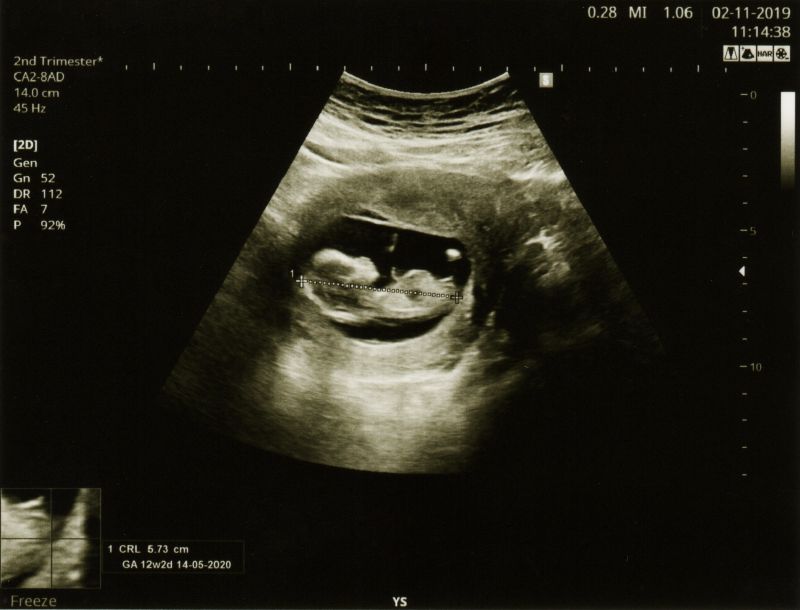
A sonogram picture of a fetus in the second trimester of a woman’s pregnancy / Shutterstock

Washington D.C., Feb 20, 2023 / 15:58 pm (CNA).

Last Friday the Utah House of Representatives passed some of the strongest pro-life legislation advanced since the reversal of Roe v. Wade. If passed by the state’s Senate and signed into law, the measures effectively would shut down abortion clinics that only offer abortion and would also help victims of rape and incest.

The two bills passed the Utah House in strictly party-line votes, 53-14.

Though Utah has pro-life supermajorities in both houses of the Legislature, abortion is currently legal in Utah until 18 weeks of pregnancy. A “trigger law” was passed in 2020 to go into effect with the overturning of Roe v. Wade. The law would ban abortion through all stages of pregnancy, but it remains blocked in the courts due to a legal challenge by Planned Parenthood Association of Utah and the Utah chapter of the ACLU.

The first bill, sponsored by Rep. Karianne Lisonbee, a Republican, prohibits abortions outside of hospitals and bans clinics that only offer abortion. 

Further, the bill prohibits the licensing of abortion clinics after May 2, 2023, and makes it a criminal offense for out-of-state actors to prescribe abortion drugs to Utahns.

The Utah House Democratic Caucus decried the bill as “a direct attack on reproductive health care.”

Planned Parenthood Action Council of Utah posted on Twitter that the bill “would shutter all abortion clinics in (Utah) and make this essential health care MUCH more inaccessible and expensive for #Utahns.”

Lisonbee pushed back on the claim that her bill would close abortion clinics, saying that providers like Planned Parenthood can continue offering other health services and abortions in limited exceptions.

Doctors performing abortions in fetal anomaly cases will now be required to inform the mother that perinatal hospice care, which is care for infants with short life expectancies, is available as an alternative to abortion.

“As a state, we deeply value human life at all stages and in all circumstances,” Lisonbee said. “It is the state’s responsibility to protect the most vulnerable, and that includes the unborn.”

Utah Gov. Spencer Cox, a Republican, signaled his support for the bill, saying in a Feb. 16 news conference that he “feels pretty good” about the bill and that the 18-week cutoff gives “plenty of time for a decision to be made.”

The second pro-life bill sponsored by Rep. Kera Birkeland, also a Republican, expands care for rape and incest victims. The bill provides health care for the victim and the child during the resulting pregnancy and for the first year after the child is born. The bill also further expands already existing laws that doctors performing abortions on rape or incest victims verify the crime with authorities.

Both bills limit abortions performed in the rape and incest exceptions to the first 18 weeks of pregnancy.

Having cleared the House, both bills will now advance to the Utah Senate, which is majority Republican.

[…]

No Picture
News Briefs

UPDATE: Murder investigation underway in shooting death of LA Auxiliary Bishop O’Connell

February 19, 2023 Catholic News Agency 1
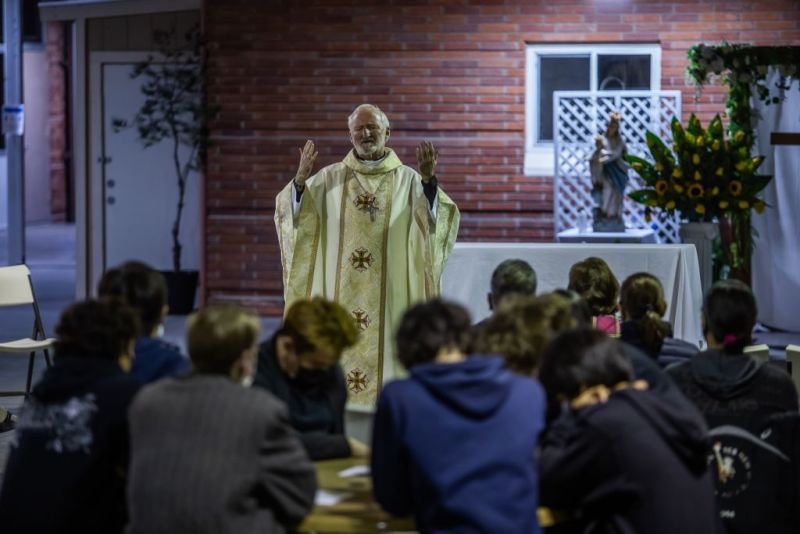
Bishop David O’Connell leads a non-denominational memorial service to provide a space for community members who have lost loved ones in 2020 at the St. Cornelius Catholic Church in Long Beach, California, on Nov. 14, 2020. / Apu Gomes/AFP via Getty Images)

Washington, D.C. Newsroom, Feb 19, 2023 / 13:47 pm (CNA).

The shooting death of Los Angeles Auxiliary Bishop David G. O’Connell Saturday is being investigated as a homicide, authorities have confirmed.

“This incident is being handled as a murder investigation,” the Los Angeles County Sheriff’s Department (LASD) said in a statement Sunday. No additional details were released.

“We learned early this morning from the Los Angeles County Sheriff’s office that they have determined that the death of Auxiliary Bishop David O’Connell yesterday was a homicide. We are deeply disturbed and saddened by this news,” Los Angeles Archbishop José Gomez said in a statement Sunday. 

“Let us continue to pray for Bishop Dave and his family. And let us pray for law enforcement officials as they continue their investigation into this terrible crime,” Gomez added. “We ask Our Blessed Mother Mary to intercede and be a mother for all of us in this moment of sadness and pain.”

The shooting happened around 1 p.m. local time Saturday inside a home in the 1500 block of Janlu Avenue in Hacienda Heights, Los Angeles County, the sheriff’s department said. Property records show an address on that block as being associated with O’Connell, but CNA could not immediately confirm local media reports that identified the location as O’Connell’s residence.

Sheriff deputies called to the scene for a medical emergency found O’Connell suffering from a gunshot wound to his torso. He was pronounced dead at the scene, the LASD said.

A native of Ireland, O’Connell, 69, ministered to immigrants, the poor, and victims of gang violence for 45 years in the South Los Angeles area. Pope Francis made him a bishop in 2015.

O’Connell’s friends and fellow bishops reacted with shock and sadness to the news of his death.

Among those to comment on social media was Bishop Robert Barron of Winona-Rochester, Minnesota, who was ordained an auxiliary bishop of Los Angeles with O’Connell in 2015.

“From the moment I met him, I was struck by his goodness, kindness, prayerfulness, and simplicity of heart,” Barron tweeted.

“Throughout the course of my years in the LA Archdiocese, Bishop Dave was a constant source of support, encouragement, and good humor,” Barron continued.

“He dedicated his priesthood to serving the poor. I can honestly say that he was one of the most Christ-like men I’ve known. May he rest in peace.”

Linda Dakin-Grimm, an immigration lawyer in California, tweeted a photo of O’Connell with one of her young clients.

“Bishop Dave, who was shot to death in his home today, was there for every child and family I have represented. Always,” she tweeted. “Helping, supporting and generally being the face of Jesus for me and many many others.”

Sister Norma Pimentel, the director of Catholic Charities of Rio Grande Valley known for her work with migrants on the Texas-Mexico border, also shared a photo of O’Connell on Twitter, calling him “truly a man of God.”

The Los Angeles County Sheriff’s Department posted a statement on Facebook Sunday addressed to the grieving South LA community. “We can only imagine how the community is suffering because of this senseless murder. Bishop O’Connell was a guiding light for so many, and his legacy will continue to live on through the community that he helped build,” the statement said.

“Please know that you are not alone in your grief and that @lasdhq is here to support you. Our thoughts and prayers are with you, and we are working diligently to seek those responsible.”

Anyone with information about this incident is encouraged to contact the Los Angeles County Sheriff’s Department’s Homicide Bureau at (323) 890-5500.

Those who prefer to provide information anonymously may call “Crime Stoppers” by dialing (800) 222-TIPS (8477), use their smartphone by downloading the “P3 Tips” Mobile APP on Google Play or the Apple App Store, or by using the website http://lacrimestoppers.org.

[…]

The Dispatch

God, creation, and humanity: The ‘lost lectures’ of Benedict XVI collected in new book

February 19, 2023 Catholic News Agency 4
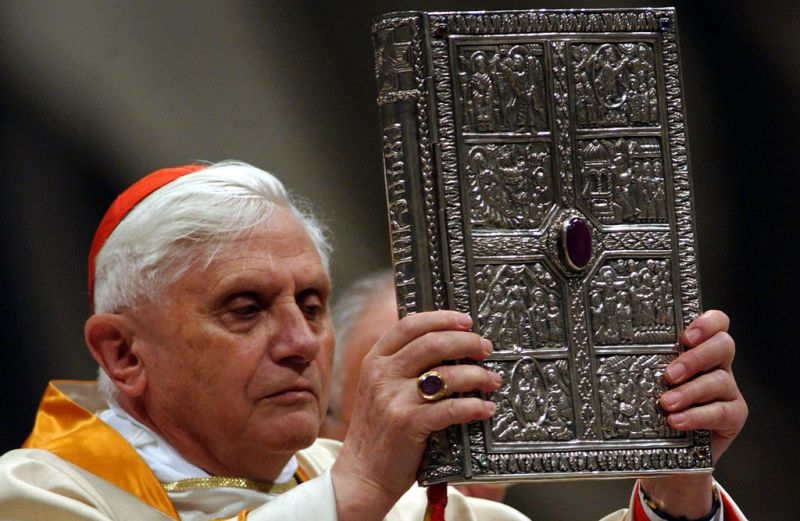
Cardinal Joseph Ratzinger at the Easter Vigil in St. Peter’s Basilica on March 26, 2005, in Vatican City. / Photo by Franco Origlia/Getty Images

Denver, Colo., Feb 19, 2023 / 07:00 am (CNA).

Six lectures of Cardinal Joseph Ratzinger were almost lost forever. But now, they have been collected in a new Ignatius Press book, “The Divine Project: Reflections on Creation and Church.”

“It’s a wonderful summation of what God intends in creating us and redeeming us, in six lectures. It’s just a great find,” Father Joseph Fessio, SJ, president of Ignatius Press, told CNA. “It’s written for students and spoken for students. It’s really quite readable.”

The future Pope Benedict XVI delivered the series of lectures in 1985 at the Bishop of Gurk’s formation house at St. George’s Abbey in Längsee in the southern Austrian state of Carinthia. They were recorded on audio cassettes but the tapes were misplaced for 30 years and forgotten. By chance, they were rediscovered.

“It was a treasure that was lost and found again,” said Fessio, who studied under Ratzinger when the future pontiff was a theologian and university professor. Ratzinger would serve as a cardinal under Pope John Paul II. He was elected pope in 2005.

The lectures were first published in German in 2008, but Ignatius Press is the first to publish them in English, in a 177-page book.

Fessio stressed Ratzinger’s emphasis on Scripture.

“He always goes back to Scripture when he is presenting on any topic,” Fessio commented. “This is theological. It has to do with faith, of course. His interpretation of Genesis brings it right up to the present. He understands traditional scholarship and the historical-critical method, but he’s able to make it come alive.”

Ratzinger’s lectures reflect upon God as the creator of a reasonable cosmos, in which each man and woman is ultimately a creature. He considers how to read the Bible and understand original sin and redemption.

Ratzinger considers the first eight lines of the Book of Genesis, about the creation of the heavens and the earth.

“Is this merely a beautiful passage, or does this beauty also reveal something of the truth?” he asks. “And if so, how do we find it?”

He reflects on explanations of Genesis that engage scientific accounts of the universe and of humankind, including evolutionary theory. He asks whether and how the scientific and Christian approaches can complement each other, and he ponders the place of the Genesis account of creation in historic Christian thought, including the fall of humankind through Adam.

The early Church and the Middle Ages “understood that the Bible is one whole and that we can only truly hear what it is saying if we hear it as coming from Christ,” Ratzinger explains.

“This means hearing it in the freedom that he has given us and from the depths where, through the screen of images, he reveals the true and enduring reality, the solid ground on which we can always stand,” he says.

Fessio told CNA that the Book of Genesis is written in “a very parabolic or even mythical way.” In Ratzinger’s commentary, the Old Testament must be read as a preparation for the New Testament. The Bible should be read as a whole.

“Its parts help to understand each other and [to understand] that Christ is the goal and therefore the key of interpretation,” Fessio said. He added that Ratzinger’s lectures show “how Creation was made for the worship of God, for the Sabbath, for the day of worship, and the day that God rested.”

“If God is the Creator, it means we are creatures,” Fessio added. “It means that we do not create ourselves, we depend for existence on God and on others.

“[Ratzinger] spends a lot of time on how man is relational. We come from parents, we live for others. We give ourselves to a project we can’t consider ourselves,” he said.

“We’re not just autonomous monads floating around each other,” Fessio said. “Rather, we’re connected to each other because we’re connected to God, who himself is relationship as the Trinity.”

Ratzinger considers the place of necessity and chance in creation and contemporary attitudes about the place of each person in the world. He notes that many object, saying, “No one ever asked me if I wanted to be born!”

To this, Ratzinger responds: “It is only when we know that there is One who did not cast lots blindly, when we know that our existence is not an accident, but is rather born of freedom and love, only then can we, whose existence is not necessary, be thankful for this freedom and know, with gratitude, that it is indeed a gift to be human.”

According to Fessio, Ratzinger is “expounding the Catholic faith, but doing it in a contemporary language.”

“Sin is the destruction of that relationship with ourselves and God, and then among each other. [Ratzinger] makes the very important point that there’s no such thing as an individual sin that doesn’t have effects on others,” the priest said. “Every turn away from God’s plan, God’s law, affects not only oneself, but everyone else, as well.”

This can be healed “by losing self and turning to Christ,” the source of our love, Fessio commented. Ratzinger emphasizes “how important the Eucharist is in restoring fallen man to unity with himself and with God.”

Other topics in “The Divine Project” include technology and ecology, the cross and the Eucharist, religious pluralism, the teaching authority of the Catholic Church, and the nature of the Church.

For Fessio, the theologian’s former student, the qualities of Benedict XVI are evident in the book.

Cardinal Ratzinger was “brilliant and humble, warm, holy, a good listener,” Fessio said.

“He had a tremendous ability to synthesize the thoughts of others and present them in a clear and compelling way,” he said. “He was just simply a great teacher. And therefore, those of us who are learners do well to turn to that great teacher whenever we can.”

[…]