No Picture
News Briefs

Boston Archdiocese opposes bill eliminating time limits for child sex abuse claims

October 5, 2023 Catholic News Agency 1
Cardinal Sean O’Malley briefs reporters during a Vatican abuse summit. / Credit: Daniel Ibanez/CNA

Boston, Mass., Oct 5, 2023 / 12:21 pm (CNA).

The Archdiocese of Boston is opposing a state bill that would eliminate the time limit for filing a civil lawsuit for claims of sexual abuse of children, saying it would put its efforts to assist victims at risk. 

In 2014, the state enacted a bill that extended the statute of limitations to when the plaintiff turns 53 or seven years after the plaintiff “discovered or reasonably should have discovered that an emotional or psychological injury or condition was caused by such act.” 

The current bill being considered by the Legislature would eliminate the time limit and allow lawsuits at any time against a purported perpetrator or against a defendant that “negligently supervised a person who sexually abused a minor” or “caused or contributed to the sexual abuse of a minor by another person.” 

Supporters of the bill say it would help more traumatized victims get justice and healing. 

William Giblin, 55, of Methuen, Massachusetts, told a legislative committee last month he was “sexually, physically, and emotionally” abused by a priest at a seminary where he was sent to do court-ordered community service at age 14 and that he subsequently suffered for years from shame and drug addiction and has had problems with trust and relationships. 

“These institutions need to be held accountable for the damage it’s done to so many children. … So many people overdose or commit suicide because of the secret you keep, and the toll it takes on your body,” Giblin told members of the Massachusetts Legislature’s Joint Committee on the Judiciary during a public hearing Sept. 12. “Please eliminate the statute of limitation. You can’t force someone to start talking about this. It’s when you’re ready, period.” 

Another supporter of the bill, Kathryn Robb, executive director of Child USAdvocacy, told the committee that eliminating the statute of limitations would educate the public about the problem and shift financial costs away from victims and taxpayers and “to the bad guys where it belongs.” 

“And finally, and perhaps most importantly, it identifies hidden sexual predators,” Robb said during the hearing

Child USA, a nonprofit organization that supports eliminating statutes of limitations for child sex abuse for civil and criminal cases, says that as of earlier this year 17 states, the federal government, and two territories had eliminated time limits for filing civil lawsuits “for some or all” child sex abuse claims. 

But an opponent of the bill said removing time limits retroactively makes it hard for an organization to defend itself from long-ago claims or to make adequate provisions to protect itself going forward. 

Cary Silverman, a lawyer representing the American Tort Reform Association, said statutes of limitations “have a critical function in the civil justice system.” 

“They’re there to allow judges and juries to evaluate liability when the evidence is available, before records are lost and witnesses disappear. Their length doesn’t reflect the severity of the injury or the reprehensibility of the conduct. They’re there based on evidence that will be needed to accurately decide liability in any sort of civil action,” Silverman said during the hearing Sept. 12. 

Silverman said the American Tort Reform Association doesn’t oppose what he called “a lengthy statute of limitations,” but he said there must be limits. 

“In the revived lawsuits that will result from this bill, there may be no doubt that the plaintiff has experienced horrific abuse. The question that will be difficult or impossible to fairly answer is whether decades ago an organization could have detected that abuse or have had additional practices in place that might have prevented or stopped the employee or the volunteer who committed it,” Silverman said. 

“In a revived action alleging that a school failed to prevent abuse in 1965, for example — the type of claim you’re going to see — a 35-year-old employee from that time, who would serve as a witness now, would be 93 years old. And any paper records from that time would be gone.” 

Widespread public awareness of the clergy sex abuse problem in the Catholic Church began in the Archdiocese of Boston, where in January 2002 The Boston Globe’s Spotlight Team uncovered scores of priest-abusers and victims. (As of 2021, the Globe reported, the archdiocese had identified 132 priest-abusers; as of 2017, the archdiocese had met with more than 1,000 victims.) 

A spokesman for the Archdiocese of Boston contacted Wednesday by CNA said the state’s current statute of limitations works well but that eliminating it might cause more harm than good. 

“For the last 20 years, the Archdiocese of Boston (which represents two-thirds of the Catholics in Massachusetts) has been caring both financially and pastorally for all victims who come forward. We do not turn people away and have not shut the door, rather focusing on healing and taking responsibility for the harm they have experienced,” said Terrence Donilon, spokesman for the archdiocese, in an email message, with emphasis in the original. 

“We worked with the Legislature in 2014 to amend the law which allows us to continue the work with victims and their families in this manner. After nine years, the law has proven to be beneficial to the victims,” Donilon said. “The legislative changes currently proposed and under consideration would jeopardize our ability to continue to work with victims and their families in a manner that they deserve.” 

The statute of limitations bill’s primary sponsor is state Sen. Joan Lovely, D-Salem, who has also filed a bill that would eliminate the time limit for filing criminal charges in Massachusetts in cases of sexual assault or rape of a person under 18. 

The Joint Committee on the Judiciary has not taken action on the bills yet. 

[…]

No Picture
News Briefs

Mother Teresa’s postulator says new film’s creators made ‘grave errors’ 

October 4, 2023 Catholic News Agency 1
Mother Teresa around the year 1994. / L’Osservatore Romano.

Washington, D.C. Newsroom, Oct 4, 2023 / 16:36 pm (CNA).

The chief promoter of St. Teresa of Calcutta’s cause for canonization says a new film about the beloved saint is hampered by “grave errors” in how its producers approached the life of the celebrated nun.

Father Brian Kolodiejchuk, the director of the Mother Teresa Center and the postulator of the cause of beatification and canonization of Mother Teresa, said in a Sept. 28 statement before the release of “Mother Teresa and Me” that its creators committed “several crucial errors” in adopting how the film approaches the doubts St. Teresa experience in her life even as she devoted herself to living out the Gospel in her care for the sick and poor.

“Mother Teresa and Me” tells the story of Kavita, a young woman who finds herself with an unexpected pregnancy. Battling whether or not to get an abortion, she returns to her hometown in India where her now very old nanny shares the story of Mother Teresa’s first days working in the streets of Calcutta. Learning how Mother Teresa faced many doubts after no longer being able to hear the voice of Jesus, Kavita is inspired.

The film’s writer and director, Kamal Musale, claimed on the film’s website, before it was revised, that the film’s portrayal of Teresa is “more true to life” because of its treatment of how she “lost her faith” and apparently “never recovered from it.”

“During [an] approximately 12-year period, Teresa goes through a complete change, from the intensity of her epiphany to the disillusionment and the realization that her connection with God is lost,” Musale said.

Yet, Kolodiejchuk has criticized this characterization of St. Teresa as inaccurate.

“Unfortunately, the producers of the film appear unaware of Mother Teresa’s own interpretation of her darkness, or the significance it had for her life and vocation,” Kolodiejchuk said.

“As her own writings attest, one of the most profound things about Mother Teresa is that she never ‘lost her faith,’ even amid desolation and uncertainty. Her personal letters speak of her ’unbroken union [with God]’ during her darkness and observe that ‘my mind and heart is habitually with God,’”

“She describes the ‘doubt’ in which she lived ‘for the rest of her life’ as, instead, a trial of faith — an experience well-known in the Catholic mystical tradition,” Kolodiejchuk said. 

The priest argued that, rather than demonstrate a loss of her faith, St. Teresa’s doubts “illustrated the depth of that faith, and her confidence that Christ would not abandon her.” 

“She even states that, ‘I will hear his voice’, and ‘I know this is only feelings — for my will is steadfast bound to Jesus.’”

Citing his own personal experience with the saint, Kolodiejchuk said the film “does not accurately capture the woman who captured the world with her steadfast, joyful love of God and neighbor; one of the most loved and admired women of the 20th century.” 

“We still must wait for a nondocumentary film that adequately portrays the ‘real and relatable’ St. Mother Teresa,” he said, “since a misrepresentation is unjust to her and to those who wish to know her in all her beauty and fullness.”

The film is set to premiere for a one-night-only release on Oct. 5 in 800 theaters around the United States. It was produced by Curry Western Movies out of India along with Switzerland’s Les Films du Lotus. 

Musale, the film’s director, has also directed the films “Millions Can Walk” and “Bumbai Bird,” among others. 

[…]

No Picture
News Briefs

Carlo Acutis’ mother places his first-class relic in new diocesan shrine in New Jersey

October 4, 2023 Catholic News Agency 2
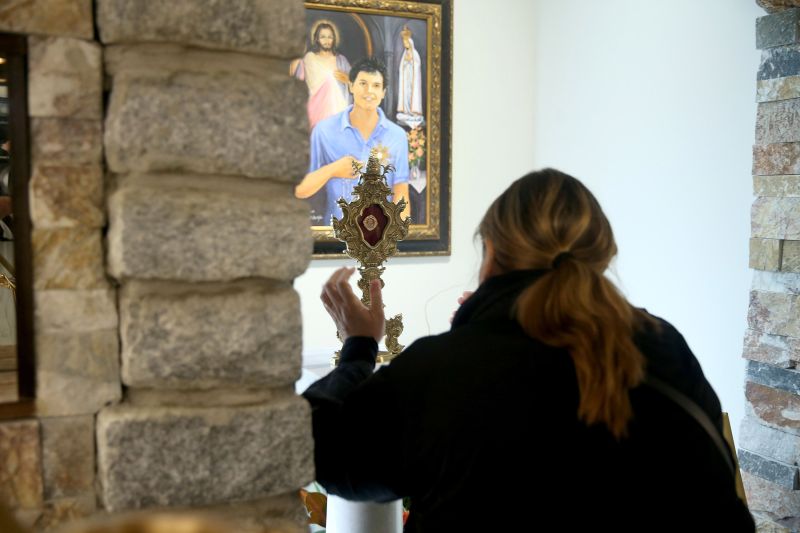
Antonia Salzano, Blessed Carlo Acutis’ mother, after installing the relic of her son in the new shrine dedicated to his life on Oct. 1, 2023. Her hands were the first to hold him, and the last to touch his earthly relic. / Credit: Thomas P. Costello II

Trenton, N.J., Oct 4, 2023 / 11:25 am (CNA).

The faith community of St. Dominic Parish in Brick, New Jersey, celebrated the life of Blessed Carlo Acutis on Oct. 1 with a very special guest among them — Acutis’ mother, Antonia Salzano. After the jubilant Mass concluded, Salzano took the relic of her son from the hands of Bishop David O’Connell of the Diocese of Trenton, and together they processed to the narthex, where a new shrine to Acutis was blessed. 

In her remarks to the faithful gathered for the celebration, Salzano declared: “Sainthood is for everyone. Carlo became a saint by practicing the seven theological and cardinal virtues.” She emphasized: “This is what makes us all saints.”

“Carlo prayed the rosary and read sacred Scripture every day,” Salzano shared. “He went to confession each week. Since his holy Communion at 7 years old, he never missed daily Mass. Before Mass or after, he would also spend time in adoration of the Blessed Sacrament. Carlo believed the Eucharist was his ‘highway to heaven.’”

Carlo’s life

Carlo Acutis was born on May 3, 1991, in London, England, and then moved with his family to Milan, Italy. There, he grew up to be a “normal” teenager — a gamer, a brilliant computer programmer, and a website developer. He liked to travel, enjoyed his PlayStation, and took great care of his pets. He loved St. Francis of Assisi and the poor. He was also deeply in love with this Catholic faith and practiced it with all his heart. 

At just 14 years old, Acutis turned his devotion to Jesus in the Blessed Sacrament into a website. He cataloged more than 100 Eucharistic miracles around the world that have been approved by the Catholic Church. The website inspired the Eucharistic Miracle Exhibit, which has been viewed more than 10,000 times across the globe and counting.

On Oct. 4, 2006, after just a few days of illness, Acutis was diagnosed with promyelocytic leukemia. He offered his sufferings for the conversion of sinners. His mother offered her suffering as well. She prayed there would be greater love for Jesus in the Blessed Sacrament and for those who did not yet know Christ. After slipping into a coma, Carlo Acutis’ heart stopped beating on Oct. 12, 2006. 

Because of his love for the poor and his desire to emulate St. Francis of Assisi, Acutis requested to be buried in Assisi, Italy. The cause for his canonization opened officially in 2013. Pope Francis declared him Venerable in 2019 and Blessed in 2020. He is one step away from being canonized a saint. 

Just a regular teenager

“Carlo was a regular teenager like me,” said Anthony Ricardo, a 15-year-old sophomore at Morris Hills High School in Rockaway, New Jersey, who came to the event. “I really wanted to see Carlo’s mom, and I wanted to see his relics. Carlo was totally devoted to the Eucharist, which I think is the most important part of our faith.” 

Traveling from Allentown, New Jersey, the Schuster family brought six of their eight children to see the dedication of the new shrine. Eight-year-old Brian Schuster said: “I came to see Carlo’s relics. He reminds me to be holy.”

Brian’s 10-year-old brother, Paul, added: “I wanted to meet Carlo’s mom. Carlo is a role model for all kids. He teaches us how to get closer to Jesus by going to Mass as often as we can and by praying the rosary every day.”

One of their own 

Blessed Carlo’s journey to the Diocese of Trenton began several years ago when Father Marian Kokorzycki, parochial vicar of St. Dominic Parish, brought a relic of Blessed Carlo back from a pilgrimage to Assisi for the diocese. Bishop O’Connell supported the idea of a shrine at the parish devoted to the new Blessed.

“I love his story,” O’Connell told CNA. “I’ve read everything I could get my hands on about Blessed Carlo Acutis. He was a normal boy, but his devotion to Jesus in the Eucharist and love for his Catholic faith created a collective orientation toward God in all that he did.”

Sometime later, at the annual Catholic school Mass for the diocese, a video was shown to the students before Mass about Blessed Carlo Acutis. “I watched the young people in the church,” O’Connell recalled. “They were riveted. You could hear a pin drop. That’s when the idea came to me.” 

In April 2022, O’Connell declared Blessed Carlo Acutis the patron of students in his diocese. “Since then, I’ve noticed Blessed Carlo Acutis’ picture is in all of our schools,” O’Connell said. “There is an awareness of him. Young people talk about him. He was a computer geek. He went to school. He even defended kids from bullies —­ all the things the young people of our diocese do. Carlo is one of their own. I’m counting on him to help me evangelize the young people of the Diocese of Trenton.”

‘A higher project’

During the ceremony, the reliquary containing Blessed Carlo’s relic stood prominently before his portrait in the shrine. Salzano looked on as O’Connell blessed the shrine in honor of her son. The room was packed to capacity. Many held their phones over their heads to capture the historic moment. Even though it was a Sunday, the students of St. Dominic Catholic School proudly wore their school uniforms. 

Then it was time for Salzano to leave Carlo with his new parish family. “As a mother,” she said, “it was a pleasure for me to do this for Carlo. This is a higher project. Through Carlo, God will help many people. It makes me very happy to see so many young people here today.” 

“Through Carlo, Jesus is doing a lot of miracles, healings, and conversions. This is a time when we need saints because the darkness is all around us, and young people have so many dangers. Pornography, drugs, gaming addictions, alcohol, brainwashing from the media and its anti-Gospel —­ the danger is strong. Carlo is a sign of hope. He passed over all these things, too. He was not polluted by it. This is possible for everybody. Our children can still be holy.”

[…]
