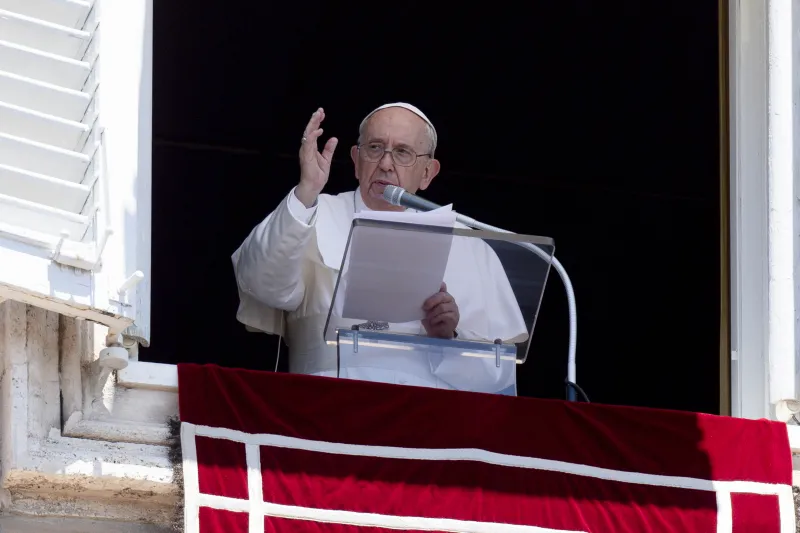
 Pope Francis speaks to the crowd on June 12, 2022 gathered in St. Peter’s Square in Rome for the recitation of the Angelus on Trinity Sunday. / Vatican Media
Washington, D.C. Newsroom, Jun 12, 2022 / 07:47 am (CNA).
Speaking on Trinity Sunday, Pope Francis said that celebrating the Trinity is “not so much a theological exercise, but a revolution in our way of life.”
“God, in whom each person lives for the other in a continual relationship, in continual rapport, not for himself, provokes us to live with others and for others,” he said.
In his address prior to the recitation of the Angelus, Pope Francis reflected on Sunday’s Gospel reading, from the 16th chapter of John. In the reading, Jesus is speaking to the apostles about the coming of the Holy Spirit. “I have much more to tell you, but you cannot bear it now. But when he comes, the Spirit of truth, he will guide you to all truth,” the Lord says.
Jesus tells the apostles, “Everything that the Father has is mine; for this reason I told you that he will take from what is mine and declare it to you.”
“We notice that the Holy Spirit speaks, but not of himself: He announces Jesus and reveals the Father,” Pope Francis said to thousands of pilgrims gathered in St. Peter’s Square June 12.
“And we also notice that the Father, who possesses everything because he is the origin of all things, gives to the Son everything he possesses: He keeps nothing for himself and he gives himself fully to the Son,” he said.
Pope Francis added that “the Holy Spirit speaks not of himself; he speaks about Jesus, he speaks about others. And the Father does not give himself, he gives the Son. It is open generosity, one open to the other.”
The Holy Father then invited the crowd to do a self-examination.
“When we speak, we always want to say something good about ourselves, and often, we only speak about ourselves and what we do,” he said. “How often!”
Giving examples, Pope Francis said that people often say “I have done this and that” and “I had this problem.”
“We always speak like this,” he said.
He added, “How different this is from the Holy Spirit, who speaks by announcing others, and the Father the Son! And, how jealous we are of what we possess. How hard it is for us to share what we possess with others, even those who lack the basic necessities! It is easy to talk about it, but difficult to practice it.”
He encouraged the crowd to question whether “our life reflects the God we believe in.”
Leading the crowd in self-examination, the pope asked, “do I, who profess faith in God the Father, and the Son, and the Holy Spirit, truly believe that I need others in order to live, I need to give myself to others, I need to serve others? Do I affirm this in words, or do I affirm it with my life?”
The one, triune God must be manifested in deeds, not words, he said.
“God, who is the author of life, is transmitted not so much through books as through witness of life,” Pope Francis said. “He, who, as the evangelist John writes, ‘is love’ (1 Jn 4:16), reveals himself through love.”
Pope Francis encouraged the crowd to think about “good, generous, gentle” people they have met and reflect on their way of thinking and their actions.
By doing this, “we can have a small reflection of God-Love,” he said. “And what does it mean to love? Not only to wish them well and to be good to them, but first and foremost, at the root, to welcome others, to be open to others, to make room for others, to make space (for) others. This is what it means to love, at the root.”
To better understand the Trinity, the Holy Father encouraged the crowd to consider each name of the three persons of the Trinity, “which we pronounce every time we make the sign of the cross: Each name contains the presence of the other.”
“The Father, for example, would not be such without the Son; likewise, the Son cannot be considered alone, but always as the Son of the Father. And the Holy Spirit, in turn, is the Spirit of the Father and the Son,” he said.
“In short,” Pope Francis added, “the Trinity teaches us that one can never be without the other. We are not islands, we are in the world to live in God’s image: open, in need of others, and in need of helping others.”
After praying the Angelus at noon, Pope Francis called for a round of applause for the recent beatification of Sister Paschalis Jahn and nine sister martyrs of the Congregation of the Sisters of St. Elizabeth, who were killed at the end of World War II by Red Army soldiers.
The nuns were beatified Saturday in Wroclaw, Poland.
Although the women knew the danger they were putting themselves in by attending to the sick and elderly, Pope Francis said, they did it anyway because of their Christian faith.
“May their example of faith to Christ help us all, especially Christians who are persecuted in various parts of the world, to bear witness to the Gospel courageously,” he said of the new blessed.
Pope Francis also spoke about the “great regret” he felt for having to postpone his scheduled trip in early July to the Democratic Republic of Congo and South Sudan due to issues he is having with his leg.
“I truly feel great sorrow for having had to postpone this trip, which means so much to me,” he said. “I apologize for this. Let us pray together that, with the help of God and medical attention, I will be able to be with you as soon as possible. Let us be hopeful!”
Speaking of World Day against Child Labor, Pope Francis called for all to work to “eliminate this scourge “so that no child is deprived of his or her fundamental rights and forced or coerced to work.”
The Holy Father also said that the Ukrainian people remain “vivid in my heart,” speaking of the Russian-Ukrainian war.
“Let the passage of time not temper our grief and concern for that suffering population,” he said. “Please, let us not grow accustomed to this tragic situation! Let us always keep it in our hearts. Let us pray and strive for peace.”
[…]