No Picture
News Briefs

Church of England to create ‘celebratory’ transgender liturgies
December 12, 2018 CNA Daily News 3

London, England, Dec 12, 2018 / 04:50 pm (CNA).- The Church of England has published pastoral guidelines for liturgical services that would celebrate the completion of “gender transitioning” by those Anglicans who identify as transgendered.

The guidelines, titled Pastoral Guidance for use in conjunction with the Affirmation of Baptismal Faith in the context of gender transition, were approved by the Church of England’s House of Bishops Dec. 10, and published Tuesday.

The guidance applies only to the Church of England, and not to other branches of the worldwide Anglican Communion.
 
The guidelines state that baptism is the “natural liturgical context for recognizing and celebrating [a transgendered person’s] identity in Christ and God’s love for them” and encourages ministers to accept and use “the preference of a transgender person in respect of their name and gendered (or other) pronouns” in the baptism of transgendered persons.
 
Baptized members of the Church of England are to be offered specially adapted rituals “to recognize liturgically a person’s gender transition,” the guidelines say.

Such liturgies would allow an individual to affirm a new gender preference while renewing baptismal promises.
 
The guidelines note that the Church of England “welcomes and encourages the unconditional affirmations of trans people” and state that services to recognize their new identity should have a “celebratory character.”

The document offers guidance on the appropriate use of pronouns during the service, explaining that ministers “should be guided by the wishes of the candidate” with respect to acknowledging the actual sex of the person at birth.
 
The guidelines follow a 284-78 vote last year in the Church of England’s General Synod, calling for consideration of special liturgies which “might be prepared to mark a person’s gender transition.” The newly published adaptation of existing liturgies for baptism and baptismal affirmation is thought to be a compromise agreed among Church of England bishops divided over the creation of new liturgies particular to “gender transition.”

But Fr. James Bradley, a former Church of England deacon and now a Catholic priest of the Ordinariate of Our Lady of Walsingham, told CNA that the move represents a dramatic shift in Church of England teaching.

“It appears to represent not simply a further change in Anglican practice, but a fundamental shift in the Church of England’s understanding of the human person and the sacrament of baptism,” Bradley said.

The Church of England’s Bishop of Blackburn, Julian Henderson, led the House of Bishops’ committee that developed the guidelines. “We are absolutely clear that everyone is made in the image of God and that all should find a welcome in their parish church,” Henderson said in a Dec. 11 Church of England press release.

Henderson called the new liturgical options “an opportunity, rooted in scripture, to enable trans people who have ‘come to Christ as the way, the truth and the life’, to mark their transition in the presence of their Church family which is the body of Christ.”

The decision has caused some controversy within the Church of England.

Andrea Williams, who is a member of the Church of England’s General Synod told reporters that the  move is a “devastating trajectory towards an outright denial of God and his word” and a “misguided attempt to be loving” which “sacrifices truth.”

The Church of England is part of the worldwide Anglican Communion, and its head, the Archbishop of Canterbury, serves as “first among equals.” The Anglican Communion has been strained in recent years by division over moral and sexual issues.

The American Episcopal Church has approved same-sex marriage since 2015, while the Church of England called for a discussion for liturgies and blessings to recognize same-sex unions last year. Some member-churches, especially those in Africa, have resisted these moves, holding to more traditional Christian teachings.

A spokesman for the Church of England told CNA that the new guidelines were “just a consultation on guidance for use of liturgy in Church of England services” and so “not something with a wider Anglican Communion involvement.”

The announcement from the Church of England could make future ecumenical efforts between it and the Catholic Church more difficult.
 
Pope Francis has been outspoken in his denunciation of so-called gender theory and the Western trend to treat basic aspects of human identity as fluid or mutable. The pope has said that “biological sex and the socio-cultural role of sex (gender) can be distinguished but not separated.”
 
Addressing transgenderism in his 2016 Apostolic exhortation Amoris laetitia, Pope Francis said that “the young need to be helped to accept their own body as it was created.”
 
Pope Francis has also spoken out against so-called reassignment surgeries and techniques. In a 2017 speech to the Pontifical Academy of Life he said that such “biomedical technology” “risks dismantling the source of energy that fuels the alliance between men and women and renders them fertile.”
 
Dr. Chad Pecknold, Associate Professor of Theology at the Catholic University of America and a Fellow at the Institute of Human Ecology, told CNA that the decision by the Church of England has caused a moment of sadness for some Christians concerned with ecumenical unity.
 
“As a Catholic who cares about ecumenical friendships with our separated brethren, I can only see this decision as deeply tragic for the cause of Christian unity, and a profound betrayal of a common Christian witness,” Pecknold said.
 
Pecknold told CNA that recognizing and celebrating so-called gender transitions went against basic Christian teachings on human nature and sacramental grace.
 
“The Church teaches that the human person bears God’s image, as soul and body, a union of the material and spiritual, made for friendship with one another and God,” Pecknold said.
 
“It is true that the Fall destroyed our original harmony with God, weakened our will, and disordered our desires, but the Church also teaches that the goodness of our created nature remains intact even in our fallen state.”
 
The Catholic Church has learned these essential human truths by reason as well as by revelation, Pecknold told CNA, but also through the struggle to overcome ancient heresies.
 
“From the earliest times, Catholic Christians have rejected Gnostic, Manichean, and Albigensian attempts to pit the body and soul against one another. Today we see that transgendered activists have revived gnostic dualism, pitting biological sex against gender identity.”
 
While many communities have struggled to find a balance between welcoming people suffering from gender dysphoria or other crises of personal identity while still affirming common truths and values, Pecknold told CNA that the adaptation of liturgy, especially the liturgy of baptism, to celebrate a change of gender was especially problematic.
 
“In baptism, which is the first sacrament, God sanctifies His beloved creature which He made ‘very good.’ Only God has the power to change and heal our nature as such, and only God can give us a new name,” Pecknold said.
 
“The Church is not in the business of blessing identities, but of healing nature.”
[…]

No Picture
News Briefs

Catholic elected as leader of Germany’s largest party

December 10, 2018 CNA Daily News 2

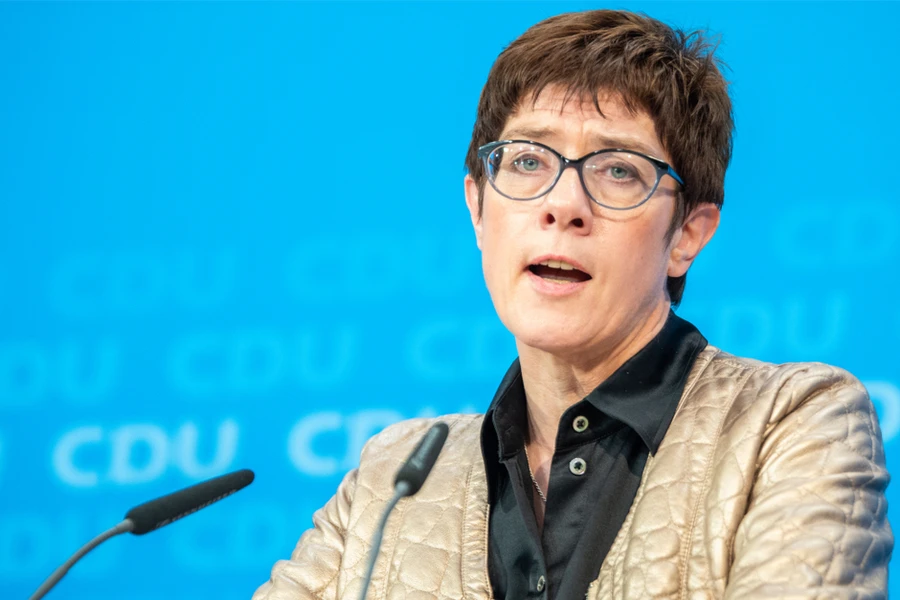
Munich, Germany, Dec 10, 2018 / 08:30 am (CNA).- Annegret Kramp-Karrenbauer was named the new leader of Germany’s Christian Democratic Union (CDU) at a special party conference December 7.


A practicing Catholic, Kramp-Karrenbauer – known as AKK in the German press – was seen as the preferred choice of German chancellor and outgoing CDU leader Angela Merkel.


A married mother of three, Kramp-Karrenbauer previously served as secretary general of the party and minister-president of the western German region of Saarland. She defeated Friedrich Merz, a former member of the European Parliament and Bundestag, winning a run-off ballot with 517 of 1,001 potential votes.


As head of the CDU, Kramp-Karrenbauer is now widely regarded as a possible chancellor-in-waiting behind Merkel, who has said she will step down at the end of her current term in 2021.


Broadly seen as economically liberal, many political commentators have dubbed Kramp-Karrenbauer “mini-Merkel” and she is widely considered to be a continuity candidate with the current chancellor, who led the party from 2000-2018.


Kramp-Karrenbauer is known for her traditional social views, and has previously drawn attention for her outspoken opposition to same-sex marriage and gay adoption. As head of the Saarland region, she warned that same-sex marriage could create a legal precedent for recognizing incesuous and polygamous unions.


“If we open up this definition [of marriage] to become a long-term responsible partnership between two adults, then other demands can’t be ruled out, such as a marriage between close relatives or between more than two people,” she argued in 2015.


Same-sex marriage became legal in Germany in 2017.


While often characterized as a “staunch” or “devout” Catholic, Kramp-Karrenbauer has been a vocal supporter of female ordination in the Church. Earlier this year, she told the weekly newspaper Die Zeit that “It is very clear: women have to take positions of leadership in the Church,” eventually including women-priests but beginning with the “more realistic goal” of a female diaconate.


As the largest economy in the European Union, Germany politics plays a crucial role in the direction of the continent, with the German chancellor functioning as a de facto leader for the union. As Merkel’s acknowledged preferred successor, Kramp-Karrenbauer’s views on a range of policy issues will be scrutinized by leaders across the EU.


On the politically sensitive topic of mass-migration to the Europe, Merkel’s open-door policy to migrants in 2015 was widely seen as out of step with broader European policy, making Germany a beacon nation for refugees and economic migrants alike, and putting pressure on neighbouring countries.


Kramp-Karrenbauer has called for a more forward-looking debate on the subject of immigration and mass-migration.


In November, she told German television station NTV that she did not want to see a “backward-looking discussion” or “eternal debate about what was done right or wrong in the autumn of 2015.” Instead, she said, she wanted to see an “honest” discussion about the current effects of years of migration “uncontrolled and without integration.”

[…]

No Picture
News Briefs

Small Irish community seeks help to save a saint’s iconic cross

December 6, 2018 CNA Daily News 0

Dublin, Ireland, Dec 6, 2018 / 03:01 am (CNA/EWTN News).- A unique Irish cross marking the 1,400-year-old grave of a Catholic saint is in danger of destruction due to erosion, and the local community is seeking help to restore the “icon of Ireland’s early Christian heritage.”

St Mura’s Cross is carved into a slab nearly seven feet tall that marks the grave of St. Mura, the first abbot of a sixth-century monastery in the far north of Ireland in what is now County Donegal. The monastery, one of Ireland’s earliest, was founded by St. Colmcille less than a century after the death of St. Patrick. It became a center of religion and scholarship and its surrounding settlements gave birth to the town of Fahan, where nearly 600 people live today.

A nearby gable wall must be repaired before preservation efforts on St. Mura’s Cross must begin.

“Cracks have appeared on the wall and if we don’t stabilize that it could fall. If it does, it will fall on the cross and it will be destroyed forever,” Colm Toland of the Fahan Heritage Group told The Irish News in November.

St. Mura, said to be a descendant of the Irish king Niall of the Nine Hostages, died in 645 at the age of 94. He became the patron saint of the O’Neil Clan, whose leaders were among the High Kings of Ireland. His feast day is observed March 12.

Both a Catholic church and a Church of Ireland church in the Fahan area are named for the saint.

The cross is the only one of its kind to bear an inscription in Greek: “Glory and honor to the Father, the Son and Holy Spirit”. It is considered a unique inspiration of the Irish High Cross artistic tradition of massive and ornately carved stone crosses.

The saint’s cross was carved sometime from the sixth to the tenth century. The gable wall was built in 1608, using stones from the original monastery, the Irish state broadcaster RTE News reports. It is surrounded by a graveyard that includes St. Mura’s tomb.

The monastery and village were sacked by the Vikings twice in the middle ages, though the site’s current ruins date to the 17th century. Some monastery artifacts are now in museums in Dublin and London.

Fahan’s heritage group is seeking support to protect the cross and the nearby church gable ruins. The gable is one of the distinctive landmarks of the village and a favorite stop for tourists and wedding parties, Fahan Heritage Group said in its YouTube video “Save St. Mura’s Cross.”

<iframe width=”560″ height=”315″ src=”https://www.youtube.com/embed/vr-R-yP7Bto” frameborder=”0″ allow=”accelerometer; autoplay; encrypted-media; gyroscope; picture-in-picture” allowfullscreen></iframe>

The stone-carved cross was distinctive for centuries, but now it has faded due to severe erosion attributed to acid rain or other environmental factors. The carving and Greek inscription are almost illegible.

“One thing we might have to consider is moving the cross to an indoor location and replacing it with a replica outside,” Toland said. “That way we could protect if from whatever environmental or pollution influences which are eroding it.”

Backers of the restoration include individuals from local community heritage and church societies, including historians, archaeologists, and architects.

They have launched an online fundraiser seeking an additional 15,000 Euro, about $17,000, to add to a startup grant from the Heritage Council of Ireland and funds from other sources.

“If left unprotected we will have lost an icon of Ireland’s earliest Christian period,” said the backers of the “Save Saint Mura’s Cross” project on the group fundraiser site fundit.ie. The fundraiser will close in mid-January.

They and the wider community are “determined to conserve the local history and heritage of Saint Mura’s monastic settlement from which the village itself grew.”

[…]

No Picture
News Briefs

English bishop dedicates ‘Year of Holiness’ in 2019

December 4, 2018 CNA Daily News 1

Shrewsbury, England, Dec 4, 2018 / 03:01 am (CNA/EWTN News).- In a pastoral letter marking the first Sunday of Advent, Bishop Mark Davies of Shrewsbury dedicated 2019 as the diocesan Year of Holiness, calling attention to the Second Vatican Council’s emphasis on the universal call to holiness.

“It is this universal call to holiness which I wish all of us, clergy and people, to focus upon anew. It is striking that, amid all the crises of the 20th Century, the central message of the Second Vatican Council was that every one of us, in every state of life, is called to the fullness of the Christian life and the perfection of love: that is, called to become nothing less than a saint,” Bishop Davies wrote.

“Advent is a time of renewed hope leading us to the light of Christmas,” he said. “It is a journey we make in the darkest days of our year. Such days evoke the dark shadows in the world around us, and those failures in the lives and witness of Christians which have at times cast dark shadows over the face of the Church, obscuring for many, the clear light of Christ shining from her.”

He said that “our renewal in holiness” is “the only renewal of the Church which will ever matter … It is why only saints resolved the crises the Church has faced throughout history and why they have proved to be the great evangelisers.”

“It is also why, today, amid the dark shadows of scandal and the challenge of a new evangelisation of western societies, it is urgent to recall this one goal of every Christian life for it is in the saints that the true face of the Church shines out. For, though they can have their place, no pastoral programme; no discussions amongst us; no re-organisation or re-structuring can ever accomplish this; only our striving for holiness to become the saints we have been called by God to be.”

Both “our Christian calling and the ultimate goal of every human life” is “to become, in the end, a saint,” said Bishop Davies, recalling that Christ told us “that this is the one thing which alone matters.”

The bishop noted that Pope Francis wrote in a recent letter that “the only great tragedy in life, is not to become a saint.”

“A saint is someone who reaches the complete and everlasting happiness of Heaven. We might say that holiness is happiness … it is only by being holy that we can be truly happy.”

Bishop Davies said: “The Holy Father writes, ‘Do not be afraid to set your sights higher, to allow yourself to be loved and liberated by God’. For holiness, he writes, is ‘the extent that, by the power of the Holy Spirit, we model our life on Christ’s’. We can never reach this goal by our own unaided efforts. By the grace of God we can!”

He encouraged everyone in the Diocese of Shrewbury to recall in the coming year that there is found in the Church, holy though composed of sinners, everything needed to grow in holiness.

“In daily prayer, frequent Confession and, above all, in the Holy Eucharist, we are given the Divine means, the grace to reach this goal,” wrote Bishop Davies.

“This is our purpose as we enter anew into Advent,” the bishop concluded. “Let us ask Our Lady, she who is ‘full of grace’, to accompany us along the path to the holiness, the true happiness to which we are called. In the beautiful words of the Second Vatican Council, we know that in the most Blessed Virgin Mary the Church has already reached perfection and in our struggle she shines out for us as a sign of certain hope and consolation until the day of the Lord shall come in splendour.”

[…]