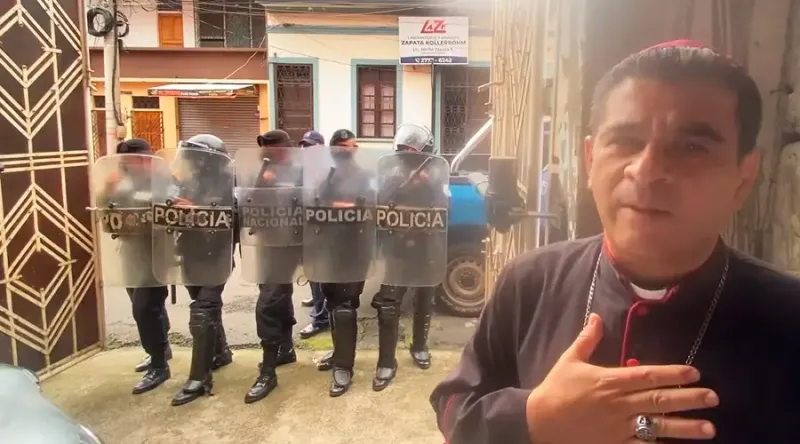
 Bishop José Álvarez Lagos is surrounded by police officers on Aug. 4, 2022. The bishop’s detention was cited in a Sept. 13, 2022, U.N. human-rights report. / Diocese Media TV Merced / Diocese of Matagalpa
Washington, D.C. Newsroom, Sep 15, 2022 / 09:50 am (CNA).
The United Nations Human Rights Council (UNHRC) released a report Sept. 13 that condemned the regime of Nicaragua’s President Daniel Ortega and his wife, Vice President Rosario Murillo, citing a “deterioration of the human rights situation.”
The report included a compilation of recent incidents in which the Nicaraguan government has attacked and repressed the Catholic Church.
Ortega, who took office in 2007, has become increasingly authoritarian since his re-election in November 2021. A brutal crackdown on protesters in 2018, the arrest and imprisonment of political opponents before the presidential election, and the repression of the Church prompted a U.N. resolution to further monitor the country.
The report, introduced before the 51st session of the UNHRC in Geneva, documented known human rights violations since March when the report was commissioned.
In summing up the report’s findings, U.N. official Christian Salazar Volkmann cited “serious violations of civil and political rights, the absence of a national dialogue, the deepening of the political crisis, and the isolation of Nicaragua from the international community.”
“I urge the international community to sustain its efforts and engagement, including, most urgently, to keep calling on the authorities for the release of the arbitrarily detained persons,” Volkmann said.
Attacks on the Catholic Church
Included among the findings were attacks on the Catholic Church:
— In March, the report noted, Nicaragua expelled the apostolic nuncio, “who had supported dialogue at the beginning of the crisis.”
— On Aug. 1, Nicaraguan police broke into a Catholic radio station in Sébaca, Matagalpa, using violent force. A parish priest and six others were confined in his house for three days without food or electricity.
— The bishop of Matagalpa, Rolando Álvarez, along with two priests, was harassed beginning in May, the report noted. On Aug. 4, police surrounded the bishop’s home and prevented him from going to the cathedral to celebrate Mass. The bishop, five other priests, and six lay people were held by riot police and subject to a criminal investigation. According to human-rights observers, as of today, his location is not known.
— Between May and August, government authorities shut down 12 radio and television media outlets of the Catholic Church, “arguing that they did not have operating permits,” the report said.
— Twelve universities “had their legal personality canceled,” according to the U.N. report. Among them was the Jesuit-run Central American University.
Other human rights abuses
The Catholic Church was only one entity targeted by the Ortega regime. Other instances of human-rights violations found in the report include:
— As many as 1,178 human rights and development organizations were shut down or ordered to leave the country. Among these nongovernmental organizations were entities affiliated with the Catholic Church, including members of Mother Teresa’s order, the Missionaries of Charity, who were expelled from the country in July.
— As of the writing of the report, 180 people who were arrested during the political crisis of 2021 remain in detention. The report found that their trials were held behind closed doors, and the attorneys of the accused were denied access to evidence and were not allowed to meet with their clients for more than a few minutes before their hearings.
— The U.N. body’s investigations found inhumane conditions at a detention center that resulted in the death of one individual in February. The report noted that the Nicaraguan government had not complied with the UNHRC’s recommendation that they “prevent acts of torture and ill-treatment in custody.”
— Freedom of the press also “deteriorated,” according to the report, which noted that the manager of La Prensa, who was arrested in the run-up to the 2021 elections, was sentenced to nine years in prison for money laundering. The newspaper’s staff has since fled the country, “joining the 120 other journalists who are in exile.” Three journalists were also sentenced to up to 13 years in prison for “spreading fake news and undermining national integrity.”
— The report found that the Nicaraguan government had failed to carry out the recommendations of the UNHRC that included electoral reform and the investigation of human rights violations committed by security forces.
[…]