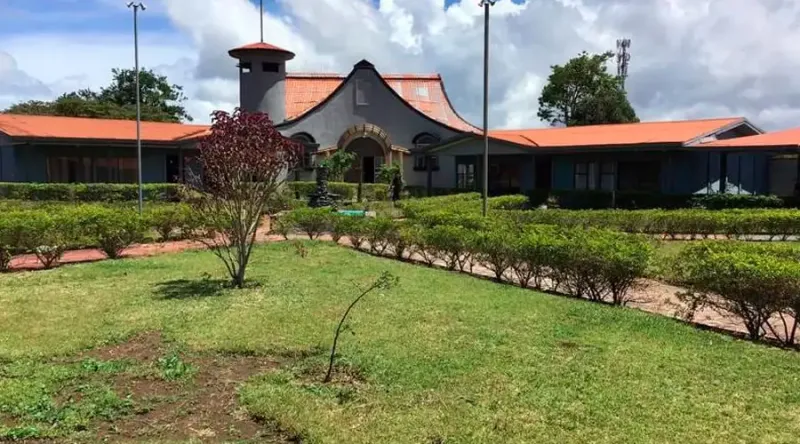
 The Benedictine Monastery of San Jose in Costa Rica’s Diocese of Cartago, which was canonically closed Nov. 7, 2021. / Diocese of Cartago.
Cartago, Costa Rica, Nov 10, 2021 / 10:24 am (CNA).
The Diocese of Cartago has ordered the canonical closure of the San José Benedictine Monastery, a diocesan foundation that had functioned ad experimentum for some years.
“This decision of ecclesiastical closure is carried out as a result of an internal administrative process of the Church, which originated in a pastoral visit to the Monastery; this being done in accordance with the powers conferred by the Code of Canon Law, whose result and conclusions were endorsed by the Congregation for the Institutes of Religious Life and Societies of Apostolic Life in Rome,” the diocese stated Nov. 7.
Father Jorge David Arley Campos, press officer for the Diocese of Cartago, told ACI Prensa, CNA’s Spanish language sister news agency Nov. 9. that “as the assessment and investigation of the fruits of the experience is an internal process, the specific reasons” for the closure are not published, since “it was the decision of the commission in charge and the judicial vicar of the diocese.”
“The final decision was made known but not the reasons, since there are elements of secrecy in the matter and they cannot be exposed to public opinion due to the nature of the entrusted secret, in order not to damage the conscience of the faithful and to avoid incorrect interpretations by the faithful,” the priest said.
On its Facebook page, the monastery calls itself a “monastic community governed by the Rule of Saint Benedict, cloistered under our constitutions, and our main work is: prayer and manual labor.”
“We are a cloistered community, we do not do pastoral work outside the monastery. We do not belong to the Diocese of Cartago,” the Facebook page states.
The Nov. 7 diocesan communiqué says that “the members of this diocesan experience have been allowed and offered all our collaboration in their transfer to other experiences of community, if they see fit, awaiting word from them.”
The diocese said that while it has closed the monastery and thus ended its ecclesial mission, it is aware that the monastery was also established as a civil association enrolled in the Civil Registry and so “it belongs to them to determine its future as a civil association.”
From Nov. 7 “the Diocesan Experience of the San José Benedictine Monastery will not be part of the Diocese of Cartago, likewise there will be no authorization for the celebration of the sacraments and sacramentals in the place of that experience.”
Fr. Arley Campos explained to ACI Prensa that as a civil association the monastery is “a legal entity under which they were legally protected as a group.”
“As an association it’s up to them to determine their future, but they are no longer canonically a movement of the Catholic Church,” the priest said.
An article published Nov.1 La Nación, a San José daily, says that “the Benedictine monks of the San José Monastery, in Paraíso de Cartago, charged that the current bishop of Cartago, Mario Enrique Quirós Quirós, has persecuted them for years to ‘eliminate’ their ‘presence ‘in the diocese and take from them their monastery grounds.”
The monastery was founded about eight years ago under Bishop José Francisco Ulloa Rojas. Bishop Quirós succeeded him in 2017.
In its Nov. 7 statement, the Diocese of Cartago doesn’t mention the article in La Nación, but noted that “the land and facilities where the campus of said experience have been located is the property of the indicated Association and has never been the subject of discussion.”
A response sent by the Diocese of Cartago to La Nación says that “the members of the San José Monastery, which was founded by the diocese, were informed of the conclusion of said experience, as a result of not obtaining the expected fruits during this time.”
The diocese further noted that members of the monastery “have been given the opportunity to exercise, pursuant to CIC c. 50, their right of reply.”
Canon 50 of the Code of Canon Law establishes that “before issuing a singular decree, an authority is to seek out the necessary information and proofs and, insofar as possible, to hear those whose rights can be injured.”
The press officer of the Diocese of Cartago explained to ACI Prensa that what happened in this case was the “closure of a diocesan foundation that was subject to evaluation and that could have become an autonomous monastery,” as they exist in other parts of the world.
Fr. Arley Campos said that the members of the group can stay on their property, “since the material goods they enjoy are theirs and their internal regulations, like those of any civil group, are those that govern their action.”
However, the priest clarified, “its mode of operation and what that entails is no longer covered by the Diocesan Church of Cartago.”

[…]