The Dispatch

Pope Francis reportedly takes Vatican apartment, salary from Cardinal Burke
November 28, 2023 Catholic News Agency 43
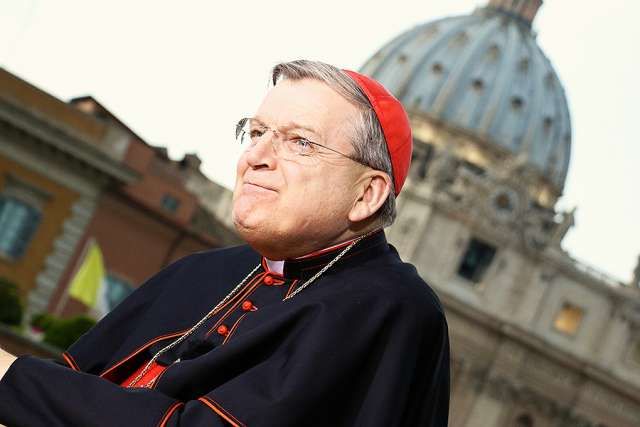
Cardinal Raymond Burke at EWTN’s studio in Rome during the canonization of St. John Paul II and St. John XXIII. / Credit: Steven Driscoll/CNA

Vatican City, Nov 28, 2023 / 13:34 pm (CNA).

Pope Francis has stripped one of his top American critics, Cardinal Raymond Burke, of his Vatican housing and salary privileges, the Associated Press is reporting.

According to the AP report, which is based on conversations with two anonymous sources briefed on the measures, the pope discussed his planned actions against the American prelate at a Nov. 20 meeting of Vatican office heads.

The pope reportedly said that Burke was a source of “disunity” in the Church and that he was using the privileges afforded to retired cardinals against the Church.

The Italian Catholic news blog La Nuova Bussola Quotidiana first reported pending actions against Burke on Nov. 27.

“Cardinal Burke is my enemy, so I take away his apartment and his salary,” the pope had said at the Nov. 20 meeting, according to Bussola’s undisclosed Vatican source.

CNA was unable to immediately reach Burke to confirm the measures against him. The Vatican’s communications office did not respond to EWTN’s request for comment by time of publication.

The AP reported that the Vatican spokesman, Matteo Bruni, “referred questions to Burke.”

“I don’t have anything particular to say about that,” Bruni told reporters.

Burke was ordained a priest by Pope Paul VI in Rome in 1975 and was bishop of La Crosse, Wisconsin, from 1995 to 2004 and archbishop of St. Louis from 2004 to 2008. Widely regarded as an expert in canon law, Burke was appointed in 2008 as prefect of the Supreme Tribunal of the Apostolic Signatura (the highest judicial authority in the Church) by Pope Benedict XVI. Two years later, Benedict made him a cardinal. 

Pope Francis removed him from the post of prefect in 2014 and instead appointed him cardinal patron of the Sovereign Military Order of Malta, a mostly ceremonial role dedicated to the spiritual welfare of the members of the order. He remained patron until this year but had held only the title, having been reportedly restricted from active involvement since 2016 and thus sidelined during the extensive institutional reforms of the order over the last years. In June, Pope Francis named Cardinal Gianfranco Ghirlanda, SJ, as Burke’s official replacement. At the time of the announcement, Burke was only a few days away from the customary retirement age for bishops of 75.

Burke has emerged as a strong critic of some of Pope Francis’ initiatives.

He was one of the five cardinals who sent “dubia” to Pope Francis asking for clarification on the Church’s position on doctrinal development, the blessing of same-sex unions, the authority of the Synod on Synodality, women’s ordination, and sacramental absolution. 

The document was made public on the eve of the opening of the Synod on Synodality at the Vatican and discussed at an Oct. 2 press conference in which Burke took part and expressed his concerns about the synod.

“It is unfortunately very clear that the invocation of the Holy Spirit by some has for its purpose the advancement of an agenda that is more political and human than ecclesial and divine,” Burke said.

This would not be the first former curial official this year asked to leave his Vatican living quarters.

According to a German newspaper report in June, Pope Francis ordered Archbishop Georg Gänswein to leave the Vatican and return to Germany. Gänswein, a longtime secretary to Pope Benedict XVI, served as prefect of the Papal Household to both Benedict and his successor, Pope Francis, until February 2020. Gänswein’s departure from the Vatican following the death of Benedict and subsequent dismissal by Pope Francis was seen by some as a fall from grace.

According to the German media report, Pope Francis in his comments on the decision “referred to the custom that the former private secretaries of deceased popes did not remain in Rome.”

Like Burke, Gänswein, 66, is without portfolio.

This is a developing story.

[…]

The Dispatch

Consoling the Heart of Jesus

November 25, 2023 Rob Marco 7

My wife and I have been listening to a good primer on mental prayer. Though I have practiced mental prayer for a number of years now, it’s always good to go back for refreshers, as […]

The Dispatch

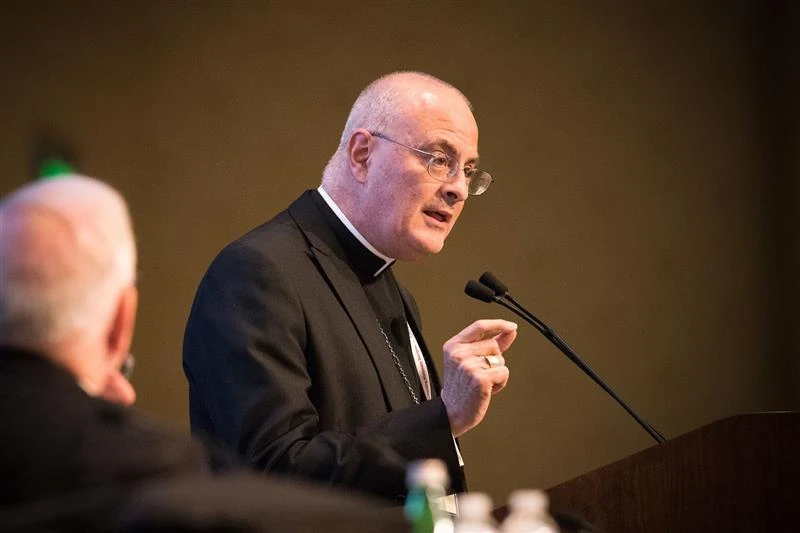
Maronite bishop dives deep into the ‘masculine soul’

November 23, 2023 Catholic News Agency 10
Bishop Gregory Mansour released his sixth pastoral letter on men’s spirituality on Oct. 12, 2023. / Credit: Eparchy of Saint Maron of Brooklyn

CNA Staff, Nov 23, 2023 / 10:38 am (CNA).

In his sixth pastoral letter on male spirituality, Maronite Bishop Gregory Mansour says that “fatherhood is expected of all men, whether biological, natural, or spiritual.”

In the Oct. 12 letter titled “The man of God is a man for others: Some themes in men’s spirituality,” Mansour, said that there are “some worrisome trends” in the culture that “undermine masculinity under the guise of remedying past chauvinism or over-reliance on patriarchal structures.”

Mansour added that given “the absence of dads in far too many homes in our country and the need for inspiring male role models, many young men are growing up without effective guidance about how to live out their male identity.”

Expressing the desire to reach the “hearts of men” through his letter, he added that “I would be grateful if this Pastoral Letter nourishes women and youth as well because so much of this letter can be helpful to everyone interested in the spiritual life.”

Pastoral letters are often released by bishops to members of their dioceses on a certain aspect of the faith, in an attempt to guide the faithful. 

The letter explores a myriad of topics ranging from a man’s disposition towards his wife and children, the use of contraception and pornography, the need for self-mastery and a life of prayer, and the call to fatherhood for all men regardless of one’s current state in life. 

“Men who live as ‘chips off the old (divine) block’ are the greatest need today; women and children long for this — many men also long for this,” he wrote.

‘A man for others’

Much of a men’s spirituality can be discovered through reflecting on Jesus as “a man for others,” the letter said. 

Mansour cites the Gospel of John where Jesus washes the feet of his disciples. He adds that Jesus was teaching “all of us, but especially men” about servant leadership.

“Jesus wanted to teach men how to undo the sin of the first man, Adam, who after the Fall would ‘rule over’ his ‘helpmate’ Eve (Gen. 3:16),” he wrote. 

Christ was making service “his privileged way,” Mansour wrote, adding that “the path of redemption would involve self-mastery rather than domination of others.” 

Men and women have equal dignity, Mansour wrote pointing to Jesus’s discourse on marriage and divorce with the Pharisees.

Mansour wrote that Christ “rebutted the religious leaders of the day who were justifying divorce by referring to how Moses allowed a man to divorce his wife for any reason whatsoever.”

Jesus responded by stating “that it was God’s intention from the beginning that what God has joined no human authority should separate,” Mansour wrote, adding that his new command “shattered all previous rights to male domination in marriage.”

“Jesus, it should be noted, was speaking only to men, because women did not have the ‘right,’ given by Moses, to divorce their husbands. Thus, Jesus was indicating that a woman and a man are, by nature, and by the intention of the Creator, of equal importance and dignity,” he wrote.

The call to chastity

Noting that men and women are able to give themselves as gifts to each other in the sexual embrace, Mansour said that “a man and woman need to develop within themselves the virtues necessary to ensure that they can be faithful to each other.”

Mansour wrote that chastity orders sexual intimacy to be “appropriately expressed in fidelity, love, and mutual reverence,” adding that “man completes woman and woman completes man, as two halves make a whole.”

“We can easily enslave ourselves to our desires, passions, compulsions, addictions, and whims. Pornography, masturbation, and sexual promiscuity are always sinful, as is sexual harassment or abuse,” he wrote. 

Mansour wrote that if one falls into any of these sins or crimes, “he should repent of these quickly, and ‘flee’ from them, saying that professional help may be necessary in some cases.

“We should all work to rid ourselves and the culture of such ills, to make our culture and ourselves, more holy, chaste, and respectful, especially for the sake of women, girls, and boys,” he wrote.

Mansour said that one way chastity can be used in marriage is through Natural Family Planning, a method of tracking a woman’s natural cycle which can help couples either conceive or avoid pregnancy.

“If a couple for serious reasons prayerfully recognizes the need to space children, they should not make recourse to contraception but work together to achieve a healthy spacing of children in the chaste and natural way given by God,” he wrote.

On the topic of children, Mansour said that God intended “these ‘little ones’” to enter the world in the context of the marriage covenant. 

“A child has the right to come into the world through this kind of marital love, embrace, complementarity, and commitment, in which the mother and father mutually pledge to love and care for the child and each other in a stable and permanent relationship,” he wrote.

Turning his attention to the single and celibate man, Mansour wrote that these groups of men are also called to live chaste lives and deny themselves.

Mansour cited Pope John Paul II, who referred to the “nuptial meaning of the body,” adding that those who forsake marriage for the sake of the kingdom can live in a “spiritual union” with God. 

“This gift, in imitation of the chaste and celibate Christ, depends on and deepens one’s communion with God, and sets one free to embrace an intense and life-giving love for others,” he wrote.

A man’s prayer

A prayerful man will learn that his life’s purpose is holiness, Mansour wrote. He added that men are called to make themselves vulnerable in prayer.

Mansour notes that it can seem “contradictory” for a man who is a “protector, provider, and cultivator” to become so vulnerable in prayer, but said that to “enter into a prayerful state requires a man to now go a step even further, and to stand vulnerable before another man, that is before the God-man, Jesus Christ, and ask him for help.”

But a man’s prayer is not just for himself, Mansour wrote, it is for “all those for whom he loves and cares.”

“A good father, husband, friend, priest, or consecrated man carries the responsibility to not only answer his call to holiness, but to also help bring others to holiness as well,” he wrote.

Fatherhood “is expected of all men,” regardless of their current state of life, Mansour wrote.

He wrote that all men, biological or not, are called to “natural” fatherhood, which is “a role in which a man teaches by example, providing proof that what the father teaches is possible in one’s life.”

The biological father is a “generator of life” that will “go on to nurture other generators of life,” he wrote.

“Thus, the biological father ‘passes on the torch’ allowing his sons the potential to take on the same name, ‘father.’ Fatherhood does not end with the generation of new life, but rather the perfection of this new life through proper rearing, education, and accompaniment,” Mansour wrote.

A natural fatherhood calls a man “to showcase a virtuous life that embodies a lifestyle worthy of imitating,” he wrote.

“Whether one is both a biological and natural father or only a natural father, both roles are ordered to an even greater level of fatherhood: spiritual fatherhood. This is a fatherhood expected of all men of goodwill, focused on accompanying one’s loved ones through this temporal, earthly journey while keeping their eyes fixated on eternal life,” Mansour wrote.

The full 15-page letter can be read here.

[…]