Marijuana scores badly in ‘entirely predictable’ report

April 20, 2017 CNA Daily News 0

Denver, Colo., Apr 20, 2017 / 03:02 am (CNA).- A recent report shows that traffic deaths, crime, emergency room visits and youth usage of marijuana increased significantly in the first two years following the legalization of recreational pot in the state of Colorado.

Released by the Rocky Mountain High Intensity Drug Trafficking Area in September, the report compared marijuana-related statistics from previous years in Colorado to data from 2013-2015, the first years after the legalization of recreational marijuana in the state in November 2012.

The results aren’t promising.

Marijuana-related traffic deaths increased by 62 percent in 2013, the first year of legalization of recreational marijuana. About one in five more youth are now reporting having used marijuana in the past month since its legalization. Marijuana-related hospitalizations in the state nearly doubled from 6,305 in 2011 to 11,439 in 2014.

“Perhaps there is not much value in saying to my beloved state of Colorado that ‘I told you so,’ but these results were entirely predictable,” said Dr. E. Christian Brugger, professor of Moral Theology at Denver’s St. John Vianney Theological Seminary.

Dr. Brugger has spoken and written about the moral questions surrounding the legalization of marijuana several times over the years, as his home state of Colorado has been central to the debate over the drug that has now spread to many other states.

“If there had been any sincere effort on the part of Colorado citizens and legislators to gauge in advance the harms that would arise from legalization, they would have foreseen precisely (these results),” he told CNA in e-mail comments.

The biggest health concern for young people using marijuana is its harmful effect on the brain, which continues its development well into a person’s 20s.

The main active ingredient in marijuana, THC, binds to receptors in the brain and can cause a significant decrease in IQ over time. A 2012 study published in the National Academy of Sciences found that adolescent exposure to marijuana can lead to an 8-point drop in IQ, on par with the drop seen in children exposed to lead.

Another concerning impact is the relationship between adolescent marijuana use and schizophrenia. A study repeated by multiple research groups has found that adolescent marijuana use can quadruple a teen’s risk of developing schizophrenia.

Marijuana can also be addictive, with one in six adolescent users developing a dependence over time.

A secondary health concern is traffic accidents, which make up the leading cause of death in 15-20 year-olds.

According to the report, in 2009, marijuana-related traffic deaths involving operators testing positive for marijuana represented 10 percent of all traffic fatalities in Colorado. By 2015, that number doubled to 21 percent. The amount of youth reporting marijuana use after legalization, compared to before, increased by about 20 percent. College-age Coloradans now rank first in the nation for marijuana use.

Crime has also increased in Denver and Colorado as a whole in the post-legalization years.

“Since 2014, there has been a notable increase in organized networks of sophisticated residential grows in Colorado that are orchestrated and operated by drug trafficking organizations. These organizations currently operate hundreds of large-scale home grows throughout Colorado. Harvested marijuana is shipped or transported out of Colorado to markets in the Midwest and East Coast. Home grows have significantly increased illicit production of marijuana in Colorado,” the report states.

And while marijuana has often been touted as an economy booster, the report shows that Colorado may be losing business from conventions that are no longer hosted in the state due to concerns about marijuana.

According to the report, 49 percent of meeting planners expressed concerns about marijuana when considering holding an event in Denver. VISIT DENVER, the marketing organization for the city,  found that Denver’s reputation as a clean and safe city where organizations can host events and conventions has decreased since the legalization of marijuana.

“The legalization initiative was never based upon a rational assessment of whether legalization would be good for our communities, it was driven by money and rotten politics,” Dr. Brugger said.

“And mark my word, those numbers will go up, not down, in the next years.” What’s the solution?  “Re-criminalization of the possession and smoking of marijuana in Colorado,” he says.

Tom Gorman, Director of Rocky Mountain High Intensity Drug Trafficking Area, which released the report, also believes that the negative impact will only increase overtime.

“Any time you legalize a substance, you’re going to have more people using. The more people you have using, the more adverse (effects) you’re going to have on society, as well as the individual,” he told CNA.

“Alcohol is a perfect example of that, because so many people use and abuse alcohol. We almost have as many people addicted to alcohol as all the illegal drugs combined. We can expect the same thing from marijuana, although with alcohol you don’t necessarily drink and get drunk. With marijuana, you smoke to get (high).”

The report is also a good reference point for other states considering legalization of marijuana. Until now, there hasn’t been enough data available.

“Basically what it does is give you a look at actual data versus rhetoric.”

“If you look at it overall and you look at the trends, which are all negative, whether it’s emergency room visits or hospitalization or fatalities or drug use among our kids, the other states now have some data to make an informed decision.”


This article was originally published Sept. 9, 2016.

[…]

Catholic scientists converge in Chicago to ask big questions

April 20, 2017 CNA Daily News 0

Chicago, Ill., Apr 19, 2017 / 08:02 pm (CNA/EWTN News).- The first conference of the Society of Catholic Scientists will focus on beginnings: the origin of consciousness, the origin of human language, the origin of the cosmos, and the origin of living things.

“Might there be other planets that harbor life – perhaps one of the recently discovered earth-like ‘exoplanets’? Might there even be other universes?” reads an April 18 announcement of the event.

Almost 100 attendees are expected at the society’s inaugural conference will be held April 21-23 at Chicago’s Knickerbocker Hotel.

The society, founded in mid-2016, aims “to witness to the harmony between the vocation of the scientist and the life of faith.” It works to help foster fellowship among Catholic scientists and to provide a resource and discussion forum for those with questions about science and faith, while also adhering to Catholic teaching.

Marissa March, a physicist and researcher from the University of Pennsylvania, will speak to the conference on the topic “The Catholic Scientist in the Secular World: What is the meaning of our vocation and how does it distinguish us?”

For his part, Father Joachim Ostermann, O.F.M., a Canadian Franciscan who has served as a biochemistry professor, will speak about science in light of the Christian view of the human person.

Other conference speakers include Catholics like Vatican Observatory director Brother Guy Consolmagno, S.J.; Karin Öberg, an astronomy professor at Harvard University; and Kenneth R. Miller, a biology professor at Brown University.

Non-Catholic speakers include Robert C. Berwick, a computer science professor at the Massachusetts Institute of Technology; and John D. Barrow, a theoretical physicist at the University of Cambridge in the United Kingdom.

Barrow will discuss his views on the origin and evolution of universes, while Berwick will speak on the ideas he and Prof. Noam Chomsky have developed on the beginnings of human language and why they think no other animals have anything like human language.

Besides lectures, there will be meals, social occasions, and a membership meeting at the conference.

The Society of Catholic Scientists has several hundred members. These include top researchers in such astrobiology, evolutionary theory and super-string theory.

Members include American Catholic scientists as well as undergraduate, graduate or postdoctoral students pursuing research in a natural science. The society’s president is Stephen M. Barr, a professor of physics and astronomy at the University of Delaware. Its episcopal adviser is Archbishop Charles Chaput of Philadelphia.

The society held its first-ever Gold Mass at the Massachusetts Institute of Technology’s chapel on Nov. 15. It chose the term “Gold Mass” because it is the color of the hoods worn by those graduating with a doctorate in science and because St. Albert the Great, a medieval philosopher with a strong interest in natural sciences, was an alchemist who worked to turn base metals into gold.

That Mass followed the tradition of Masses for other professions, such as Red Masses for lawyers, White Masses for medical professionals, and Blue Masses for police officers.

The Society of Catholic Scientists website is https://www.catholicscientists.org.

[…]

Fears rise in Egypt after ISIS attack near ancient monastery

April 19, 2017 CNA Daily News 0

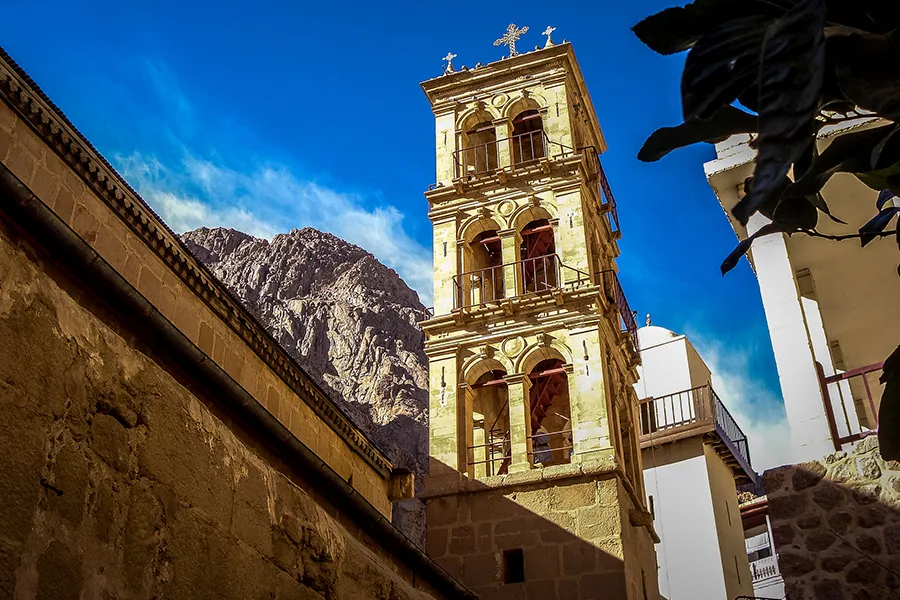
Cairo, Egypt, Apr 19, 2017 / 04:14 pm (CNA/EWTN News).- Gunmen attacked a police checkpoint near an historic Orthodox Christian monastery in Egypt, killing one and wounding four.

The Islamic State group has claimed responsibility, the Associated Press reports.

St. Catherine’s Monastery, located in a remote desert and mountainous area of the South Sinai governorate, was built in the sixth century at the foot of Mount Sinai. It is a UNESCO world heritage site and a popular destination for tourists and visitors to the Red Sea.

Militants ascended onto an elevated hilltop overlooking the police checkpoint several hundred meters outside the monastery. Then they opened fire.

Some of the gunmen were wounded when police returned fire, Egypt’s Interior Ministry said.

The northern Sinai region is under a state of emergency, with near-daily Islamic State militant attacks on police and security forces. The militants are attacking other parts of Egypt and their tactics are believed likely to inflame sectarian tensions and embarrass President Abdel-Fattah el-Sissi.

The Islamic State group has vowed more attacks against Christians in Egypt, the Associated Press says.

Pope Francis will visit the country next week. The attacks have increased fears about security ahead of the visit.

Suicide bombers attacked two Egyptian churches on Palm Sunday, killing 45. The Sinai-based Islamic State affiliate claimed credits for the attacks.

In response, President el-Sissi declared a three-month state of emergency and deployed armed forces to help guard important installations and churches across Egypt.

[…]

Supreme Court appears skeptical of state denying benefits to churches

April 19, 2017 CNA Daily News 0

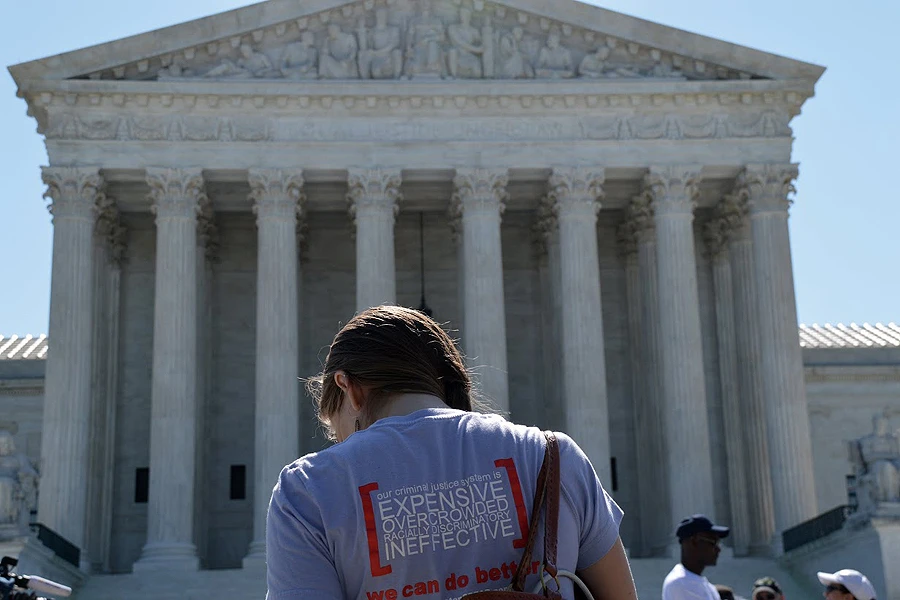
Washington D.C., Apr 19, 2017 / 02:42 pm (CNA/EWTN News).- The Supreme Court on Wednesday heard arguments about whether a state benefit program could exclude churches because of their religious status.

Several justices appeared skeptical of Missouri’s rationale for denying a church preschool access to a reimbursement program intended to encourage safety updates to playground surfaces.

Justices also debated the extent to which public services – including firefighting and security services – can constitutionally be offered to religious organizations.

Justice Elena Kagan stated that “there’s a constitutional principle” for religious institutions to be eligible for certain public programs.

“As long as you’re using the money for playground services, you’re not disentitled from that program because you’re a religious institution doing religious things,” she said of the case at hand. “And I would have thought that that’s a pretty strong principle in our constitutional law.”

The Supreme Court heard oral arguments Wednesday in Trinity Lutheran Church v. Comer, the most significant religious freedom case of this term so far.

At issue is whether a playground owned by a church and operated by its preschool can be denied access to a state benefit program simply because of the church’s religious status. Other properties of non-profits and secular institutions are eligible for the program.

Trinity Lutheran Church Child Learning Center in Columbia, Missouri, applied for the Scrap Tire Surface Material Grant program within the state’s department of natural resources, which would have provided reimbursements for making safety upgrades to its playground surfaces with material from used tires.

The state ultimately denied Trinity Lutheran participation in the program because it is run by Trinity Lutheran Church of Columbia, after the church was initially ranked fifth out of 44 applicants to receive reimbursements. On the state’s list of eligible recipients, the church originally scored higher than the ultimate recipient of the grants, the legal group Alliance Defending Freedom has said.

Missouri’s state constitution forbids taxpayer funding or preferential treatment of churches, an amendment passed at the same time as the federal Blaine Amendment was proposed.

The Blaine Amendment forbade federal funds from going to churches or their schools, and was seen by many as a ban on taxpayer funding of Catholic schools, as the public school system at the time, in the 1870s, was largely Protestant. Other states have similar amendments.

Groups like the American Civil Liberties Union have argued that the amendment is a protection against the unconstitutional government establishment of religion, although the Eighth Circuit said in its ruling that Trinity Lutheran being reimbursed by the state would not be a violation of the Establishment Clause.

The state’s new governor, Eric Greitens (R), recently announced that religious groups will be eligible for grant programs from the natural resources department in the future, although Trinity Lutheran might not be retroactively eligible for its playground grant.

On Wednesday, David Cortman of the legal group Alliance Defending Freedom argued on behalf Trinity Lutheran. He said that the state had conceded its denial of funding was “not facially neutral” and was “based on their religious character,” thus making it “discrimination against religion.”

Inside the Court on Wednesday, the justices pressed Cortman on whether the playground would be used for religious purposes and if that effectively constituted state funding of religious ministry.

Justice Ruth Bader Ginsburg promptly brought up the Court’s 1947 Eberson decision, which said public funding for maintenance of churches or church property was unconstitutional. Cortman replied that the decision also said that churches shouldn’t be deprived of all public benefits.

Justice Sonia Sotomayor said she believes “that this program is part of the religious ministry of this church.” She then asked if the playground surface reimbursement was an establishment of religion if play time at the preschool began with prayer, or if religious ministries took place on the playground.

The church’s case is for a “safe surface,” Cortman replied, and just because the playground might be used for religious purposes does not mean that it should be ineligible for the funds. If a church school receives public funding, that does not mean that it has to “just stop all religion in school,” he said.

The Supreme Court in Locke v. Davey drew a “narrow distinction,” he said, as that case focused on taxpayer funding of education of religious ministers.

Justice Sotomayor pressed Cortman to explain how the church’s free exercise of religion was being unconstitutionally violated, as it would not close its doors just because it had not received a reimbursement for the playground surface.

James Layton represented the state’s natural resources department, arguing in place of the new Missouri attorney general who recused himself in the case. Layton said that the state amendment is rooted in the 1820 Constitution, which was inspired by Thomas Jefferson’s Statute on Religious Freedom from 1786. It was “reenacted” in the latest version of the state’s constitution in 1945.

The state has “concerns” about the church’s eligibility for the program, he said, as a playground resurfacing funded by the state would be a “visible physical improvement on church property.” The church, he added later, admits it “uses the preschool to bring the Gospel to non-members.”

Justice Alito asked him if a Jewish synagogue or a mosque, threatened by vandals, asked for a public security detail, would that be a violation of the state’s constitution. Layton said it would, according to a traditional reading of the constitution.

Justices Stephen Breyer and Kagan followed up, asking him if emergency responses by fire departments or police officers to the school, or public health programs, would be allowed under the state’s constitution.

Layton admitted that wouldn’t be denied, and Breyer then followed up, asking, “If it does not permit a law that pays money out of the treasury for the health of the children in the church, school, or even going to church, how does it permit Missouri to deny money to the same place for helping children not fall in the playground, cut their knees, get tetanus, break a leg, et cetera? What’s the difference?”

Layton countered that the safety reason, and other health reasons, would not meet exceptions for public benefits for churches.

Justice Neil Gorsuch, the newest addition to the Supreme Court, did not ask many questions save for an exchange with Layton over government discrimination against religious groups in “selective” and “general” public programs.

After the arguments, Cortman was optimistic about the reception from the justices.

“I think the theme that came out was what we emphasized in our briefs, and that is if the government is going to open up some sort of a neutral benefit program, then it can’t discriminate against religious organizations simply because of their religious status,” he insisted.

“The government should be religion-blind just like it’s race-blind,” he added. “When the government’s engaging in safety benefit programs, it should want all kids to be safe. It shouldn’t matter what their status is, it shouldn’t matter where they decide to attend school, and I think that’s a principle here that the state violated.”


[…]

Vatican cricket club takes interreligious tournament to Fatima

April 19, 2017 CNA Daily News 0

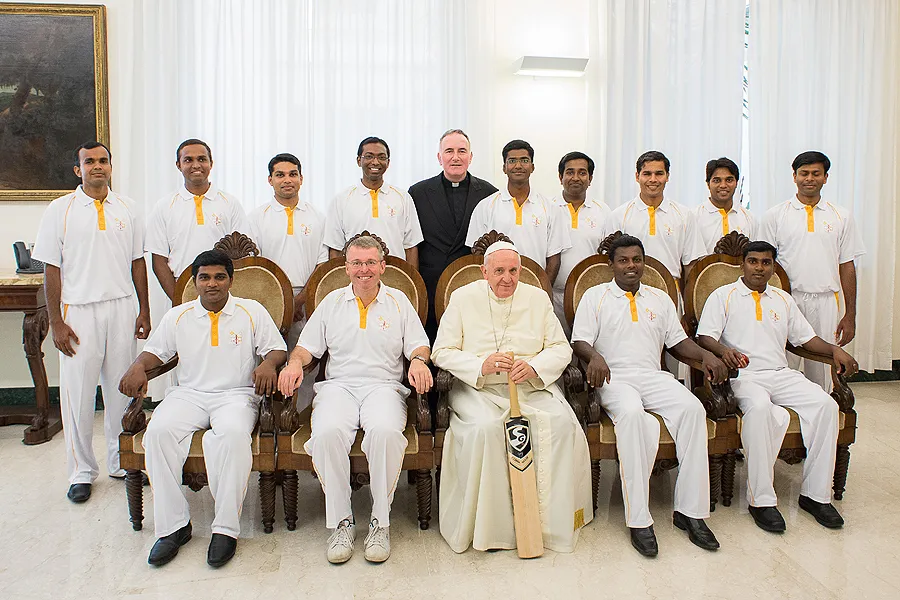
Fatima, Portugal, Apr 19, 2017 / 10:45 am (CNA/EWTN News).- St. Peter’s Cricket Club, the Vatican’s cricket team, is traveling to Fatima April 19-22 for an interreligious tournament ahead of the 100th anniversary of the appearance of Our Lady to three shepherd children in the country.

The team’s third international tour, the tournament will include Muslim, Hindu, and Jewish teams coming from Portugal, Spain, and the United Kingdom.

It takes place just three weeks before the Pope’s pilgrimage to Fatima May 12-13 to join in the centenary celebrations.

Established in 2013, St. Peter’s Cricket Club is made up of priests, deacons, and seminarians currently living and studying in Rome.

Current and past members have hailed from England, India, Sri Lanka, and Pakistan. The team was formed under the Vatican’s Pontifical Council for Culture as a way to creatively engage with people from other Churches, ecclesial communions, and religions.

The first day of the trip will be dedicated to visiting the shrine at Fatima, and the three following to the tournament. The team is hosted by the municipal council and people of Miranda do Corvo, near the historic university city of Coimbra.

The cricket club’s third “Light of Faith Tour,” the first was held in England in 2014. On April 23, 2016 the team played their second cricket match against the Royal Household in Rome to mark Queen Elizabeth II’s 90th birthday.

Their second “Light of Faith Tour” was also held in England, in September 2016.

Pope Francis has frequently praised sports, particularly for their ability to bring people together.

In June 2014, he told a crowd of Italian youth gathered in St. Peter’s Square for a field day event that “Sports in the community can be a great missionary tool, where the Church is close to every person to help them become better and to meet Jesus Christ.”

And in October 2016, he told participants in an international conference on sports at the Vatican that the beauty and joy found in sports, whether playing or watching, is something that benefits and unites everyone, regardless of religion, ethnic group, nationality, or disability.

“Sport is a human activity of great value, able to enrich people’s lives,” he said. “As far as the Catholic Church is concerned, she is working in the world of sport to bring the joy of the Gospel, the inclusive and unconditional love of God for all human beings.”

[…]

Pope: Easter is about the gift of Christianity – not us

April 19, 2017 CNA Daily News 0

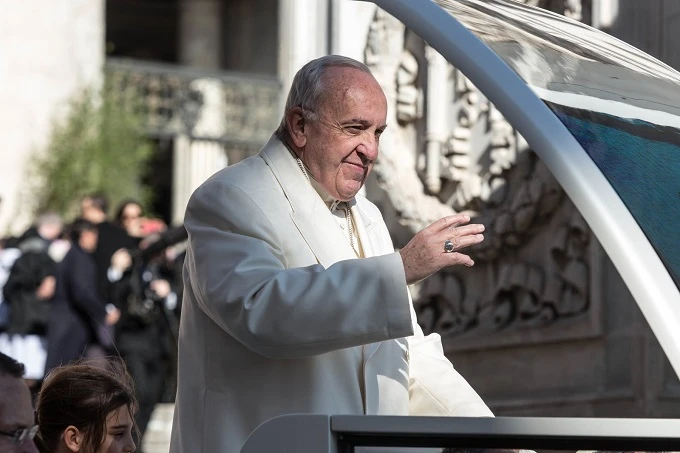
Vatican City, Apr 19, 2017 / 06:05 am (CNA/EWTN News).- As the Church jumps into the Easter season, Pope Francis Wednesday offered a reflection on Christ’s Resurrection and the start of Christianity, saying it’s not about us and what we do, but what the Lord has done for us.

“(Christianity) is not so much our search for God, but rather God’s search for us. How beautiful to think that Christianity, essentially, is this!”

Jesus, the Pope said April 19, “has taken us, has seized us, has conquered us in order to not leave us anymore.”

In his catechesis for his first general audience of the Easter season, Francis spoke about the “grace” and “surprise” found in our Christian faith, saying we need hearts able to wonder, because hearts that are closed-off cannot understand the truth of what Christianity is.

Even though we are sinners and might look at our lives realizing how many times we have failed to live out our good intentions, we can follow the example of the men and women in the Gospel on Easter morning, he said.

“We can do as those people spoken of in the Gospel: go to the tomb of Christ, see the large upturned stone and reflect that God is building for me, for all of us, an unforeseen future.”

And more, we can all go into the tomb of our hearts, he said, and see how God is able to transform death into life.

“Here is happiness, here is joy and life where everyone thought there was only sadness, defeat and darkness,” Francis said, adding that “God raises his most beautiful flowers in the midst of the most arid stones.”

Pope Francis then reflected on the start of Christianity following Christ’s death and resurrection, emphasizing that these events aren’t just an “ideology” or a “philosophical” belief, but real events witnessed by Jesus’ disciples.

These, he said, are the facts: “he died, was buried, is risen and has appeared. That is, Jesus is alive! This is the core of the Christian message.”

If facts had been different and Jesus hadn’t risen from the dead, but only died for us, we would perhaps have an example of heroism or supreme dedication, but it could not be the source of our faith, he said.

Instead, our faith is born out of Christ’s resurrection, the Pope said, noting that this is true even for the faith of St. Paul, who was no “altar boy,” but actually persecuted Christians and the Church.

“And the persecutor becomes an apostle because?” he asked, explaining that the reason is because he saw the Risen Christ on the road to Damascus.

“This is the foundation of Paul’s faith, like the faith of the other Apostles, like the faith of the Church, of our faith,” he said. “Because I have seen Jesus alive! I have seen the risen Jesus Christ!”

Francis closed his audience saying that Christianity comes not from death, but from God’s love for us in defeating our “bitter enemy.”

“God is bigger than anything, and you only need one lite candle to overcome the darkest of nights,” he said. “Paul cries, echoing the prophets: ‘Where, O death, is your victory? Where, O death, is your sting?’”

“In these days of Easter, let us carry this cry in our hearts, and if they ask us for the reason for our smile and our patient sharing, then we can respond that Jesus is still here, he continues to live in the midst of us. Jesus is alive!”

[…]

The Catholic Church still cares about Latin

April 19, 2017 CNA Daily News 0

Vatican City, Apr 19, 2017 / 06:01 am (CNA/EWTN News).- Existing in some form since several hundred years before Christ, the Latin language seems like an unlikely subject to still be generating brand new research, especially among young scholars.

Neve… […]