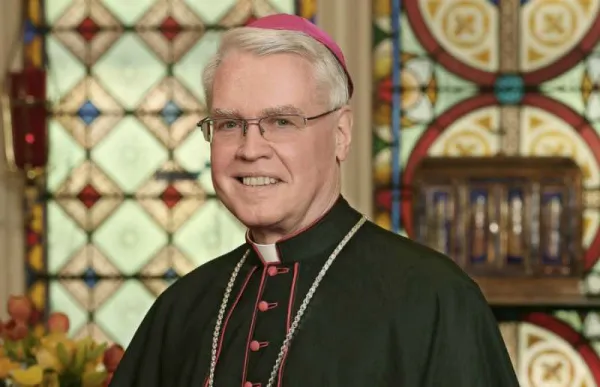
Bishops urge mercy on World Day Against the Death Penalty

October 10, 2019 CNA Daily News 5

Washington D.C., Oct 10, 2019 / 03:00 pm (CNA).- The death penalty is outdated and promotes a culture of violence, three bishops said during a livestream conversation on Oct. 10, marked as World Day Against the Death Penalty. 

Archbishops Paul Coakley of Oklahoma City and Wilton Gregory of Washington were joined by Bishop Frank DeWane of Venice (FL) for the roundtable discussion facilitated by Catholic News Service. DeWane is the current chairman of the USCCB’s domestic justice committee, and will be succeeded by Coakley in a few weeks’ time. 

“There’s no question that we are living in an age where violence has captured the hearts and minds of a lot of people,” said Gregory, offering that social media in particular has put “despicable” human carnage on display. 

On Wednesday, the day before the livestream, an anti-Semitic attack on a synagogue in Germany resulted in the murder of two people. The attack was broadcast over the streaming site Twitch. 

“What the Church wants us to understand is that taking a life, even the life of one who may have been guilty of a horrendous crime, is itself a continuation of violence,” said the Washington archbishop.  

“It makes us violent to do violence against another human being” regardless of the circumstances, Gregory said. 

October is also Respect Life Month, during which the Church makes special efforts to promote its teachings on the sanctity of life, something Coakley said is “foundational” to the Church’s teachings on human dignity and which, he emphasized, is not granted by a government, but endowed by the creator.

The Church’s positions are “very consistent in affirming human life and human dignity at every stage,” he said.

DeWane concurred with Coakley, saying that throughout the entirety of a person’s life, “we have to see that life is sacred.”

Catholics, said DeWane, have a moral obligation to “say something” when life is not being respected, especially in instances that involve people who cannot speak for themselves. 

Coakley pointed out that there is another side of the death penalty debate that is often forgotten: the victims of violent crime and their surviving friends and relatives. While it is important to champion the rights of accused, and even convicted criminals, Coakley stressed, it is important of acknowledge that some survivors–as well as those in the community–want to see the death penalty carried out in as a form of justice. Their desire for justice, Coakley said, cannot be ignored, even while accepting that the death penalty is not the answer.

“I think in our conversations about the death penalty, even though we’re speaking out in favor of abolition of the death penalty, we have to affirm and acknowledge–not just give lip service–to the suffering of victims as well,” said Coakley, noting that his archdiocese is home to the deadliest act of domestic terrorism in this country’s history. 

As a result of the 1995 Oklahoma City bombing, Coakley said that many within his archdiocese remain supportive of capital punishment. 

Speaking to CNA after the discussion, Coakley developed his point. 

“Revenge is not the same as justice,” said Coakley. “And as even William Shakespeare said, ‘mercy seasons justice,’ I think just as many people who maybe see the perpetrator of a violent crime executed, would acknowledge that it did not bring them the release and the relief and the peace that they expected that it might.”

During the roundtable, DeWane also questioned the common assertion that executions bring any sense of relief to the families of victims. Instead, he said, the act of taking a life in an execution hurts society as a whole, while observing that there is little evidence that the death penalty serves as a deterrent against crimes. 

Gregory also highlighted the many cases in which a person is released from death row having been exonerated by either new evidence or modern DNA testing.  

“With the death penalty, there are no re-tries. It concludes and ends a life that may have been wrongly [convicted],” Gregory said. The Washington archbishop went on to point out the significant racial disparity in the application of the death penalty in the United States.

At the same time, Gregory said that favoring the abolition of the death penalty does not mean any lessening of the requirement to keep society safe. The choice, he said was not between killing or releasing the most violent offenders. Instead, “our society has the capacity to take violent personalities and put them away so they don’t harm others,” he said.  

“The Gospel calls us to mercy. Mercy is never cruel,” said Gregory. 

“I think our Church has to be a voice that is faithful to the call of the Gospel, which calls us to love our enemy and pray for those who persecute us,” Coakley told CNA after the livestream. 

“I think that’s incumbent upon us — because we have to affirm the dignity of human life, that every person has been created in the image and likeness of God–even for the person who was guilty of heinous crimes. They don’t forfeit their human dignity as a result of their criminal activity.” 

The World Day Against the Death Penalty was first observed in 2003. This year, the theme is “Children, Unseen Victims,” which is focused on increasing awareness of the children whose parents were executed or have been sentenced to death.

[…]

A day in the park for L.A.’s foster families

October 10, 2019 CNA Daily News 0

Los Angeles, Calif., Oct 10, 2019 / 01:01 pm (CNA).- The Archdiocese of Los Angeles is hosting a day in the park to not only celebrate foster families throughout the archdiocese but to get to know these “heroes,” who are often unknown among the Catholic community.

“To be a foster parent is really to be a hero, honestly,” said Kathleen Domingo, the archdiocese’s senior director of the Office of Life, Justice, and Peace.
 
“We know for sure that there are thousands of Catholic families in our parishes and in our schools who are fostering; we just don’t always know who they are. Part of the reason that we are doing this event is to help them come out of the woodwork a little bit so we can get to know them and find out better ways to support them.”

The event is titled “Catholics Love Foster” and is part of the archdiocese’s march for life organization, OneLife LA. It will take place Oct. 13., beginning a Mass said by Archbishop Jose Gomez.

Afterward, attendees will walk to LA State Historic Park, where there will be music, food, and games. There will also be 20 organizations with giveaways for kids and resources for foster parents.

According to Domingo, the event will be catered for free by a few local vendors, who will prepare enough food for 1,000 people.

Domingo said lots of Catholics in the archdiocese are foster parents, but these families are perhaps unknown to the parish community or their pastor. She said that since the archdiocese revamped its foster care efforts two years ago, parishioners have loved the idea but do not know who these families are or how to support them.

“A number of different parishes we have been working with told us that they are happy to have foster agencies come and speak and that they are happy to make these introductions… [However], they really felt like they wanted to do more for the families,” she said.

“They know that families are going through the process and they can tell sometimes when some families … come with kids they didn’t have before … but they didn’t always know who they were or they didn’t always know if it would be okay if they [approached them].”

She said fostering needs extra support because it’s a 24/7 job with kids who face additional challenges. She said, very often, foster children come with almost nothing – sometimes only a garbage bag full of clothes – and experience instability, affecting mental health and school. She said the kids may have also faced abuses and court pressures.

“Because many of them have been through times of trauma in their young lives, they may come with some more needs where they may need some additional counseling or some therapy,” she said.

“What I hear from foster families is even just that extra help with tutoring and making sure that their kids have extra support in the classroom.”

She said the archdiocese will help connect foster families to a greater support system in the Church. She said numerous parishioners, who may not have foster kids themselves, have offered to provide physical aid like clothes, food, or daycare. She also stressed the spiritual support of a praying community.

“[Parishioners] loved doing this work to promote fostering, but, so often, they aren’t aware of who in the community is actually fostering and they would love to provide traditional support,” she said.

“[We want to] find out how can the parish can support you, how can we support your kids, how can we integrate them better and reach out in love to them.”

Daria Ongsing, a 53-year-old grandmother, and her husband Virgilio will be attending the event. This couple was approved to be foster parents in July, but they are not new to foster care.

Around five years ago, she and her husband took in the children of their daughter, who had been struggling with drug addiction and had her kids confiscated by Child Services. After two and a half years, her daughter was able to get her children back.

She told CNA that the experience awoke a desire within her to help other people through foster care. Then last February, the couple went on a pilgrimage to Cebu. Once they returned, they saw flyers on their back door for a foster care orientation at the parish.

“There were flyers in the back, for Foster ALL had come to our church to do like an orientation. I just felt in my heart again, look, God is calling us to this,” she said. 

After the couple was approved, the Virgilios received four siblings into their home for a few days at the beginning of August. Later that month, the family took in Bryant, who turned five in September, and Bri-Asia, who will be turning seven in December. The two siblings are still at her house and have become a source of joy, she said.

Ongsing said the process has been a struggle at times. She expressed hope to meet more Catholics at the event who may be a source of support and that it inspires other parents to take on this ministry which has a great need.

She is currently working for Kaiser Permanente as a certified ophthalmic technician, but she plans to enter into early retirement within the next few years and take on fostering full-time.

“The [fostering] need is so great. It’s crazy. So my plan is to retire young in the next year or two and certainly give it even more than I can do now,” she said.

“It’s quite challenging, but it’s very rewarding. I keep praying and asking God to just get us to do the best thing for these kids while they need us,” she further added. “I’m just trying to share a little bit of our blessings.”

Domingo told CNA that the Catholic Church in California has been shut out of the foster system because they will not place children with same-sex couples. She said the archdiocese’s Catholic Charity has not acted as a foster care agency for nearly 20 years.

“When Catholic Charities got out of the business of doing foster care, what happened is nobody picked it up, nobody in the Church was tasked with working on foster issues. What I’ve come to realize is that that is a similar story in most dioceses,” she said.

The Archdiocese of Los Angeles decided to ramp up its foster care efforts during the second OneLife event, after Nick Vuljicic, a motivational speaker born with no arms and no legs, encouraged the archdiocese to act “pro-life” to the unborn as well as those already born, like foster kids. Domingo said, at the time, LA County had an estimated 30,000 foster children.

Since then, Domingo has spoken to numerous parishes to booster fostering efforts. She said, although the archdiocese can no longer place kids into foster care, parishes in the area will host agencies to come talk to the laity.

Domingo said foster care is a “bridge-building topic” and supported by a variety of different people and groups. She also said good foster care is a solution to many issues in society.

“You can talk about fostering as a preventative for human trafficking, you can talk about it for keeping young adults off the streets, … you can talk about it in terms of helping birth parents, … who often get cleaned up and get prepared to accept their children back.”

“What we find is that when are talking about fostering and do these kinds of events, we are bringing people from different perspectives together to say we need to do something wonderful for these children and their families.”

[…]

Vatican: Pope Francis ‘never said’ what Scalfari reported about divinity of Jesus Christ

October 10, 2019 CNA Daily News 3

Vatican City, Oct 10, 2019 / 07:17 am (CNA).- A Vatican spokesman denied directly on Thursday the report of an Italian journalist who wrote that that Pope Francis said he did not believe that Jesus Christ was divine.

“The Holy Father never said what Scalfari wrote,” Vatican communications head Paolo Ruffini said at an Oct. 10 press conference, adding that “both the quoted remarks and the free reconstruction and interpretation by Dr. Scalfari of the conversations, which go back to more than two years ago, cannot be considered a faithful account of what was said by the pope.”

“That will be found rather throughout the Church’s magisterium and Pope Francis’ own, on Jesus: true God and true man,” Ruffini added.

The statement came in response to an Oct. 9 column in La Repubblica, the newspaper founded by Scalfari, in which the 95-year-old self-declared atheist said that “Pope Francis conceives Christ as Jesus of Nazareth, a man, not God incarnate.”

Ruffini’s remarks followed an Oct. 9 statement from Matteo Bruni, the director of the Holy See’s press office.

“As already stated on other occasions, the words that Dr. Eugenio Scalfari attributes in quotation marks to the Holy Father during talks with him cannot be considered a faithful account of what was actually said but represent a personal and free interpretation of what he heard, as appears completely evident from what is written today regarding the divinity of Jesus Christ,” Bruni said.

Some commentators responded to Bruni’s initial statement with criticism; saying the statement was too vague or was unclear. Ruffini’s remarks seemed intended to respond to that criticism.
Scalfari’s column did not claim that he had recently interviewed the pontiff, only saying that this was a topic he had discussed with Pope Francis at some time in the past.

Scalfari mentioned examples in Scriptures in which Christ prayed, among them his agony in the Garden of Gethsemane, to support his thesis that Jesus Christ was not divine.

He wrote that when he raised those points to Pope Francis, the pope told him: “‘They are the definite proof that Jesus of Nazareth, once he became a man, even if he was a man of exceptional virtue, was not a God.’”

Pope Francis has made reference to Christ’s divinity frequently.

In Evangelli Gaudium, the pope speaks of the “divine life” of Jesus.

In his Dec. 24, 2013 homily, the pope said that “The grace which was revealed in our world is Jesus, born of the Virgin Mary, true man and true God…In him was revealed the grace, the mercy, and the tender love of the Father: Jesus is Love incarnate. He is not simply a teacher of wisdom, he is not an ideal for which we strive while knowing that we are hopelessly distant from it. He is the meaning of life and history, who has pitched his tent in our midst.”

Speaking of Jesus last October, the pope said “God chooses an uncomfortable throne, the cross, from which he reigns giving his life.”

Scalfari, who famously does not take notes during interviews has misrepresented Pope Francis in the past.

In 2018, he claimed the pope denied the existence of hell, and the Vatican subsequently said that the pope had not granted an interview, and that the journalist had inaccurately represented a conversation between the men during a private Easter visit.

“What is reported by the author in today’s article is the result of his reconstruction, in which the literal words pronounced by the Pope are not quoted. No quotation of the aforementioned article must therefore be considered as a faithful transcription of the words of the Holy Father,” a Vatican statement said in March 2018.

The first time Scalfari reported that Pope Francis had made comments denying the existence of hell was in 2015. The Vatican dismissed that reporting as well.

In November 2013, following intense controversy over quotes the journalist had attributed to Francis, Scalfari admitted that at least some of the words he had published a month prior “were not shared by the Pope himself.”
 

[…]

Pope accepts resignation of NY auxiliary under investigation for abuse

October 10, 2019 CNA Daily News 1

Vatican City, Oct 10, 2019 / 04:55 am (CNA).- Pope Francis accepted Thursday the resignation of Bishop John Jenik as an auxiliary bishop of the Archdiocese of New York and appointed two New York priests as auxiliaries of the archdiocese.

Jenik, 75, was removed from ministry last year after the archdiocese found credible an accusation of sexual abuse against him. Jenik, who has been an auxiliary of New York since 2014, maintains his innocence.

Neither the Vatican nor the Archdiocese of New York have announced the results of a preliminary investigation into the abuse allegations against Jenik.

Jenik’s alleged victim, Michael Meenan, 53, said last November that Jenik cultivated an inappropriate relationship with him during the 1980s that involved dozens of trips upstate to Jenik’s country house, where Jenik allegedly groped him in bed.

Meenan’s allegation was reviewed by the Lay Review Board of the Archdiocese of New York, which concluded “the evidence is sufficient to find the allegation credible and substantiated.”

Jenik, who has served as pastor at Our Lady of Refuge parish since 1985, wrote in an Oct. 29 letter to his parishioners that he continues “to steadfastly deny that I have ever abused anyone at any time.”

Jenik’s case is being reviewed by the Vatican, most likely at the Congregation for the Doctrine of the Faith, sources says, before being passed to Pope Francis for judgment.

Pope Francis Oct. 10 also appointed two New York priests, Fr. Edmund J. Whalen and Fr. Gerardo J. Colacicco, to serve as auxiliary bishops in the archdiocese.

Whalen, 61, has been the vicar of clergy for New York since January. He was previously dean of Monsignor Farrell High School on Staten Island for eight years.

From Staten Island, Whalen studied at Cathedral College in Douglaston, New York and at the Pontifical North American College and Gregorian University in Rome. He later received a doctorate in moral theology from the Alfonsianum, a graduate school of theology in Rome. He was ordained a priest of New York in 1984.

Fr. Gerardo J. Colacicco, 64, is from Poughkeepsie, New York. He attended St. Joseph’s Seminary in Yonkers and has a license in canon law from Rome’s Angelicum university.

He was ordained a priest in 1982. In addition to serving in parishes, Colacicco has worked in the archdiocesan tribunal as a defender of the bond and a judge. Since 2015, he has been pastor of St. Joseph-Immaculate Conception Parish in Millbrook.


[…]