Indonesian Muslim party warns Erdogan could spark global ‘clash of civilizations’
July 24, 2020 CNA Daily News 1

CNA Staff, Jul 24, 2020 / 01:00 pm (CNA).- An Islamic political party in Indonesia said Tuesday that Turkey’s President Recep Tayyip Erdogan could spark a civilizational clash because of his calls for an Islamic “reawakening” amid the establishment of the Hagia Sophia as a mosque.

A recent tweet from Erdogan “summoned Muslims ‘in every corner of the earth’ to follow Turkey’s lead in reawakening the Islamic nation, or ummah, which was largely united under the political and military leadership of a caliph from the 7th century CE until the dissolution of the Ottoman Caliphate in 1924,” Indonesia’s National Awakening Party said in a July 21 statement.

Recent statements from the Turkish president “are attacking the rules-based international order; inflaming emotions ‘wherever Muslims dwell throughout the earth;’ and threaten to
rekindle a clash of civilizations that afflicted humanity for nearly 1300 years, along a fault line stretching ‘from Bukhara (in Central Asia) to al-Andalus (Spain),’” the statement added.

While “President Erdogan has defended the conversion of Hagia Sofia into a mosque by citing Turkey’s right, as a sovereign nation state, to do as it pleases with the former Orthodox Christian cathedral,” the effects of the president’s call for an Islamic reawakening “extend far beyond Turkey’s borders and threaten both Muslim- majority and non-Muslim nations worldwide,” the National Awakening Party said.

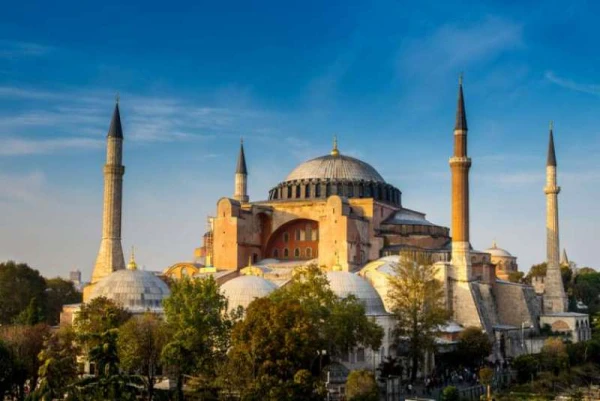
Hagia Sophia, the church of “Holy Wisdom,” was built in the year 537 and served as the cathedral of the Patriarch of Constantinople. It stood as the largest known building in the world and the largest Christian church, for a period of time.

In the year 1453, Turkish armies sacked Constantinople and the church was turned into a mosque. In 1934, the cabinet of then-Turkish leader Mustafa Kemal Ataturk—head of a secularist government—converted the mosque into a museum and opened it to visitors from around the world.

On July 2, a Turkish court ruled that the 1934 conversion of Hagia Sophia from a mosque to a museum was unlawful. The decision was announced July 10, and Erdogan subsequently announced that Hagia Sophia would be converted back into a mosque.

Erdogan made his announcement in a lengthy July speech that was littered with historical, geographical, and religious references to the old Islamic world, connecting Hagia Sophia’s reconversion to a much-broader “Islamic renaissance.”

In his speech, the Turkish leader predicted that Hagia Sophia’s reconversion would herald the liberation of al-Aqsa mosque on the Temple Mount in the old city of Jerusalem, the third-holiest site in Islam.

Dr. Elizabeth Prodromou, a former vice chair on the U.S. Commission on International Religious Freedom, told CNA July 17 that the president’s speech aimed to “justify what he [Erdogan] sees as a kind of religious destiny, and also a geopolitical model for Turkey’s revisionism and expansionism.”

Erdogan specifically chose these “historical figures” to promote the depth of Turkey’s history and to “encompass Turkic tribes from Central Asia into the Ottoman Empire,” she said.

It was a speech “heralding the liberation of the full Muslim world,” Prodromou said.

Christian and political leaders around the world condemned the decision to reconvert Hagia Sophia. Orthodox and Catholic leaders have declared July 24 a day of mourning for the decision.

For its part, the National Awakening Party said that “Erdogan’s statements were swiftly endorsed by the Muslim Brotherhood, Iran and a wide range of Islamic supremacists worldwide, including Indonesian Muslims who seek to transform the multi-religious and pluralistic Republic of Indonesia into an Islamic State or caliphate.”

“The Islamic world is in the midst of a rapidly metastasizing crisis, with no apparent sign of remission. Among the most obvious manifestations of this crisis are the brutal conflicts now raging across a huge swath of territory inhabited by Muslims, from Africa and the Middle East to the borders of India; rampant social turbulence throughout the Islamic world; the unchecked spread of religious extremism and terror; and a rising tide of Islamophobia among non-Muslim populations, in direct response to these developments,” the party said.

That crisis, the statement added, has led to humanitarian problems in many parts of the world, and increased Islamic militant radicalization.

“In the midst of these circumstances, it is the height of irresponsibility for Recep Erdogan to further inflame Muslim emotions in pursuit of his domestic political agenda and to serve as a cover for his violation of international norms—by drilling for natural gas within the territorial waters of Cyprus and Greece; supporting al-Nusra (an affiliate of al-Qaeda) in Syria; and intervening in the Libyan conflict on behalf of the Islamist-dominated interim government—in an effort to enhance Turkish regional power and assert maritime rights in the eastern Mediterranean,” the party said.

The National Awakening Party was founded in Indonesia in 1999, and holds 47 of 560 seats in the country’s lower legislative house. It is generally identified as a centrist party, and is aligned with centrist Christian Democrat parties in Europe.

Las week, Indonesian Sheikh Yahya Cholil Staquf, leader of the largest independent Muslim organization in the world, said that “campaigns of mass killing, displacement, and terror that threaten to break the already badly frayed bonds of trust that make a shared communal life between Muslims and non-Muslims possible.”

Staquf is the general secretary of Indonesia’s Nahdlatul Ulama, the world’s largest Muslim organization with more than 90 million followers. He has also co-founded a global movement promoting a “humanitarian Islam” that shuns the ideas of a caliphate, Sharia law, and “kafir,” or infidels.

In a July 7 essay in Public Discourse, he called for “a global strategy to develop a new Islamic orthodoxy that reflects the actual circumstances of the modern world in which Muslims must live and practice their faith.”


[…]

Columbus statues ‘temporarily removed’ from Chicago parks

July 24, 2020 CNA Daily News 1

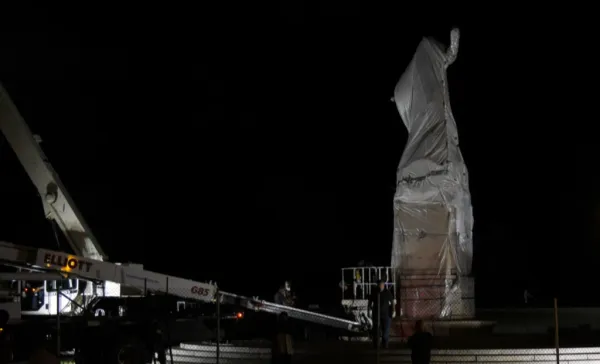
CNA Staff, Jul 24, 2020 / 12:25 pm (CNA).- Two statues of Christopher Columbus in Chicago parks were removed Friday following demonstrations and attempts to pull down one of the monuments.

The office of Chicago mayor Lori Lightfoot announced July 24 that the city had “temporarily removed the Christopher Columbus statues in Grant Park and Arrigo Park until further notice. This action was taken after consultation with various stakeholders. It comes in response to demonstrations that became unsafe for both protesters and police, as well as efforts by individuals to independently pull the Grant Park statue down in an extremely dangerous manner.”

It said the move “is about an effort to protect public safety and to preserve a safe space for an inclusive and democratic public dialogue about our city’s symbols. In addition, our public safety resources must be concentrated where they are most needed throughout the city, and particularly in our South and West Side communities.”

The city will be assessing each of its “monuments, memorials, and murals” and will “develop a framework for creating a public dialogue to determine how we elevate our city’s history and diversity.”

The mayor’s office emphasized that “this is not about a single statue or mural, but how we create a platform to channel our city’s dynamic civic energy to collaboratively, purposefully and peacefully reflect our values as Chicagoans and uplift the stories of all of our diverse city’s residents, particularly when it comes to the permanent memorialization of our shared heritage.”

The statues were removed in the early morning, between 3:00 and 5:30 am, the AP reported.

Both the statues had been vandalized recently, protesters had violently clashed with police in Grant Park.

There has been a spate of vandal attacks on statues of historic figures and a wave of critical commentary on American monuments. Vandals particularly targeted statues of Confederate leaders, but also moved against statues of Ulysses S. Grant and St. Junipero Serra. Catholic churches and statues have also come under attack.

The protests were originally launched in response to the death of Minnesotan George Floyd, a black man, while he was being detained by Minneapolis police

Columbus has long been an American Catholic and Italian-American folk hero. They have seen his pioneering voyage from Europe as a way of validating their presence in a sometimes hostile majority-Protestant country and as the means by which Christianity reached the New World.

He was depicted as a symbol of exploration and discovery, critical for launching the encounter between Europe and the Americas. He was also a symbol of immigrants, and honors for Columbus drew opposition from nativist and anti-Catholic groups such as the Ku Klux Klan.

While Columbus never set foot in North America, the District of Columbia bears his name and he is the namesake of the Knights of Columbus, now the largest Catholic men’s fraternal organization in the world.

In recent decades, Columbus has drawn critical coverage. Some blame him for the launch of the transatlantic slave trade, and fault him for the enslavement and other mistreatment of some Native Americans under his command. Some critics blame him for the subsequent sufferings of Native Americans under Spanish rule, or under the rule of European colonists generally.

A statue of Columbus in Philadelphia’s Marconi Plaza has also been targeted for removal by activists. That monument has been surrounded by a makeshift wooden box since June to protect it from being defaced.

In June a Columbus statue in Boston’s historically Italian North End was beheaded, and one in St. Paul was toppled.

The Worcester city council voted July 21 to shelve a proposal that would have ordered the removal of a Columbus statue located outside the city’s Union Station, citing the need to respect the local Italian community.

And in June, a Catholic high school in Wisconsin said it not change its name from “Columbus Catholic High School” after a petition from alumni and other members of the community requested the change. The school was named for the Knights of Columbus, who funded its construction.

Carol Delaney, an emerita professor of anthropology at Stanford University and author of “Columbus and the Quest for Jerusalem,” told CNA in 2017 that a popular current narrative around Columbus is tarred by bad history.

“They’re blaming Columbus for the things he didn’t do. It was mostly the people who came after, the settlers,” Delaney said. “He’s been terribly maligned.”

She said Columbus initially had a favorable impression of many of the Native Americans he met and instructed the men under his command not to abuse them but to trade with them; he also punished some of his own men who committed crimes against the natives.

Delaney acknowledged that some Native Americans were sent to Spain as slaves or conscripted into hard labor at the time Columbus had responsibility for the region, but she attributed this mistreatment to his substitutes acting in his absence.

The explorer had good relations with a Native American leader on Hispaniola. There, a Taino chief named Guacanagari aided Columbus after the wreck of his main ship the Santa Maria. Columbus adopted one of his sons, who took the name of Columbus’ natural son, Diego, and accompanied Columbus on his final three voyages.

The Knights of Columbus have said that their namesake “has frequently been falsely blamed for the actions of those who came after him and is the victim of horrific slanders concerning his conduct.”

Leo XIII wrote an encylical marking the Columban quadricentennial in 1892, reflecting on Columbus’ desire to spread the faith. In Quarto abeunte saeculo, the pope wrote that Columbus “resolved to go before and prepare the ways for the Gospel” by his exploration.

“When [Columbus] learned from the lessons of astronomy and the record of the ancients, that there were great tracts of land lying towards the West … he saw in spirit a mighty multitude, cloaked in miserable darkness, given over to evil rites, and the superstitious worship of vain gods. Miserable it is to live in a barbarous state and with savage manners: but more miserable to lack the knowledge of that which is highest, and to dwell in ignorance of the one true God. Considering these things, therefore, in his mind, he sought first of all to extend the Christian name and the benefits of Christian charity to the West,” Leo declared.

Regarding the recent controversy over Columbus, Delaney told CNA that Columbus is being blamed “for things he did not do,” including the history of slavery in the U.S.

[…]

Analysis: The Vatican and China Part III, Taiwan

July 24, 2020 CNA Daily News 0

Washington, D.C. Newsroom, Jul 24, 2020 / 06:00 am (CNA).- Part 3 of a three part series examining the situation of the Church in China. Part 1 examined the Church on the mainland, Part 2 examined the situation in Hong Kong.

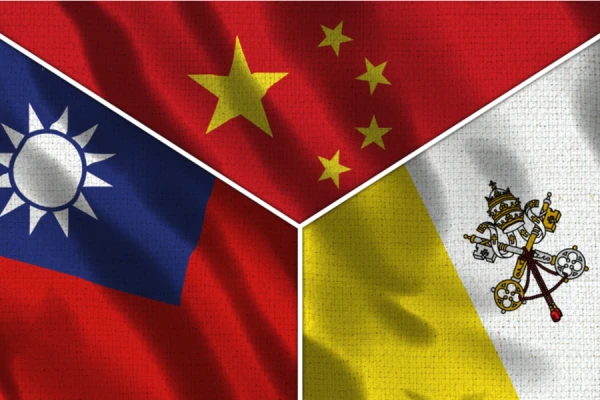
With negotiations ongoing for an extension of the 2018 Vatican-China deal, the fate of Vatican-Taiwan relations may prove inextricable from the future of the deal – and of the Church in China.

When the 2018 deal was signed, ceding some control over episcopal appointments to the Communist Party, the Holy See stressed that it was a “pastoral” not “political” agreement, aimed at bringing together the underground Church loyal to Rome and the communist-controlled, schismatic Chinese Patriotic Catholic Association (CPCA). 

But the “pastoral” split among China’s Catholics is rooted in the diplomatic split between Communist China and the Holy See. While the Vatican may insist its goals are purely ecclesiastical, the Chinese government is unlikely to make such a distinction. And with an extension of the deal under discussion, many are now asking if the Holy See is preparing to accept recognizing “one China” as the price of a unified Church.

The Holy See has recognized the government of Taiwan, officially the Republic of China, since 1942, while the Communist People’s Republic of China has had control of the mainland since the conclusion of the Chinese civil war in 1949. While the Church has maintained an embassy in Taiwan since then, it has had no official diplomatic presence on the mainland since 1951, when it was officially expelled – creating the split between the CPCA and the underground Church.

The communist government has always made claim to Taiwan as a rebel province, insisting that there is only one China, and one Chinese government. Isolating Taiwan and curtailing international recognition of it as a sovereign democratic nation was, and remains, a central foreign policy priority.

China succeeded in getting the United Nations to cease recognition of the Taiwanese government in 1971, and since that time the vast majority of member states have severed official ties, often as a condition of increased aid from or trade with China. Taiwan has lost five diplomatic allies since 2016, with developing nations such as El Salvador, Panama, and the Dominican Republic cutting ties under pressure from Beijing.

Although its embassy in Taipei has been led by a chargé d’affairs, not a full ambassador, since 1971, today the Holy See remains the last European government, and the most prominent international body, to recognize Taiwan.

Ever since the 2018 agreement was signed, China and Vatican watchers have waited to see if there would be a further shift in the Vatican’s China diplomacy, and the signs, while subtle, have been there to be seen.

In March 2018, the Vatican-China deal was under negotiations and widely discussed in the media. Taiwan’s Archbishop John Hung Shan-chuan of Taipei voiced his own opinion, saying Taiwan did not anticipate that the Holy See and mainland China would establish diplomatic relations, because to do so requires sharing “common values with each other.”

“The values the Vatican holds are different from those of the Chinese Communist Party. Building ties with the Vatican requires values including freedom and democracy,” he said at the time.

Yet, since then, overt support for these values from Rome has been scant regarding China. The Vatican has not commented on the more than 1 million Uyghurs interned in concentration camps, subject to forced sterilizations, torture, and anti-religious indoctrination. Nor has it spoken publicly on the continued persecution of Christians across the mainland, including the harassment, arrest, and detention of faithful Catholic bishops.

Instead, Cardinal Pietro Parolin has praised Chinese president Xi Jinping’s campaign of “sinicization” of religion and culture in the country, saying it relates to the Catholic concept of inculturation “without confusion and without opposition.”

At the same time, the Chinese government has launched a crackdown on civil liberties in Hong Kong, first in response to protests against a 2019 law to authorize extradition to the mainland, and more recently following the imposition of sweeping new “national security” measures on the supposedly self-governing territory.

At the beginning of the year, Taiwan’s president, Tsai Ing-wen, wrote to Pope Francis in response to his message for the 2020 World Day of Peace. The president used her letter to explain the parallels between Chinese attitude to, and actions against Hong Kong and Taiwan.

“I am in complete accord with your statement that walking the path of peace requires us to set aside every act of violence in thought, word and deed, whether against our neighbors or against God’s creation,” Tsai wrote to Francis in January, as she detailed a list of China’s actions that she said constitute “abuses of power” in Hong Kong, the persecution of religious believers on the mainland, and its aggression toward Taiwan.

“The crux of the issue is that China refuses to relinquish its desire to dominate Taiwan. It continues to undermine Taiwan’s democracy, freedom, and human rights with threats of military force and the implementation of disinformation campaigns, cyberattacks, and diplomatic maneuvers.”

Yet, as negotiations with the Communist government continue, the diplomatic discourse between the Holy See and Taiwan appears distinctly one-sided. 

Amid the COVID-19 pandemic, the Holy See was the only diplomatic ally of Taiwan which did not make an appeal to allow Taiwan to participate in the World Health Organization’s assembly meetings. Taiwan’s Ministry of Foreign Affairs said in May that the Vatican would voice its support for Taiwan through other channels.

Earlier this month, the Hong Kong newspaper South China Morning Post quoted a Vatican source saying that the Holy See could even move its embassy from Taiwan to the mainland.

“Taiwan should not be offended if the embassy in Taipei is moved back to its original address in Beijing,” the Vatican source was quoted saying.

While such a move would be seen by many observers as a dramatic diplomatic coup for Beijing, Taiwan’s newly installed Archbishop Thomas An-Zu Chung downplayed the significance of the possibility, telling the Morning Post that the Taiwan mission “should be maintained” even if the official Vatican embassy is moved to Beijing.

Such a move “could happen soon if the mainland Chinese government is more open-minded and receptive towards the Roman Catholic Church,” Chung said, adding that “in reality, the Sino-Vatican agreement has not had an actual impact on Taiwan’s relationship with the Vatican.”

The Vatican has been vocal in its desire to see a unified Catholic Church in China, presumably encompassing the official and underground Churches on the mainland, as well as the for-now independent dioceses of Hong Kong and Taiwan. If the mainland government hopes to press the Holy See into accepting a “one China” policy as a price of a “one Church in China,” the signs suggest it may work.

In 2018, some in Rome might have hoped to see the freedoms of Taiwanese and Hong Kong Catholics protected as it moved towards uniting the Church on the mainland. Yet in the two years since the Vatican-China agreement was signed, the Communist government has made it abundantly clear that they – not Rome – will be the supreme authority over Catholics in the country.

While it remains, in the eyes of many Chinese Catholics, a deeply unpleasant offer, the Holy See is still at the table.

[…]

Venezuelan bishop pleads for help: ‘Either COVID kills us or hunger kills us’

July 23, 2020 CNA Daily News 1

CNA Staff, Jul 23, 2020 / 04:52 pm (CNA).- The dire economic situation in Venezuela, combined with the effects of the pandemic lockdown, has led to a crisis more severe than the biblical plagues in Egypt, said one local bishop.

“The plagues of Egypt are nothing compared to what we are suffering here,” Bishop Polito Rodríguez Méndez of San Carlos, Venezuela told Aid to the Church in Need (ACN) in a recent interview.

He called for international aid to alleviate the crisis, which has hit the poorest of the poor especially hard.

Under the socialist administration of Nicolas Maduro, Venezuela has been marred by violence and social upheaval, with severe shortages of food and medicine, high unemployment, power outages, and hyperinflation. Some 4.5 million Venezuelans have emigrated since 2015.

The coronavirus pandemic has now exacerbated a situation that was already at a crisis point, the bishop said.

With a paralyzed economy and GDP now below zero, he told ACN, “those most affected are the poorest of the poor – they have nothing to eat, they have no chance of living a decent life.”

Some 96% of households in Venezuela are living in poverty, according to studies.

“A family earns about three or four dollars a month. A carton of eggs costs two dollars and a kilo of cheese costs three dollars,” Rodríguez explained. “We’ve been under the lockdown for more than two months, and everything has become very expensive. It is impossible to go on like this.”

The bishop said the crisis in Venezuela is likely to worsen in the coming months, which will seriously affect the Church in the country, which is already lacking financial resources.

“Our churches have been closed for four months and the priests have nothing to eat,” he added.

Another big problem is the decrease in money sent back from abroad by the nearly 5 million Venezuelans who have emigrated.

“The other day, I met with a seminarian who was crying. His parents had been let go, they have nothing to live on and can’t send their son anything,” he said. “We’re living on God’s providence.”

Due to the pandemic, the country’s borders are closed to prevent the entry of migrants who have lost their jobs and are trying to return to Venezuela from Colombia, Peru, Chile or Argentina.

Additionally, a recent plague of worms has devastated plantations in the states of Cojedes, Portuguesa and Barinas, adding to the food insecurity in the region.

Rodríguez said he is asking God to give them the strength to help those who are in need and are facing a crisis that continues to grow.

“Despite personal limitations, we’re not going to abandon the people in this terrible situation we’re going through,” he said.

He also called for international support to aid the struggling nation.

“We don’t want outside intervention, especially armed intervention, but we have to ask for international humanitarian and health care aid because if not, we have no other alternative: either COVID kills us or hunger kills us.”

[…]

How three dioceses are bringing NFP to Hispanic Catholics 

July 23, 2020 CNA Daily News 0

Denver Newsroom, Jul 23, 2020 / 04:43 pm (CNA).- Susana Diaz gets a kick out of watching couples’ faces during their first marriage preparation class.

Diaz, who is the manager of marriage ministries for the Archdiocese of Miami, said she likes watching people realize they will be talking about sex, in intimate detail, in a church setting.

“Most of the time that is the first moment that they realize what NFP is, or that the Catholic Church is talking about sex. Some of them, they’re in shock. So yeah, being in that class, it’s hilarious. Seeing their faces is fun,” Diaz told CNA.

Natural Family Planning, or NFP, is the term for a variety of methods by which married couples can chart their fertility to plan and space children according to Church teaching.

Learning a method of NFP is a standard requirement of marriage preparation in most Catholic dioceses throughout the country, and many couples are exposed to the concept of NFP for the first time during marriage preparation. Still, most dioceses find themselves playing catch-up when it comes to having Spanish NFP resources proportional to their Hispanic populations.

And because the topic of NFP can be so intimate and awkward, it is all the more important that it is being presented in a person’s native language, Diaz said.

“They feel more comfortable in Spanish because it’s a new topic. Even if they speak English and they’re receiving the (marriage preparation) class in English, when they need to talk specifically about sexuality, about NFP, they feel more comfortable in their first language, Spanish. And that’s why we’ve always given them that option,” Diaz said.

In recent years the Archdiocese of Miami has worked to ramp up their NFP resources available in Spanish, due to their large Hispanic population.

“We have Cubans, Venezuelans. We have a lot of Nicaraguans too,” Diaz said. In some parishes in the archdiocese, the number of Spanish Masses offered outnumbers the English Masses. All major events and Masses of the Archdiocese are celebrated in English, Spanish and Haitian Creole, and Archbishop Thomas Wenski is fluent in these three languages, Diaz added.

In the Archdiocese of Denver, Hispanics make up more than 50% of Catholics. But Spanish NFP resources, particularly Spanish-speaking instructors, can be difficult to find.

“Part of the battle is finding individuals who are interested in teaching,” Carrie Keating, NFP and Marriage Specialist for the Archdiocese of Denver, told CNA.

“And especially if it’s a method that we don’t have a lot of experience with in our diocese, it makes it even harder because you’re trying to recruit someone who’s bilingual or Spanish speaking that actually knows the method that we haven’t even had taught here.”

The Archdiocese of Denver does not have any Spanish speakers available for the Billings Method or the Marquette Method of NFP, Keating said, but they have at least one Spanish-speaking instructor for the Creighton Method and 10 couples teaching the sympto-thermal method through the Couple-to-Couple League.

Keating said she was also recently approached by a Spanish-speaking woman who wants to teach the Family of the Americas method in Spanish in the archdiocese, and they are working with her to make that method available.

Besides language barriers, learning NFP can be either cost- or time- prohibitive for some working Hispanic couples, Keating said, and the Family of the Americas method will be more cost-effective and less time-prohibitive than some of the other methods.

Alejandra Bravo, the associate director for Hispanic evangelization at the Archdiocese of Denver, told CNA that she is working to provide more NFP resources in Spanish because she believes it “makes more sense” for people to learn the methods in their native language.

“I remember I was taking the classes five years ago with my husband, and we both speak English, but we feel comfortable in Spanish because that’s the way we communicate at home. And that’s the way we talk about topics that are important to us,” Bravo said.

“So it is definitely something that we are working on, it is one of our priorities,” she said.

The Diocese of Phoenix is another diocese with a significant Hispanic population – roughly 70% of the 1.2 million Catholics in the diocese speak Spanish.

Ana Luisa Martinez de Carillo is the facilitator of programs in Spanish in the Office of Natural Family Planning for the diocese.

Martinez de Carillo told CNA that the Diocese of Phoenix has 16 Spanish-speaking NFP instructors who teach the Family of the Americas method.

While Spanish instruction in various NFP methods can be found online, Martinez de Carillo said it is helpful to have instructors in the diocese who can provide “personalized follow-ups with each couple, and sometimes more follow ups are needed for the couples to feel confident in using the method. Our instructors walk with them, supporting them, answering questions, and also referring them to seek further medical attention if they detect a problem or the clients inquire about it.”

The Diocese of Phoenix is also working with the St. Augustine Foundation to develop a free video series in Spanish about fertility and Natural Family Planning for married couples.

Martinez de Carillo said that while she would like to bring even more methods of NFP in Spanish to the Diocese of Phoenix, she is proud of what they already have to offer couples.

“It is a reality that we can do more for our Spanish speaking community and offer them more resources, like offer more NFP methods in Spanish, but right now we feel confident that [with] the number of classes we offer with the [Family of the Americas] method, we are serving our Spanish-speaking community greatly,” she said.

There are some specific advantages and unique challenges to teaching NFP to Hispanic populations, some instructors told CNA.

Guadalupe Carral, who teaches the Creighton method of NFP in the Archdiocese of Miami, said that because NFP impacts so many aspects of a couple’s life, it is best if couples learn the methods in their native language.

“This is so personal. I mean, human sexuality involves so many things. It’s something spiritual, physical, intellectual, communicative, emotional. So being able to express yourself in your mother language, I think it’s definitely a difference,” Carral said. “There’s a lot of different feelings and thoughts that are related to couples that decide to do NFP that I definitely feel like it’s important for them to feel comfortable to express all that they want to communicate with a person that’s going to completely understand that.”

Carral first learned about the Creighton method of NFP through a friend, and she became an instructor in the method because of her passion for helping couples who are experiencing infertility. She said once Hispanic couples decide that they are going to really practice their Catholic faith – a faith they typically inherit from their families – they are open to learning and practicing NFP in their lives.

“When they want to go down to their roots and live their faith well and do what God asks us to do, I think that they’re very open to NFP, especially when they listen to the success rates [of NFP],” she said.

Carmen Santamaria, another bilingual NFP instructor in the Archdiocese of Miami, first learned about Natural Family Planning during marriage preparation classes. At the time, the Archdiocese was recruiting instructors, and Santamaria believed so strongly in what NFP could do for married couples, that she and her husband became certified teachers in both English and Spanish.

Santamaria said she has been involved in efforts to improve the Spanish NFP resources for the Couple-to-Couple League in the past few years so that they speak more directly to Hispanic populations. The league’s sympto-thermal method has always been taught in Spanish, she noted, but updated materials were necessary.

“Unfortunately, sometimes Spanish language programs in the Church tend to be just translations of American or English programs,” she said. “And that’s fine, they can meet a need. However, it doesn’t necessarily speak to the reality of the Hispanic population or, it’s not necessarily where they’re at.”

Santamaria, who is Cuban American, said the Hispanic population in the Miami area “runs the gamut” of cultures and socioeconomic statuses, from “migrant workers to professionals.”

With the help of technology and Hispanic instructors, Santamaria said they were able to create NFP resources that represented a variety of Hispanic cultures.

Another challenge to teaching NFP to Hispanic populations can be the cultural taboos surrounding topics of sexuality and the nitty-gritty of fertility, instructors told CNA.

“There is the taboo that exists in Hispanic cultures around sex. It is something that it is hard to talk about because there is no sex education or too little in Hispanic cultures. You can see how the couples open up once you start talking about sex with them, the call for marriage that God has, and when you also even joke around it, this relaxes them and you can see how they open up,” Martinez de Carillo said.

Santamaria said she has also noticed an initial discomfort in talking about fertility in the couples she instructs, but she said the courses can be especially eye-opening for men, and that the communication involved in the methods ultimately strengthens marriages.

“Obviously NFP is really focusing on the woman’s fertility, and the man has to learn these things,” Santamaria said. “And I think that it can really strengthen a relationship, especially a marriage, because…it makes the men change their focus.”

There is also another challenge facing anyone teaching NFP to any population, Diaz said, which is convincing couples that they do not have to use contraception to plan and space their children and families.

“We always have the same challenge no matter if the message is for the Anglo or Latino community; this is to provide the message of a unique natural method, approved by God and the Catholic Church, and healthy for a woman’s body, to achieve or avoid pregnancy.”


[…]