Menorah exhibit in Rome underlines positive Catholic-Jewish relations
May 18, 2017 CNA Daily News 0

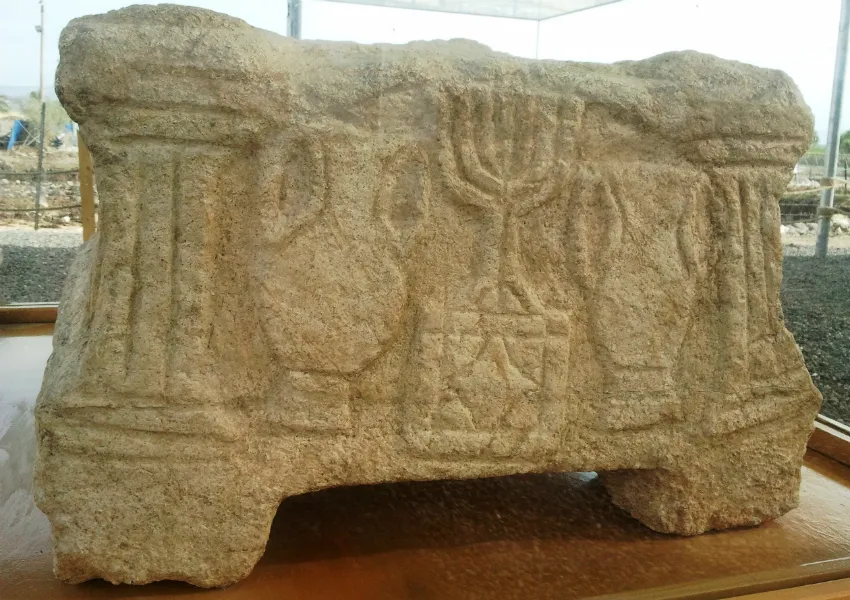
Rome, Italy, May 18, 2017 / 03:04 am (CNA/EWTN News).- At the center of the first joint exhibit between the Vatican Museums and the Jewish museum in Rome is the Magdala Stone, a large decorated stone block from a first century Galilean synagogue which has shed light on synagogue worship before the destruction of the Second Temple.

The Magdala Stone was found during the excavation of an synagogue on the site of what is believed to be Magdala, the hometown of Mary Magdalene. The 4.2 cubic feet limestone block may have been used as a bema, on which the Torah was read.

It is carved on four sides and its top with decorative symbols, most prominently the Menorah which was found in the Jewish Temple – a seven-branch menorah described in Exodus, distinct from the nine-branch menorah associated with Hannukah and the Maccabees.

The stone is the centerpiece of the exhibit “Menorah: Worship, History, and Legend”, shown simultaneously at the Jewish Museum and the Braccio di Carlo Magno Museum in the Vatican, located under the left colonnade in St. Peter’s Square.

The exhibit runs May 15-July 23 and includes roughly 130 pieces, including menorahs from various periods and depictions of them in paintings, sarcophagi, sculptures, and medieval and Renaissance drawings and manuscripts.

This is the first time the Magdala Stone has left Israel or been displayed publicly, and its presence at the Vatican is just “one more sign of the collapsing of the walls between Christianity and Judaism,” in the opinion of Fr. Juan Solana, L.C., General Director of the Magdala Project.

Fr. Solana told CNA that the stone’s presence at the exhibit marks not only an interreligious effort between the Vatican Museums and the Jewish museums in Rome, but also collaboration between Vatican City and the State of Israel.  

“I know that it was a lot of work behind the scenes to make it happen,” he explained. “I think it really shows the importance of interreligious dialogue and especially dialogue and friendship between Catholics and Jews.”

Magdala “is very close to Capernaum, in the old area where Jesus preached and taught and performed many miracles,” Fr. Solana said. “So we believe that Jesus went to Magdala and eventually he went to the synagogue and preached there.”

While they can’t know for sure, it is even possible that Christ used the Magdala Stone himself to display scrolls of the Torah.

The town and synagogue were first discovered in 2009 during excavations in preparation for building a Catholic center in Israel. Stalled by the discovery of the site, the Magdala Center, as it is called, is still in the works.

“We found the whole town of Mary Magdalene,” Fr. Solana said; and the cherry on the top, so-to-speak, was the Magdala Stone.

There are seven synagogues known of from the period of Christ’s life and more or less 50 years before and after, but in no other synagogue have they found this kind of block, he said.

Archaeologists found a total of three stone blocks in Magdala: one from what was probably a school of the synagogue and one which had been reused as a chair of Moses, the place of authority from which the scribes and Pharisees interpreted the Jewish law. The Magdala Stone was at the center of the synagogue.

The stone is considered important for Judaism because Jewish scholars believe it marks a change within Judaism itself, brought about by the influence of Christianity, Fr. Solana explained.

This is because “Jesus destroyed the idea of the Temple as the center of Judaism,” he said, “and it was confirmed by the destruction of the Temple” in AD 70.

The Magdala Stone and the synagogue both pre-date the destruction of the Temple, which has been confirmed by coins found inside which range from AD 5 to 63 – the time of Christ’s life and the first generation of Christians.

Of course, this makes them very important pieces historically, Fr. Solana continued, explaining that the stone itself is a model of the destroyed Temple in Jerusalem. Covered in carvings of Jewish symbols, more even than the Temple itself, it also displays the oldest-known carving of a menorah in Israel.


 

[…]

How one cardinal believes euthanasia can be shown as ‘toxic’

May 18, 2017 CNA Daily News 0

Toronto, Canada, May 18, 2017 / 12:02 am (CNA/EWTN News).- Legalized euthanasia must still be fought – and that fight requires a broad argument that can persuade people of all beliefs, Cardinal Gerhard Mueller told a Canadian audience May 15.

Euthanasia is not only wrong in itself, but its legalization creates “toxic and deadly pathologies that disproportionately afflict the weakest members of society,” the cardinal told the Canadian Catholic Bioethics Institute at a gathering at Toronto’s St. Michael’s Cathedral Basilica.

A clear understanding of legal assisted suicide’s individual and social wrongs is needed to persuade Canadians to take the steps to reverse the “dangerous legal error” of the Canadian Supreme Court and Parliament, which recently legalized euthanasia and assisted suicide nationwide.

He voiced confidence that all persons of good will should be able to see “the profound and inevitable social harms that fall disproportionately on the weak and vulnerable when euthanasia is legalized.”

“The goodness of a society can be measured by how well it treats and protects its weakest and most vulnerable members,” he said. “Nations that legalize euthanasia fail to care rightly for the least of our brothers and sisters.”

In Cardinal Mueller’s view, the prudential argument against euthanasia is the most powerful argument in a pluralistic society that can persuade people of all religious beliefs, including those without religious beliefs.

He found an example of such persuasion in early 1990s New York. A commission called the New York Task Force on Life and Law had been convened by then-New York Gov. Mario Cuomo. The commission began its work expecting to recommend legal assisted suicide.

“But when they studied the question carefully and dispassionately, they quickly realized that the toxic and deadly social pathologies that would inevitably accompany legalization were too grave and severe to justify such a course of action,” he said.

“The committee recommended that assisted suicide and euthanasia should remain illegal, because decriminalizing these practices would inexorably lead to: grave and lethal new forms of fraud, abuse, coercion and discrimination against the disabled, poor, elderly, and minorities; deadly forms of coercion by insurers and faithless family members; corrosion of the doctor-patient relationship; an eventual shift to non-voluntary and involuntary euthanasia; and widespread neglect of treatment for mental illness and pain management.”

The cardinal cited the commission’s own words:

“We believe that the practices would be profoundly dangerous for large segments of the population, especially in light of the widespread failure of American medicine to treat pain adequately or to diagnose and treat depression in many cases. The risks would extend to all individuals who are ill,” it said. They would be most severe for those whose autonomy and well-being are already compromised by poverty, lack of access to good medical care, or membership in a stigmatized social group.”

The commission said the risks of legalizing assisted suicide and euthanasia for marginalized groups are “likely to be extraordinary” given that the health care system and society “cannot effectively protect against the impact of inadequate resources and ingrained social disadvantage.”

According to the cardinal, the New York task force was particularly struck by the situation in the Netherlands at the time, where there was one case of killing without consent for every three or four who died in consensual euthanasia. The commission projected that if euthanasia were similarly practiced in the U.S., about 36,000 people would die in voluntary euthanasia per year and another 16,000 would be victims of non-consensual euthanasia.

As an example of involuntary euthanasia, the cardinal cited reports from the Netherlands in which “a doctor surreptitiously euthanized a nun over her objections, and justified it on the grounds that she was mistaken about her best interests due to an irrational and superstitious commitment to religious belief.”

In U.S. states where euthanasia has been legalized, there have been cases of insurance companies that offer to pay for assisted suicide drugs rather than pay for costly medical treatment. Family members have also pressured patients into choosing suicide.

The cardinal distinguished assisted suicide and euthanasia from aggressive pain treatment, which aims to eliminate suffering through potentially risky means, not to kill the patient.

He said assisted suicide or direct killing are deceptively described as “aid in dying.” This is “a fabricated expression whose only rhetorical function is to conceal the very nature of the death-dealing action it describes.”

“The use of euphemism or obscure terminology in issues involving life and death should always alert us to an effort to hide the truth,” Cardinal Mueller said.

He countered justification for assisted suicide that claims that euthanasia only affects the patient and people are entitled to choose the time and manner of their death.  

“Anyone who has ever experienced the suicide of a loved one or even a casual acquaintance knows the profound effects this can have on entire communities,” he said, citing the demonstrated risks of suicide spreading like a “contagion.”

Euthanasia is not self-contained, as it affects families and communities and alters the medical community’s relationship to patients and the public.

Suicidal patients are often not in a position to exercise autonomy, and suicidal desires often depart once mental illness and pain are effectively treated.

“This is true even among the terminally ill,” he said.
The cardinal defended doctors and nurses who could face coercion for refusing to participate in euthanasia.

“ No one who trains and takes an oath to care for the sick should be pressed into ending the lives of the very people that they have promised to serve,” he said, saying that refusal to aid in euthanasia “represents basic fidelity to the very medical art that the physician professes.”

Cardinal Mueller said church teaching on euthanasia is accessible and enduring.

“The Catholic Church has long recognized that every human being, no matter his or her condition or circumstance, is possessed of inalienable and equal dignity,” he said. “This beautiful truth about the human person and his matchless worth is intelligible and self evident to every person of good will, regardless of faith tradition.”

The cardinal cited the Congregation for the Doctrine of the Faith’s 1980 Declaration on Euthanasia, which said that making an attempt on the life of an innocent person opposes God’s love for the person.

While there are psychological factors that diminish or remove moral responsibility, to take one’s own life is “often a refusal of love for self, the denial of a natural instinct to live, a flight from the duties of justice and charity owed to one’s neighbor, to various communities or to the whole of society.”

[…]

Cardinal Mueller to graduates: ‘Dare to be great’

May 17, 2017 CNA Daily News 0

, May 17, 2017 / 03:01 pm (CNA/EWTN News).- With God’s grace, you can accomplished great things, Cardinal Gerhard Mueller challenged young Catholics at Christendom College last weekend at their 2017 commencement ceremony.

“The summary of all natural and Christian anthropology is to say, ‘Dare to be great in the grace of the Father and the Son and the Holy Spirit, Amen’,” Cardinal Mueller, prefect of the Congregation of the Doctrine of the Faith, told undergraduate students of Christendom College in Front Royal, Va. on May 13, the feast of Our Lady of Fatima.

Cardinal Mueller, the college’s 2017 commencement speaker, was the celebrant and homilist at the baccalaureate Mass on May 12 and received an honorary doctorate from the college before his commencement address. He is also the president of the Pontifical Commission “Ecclesia Dei,” appointed to that post and as prefect of the CDF by Pope Benedict XVI.

“Gerhard Cardinal Müller has been a strong, consistent voice in defense of the Church’s perennial teaching in the midst of so much confusion in our modern world,” the college’s president Dr. Timothy O’Donnell stated before the prelate’s appearance.

The cardinal focused his May 13 address on “Christian anthropology,” and exhorted the graduates “to be salt and light in the midst of the contemporary world.”

The Christian, he insisted, can only bring about the Kingdom of God on earth by performing the corporal and spiritual works of mercy through God’s grace, not solely through his own merits.

“No, the Kingdom of God is grace, and grace brings the Holy Spirit in the world, a new spirit, the spirit of charity that sanctifies and assists, the spirit of understanding, of love, that changes our hearts and introduces in all human relations a movement of freedom,” he explained.

This movement of the Holy Spirit, he continued, includes the theological virtues of faith, hope, and charity, as well as the cardinal virtues of prudence, justice, fortitude, and temperance, and “other gifts and charisms.”

Through these virtues and gifts, men can be “collaborators with God in the bringing about of His Kingdom,” he said, where “the Church, with the arrival of the Messiah, carries out her mission in the Holy Spirit to bring glad tidings to the poor, to proclaim liberty to captives, and recovery of sight to the blind, to let the oppressed go free and to proclaim a year acceptable to the Lord.”

He warned against seeing Christianity as a “bourgeois” practice of “interiority, only love of neighbor, and individual philanthropy” where salvation is reduced “to the world alone in the sense of social and purely humanitarian NGOs.”

However, he also taught against seeing God’s kingdom “only as above and outside of the world.”

Rather, he continued, “reverence toward God and the responsibility for the world are inseparably connected in Christ, Who did not come into this world to free us from the world, but to lead men and the world to their authentic destiny in the salvific plan of God.”

This does not mean the rejection of non-Christians who perform “good works,” he insisted, as “it would appear wrong to divide in an exaggerated manner Christianity from the rest of humanity.”

“Whomever does the good, even if they do not yet recognize God explicitly, is the mediator of the goodness of God,” he said. “For us grace and nature are belonging together, and are not in a contradiction. Grace and nature, faith and reason, must be distinct (but) not separate.”

Cardinal Mueller also exhorted those in attendance to be on guard against totalitarian ideologies that set themselves up against the vision of God and the Church.

Many ideologies of the 20th century were totalitarian in that they sought to establish their own vision of creation, a “humanism without or humanism against God,” he said.

Forms of totalitarianism exist today, he explained, like “the concept of designing one’s baby,” and the promotion of “euthanasia for those who are too tired to live, or who have become un-useful up to the sociological laboratories that want to make humanity happy with their political and economic theories, but in reality only enslave to their fantasy for omnipotence.”

Christians must fight injustices in the world in the name of human dignity, he insisted.

“Nobody may divert their gaze while the number of souls who go hungry grow, are deprived of their rights and recused to slavery, while the trauma of the refugees arriving on the European shores and the American border increase, and while being in a unified world, the risks and the challenges of globalizations are ever present,” he said.

“At the foundation of this dignity,” he added, “are the rights to lodging, food, and clothing, as well as the right to earn a living for himself and for the well-being of his family.”

The cardinal also warned against what Pope Francis has called the “ideological colonization” of the developing world, where developed countries try to force programs like abortion, birth control, sterilizations, and the approval of same-sex marriage onto developing countries.

Cardinal Mueller called this “an aggressive importation of a deformed image of the human person of the so-called ‘society of well-being’.”

These “developing cultures” cannot be ignored or trampled underfoot, he said, as “variety enriches,” which is also “the message of Pentecost when all peoples in diverse languages announce together the great works of God in the language of love.”

Christians, he insisted, must not only confess God with words, but work to do His will “by holding faithful to the Gospel and benefitting from its resources.”

“Not everyone who cries or confesses ‘Lord, Lord,’ will enter the Kingdom of Heaven, but those who do the Father’s will by taking a strong grip on the work at hand,” he continued. “Now the Father wills that in all men we recognize Christ our brother and love Him effectively in word and in deed.”

“By thus giving witness to the truth, we will share with others the mystery of the Heavenly Father’s love,” he concluded.

“As a consequence, men throughout the world will be aroused to a lively hope, the gift of the Holy Spirit, that some day at the last they will be caught up in peace and utter happiness in that fatherland radiant with the glory of the Lord.”


[…]

Medjugorje, the findings of the Ruini report

May 17, 2017 CNA Daily News 0

Vatican City, May 17, 2017 / 10:29 am (Vatican Insider / La Stampa).- Thirteen votes in favor of recognizing the supernatural nature of the first seven appearances in Medjugorje, one vote against and one “suspensive” ballot, which will give… […]

Priest stabbed during Mass at Mexico City cathedral

May 17, 2017 CNA Daily News 0

Mexico City, Mexico, May 17, 2017 / 06:04 am (CNA/EWTN News).- A Mexican priest is in “delicate but stable” condition after being stabbed in the neck Monday evening at Mexico City’s cathedral, according to government and church authorities.

Father José Miguel Machorro Alcalá, 55, was stabbed in the neck and torso May 15 at the conclusion of saying Mass at the cathedral.

Witnesses reported that it appeared the attacker’s intention was to slit the priest’s throat.

Authorities detained a suspect at the scene who had reportedly attempted to flee the cathedral. The suspect has been identified as John Rock Schild, who identified himself as an artist from the United States. He is believed to be about 30 years of age.


Afortunadamente la policía detuvo al agresor! pic.twitter.com/ehHNRhK19w

— Padre José Aguilar (@PadreJosedejesu) May 16, 2017


At a news conference, the lawyer of the Archdiocese of Mexico, Armando Martínez, asked for prayers for the priest and said the motive for the attack was still unclear.

“We cannot talk about terrorism, we cannot talk about motives, because we obviously have no significant facts,” he said.

In a radio interview Tuesday morning, archdiocesan spokesman Hugo Valdelomar said the attack occurred as Fr. Machorro was blessing the congregation with holy water. He said the priest suffered severe injuries to his neck and near his lung.

Fr. Machorro was transferred by helicopter to a private hospital. He was operated on, and is now stable but in intensive care, according to the Mexico City archdiocese.

Masses at the cathedral are continuing at regularly scheduled hours.

The attack is one of many recent attacks against priests in Mexico. Drug trafficking has led to increased murder and kidnapping in the country. In recent years, 17 priests have been murdered and many others have been kidnapped or assaulted.


[…]

Sign of hope in Syria – Aleppo consecrated to Our Lady of Fatima

May 17, 2017 CNA Daily News 0

Aleppo, Syria, May 17, 2017 / 12:01 am (CNA/EWTN News).- Still reeling from the Syrian civil war, the city of Aleppo saw a ray of hope this weekend with a consecration to Our Lady of Fatima on May 13.

The Mass of Consecration took place in Saint Francis of Assisi Roman Rite Cathedral, which is also known as the Latin Church of the Franciscans. It was presided over by the pastor, Fr. Ibrahim Alsabagh, and concelebrated by the bishops and priests of the city.

The consecration of Aleppo took place on the 100th anniversary of the first Marian apparition at Fatima, the same day that Pope Francis celebrated the Mass of canonization of the shepherd children Francisco and Jacinta Marto at the Fatima Shrine in Portugal.

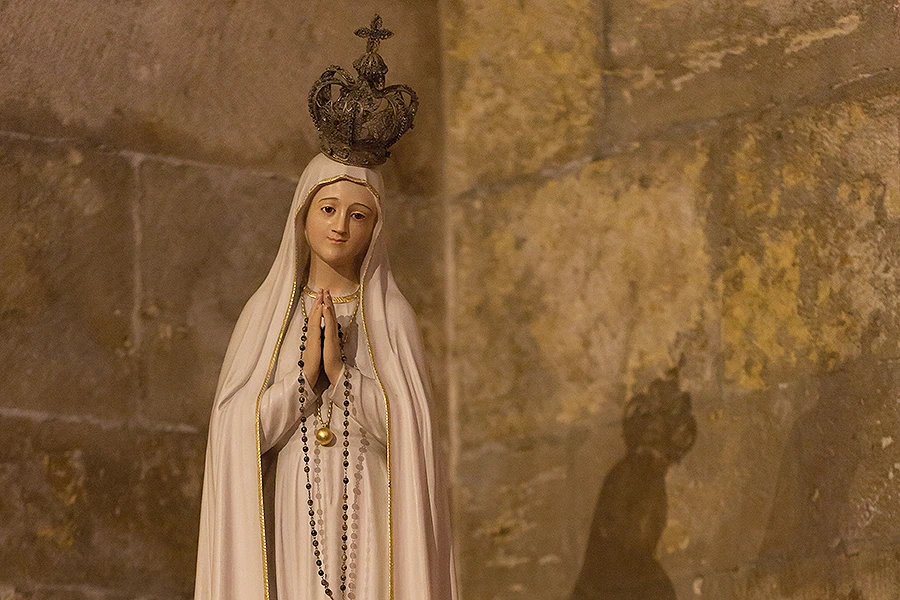
Present at the Mass of Consecration, according to the Facebook page for the Cathedral of Saint Francis of Assisi, was a statue of Our Lady of Fatima that was sent directly from the shrine in Portugal.

After the Eucharist, the statue was carried in procession through the Christian al-Azizieh neighborhood, which has suffered numerous attacks in recent years.

On their Facebook account, SOS Christians in Syria said that the church was full of the faithful and that a number of them were joyful and were moved to tears because for many years, a procession with the statue of Our Lady of Fatima had not been held.

“Let us give thanks to God for this heavenly day that was ours to experience, and let us entrust the Christians of Aleppo to our Blessed Mother. May she, the Queen of Peace, since she gave to the world the Prince of Peace, grant to us the much longed for peace in the Middle East and the entire world,” they said.

The consecration of Aleppo was part of a program of activities organized by the Latin Cathedral of Saint Francis of Assisi on the occasion of the centenary of the apparitions of Our Lady of Fatima.

The cathedral stated on its Facebook page that the celebrations began on May 11 with a community prayer and a procession with the statue of the Virgin sent from Fatima.

“Many of us cried because after six years we’re able to again organize the procession through the streets of Aleppo without the fear of missiles. With emotion we welcome the Virgin of Fatima to Aleppo and with the hope that the Virgin Mary will pray for peace for all of Syria,” they said.

On October 13, 2016, at the close of the last international pilgrimage of the year at the Fatima Shrine, the Bishop of Leiria-Fatima, Antonio Marto, blessed a statue that would be sent to the “martyr diocese” of Aleppo.

Currently living conditions in the city are still very hard because there is a shortage of food, medicine, and other supplies, and because electric and water services have not yet been restored.


[…]