Sudanese bishop delivers Christmas message in midst of war
December 26, 2025 Catholic News Agency 0
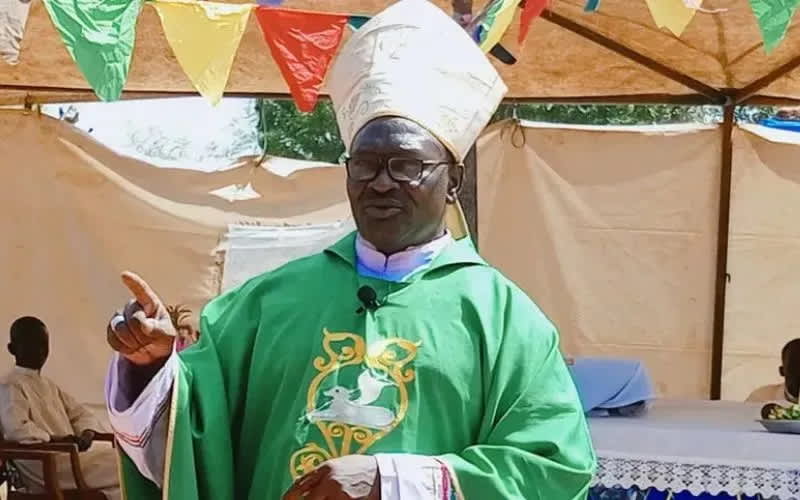
Bishop Yunan Tombe Trille Kuku of Sudan’s El Obeid Diocese. Credit: CRN

ACI Africa, Dec 26, 2025 / 15:37 pm (CNA).

In a country battered by violence, displacement, and fear, the 2025 Christmas message of Bishop Yunan Tombe Trille Kuku Andali of Sudan’s Catholic Diocese of El-Obeid addressed the people of God in the midst of their suffering and the fragile hope still carried by the celebration of Christmas.

For Trille, the Christmas proclamation is rooted in God’s fidelity, since “the birth of Christ is the manifestation of the glory of our God,” revealing his promise of salvation and peace for the whole of creation.

Through Christ’s birth, he explained, “the gate of heaven is opened for us” and reconciliation becomes possible because “the birth of Christ opens the way for our reconciliation with our Creator.”

He drew a parallel between the manger and Sudan’s humanitarian crisis, saying: “Seeing the baby Jesus in the manger describes the situation of all those of us in our country who remain without shelter and in fear.”

“Our diocese in Kordofan has become the battleground after Darfur,” he said, adding that a ”number of its parishes are deserted and desecrated.” The impact on pastoral life is severe, he lamented, noting: “There are no priests to celebrate sacred sacraments for the faithful.”

Sudan’s civil war broke out on April 15, 2023. The violent conflict is between the Rapid Support Forces (RSF), the paramilitary force under Gen. Mohamed Hamdan Dagalo, and army units of the Sudanese Armed Forces (SAF) that are loyal to the head of Sudan’s transitional governing Sovereign Council, Gen. Abdel Fattah al-Burhan.

It started in Sudan’s capital city, Khartoum, before becoming a full-fledged civil war in the entire northeastern African nation. It has reportedly resulted in the death of “as many as 150,000 people”; well over 14 million people have been displaced, including to unstable countries such as Chad, Ethiopia, and South Sudan, where they have reportedly overrun refugee camps.

With some 30.4 million people in need of humanitarian aid in Sudan, reportedly more than half of country’s population, Sudan quite possibly has the highest number of people in need ever recorded and the highest number of internally displaced globally, more than 12 million having fled violence in the country in the last two years.

Sudan also has the highest number of people in emergency or catastrophic levels of hunger, “with over 600,000 people living in famine and 8 million others on the cliff edge,” according to an April report.

As Sudan approaches the 70th anniversary of independence in 2026, Trille made a pastoral appeal rooted in compassion and faith. He called the people of God to see themselves as “brothers and sisters in solidarity, weeping with parents and relatives of those who mourn the killed,” and to remember the words of Jesus: “Whatever you did for one of these least brothers of mine, you did for me.”

Gathering testimony, prayer, and hope together, he exhorted, “let us make our hearts the manger where the baby Jesus can live to help us renew our lives and live peace.”

This story was first published by ACI Africa, CNA’s news partner in Africa, and has been adapted by CNA.
[…]

Pope, at Christmas Day Mass, says wars fed by falsehoods send young people to their deaths

December 25, 2025 Catholic News Agency 1
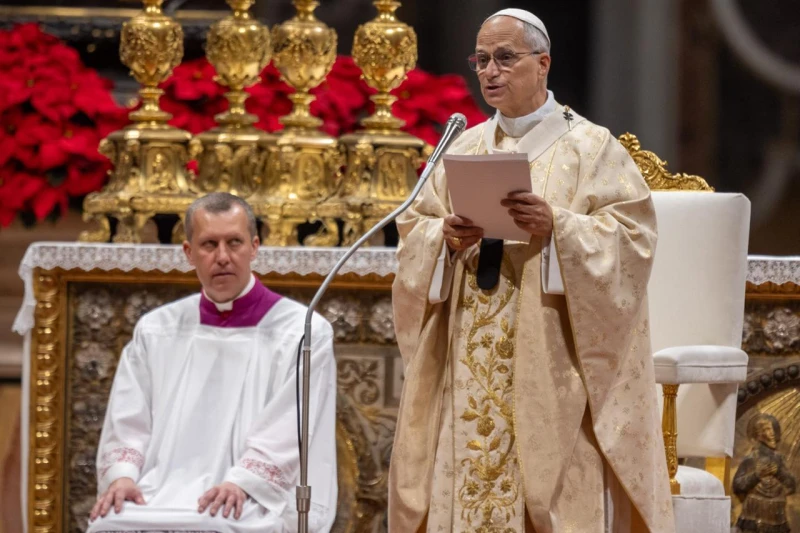
Pope Leo XIV celebrates Mass in St. Peter’s Basilica at the Vatican on December 25, 2025. / Daniel Ibañez/ EWTN News

Vatican City, Dec 25, 2025 / 06:35 am (CNA).

Pope Leo XIV on Christmas Day deplored the “falsehoods” used to justify wars that leave young people “forced to take up arms” and “sent to their deaths,” while also drawing attention to the humanitarian suffering of displaced people, including families living in tents in Gaza.

In his first Christmas as pope, Leo celebrated Christmas Day Mass in St. Peter’s Basilica, reviving a practice not seen since 1994 during the pontificate of St. John Paul II. Reflecting on the prologue of St. John’s Gospel, the pope said in his homily that the Christmas liturgy highlights a striking contrast: God’s Word, which acts with power, comes into the world in utter weakness.

“The ‘Word’ is a word that acts,” Leo said. Yet, he added, “the Word of God appears but cannot speak. He comes to us as a newborn baby who can only cry and babble.”

Leo said the mystery Christians celebrate at Christmas cannot be separated from the vulnerability of those whose dignity is assaulted by war, displacement, and poverty. He urged Catholics to let Christ’s birth pierce complacency and move them toward tenderness and solidarity.

“‘Flesh’ is the radical nakedness that, in Bethlehem as on Calvary, remains even without words – just as so many brothers and sisters, stripped of their dignity and reduced to silence, have no words today,” he said.

In one of the homily’s most striking passages, Leo connected the Gospel image of the Word “pitching” his tent among humanity with the reality faced by families living in makeshift shelters amid conflict.

“Dear brothers and sisters, since the Word was made flesh, humanity now speaks, crying out with God’s own desire to encounter us. The Word has pitched his fragile tent among us,” he said, before asking: “How, then, can we not think of the tents in Gaza, exposed for weeks to rain, wind and cold; and of those of so many other refugees and displaced persons on every continent; or of the makeshift shelters of thousands of homeless people in our own cities?”

The pope also described the toll of war in terms of both shattered communities and wounded consciences.

“Fragile is the flesh of defenseless populations, tried by so many wars, ongoing or concluded, leaving behind rubble and open wounds,” he said. “Fragile are the minds and lives of young people forced to take up arms, who on the front lines feel the senselessness of what is asked of them and the falsehoods that fill the pompous speeches of those who send them to their deaths.”

Leo framed Christmas as a proclamation that peace is not merely a hope for the future but a gift already present in Christ, even when few recognize it. Quoting Jesus’ words to the disciples, he said: “‘Peace I leave with you; my peace I give to you; not as the world gives do I give to you’ (Jn 14:27).”

That peace, he said, begins not in rhetoric but in concrete compassion that listens, stays close, and responds to suffering.

“When the fragility of others penetrates our hearts, when their pain shatters our rigid certainties, then peace has already begun,” he said. “The peace of God is born from a newborn’s cry that is welcomed, from weeping that is heard. It is born amidst ruins that call out for new forms of solidarity.”

The pope warned that believers can bury what the Gospel calls “the power to become children of God” by keeping their distance from the vulnerable.

“Becoming children of God is a true power – one that remains buried so long as we keep our distance from the cry of children and the frailty of the elderly, from the helpless silence of victims and the resigned melancholy of those who do the evil they do not want,” he said.

This story was first published by ACI Prensa, CNA’s Spanish-language news partner. It has been translated and adapted by CNA.

[…]