

Cuban government preparing a law regulating dissidents’ defense lawyers
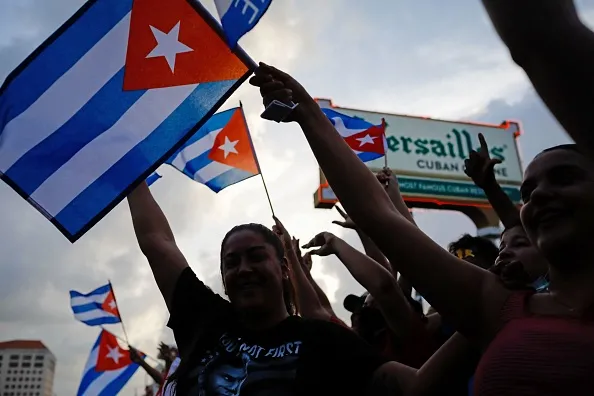 People demonstrate, some holding Cuban flags, during a protest against the Cuban government at Versailles Restaurant in Miami, on July 12, 2021. – Havana on Monday blamed a US “policy of economic suffocation” for unprecedented protests against Cuba’s communist government as Washington pointed the finger at “decades of repression” in the one-party state. Credit: Eva Marie Uzcategui/AFP via Getty Images.
Havana, Cuba, Jul 22, 2021 / 15:19 pm (CNA).
Cuba’s communist government has drafted a law that would equate the role of dissidents’ defense lawyers with that of public officials.
In May, the People’s Supreme Court, Cuba’s highest judicial authority, drew up a series of legislative proposals that it sent to the island’s legislature, the National Assembly of People’s Power, for passage.
Among these proposals is the “Draft Law on Criminal Procedures,” which could equate the role of a defense lawyer for dissidents with that of a “public employee or official,” putting the lawyer at the mercy of pressure and sanctions from the government
A group of Cuban lawyers, who asked to speak with ACI Prensa, CNA’s Spanish language news partner, on condition of anonymity for fear of reprisals from the government, warned that this bill “would violate impartiality,” because “the Prosecutor’s Office represents the state, it’s a public functionary. Imagine if the defense lawyer also were.”
The lawyers pointed out that “this is something that for many years they have tried to accomplish, but a way wasn’t found to implement it by changing the law.”
“But now, with a new criminal procedural text, an attempt is being made to introduce it in a very underhanded way,” they said.
The most controversial texts of the bill are found in the fifth special provision, which defines what is an employee and a public official.
Subsections e and f state that public employees and officials are part of state agencies “of a public nature” performing “legislative, executive or judicial functions,” among others.
However, subsection g adds that “public employees or officials are also considered those persons who, in the non-state sector, as well as in foreign entities or public international organizations, exercise positions or functions similar to those described in subsections e and f when the criminal acts derive from their relationship with the state or its institutions.”
The Cuban jurists told ACI Prensa that “although the word ‘lawyer’ is not mentioned, the generality of the expression ‘non-state sector’ is the way to allow this interpretation where the judges don’t enjoy authentic judicial independence.”
“What they’re looking for is a way to exert pressure on lawyers and, when necessary, get them out of the way. That’s how they would do it.”
“And getting them out of the way,” they warned, could mean “taking them out of circulation completely” by finding them guilty of a crime, “which also would result in their expulsion from the National Organization of Collective Law Firms, the only institution of its kind on the island for the provision of legal services to native born persons who are defendants in a criminal case.”
The judges who make up the People’s Supreme Court are elected by the National Assembly of the People’s Power, a one-party legislative body which also elects the country’s president.
Communist rule in Cuba was established soon after the conclusion of the Cuban Revolution in 1959, which ousted the authoritarian ruler Fulgencio Batista.
Protests took place across Cuba July 11-12. Protesters cited concerns about inflation, shortages of food and medicine, and the Covid-19 pandemic.
Some protesters were beaten, and at least 100 were arrested.
.jpg?w=800)