No Picture
News Briefs

Pope Francis says Our Father is poorly translated
December 8, 2017 CNA Daily News 6

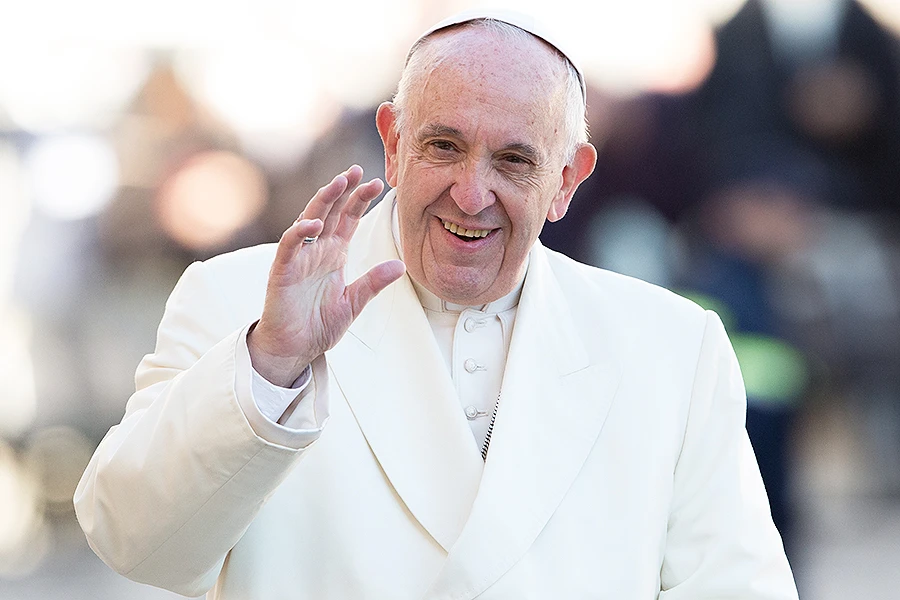
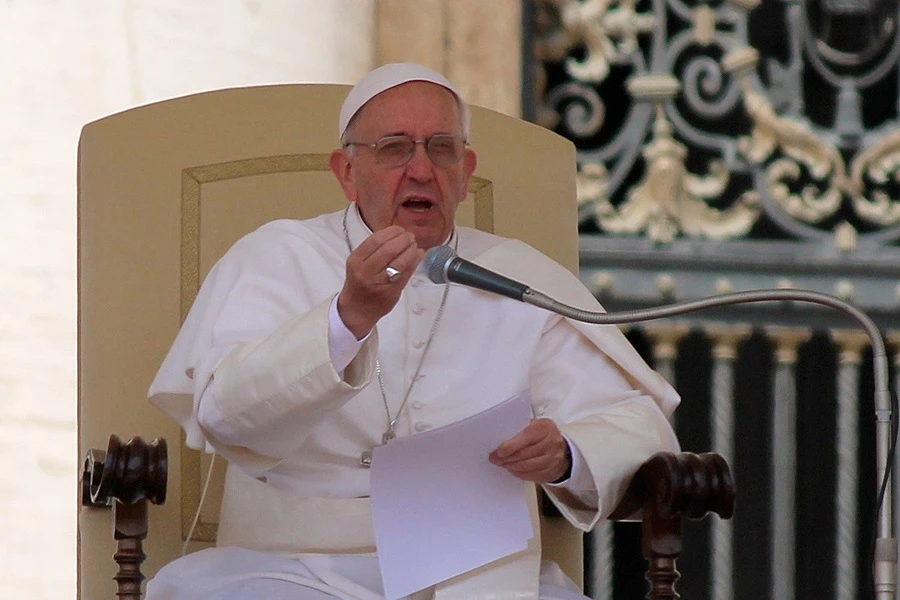
Vatican City, Dec 8, 2017 / 10:40 am (CNA/EWTN News).- In a video series for Italian television network TV2000, Pope Francis said that “lead us not into temptation” is a poorly translated line of the Our Father.

“This is not a good translation,” the Pope said in the video, published Dec. 6. “I am the one who falls, it’s not (God) who pushes me toward temptation to see how I fall. A father doesn’t do this, a father helps us to get up right away.”

He noted that this line was recently re-translated in the French version of the prayer to read “do not let me fall into temptation.”

The Latin version of the prayer, the authoritative version in the Catholic Church, reads “ne nos inducas in tentationem.”

The Pope said that the one who leads people into temptation “is Satan; that is the work of Satan.” He said that the essence of that line in the prayer is like telling God: “when Satan leads me into temptation, please, give me your hand. Give me your hand.”

Just as Jesus gave Peter his hand to help him out of the water when he began to sink, the prayer also asks God to “give me your hand so that I don’t drown,” Pope Francis said.

The Pope made his comments in the seventh part of the “Our Father” television series being aired by Italian television network TV2000.

Filmed in collaboration with the Vatican’s Secretariat for Communications, the series consists of nine question-and-answer sessions with Pope Francis and Fr. Marco Pozza, a theologian and a prison chaplain in the northern Italian city of Padua.

In each of the sessions, Fr. Pozza asks the Pope about a different line in the Our Father prayer, and the Pope offers his insights. A preview of the series was presented at the Vatican’s Film Library by Msgr. Dario Edoardo Vigano, head of the Secretariat for Communications.

The show also led to the publication of a book titled “Our Father,” which was released by the Vatican Publishing House and Italian publisher Rizzoli Nov. 23, and is based on Pozza’s conversations with the Pope in the video series.

Each of the first eight episodes of the series begin with an excerpt from conversation between the Pope and Pozza, which is followed by a second conversation between Pozza and another guest. The final episode will consist of the priest’s entire conversation with Pope Francis.

In his question to Pope Francis on the line “lead us not into temptation,” Pozza noted that many people have asked him how God can lead someone into temptation, and questioned what the phrase actually intends to say.

The question is one of the reasons the French bishops decided to make a request for a new translation of the Our Father that they believe conveys the meaning more clearly.

According to the French episcopal conference, the decision to make the change was accepted by the Congregation for Divine Worship and the Discipline of the Sacraments in June 2013.

The new translation, released Dec. 3 to mark the first day of Advent and the beginning of the new liturgical year, now reads “ne nous laisse pas entrer en tentation,” meaning, “do not let us fall into temptation,” versus the former “ne nous soumets pas à la tentation,” or “lead us not into temptation.”

The Pope’s remarks do not change the translations of liturgical texts. Such a change would begin with a resolution by an episcopal conference in English-speaking countries.

In a previous episode of the “Our Father” series, Pope Francis said “it takes courage” to recite the prayer, because it means calling on someone else and truly believing that “God is the Father who accompanies me, forgives me, gives me bread, is attentive to everything I ask, and dresses me better than wildflowers.”

“To believe is a great risk,” and means daring to make the leap of faith, he said. Because of this, “praying together is so beautiful: because we help each other to dare.”

[…]

No Picture
News Briefs

NM bishop prays for student victims of school shooting

December 7, 2017 CNA Daily News 0

Gallup, N.M., Dec 7, 2017 / 04:00 pm (CNA/EWTN News).- Two students at Aztec High School in Aztec, N.M., were killed in a shooting Thursday morning, and the local bishop has prayed for the victims and the community.

“St. Paul tells us in Romans 12:21 ‘Do not be overcome by evil, but overcome evil with good.’ In the coming days, many survivors and families will also be facing the fear and psychological effects that inevitably follow any tragedy. Please join me in offering prayers for the students and families,” Bishop James Wall of Gallup said Dec. 7.

“Please also join me in offering our support to the community of Aztec. We mourn the loss of life with you.”

The diocese is holding a prayer vigil at 4:30 this afternoon at St. Joseph parish in Aztec, about 120 miles northeast of Gallup.

The shooter is also dead. According to local outlet KRQE News 13, no other injuries have been reported, and the school has been evacuated.

Nearby schools, including those in Bloomfield, were put on lockdown as a precaution.

Please pray for the students, families, and community of Aztec. https://t.co/U0vhWduhN4

— Diocese of Gallup (@DioceseofGallup) December 7, 2017

[…]

No Picture
News Briefs

Truth will lead to African peace, Nigerian bishops say

December 6, 2017 CNA Daily News 0

Abuja, Nigeria, Dec 6, 2017 / 11:23 am (CNA/EWTN News).- The Church’s intellectual and moral truth is the key to a peaceful, free, and developing nation, Nigerian bishops have said at a conference attended by the country’s political and spiritual leaders.

Their remarks came a conference on “Peace and National Development,” hosted Nov. 19-22 by Veritas University, the Catholic university of Nigeria.

“The leaders of our future must be formed with a mentality that only the truth sets a people free,”  said Archbishop Augustine Akubeze, during remarks at the conference.

“Corruption will be eradicated if the students begin to learn that only money that accrues to a person as a result of hard work can be enjoyed.”

“The dream of the CBCN [Catholic Bishop’s Conference of Nigeria]… must always be the search for truth,” Akubeze, Vice President of CBCN, said, according to the Catholic News Service of Nigeria.

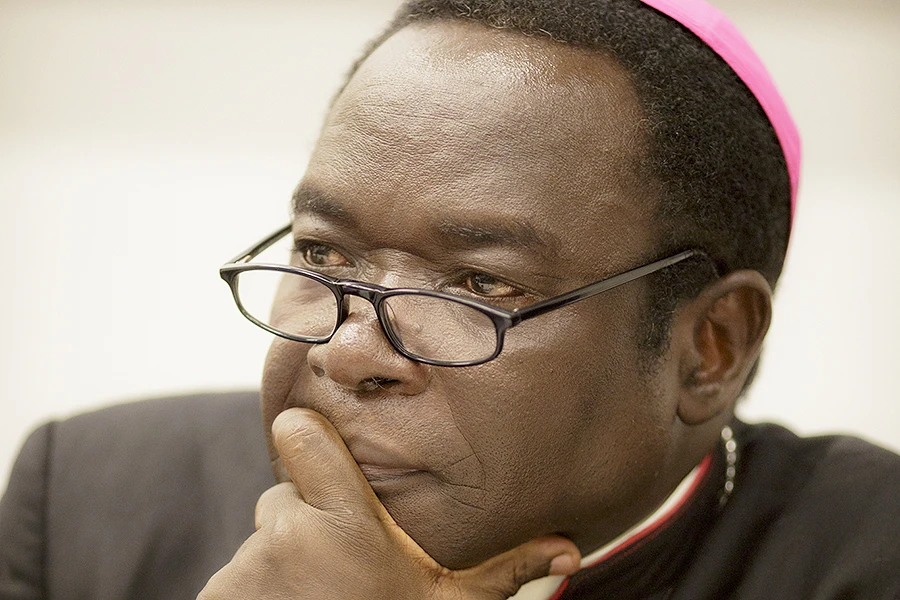
Marking the university’s 10th anniversary, the event was held at the Chelsea Hotel in Abuja, Nigeria, and included addresses from Archbishop Akubeze, Bishop Matthew Kukah of Sokoto, and the school’s Vice-Chancellor, Professor Mike Kwanashie.

The conference was also attended by Yakubu Dogara, the Speaker of Nigeria’s House of Representatives; former President Olusegun Obasanjo; and John Cardinal Onaiyekan, Archbishop of Abuja and the university’s chancellor.

While speaking about Nigeria’s future development, Bishop Kukah lamented that Nigeria has “remained permanently on top of the league of most vile and corruption in the international reports of the world institutions.”

The bishop asked on whether Nigeria could really be considered a “developing country,” because it lacks advancements in health, security, human rights, and the rule of law.
    
Archbishop Akubeze also mentioned that corruption exacerbated other severe challenges faced by Nigeria, pointing to events of terrorism, kidnappings, robberies, political violence, and tensions between religious and ethnic groups.

“These can result in disunity, instability, and if not curtailed, disintegration,” he said. “[Truth is] that fundamental value without which freedom, justice and human dignity are extinguished.”

The archbishop encouraged the university to form future leaders to search for truth and contribute to the common good, noting that some of the university’s students would likely become senators, governors, and maybe even Nigeria’s president.

He drew attention to the importance of the university’s name, “Veritas,” which is Latin for truth. He said the school, and every educational institution, should make the pursuit of truth their top priority.

He emphasized the need for human, spiritual, and moral formation at the university.
“As you know, education is not just about academic certificate. It also involves human formation. It involves character formation. In the process of your education in this institution, I want to encourage you, the staff, to help the students to have a wider horizon of life.”

Biahop Kukah stressed the importance of developing a strong moral compass among Africa’s political leaders, especially through the Catholic formation of university students.  

“I want to focus on the Catholic Church and argue that perhaps, with some level of robustness, it could provide this moral compass drawing extensively from its rich history and culture,” he said.

He pointed to the richness of Catholic social teaching, which, he said, is rooted in the mission of Christ, namely the proclamation of salvation.

The Church’s social encyclicals have identified concrete challenges and proffered solutions in the past, he said, noting that the documents would be a powerful resource developing political solutions to Nigerian and African issues.

Although the school welcomes students from all faiths, Veritas University has a strong ecclesiastical identity and has a particular focus Catholic social teaching.

Archbishop Akubeze applauded the success of Veritas University in forming its students, but challenged the school to strive further, until it becomes a reference point for other educational institutions.

The university was founded by the bishops of Nigeria in 2002. It was officially accredited by the Nigerian government in 2007, and began admitting students thereafter.  Its mission is to “provide its students with an integral and holistic formation that combines academic and professional training with physical, moral, spiritual, social and cultural formation together with formation of Christian religious principles and the social teachings of the Catholic Church.”

Nigeria, a country of 170 million people, has a Catholic population of nearly 23 million, according to the Pew Research Center.

[…]

No Picture
News Briefs

Pope Francis: It’s good for young people to study Latin

December 6, 2017 CNA Daily News 5

Vatican City, Dec 6, 2017 / 10:08 am (CNA/EWTN News).- In a message to the Pontifical Academies on Tuesday, Pope Francis praised the study of Latin, especially for young people, and encouraged scholars and teachers to promote its study as a positive guide for students as they navigate life.

Addressing academics and Latin teachers, the Pope said Dec. 5 that they should “know how to speak to the hearts of the young, know how to treasure the very rich heritage of the Latin tradition to educate them in the path of life, and accompany them along paths rich in hope and confidence…”

Pope Francis’ message was read at the 22nd Solemn Public Session of the Pontifical Academies, which had as its theme, “In interiore homine. Research paths in the Latin tradition.”

The Pope praised “the theme of interiority, of the heart, of consciousness and self-awareness” which he said is found “in every culture as well as in the different religious traditions.”

“Significantly,” he continued, this theme is “presented with great urgency and strength even in our time, often characterized by concern with appearance, superficiality, the division between heart and mind, interiority and exteriority, consciousness and behavior.”

Moments of change, crisis, or transformation, whether in relationships or in a person’s identity, require reflection “on the inner and intimate essence of the human being.”

Francis also noted the many important figures, both in the classical Greek-Roman tradition and the Christian tradition, who have reflected on the dynamism of man, pointing especially to the Fathers of the Church and the Latin writers of the first Christian millennium.

Highlighting St. Augustine in particular, the Pope quoted from his Tractates on the Gospel of St. John, which say, “Return to your heart; see there what, it may be, you can perceive of God, for in it is the image of God. In the inner man dwells Christ, in the inner man are you renewed after the image of God, in His own image recognize its Author.”

This is relevant also for our time, he stressed, and worthy of our reflection and of sharing with others, especially young people, who are just starting on the journey of life.

A journey where they may be caught up, he explained, in the “labyrinths of superficiality and banality, of the external success that conceals an inner emptiness, of the hypocrisy that masks the split between appearances and the heart, between the beautiful and cared-for body and the soul, empty and arid.”

At the meeting, the winners of the 2017 Prize of the Pontifical Academies were also awarded. This year’s prize winners are Dr. Pierre Chambert-Protat for his doctoral thesis on Florus of Lyon and Dr. Francesco Lubian for her critical publication of the Disticha attributed to St. Ambrose.

The winners of the Medal of the Pontificate were Dr. Shari Broodts for a critical edition of the Sermones of St. Augustine and the Latin Teaching Group of the University of Toulouse, for the publication of a Latin manual for university students.

The 2017 Prize of the Pontifical Academies was sponsored by the Pontifical Council for Culture and the Pontifical Academy for Latin, or Pontificia Acadamia Latinitatis, which was founded by Benedict XVI in 2012 through the motu proprio Latina Lingua.

Organized every year by the Pontifical Council for Culture, the 2017 Prize of the Pontifical Academies was on two themes: Methodological proposals for teaching Latin today, and the reception of ancient Christian Latin between the medieval and modern eras.

The first topic was “reserved to institutions (academies, schools, associations, foundations, research groups etc.) that are engaged in formative activity among the youth,” the Prize’s press release stated.

The second was for scholars between the ages of 25 and 40 who have produced doctoral theses or publications on the theme in the last five years.

[…]