No Picture
News Briefs

Irish archbishop: The Christian vision of family is attainable

April 18, 2018 CNA Daily News 1

Rome, Italy, Apr 18, 2018 / 11:53 am (CNA/EWTN News).- One of the leading organizers of this year’s World Meeting of Families has said the gathering aims to show the world that living the Christian ideal of marriage and family life is not impossible, but is something realistic that can be attained.

“Our message about marriage and family, about fidelity, that God loves you personally, that human life is sacred from the first moment of conception until the moment of death, that chastity is possible for our young people,” is a message often seen as out-of-date, Archbishop Eamon Martin of Armagh said.

Yet these messages “are achievable for people today,” he said.

“Sometimes people present the Church as being completely out of touch, but actually the Church is hugely in touch. It just wants to keep challenging people to the joy of the Gospel.”

Archbishop Martin spoke to CNA April 18 about the upcoming World Meeting of Families, which is slated to take place in Dublin Aug. 21-26.

Pope Francis will be present at the event Aug. 25-26, where he will preside over the “festival of families” and the closing Mass.

The World Meeting of Families is meant to share “the idea that family is good news, that it is a joyful message, that family is possible,” he said.

We too often “forget the huge number of families who continue faithfully to try to live out a life of love and a life of understanding and commitment to one another in very difficult or challenging circumstances,” he said.

Families, he said, are the first place where people learn to go outside of themselves through compromise and sacrifice, which goes against the individualistic mentality of global society.

“Very few families can survive individualism,” he said, explaining that one’s approach to family life has to start from the perspective of love and joy, which are the heart of the Gospel.

This in turn raises questions about how much social, political and legislative support is available to families, and how challenges can arise if this support is not given.

“Why is it that so many young people will choose not to get married? Maybe because they can’t get a hold of a mortgage, or because the benefit system suits them better to live as single people rather than as a couple with their children. Why is it that legislation on issues like addictions, gambling, or a whole lot of areas where family life can be destroyed, why are these not priorities in social policy-making?”

So in addition to focusing on the Gospel vision of the family, the “harder edge” of the global gathering in August will focus on how families can be supported from all levels of the Church and of society.

Some 16,000 people have registered for the event, most of whom are from overseas, Martin said.

And as the date gets closer, organizers on the ground are starting to “ratchet up” the preparations at a faster pace.

“This is an opportunity for families to meet families from other parts of the world and to learn from each other and to share with one another how we do it; how do we actually survive as a family in this crazy, complicated world,” Martin said.

Excitement is building and Ireland is ready to give the pope and the world “a hundred thousands of welcomes,” he said, using a colloquial Irish saying.

Martin said the gathering will be a time for families to come together and share their experiences, their hopes, and their challenges, without sugar-coating anything.

Acknowledging that no family is perfect, “we’re not in any way trying to romanticize family love,” he said. Rather, the goal is to share the Christian vision of the family, based on hope and love, and to welcome families who are distant or who perhaps don’t feel welcome, he said.

“The word ‘welcome’ is important,” he said, adding that for him, it is sad to hear when people say that for whatever reason, they do not feel entirely welcome in the Church.

And this goes not only for “these neuralgic issues, for example LGBT people or people living in second unions … I’m talking about people who think the Church’s vision of the family is completely out of touch with reality,” Martin said.

“I would love to think that we can talk about ways of welcoming families, welcoming people who … feel that they don’t measure up, or feel that unless their family is perfect, that everyone in their family is living a perfectly holy life, that they are not welcome,” he said.

To this end, he pointed to Gaudete et exsultate, Pope Francis’ exhortation on the call to holiness in today’s world, saying example of holiness can be found in “your mom, your grandmother, your dad. People who struggled but lived as best they could a faithful life.”

“So I think that when we think about reaching out, sometimes we think they are people way out on the margins, but often they are people who are simply trying to struggle to live a good family life everyday and who feel that somehow the Church presents an impossible ideal.”

[…]

No Picture
News Briefs

Vatican reportedly rejects German bishops’ plan for intercommunion of spouses

April 18, 2018 CNA Daily News 6

Vatican City, Apr 18, 2018 / 10:58 am (CNA/EWTN News).- The Congregation for the Doctrine of the Faith has reportedly rejected a plan approved by the German bishops’ conference to publish guidelines permitting non-Catholic spouses of Catholics to receive the Eucharist in some limited circumstances.

Austrian news site kath.net has reported that Vatican sources say the CDF, with papal approval, has suspended the German bishops’ proposed plan, and sources close to the congregation have confirmed this to CNA.

It is not clear whether the Vatican has asked the bishops’ conference to modify the contents of draft guidelines, whether they have suspended the development of a draft while the matter is considered further, or whether it has been entirely rejected.

In February, Cardinal Reinhard Marx of Munich and Freising announced that the German bishops’ conference would publish a pastoral handout for married couples that allows Protestant spouses of Catholics “in individual cases” and “under certain conditions” to receive Holy Communion, provided they “affirm the Catholic faith in the Eucharist”.

The announcement was made “after intensive debate” at the conclusion of the general assembly of the German bishops’ conference, which was held Feb. 19 – 22 in the Bavarian city of Ingolstadt, and attended by 62 members of the bishops’ conference under the leadership of conference chairman Cardinal Marx.

Last month, seven German bishops sent a letter to the CDF and to the Pontifical Council for Promoting Christian Unity asking for clarification on the matter. The signatories did not consult beforehand with Cardinal Marx.

The seven bishops asked whether the question of Holy Communion for Protestant spouses in interdenominational marriages can be decided on the level of a national bishops’ conference, or if rather, “a decision of the Universal Church” is required in the matter.

The letter was signed by Cardinal Rainer Woelki of Cologne, Archbishop Ludwig Schick of Bamberg, Bishop Gregor Hanke of Eichstätt, Bishop Konrad Zdarsa of Augsburg, Bishop Stefan Oster of Passau, Bishop Rudolf Voderholzer of Regensburg, and Bishop Wolfgang Ipolt of Görlitz.

“From the view of the signatories, the goal in a question of such centrality to the Faith and the unity of the Church must be to avoid separate national paths and arrive at a globally unified, workable solution by way of an ecumenical dialogue,” the Archdiocese of Cologne told CNA Deutsch April 4.

The Code of Canon Law already provides that in the danger of death or if “some other grave necessity urges it,” Catholic ministers licitly administer penance, Eucharist, and anointing of the sick to Protestants “who cannot approach a minister of their own community and who seek such on their own accord, provided that they manifest Catholic faith in respect to these sacraments and are properly disposed.”

[…]

No Picture
News Briefs

Cardinal Pell’s lawyer argues no grounds for trial as hearing ends

April 17, 2018 CNA Daily News 1

Melbourne, Australia, Apr 17, 2018 / 02:47 pm (CNA/EWTN News).- As Cardinal George Pell’s pre-trial hearing closes, his lawyer told an Australian court Tuesday that the charges being brought against the cardinal is based on false accusations.

“The allegations are a product of fantasy, the product of some mental problems that the complainant may or may not have, or just pure invention in order to punish the representative of the Catholic Church in this country,” Robert Richter, head of Pell’s defense team, said April 17, according to Reuters.

Richter added that the most serious of the alleged offences could not possibly have occurred, telling the court that the charges brought against Pell, who has been “the face” of the Catholic Church in Australia, “ought to be regarded as impossible and ought to be discharged without batting an eyelid.”

Pell’s attorney additionally cast a shadow over the credibility of some of the complainants, highlighting their inconsistencies with dates, saying that the alleged instances of abuse are “not to be believed,” because they remain “improbable, if not impossible.”

Richter told the court that Pell, who is prefect of the Secretariat for the Economy, should not be committed to trial because the evidence did not hold “sufficient weight to support a conviction,” and that a trial would “be a waste of public time, effort and money.”

Prosecutor Mark Gibson said Richter’s statements were speculation, remarking that the defense’s arguments do not “fundamentally impact on the reliability of the complainants’ evidence.” He also suggested that Richter’s claims about complainants seeking revenge on the Church were “nothing more than a theory.”

Magistrate Belinda Wallington said that Richter may have taken some arguments “too far,” saying that she believes “issues of credibility and reliability are issues for a jury.”

Pell was not present during the hearing’s final day at the Melbourne Magistrates Court. Wallington will determine May 1 whether Pell will be sent to trial.

Pell has been involved in ongoing court proceedings since June 2017, when he was charged with alleged historical sexual abuse crimes in his home state of Victoria dating back to the 1970s. He has maintained his innocence and will plead not guilty if his case proceeds to trial.

“I am innocent of these charges, they are false,” Pell told journalists in June 2017.
 
During the hearing, the Melbourne Magistrates Court heard testimony from 50 witnesses. During this time, Richter launched a counter-attack against the Victorian Police, who opened a special operation in 2013 to investigate Pell. Richter called it “an operation looking for a crime because no crime has been reported.”

Pell, 76, was ordained a priest of the Diocese of Ballarat in 1966. He heads the Secretariat for the Economy and is one of the nine cardinals advising Pope Francis, but has been on leave from his duties since last summer.

[…]

No Picture
News Briefs

The Church needs prophets of truth and hope, Pope Francis says

April 17, 2018 CNA Daily News 0

Vatican City, Apr 17, 2018 / 10:11 am (CNA/EWTN News).- In his homily Tuesday, Pope Francis said the Church needs men and women who are capable not only of bearing prophetic witness to the truth, like the early martyrs, but who are also examples of hope.

In looking to Christ’s words and actions in scripture, on one hand he “corrected with strong words: ‘perverse and adulterous generations,’” yet on the other hand he wept for the people of Jerusalem when they rejected God’s ways, the pope said April 17.

Likewise, a true prophet is not a “prophet of misfortunes,” speaking only of things that need to be corrected, but he is also “a man of hope; he corrects when needed and opens wide the doors looking to the horizon of hope.”

A prophet, he said, “restores the roots, restores one’s belonging to the people of God in order to go forward.”

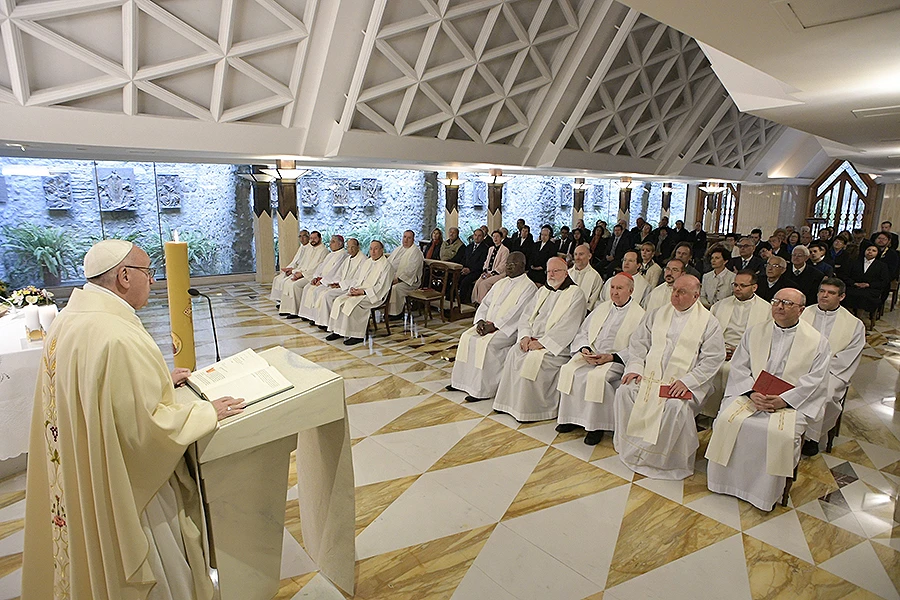
Pope Francis spoke during his Mass in the chapel of the Vatican’s Saint Martha guesthouse, focusing on the day’s first reading from the Acts of the Apostles, which recounts the stoning of Stephen, the Church’s first martyr.

When Stephan was speaking to the scribes, their hearts were closed and they didn’t want to listen to what he had to say, so they became infuriated and began to attack him, Francis said, noting that many of the prophets who preceded Christ were treated in the same way.

“When the prophet arrives to the truth and touches the heart, either the heart opens or the heart becomes more like stone and anger, persecution, are unleashed. This is how the life of a prophet ends.”

Truth, the pope observed, is often uncomfortable and hard to accept. Because of this, the prophets were always persecuted when speaking the truth.

“But what for me is the test that a prophet undergoes when he tells the truth strongly? It’s when this prophet is capable of not only speaking, but crying for the people who have abandoned the truth [Jesus gave strong rebukes, but he also wept]. This is the test. A true prophet is the one who is capable of crying for his people and also saying things strongly when he has to. [A prophet] is not timid, he is always like this: direct,” but full of hope.

Francis then noted how Stephen was killed in the presence of Saul, who would later become St. Paul.

Quoting a phrase from Tertullian, Francis said, “the blood of the martyrs is the seed of Christians.”

The Church, he said, “needs prophets…it needs all of us to be prophets.” But prophets are different than critics, he said, explaining that a critic is a person who does not approve of anything or anyone, and “this is not a prophet,” this is another thing.

“The prophet is someone who prays, who looks to God, who looks to his people, who feels pain when the people go astray, who cries,” the pope said, praying that “the Church never lacks this prophecy of service, to always go forward.”

[…]

No Picture
News Briefs

The life of a hermit: A glimpse inside the little-known state of life

April 15, 2018 CNA Daily News 2

Portland, Maine, Apr 15, 2018 / 04:01 pm (CNA/EWTN News).- The word ‘hermit’ might conjure up some strange images, a la John the Baptist living reclusively in the desert, wearing a hair shirt and eating locusts and honey.

The word itself comes from the Greek ‘eremos’, meaning wilderness or an isolated place. The vocation of a hermit became most popular among early Christians, who, inspired by Old Testament saints such as Elijah and John the Baptist, desired to live a life set apart and therefore withdrew into the desert in order to live lives of prayer and penance.

But the vocation is still a recognized calling in the Church today, and is about so much more than seemingly-odd ascetic practices and isolation.

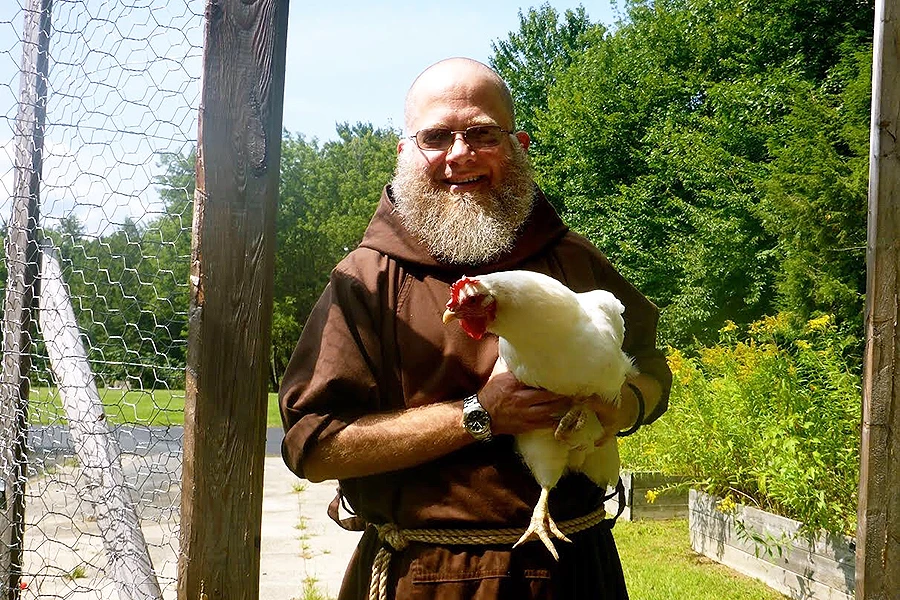
In the interview below, Brother Rex, a hermit at Little Portion Hermitage in the Diocese of Portland, told Catholic News Agency what it is like to live the eremitic life in the 21st century.


What does it mean to be a hermit?

According to the Church’s latest Code of Canon Law the canonical definition of a hermit is as follows:

Can. 603 §1. In addition to institutes of consecrated life, the Church recognizes the eremitic or anchoritic life by which the Christian faithful devote their life to the praise of God and the salvation of the world through a stricter withdrawal from the world, the silence of solitude, and assiduous prayer and penance.

§2. A hermit is recognized by law as one dedicated to God in consecrated life if he or she publicly professes in the hands of the diocesan bishop the three evangelical counsels, confirmed by vow or other sacred bond, and observes a proper program of living under his direction.

A shorthand and non-canonical definition that I use is to say that a hermit is a woman or man who lives alone expressly for the glory of God, the good of the Church and the salvation of souls. Some hermits are consecrated by the Church per Canon 603 above and live their vocation in the name of the Church; some hermits live out their calling without publicly professing their commitment in the hands of the diocesan bishop. I am hermit of the former kind, i.e. according to Canon 603.

How did you find out about this way of life, and what drew you to it?

Grace drew me to this life. The example of the Desert Fathers and Mothers drew me to this life. The example of many of the great saints throughout history – Francis of Assisi, just to name one well-known saint who lived as hermit for a time before he was called to found a religious fraternity of Brother – drew me to this life. Through all and with all and in all of this it was God’s grace calling me to this particular way of discipleship.

How does one become a hermit? Was there someone you followed or learned from? How is the formation process different than that of a religious in community?

If a person wishes to discern a vocation to the eremitic life according to Canon 603, that person will want to contact the chancery of the diocese in which they live to determine whether or not the Ordinary of the diocese is open to the possibility of having a hermit under his canonical jurisdiction. If he is, the Ordinary or his representative in conversation with the would-be hermit will determine how the discernment process is to proceed.

What does a day in the life of a hermit look like?

Each hermit has his or her own schedule. My schedule looks like this:

My day begins around 4:00 a.m. I make a daily Holy Hour from 5:00-6:00 a.m. during which I pray the Morning Office. I attend daily Mass at a local parish at 7:00 a.m. After returning from Mass I have breakfast and spend the rest of the morning engaged in spiritual reading, Lectio Divina, and meeting occasionally with any person who has made an appointment to see me for spiritual direction. After Noonday Prayer and lunch, the afternoon (approximately 1-5 p.m.) consists of a work period during which I respond to email, and take prayer requests via email or regular mail. I pray the Evening Office at 5:00 p.m., my evening meal is at 5:30pm, Night Prayer is at 7 p.m., and lights out by 8 p.m. most nights.

This schedule is rigid enough to provide stability for my vocation in the silence of solitude, yet flexible enough to accommodate running errands, doctor’s appointments, accomplishing tasks around the hermitage and so forth.

How isolated are hermits, in practice? How often or in what context do you encounter other people?

It varies. Some hermits rarely venture out of their hermitage. Some hermits venture out a couple of days a week to some form of work to provide financial support. The amount of time a hermit spends outside the hermitage or otherwise encounters other people is determined to a large degree by the interpretation of Canon 603 in dialogue with their Ordinary or his representative, and the hermit’s Rule or Plan of Life.

What are some of the biggest misconceptions about this way of life that you have encountered?

The biggest misconception I have encountered is that people seem to think that hermits are misanthropes who dislike other people and so hide away from them; that our life is not so because we love God, but because we can’t get along with other people (at best) or dislike humans altogether (at worst).

I remember one person telling me I couldn’t possibly be a hermit because I am too outgoing and friendly toward others! That being said, I would argue that eremitic life and misanthropy are two very different things. Eremitic life is a calling from God and includes a love of others. Misanthropy on the other hand is a psychologically maladaptive response to the world. This is not to say that all hermits are friendly and outgoing – being friendly and outgoing are a matter of temperament – but it is to say that hermits in a healthy and Christian sense do not, indeed cannot, “dislike humankind” which is the very definition of misanthropy.

What are some of the most joyful aspects of the life of a hermit?

One of the most joyful aspect of my life as a hermit is the opportunity God has given me to spend long periods in the silence of solitude to practice being present to God and to my neighbor through prayer. Paradoxically perhaps, another joyful aspect of my vocation is the part I am blessed to play in the lives of other people as they invite me to join them on their life journey through the ministry of intercessory prayer. Thus, in a particular way i am able to fulfill Our Lord’s command to love God and neighbor.

Are there other hermits in the U.S. that you know of, or have met? Is there a hermit network of sorts?

I’m sure someone somewhere keeps an official tally of the total number of consecrated hermits in the Church throughout world, but I don’t know who or where. In the diocese where I live there are five or six other hermits listed in the official Diocesan Directory. I am also aware of hermits, both male and female, in other dioceses in the U.S. and abroad. As for a ‘hermit network,’ I know of nothing official, but some of us do keep in touch via an occasional email, or letter or phone call. As I said, we not misanthropes. Not most of us, anyway!

Is there anything that you wish other Catholics, Christians or society at large knew about being a hermit?

What I pray for other Catholics, non-Catholic Christians and society at large is that they, like me, come to experience the freedom, happiness and joy that comes from submitting one’s will and life to the loving lordship of Jesus Christ in whatever state of life they find themselves.

Anything else you’d like to add?

Assure your readers that I live my vocation as a prayer for them. Ask them to please pray for me, a sinner.


Prayer requests for Brother Rex, as well as his spiritual reflections and links for financial support, can be found at Friends of Little Portion Hermitage.

[…]