


Technically part of Europe but floating on its own in the middle of the Atlantic, Iceland has recently emerged as a country where the Church is taking a stand against the encroachment of aggressively secular laws and demands.
This has happened before in Iceland. The country’s patron saint, St. Thorlak Thorhallsson, worked in the 12th century to protect the Church in Iceland from overbearing secular authorities.
Christianity began to gain traction in Iceland in the tenth century, and the Icelandic assembly (the Alþingi) officially adopted Christianity as the national religion in the year 1000.
The arrival of the Protestant Reformation saw Iceland switch to the Lutheran faith amid considerable violent protest. Catholics who refused to become Lutheran were exiled. And some fared even worse. The Catholic bishop at that time was executed for refusing to accept the terms of Reformation Iceland.
The country would not see another Catholic bishop for 400 years.
The Catholic Church was unable to reestablish a presence in Iceland until 1855. During the first half of the 20th century, the Diocese of Reykjavik remained tiny.
But the second half of the 20th century saw a massive proportional increase.
Iceland’s Catholic population continues to grow, largely due to newcomers from Poland and Lithuania, and to a lesser extent from Latin America and the Philippines. Aside from the English or Icelandic languages, Mass might be held in Lithuanian, Polish, or Spanish.
Iceland currently has one diocese, based in its capital city of Reykjavik, that includes seven parishes. Catholics currently comprise about 4% of Iceland’s overall population of 400,000.
The Catholic Bishop of Reykjavik said that in 2023 his diocese had performed 150 baptisms compared to just 14 funerals. These numbers may look relatively modest, but they are certainly headed in the right direction. The bishop himself even remarked that the Church in Iceland had the most dynamic trajectory in all of Europe.
Almost all Catholic clergy in the country come from abroad. Iceland is not the easiest assignment. The climate makes much of the country almost unnavigable for much of the year.
Another challenge for clergy who desire to proclaim and uphold Catholic dogma, doctrine, and practice is that Iceland is one of the most secular countries on earth.
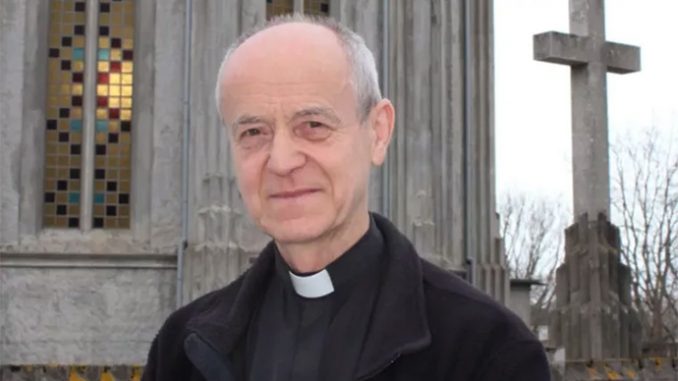
Nobody knows this better than Msgr. Jakob Rolland, the Chancellor of the Diocese of Reykjavík.
While appearing as a guest on an Icelandic state radio show in early March of this year, he stated the Church’s position on homosexuality and mentioned that the Church provides guidance to Catholics with gay tendencies who seek spiritual assistance.
It might sound pretty mundane so far. But soon, following the broadcast of the radio interview, Icelandic LGBT groups began demanding that Fr. Rolland face criminal punishment, as reported here at Catholic World Report.
Such demands could carry some real weight in Iceland: Since 2023, the nation’s penal code states that anyone seeking to alter a person’s sexual orientation could face a prison term of up to three years.
Following Fr. Rolland’s interview, the country’s Minister of Foreign Affairs, an ethnic Icelander who identifies as Catholic, urged the Church not to “go against diversity.”
Iceland’s Lutheran Church—to which most Icelanders technically still belong—needs no such convincing, as it proudly supports “equality between all genders” and has been conducting marriages between various combinations of “LGBTQ+ people” since 2010.
During this time, though, Iceland’s Lutheran Church has seen a persistent decline in attendance. Into this spiritual void, LGBT issues have thrust their way to the forefront.
But it would be incorrect to assume that everyone enjoys riding on Iceland’s LGBT toboggan.
On the contrary, Fr. Rolland told CWR that many in Iceland are “fed up with the LGBT religion embraced by the Lutheran State Church and by the political authorities of the country,” who have helped turn Iceland into “an LGBT dictatorship.”
Amid the controversy, he said he “got a lot of support from so many people both in Iceland and abroad,” adding that “every day, people have contact with me to tell me that they decided to join the Catholic Church.”
“The publicity for the Catholic Church has been huge,” said Fr. Rolland. “Maybe I should send a letter to the LGBT organization to thank them for the publicity they made.”
He said that, for the moment, nothing has happened with the Icelandic authorities, and he is not yet aware of any police investigation.
Fr. Rolland seems more concerned about the situation that young people in Iceland are facing.
“They are the victims,” he said. “They get continuous in-school LGBT teaching, at least one hour every week, and are totally disoriented. They do not know anymore what they are and completely lose orientation on what is marriage and a normal family life.”
A native of France, Fr. Rolland has lived in Iceland for over four decades and deeply regrets the trajectory taken by his adopted homeland.
“The damage is done,” he said. “Prayer is needed.”
If you value the news and views Catholic World Report provides, please consider donating to support our efforts. Your contribution will help us continue to make CWR available to all readers worldwide for free, without a subscription. Thank you for your generosity!
Click here for more information on donating to CWR. Click here to sign up for our newsletter.




Apparently a California coffee company has decided to remove the LGBT flag “in order to be more inclusive”.
We live in interesting times!
I wonder though how Catholic the Catholics in Iceland are. Like most Catholics, they are likely ambivalent about abortion (it’s not for me but okay for thee). The government there crowed a couple of years about how NOT ONE Down’s baby was born there.
Thank you Father. Prayer is needed!