No Picture
News Briefs

Federal judge: Colorado’s anti-coronavirus rules can’t single out churches

October 22, 2020 CNA Daily News 1

CNA Staff, Oct 22, 2020 / 10:56 pm (CNA).- A federal judge has said Colorado officials may not enforce anti-coronavirus limits against two churches, saying that the state rules lack sufficient exemptions for the free exercise of religion.

The regulations treat churches more strictly than similar gatherings, which are required to observe social distancing but not observe occupational limits as well, the judge said, adding that the rules fail to protect congregations that may wish to remove facial coverings for religious reasons.

“With each exception Colorado makes for secular institutions, the failure to make the same exemption for houses of worship becomes increasingly problematic,” U.S. District Court Judge Daniel Domenico said in his Oct. 15 order. “Colorado’s failure to offer a compelling reason why houses of worship are subject to greater restrictions than warehouses, schools, and restaurants violates the First Amendment’s guarantee of the free exercise of religion.”

The judge’s order exempts the two churches from mask requirements and occupancy limits that they believe bar their religious practice. However, they still must follow sanitation requirements, maintain social distancing, and prohibit shaking hands. The temporary injunction is in place while the case is heard in court.

“(T)he Constitution does not allow the State to tell a congregation how large it can be when comparable secular gatherings are not so limited, or to tell a congregation that its reason for wishing to remove facial coverings is less important than a restaurant’s or spa’s,” Domenico said.

The plaintiffs are two Protestant pastors and their Denver-area churches: Bob Enyart of Denver Bible Church in Wheat Ridge and Joey Rhoads of Community Baptist Church in Brighton. In August they filed a complaint against federal and state officials charging that the state health orders were vague and infringed on religious freedom.

“The lawsuit calls both the federal government and Colorado leaders into account for their violations of the right to free exercise of religion, among other abuses of power, primarily resulting from Governor Jared Polis’ COVID-19 related executive orders,” said Thomas More Society special counsel Rebecca Messall, who with co-counsel Brad Bergford represented the complainants.

The plaintiffs did not demonstrate a likelihood of success on most of their claims, but their First Amendment free exercise claim against state officials will likely succeed, the judge said. State officials may not enforce executive orders or public health orders against the plaintiffs “to the extent those orders treat houses of worship differently from comparable secular institutions.”

Officials may not enforce additional numerical occupancy requirements against the two churches, nor enforce the “requirement that congregants wear face masks at all times during worship services,” said Domenico.

The State of Colorado has filed an appeal.

“Absent some sort of bad faith, a law that is otherwise neutral and generally applicable does not suddenly become unconstitutional simply because it contains limited exceptions for certain secular activities but not religious activities,” said the motion from the office of the Colorado attorney general.

“Nothing in the state defendants’ public health orders reveals discrimination or bigotry targeted at religion,” the motion continued. “If anything, Colorado’s orders treat religious organizations more favorably than comparable organizations that are nonreligious.”

The state’s motion argued that Domenico took scientific evidence out of context, the Denver Post reports.

Enyart, one of the pastors, appeared skeptical of the coronavirus response.

“It’s like ‘The Boy Who Cried Wolf’,” he told CBS4 News before the judge issued the order. “If it was a true emergency, people would be inclined to ignore government orders because of government’s overreach. There’s so much evidence coming out that the lockdown is hurting people.”

Enyart, who also hosts a radio show, has sometimes been a controversial figure. He has vocally criticized and even conducted protests of other Christian groups, pro-life groups and politicians he believes to be insufficiently opposed to abortion.

According to the pastors’ complaint, compliance with state rules, executive orders and public health rules violates the plaintiffs’ “sincerely held religious beliefs.” The rules “substantially burden” free exercise of religion.

The rules “restrict or prevent religious speech and the expression of personal communication in how closely plaintiff pastors can be to persons in their congregations, and in how closely congregants can be to each other, to meet, pray, talk, stand, sit, walk, sing, pray, embrace, shake hands, smile or facially express their thoughts, opinions and emotions verbally and through facial expression.”

“Moreover, plaintiffs are restricted in holding baptisms, communion services, marriage ceremonies and laying of hands,” the complaint continued. It said the two churches conduct religious services and fellowship activities for congregations larger than 50 people. The capacity limits on houses of worship are “more severe” than those that apply to similar settings, it said.

“The state also allows a variety of exceptions to its facial-covering requirement where it recognizes that removing a mask is necessary to carry out a particular activity,” said the complaint.

Domenico said the court does not doubt the good faith decisions of state officials’ efforts “to balance the benefits of more public interaction against the added risk that inheres in it.”

While the Constitution “doesn’t kneecap a state’s pandemic response,” he said, “the existence of a crisis does not mean that the inalienable rights recognized in the Constitution become unenforceable.”

Although the religious must comply with neutral, generally applicable restrictions, he said, “the First Amendment does not allow government officials, whether in the executive or judicial branch, to treat religious worship as any less critical or essential than other human endeavors. Nor does it allow the government to determine what is a necessary part of a house of worship’s religious exercise.”

Most Colorado outbreaks have taken place at workplaces, schools and businesses, not churches, Domenico said, citing state data. The largest outbreaks have been at colleges and prisons. Less than 2% of the 900 active or resolved outbreaks in Colorado have taken place at religious facilities.

Other religious groups’ challenges to Colorado limits on public gatherings have not prevailed in court.

In September, U.S. District Judge Christine M. Arguello rejected the Colorado Springs-area Andrew Wommack Ministries’ challenge to coronavirus limits, saying public health was at risk. Health officials said a novel coronavirus outbreak at a July Bible conference hosted by the organization led to 63 cases and one death, Colorado Public Radio said.


[…]

No Picture
News Briefs

Knights of Columbus announce novena ahead of founder’s beatification

October 22, 2020 CNA Daily News 2

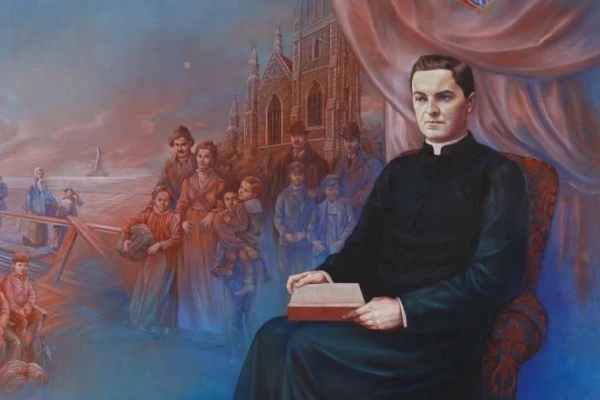
CNA Staff, Oct 22, 2020 / 07:00 pm (CNA).- The Knights of Columbus has launched a nine-day novena to prepare for the beatification of the organization’s founder, Fr. Michael McGivney, at the end of the month.

The novena starts October 22 and continues through October 30, the eve of Fr. McGivney’s beatification.

During the novena, participants will reflect on different aspects of McGivney’s life, including his pastoral leadership, charity toward the poor, and support for family life and the domestic church.

Each day of the novena will include prayers for McGivney’s intercession and reflections on virtues to imitate. It will also include a prayer for McGivney’s canonization, which will require one more approved miracle.

“We are praying that many graces will come through the beatification of Father McGivney, that by his example of virtue we may be inspired to put our faith into action for the good of our families, parishes and communities,” said Supreme Knight Carl Anderson in a press release.

“We will also pray for a miracle that will lead to the canonization of Father McGivney.”

McGivney will be beatified October 31 at the Cathedral of St. Joseph in Hartford, Connecticut.

The priest founded the Knights of Columbus in 1882. Today it is the world’s largest Catholic fraternal service organization, with nearly two million members in more than a dozen countries. Over the past year, the Knights of Columbus have volunteered over 77 million service hours and donated $187 million in charitable funds.

Born in Waterbury, Connecticut, in 1852, McGivney played a critical role in the growth of the Church in the United States in the latter part of the 19th century. After his ordination in Baltimore in 1877, he served a largely Irish-American and immigrant community in New Haven.

Amid an anti-Catholic climate, he established the Knights to provide spiritual aid to Catholic men and financial help for families that had lost their breadwinner.

McGivney’s sainthood cause officially opened in 1997 in the Archdiocese of Hartford, Connecticut. In 2008, Pope Benedict XVI declared the American-born priest a Venerable Servant of God in recognition of his life of heroic virtue.

Pope Francis approved McGivney’s first miracle in May. The miracle involved an unborn child in the United States who was healed in utero of a life-threatening condition in 2015 after his family prayed to McGivney.

Following his beatification, McGivney’s cause will require one more authenticated miracle before he can be considered for canonization.

He would not be the first member of the Knights of Columbus to be canonized. A group of six Mexican members of the organization were martyred during the Cristero War of 1926-29 and its aftermath.

The six are St. Luis Batis, St. Rodrigo Aguilar, St. Miguel de la Mora, St. Pedro de Jesús Maldonado, St. José María Robles, and St. Mateo Correa.


[…]

No Picture
News Briefs

Catholic educators ‘united in solidarity’ after France teacher attack

October 22, 2020 CNA Daily News 1

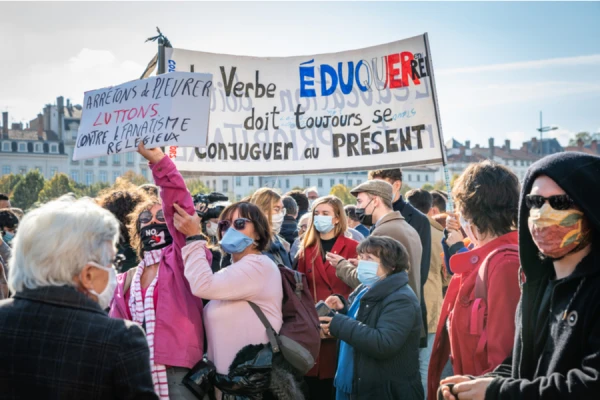
CNA Staff, Oct 22, 2020 / 06:19 pm (CNA).- The president of the French bishops’ council for Catholic education expressed solidarity with the country’s school community following the beheading of a Parish school teacher in an Islamist terror attack last week.

“In these dark hours, Catholic education feels deeply united in solidarity with the whole school community…and first of all with the teachers,” Archbishop Laurent Ulrich of Lille said in an Oct. 19 statement. The statement was co-signed by Philippe Delorme, Secretary General of Catholic Education.

“Because it is our raison d’être, we will defend the school (and school community) so that ignorance is fought everywhere,” Ulrich said.

“Ignorance builds fear,” he added.

Ulrich wrote in response to the beheading of Samuel Paty, who was killed Oct. 16 in Conflans-Sainte-Honorine, a suburb of Paris. Student Abdoullakh Abouyedovich Anzorov reportedly attacked Paty, a history and geography teacher, after Paty showed his class a cartoon depicting Muhammad. According to the BBC, Paty had reportedly told Muslim students that they could leave the room before showing the cartoon if they thought they would find it offensive.
Eyewitnesses said that Anzorov shouted “Allahu akbar” — Arabic for “God is great” — as he murdered Paty near the middle school where he taught. The 18-year-old Russian national of Chechen origin was shot dead by police shortly after the murder. “We will not back down on our confidence in the possibility of fraternity between people…of dialogue between social groups, between religions and cultures, between knowledge, between faith and reason,” Ulrich stated. “And as Catholics, we repeat here to Muslims in our country that we will always be in dialogue with them, without confusing them with fanatics, extremists and terrorists,” the bishop added. “We want to assure the members of the (Catholic education community) that the mission they carry is essential, that it is not in vain, that its fruits of humanization will outweigh the evil…you have our admiration, our friendship, our respect and our prayer,” the bishop said.
To all within the education community, “we reaffirm our firm and persevering determination to work for an educational fraternity,” he added.
Paty was remembered in a French ceremony Oct. 21, during which he was awarded the Légion d’Honneur, France’s highest national honor.
Numerous Catholic leaders have condemned the attack and mourned the violent murder in the days following Paty’s killing.
Archbishop Dominique Lebrun of Rouen was joined by representatives of Muslim, Jewish, and other Christian communities Oct. 18 at the memorial near the church of Saint-Étienne-du-Rouvray, where Fr. Jacques Hamel was murdered by Islamists in 2016.
Archbishop Jean-Paul James of Bordeaux co-signed an interreligious statement with Jewish, Buddhist, Muslim, Protestant and Orthodox leaders of Gironde, France, condemning the murder and calling for renewed, peaceful solidarity among religious believers. “May his family, loved ones, friends, students and colleagues find here the expression of our deep compassion. We are all upset by this barbaric act, and particularly in solidarity with all the teachers deeply affected by this heinous crime,” the religious leaders stated Oct. 21. “Human life is sacred. We reaffirm that any attack against (life) in the name of God is unjustifiable. Together…we want to reiterate forcefully that no one can attempt the life of another, by claiming their religious or ideological convictions whatever they may be.” “In this difficult time, against violence and hatred, we want to firmly keep our commitment to be peacemakers,” they added. “The best bulwark against barbarism, fanaticism and terrorism remain fraternity, education and unity.” The leaders invited all believers to continue to pray and work for a peaceful society.


[…]

No Picture
News Briefs

US hosts signing of declaration rejecting ‘human right’ to abortion

October 22, 2020 CNA Daily News 1

Washington, D.C. Newsroom, Oct 22, 2020 / 01:00 pm (CNA).- The United States hosted the signing ceremony of the Geneva Consensus Declaration on Thursday. The document rejects the claim that abortion is an international human right. 

“Today we put down a clear marker; no longer can UN agencies reinterpret and misinterpret agreed-upon language without accountability,” said Secretary of Health and Human Services Alex Azar during the ceremony Oct. 22.. 

“Without apology we affirm that governments have the soverign right to make their own laws to protect innocent life and write their regulations on abortion” Azar said. 

“In signing the declaration today, the United States is honored to stand alongside Brazil, Egypt, Hungary, Indonesia, and Uganda, the cross-regional cosponsors for the declaration,” he said. A total of 32 countries have signed onto the declaration. 

Azar called the signing the “high point” of his time leading the department, and noted that countries who have not yet signed the document can still do so. 

“The Geneva Consensus Declaration is a historic document, stating clearly where we as nations stand on women’s health, the family, honoring life, and defending national sovereignty,” said Azar, calling it “much more than a statement of beliefs.” 

“It is a critical and useful tool to defend these principles across all United Nations bodies and in every multilateral setting, using language previously agreed to by member states of those bodies,” he explained.  

The declaration was written partially in response to a “disturbing trend” in the United Nations, he said. 

“With increasing frequency, some rich nations and UN agencies beholden to them are wrongly asserting [that] abortion is a universal human right.” 

Azar said that these policies have the effect of forcing countries to implement “progressive” abortion laws or face the loss of funding or international standing. He accused some nations of having a “myopic focus on a radical agenda that is offensive to many cultures, and derails agreement on women’s health priorities.” 

The coalition of signing countries “will hold multilateral organizations accountable,” he explained, by denouncing these organizations for “promoting positions that can never gain consensus.”  

“We will unequivocally declare that there is no international right to abortion. We will proudly put women’s health first at every stage of life,” he said.  

Secretary of State Mike Pompeo also spoke at the signing ceremony, calling the declaration a “deep and personal commitment to protect human dignity” and “the culmination of lots of hard work.” 

Pompeo highlighted the Trump administration’s “unprecedented defense of the unborn abroad,” and said that “the United States has defended the dignity of human life everywhere and always” over the last four years.  

“It’s historic to be here,” he said. “It’s the first time that a multilateral coalition has been built around the issue of defending life.” 

The Geneva Consensus Declaration, said Pompeo, is a “commitment to work together at the UN and in other international settings to achieve tangible results,” something he is “confident” will happen. He added that he was “truly proud” of the work being done. 

Valerie Huber, Special Representative for Global Women’s Health at U.S. Department of Health and Human Services (HHS), provided background of the declaration. 

The declaration, Huber explained, was intended to be signed at the culmination of the World Health Assembly’s global women’s health summit, which was canceled due to the COVID-19 pandemic. 

“We decided to move forward with the declaration now, because accelerating health gains for women cannot wait,” said Huber.

“Supporting the intrinsic value of the family cannot wait. Protecting life born and unborn, and the sovereignty of nations to make their own laws on this issue cannot wait.”


[…]

No Picture
News Briefs

Where China’s bishops stand as the Sino-Vatican deal is renewed

October 22, 2020 CNA Daily News 0

Rome Newsroom, Oct 22, 2020 / 12:00 pm (CNA).- As the Sino-Vatican provisional agreement was renewed Thursday, an article in a Vatican newspaper said that two Chinese bishops had been appointed under the “regulatory framework established by the agreement.”

Vatican officials have repeatedly stressed that the accord between China and the Holy See — which will not expire until Oct. 22, 2022 — is focused solely on the appointment of bishops.

While the terms of the agreement have been kept confidential, it reportedly allows the Chinese Catholic Patriotic Association to choose a slate of nominees for bishop.

An article published by L’Osservatore Romano Oct. 22 said: “The main purpose of the provisional agreement on the appointment of bishops in China is to support and promote the proclamation of the Gospel in those lands, restoring the full and visible unity of the Church … The question of the appointment of bishops is of vital importance for the life of the Church, both locally and universally.”

With this in mind, what do we know about the bishops who have been affected by the Sino-Vatican agreement? Those who were newly appointed under the confidential provisions of the deal, those whose excommunications were lifted after the deal, and the bishops who stepped back from their former leadership roles.

Who was appointed?

Bishop Antonio Yao Shun of Jining, in the Autonomous Region of Inner Mongolia, was the first bishop consecrated in China under the terms of the Sino-Vatican agreement, on Aug. 26, 2019. 

Prior to his appointment, Yao had served as the secretary and later vice director of the liturgical commission overseen by the Chinese Catholic Patriotic Association and the Council of Chinese Bishops since 1998. He returned to the Diocese of Jining in 2010 to serve as victor general.

Born in Ulanqab in 1965, Yao is a native of Inner Mongolia. He both studied and taught at the national seminary in Beijing. After his ordination to the priesthood in 1991, Yao completed a degree in liturgy in the United States at St. John’s University in Minnesota from 1994 to 1998. He also spent some time pursuing biblical studies in Jerusalem.

Yao’s episcopal motto is “Misericordes sicut pater,” which means “Be merciful as the Father is.”

The New York Times has reported that the Vatican had approved Yao as the successor of Bishop John Liu Shigong in the Diocese of Jining in 2010, but the Chinese government refused to approve him, even after Bishop Liu died in 2017 at the age of 89. 

But Chinese researchers have pointed out that Yao is not one to speak out critically about the Chinese government.

“The Communist Party feels comfortable with him,” said Francesco Sisci, a Beijing-based researcher on Chinese Catholicism told the Times in 2019. “They don’t want someone doing agitprop against them.”

Bishop Stephen Xu Hongwei of Hanzhong, in Shaanxi Province, was ordained a coadjutor bishop on August 28, 2019, at the age of 44. 

He serves the Diocese of Hanzhong as coadjutor to 91-year-old Bishop Louis Yu Runchen. The diocese was divided between underground and state-approved Catholic communities for many years. Yu Runchen was selected by the Chinese Patriotic Association to be bishop without the approval of the Holy See in 1985, a year after the Vatican’s appointment of Bishop Bartholomew Yu Chengti. The Vatican recognized Yu only after the underground bishop died in 2009.

After his ordination in 2002, Xu studied at the Pontifical Urban University in Rome from 2004 to 2008. He undertook further studies in the Diocese of Vancouver, Canada. Upon returning to China in 2010, he was appointed pastor of West Street Cathedral in the Diocese of Hanzhong. 

Xu was a member of a regional Standing Committee of the Chinese People’s Consultative Political Conference — the consultative political body part of the Chinese Communist Party’s United Front — in 2012 and 2017, and the Chinese Patriotic Catholic Association.

Whose excommunications were lifted? 

With the signing of the provisional agreement between the Holy See and China in Sept. 2018, Pope Francis also lifted the excommunication of seven bishops who had been appointed illicitly by the state-controlled Chinese Patriotic Association. 

They include Bishop Joseph Guo Jincai, 52, of Chengde in Hebei Province. Pope Francis created the Diocese of Chengde in 2019 out of the Dioceses of Jinzhou and Chifeng in 2018, so that Guo could lead his own diocese after his excommunication was lifted. 

Guo participated in the Synod of Bishops in Rome in 2018 and has served three terms as a deputy to the National People’s Congress in Beijing. 

As a member of China’s legislative body, Bishop Guo publicly supported an amendment to eliminate presidential term limits and enshrine “Xi Jinping Thought on Socialism with Chinese Characteristics for a New Era” in the Chinese constitution in March 2018.

“My position as a national legislator will not and cannot affect my religious service, as China implements the principle of separation of church and state,” Guo told the state-sponsored newspaper Global Times at the National People’s Congress in 2018.

Bishop Vincent Zhan Silu, 61, of Mindong/Funing in Fujian Province. After underground Bishop Joseph Guo Xijin stepped aside to allow him to lead the diocese, Zhan led a delegation of 33 priests from the Diocese of Mindong to participate in a “formation course” at the Central Institute of Socialism, in collaboration with the United Front of Fujian Province, where they listened to presentations on the “sinicization of religion.” 

“We must contribute to the creation of a new reality in the diocese of Mindong and in the Catholic Church of Fujian,” Zhan said after the course, according to Asia News. 

“We will deepen the content of Catholic doctrine in order to foster social harmony, progress and a positive culture. To carry out the sinicization of religion with determination, we will continue to follow a path that conforms to socialist society,” Zhan said in August 2019.

Bishop Paul Lei Shiyin, 56, of Leshan in Chongqing Province. Lei served as an official delegate at the government’s Chinese People’s Political Consultative Conference in 2018. He previously served as a vice president of the Patriotic Association. 

After his excommunication was lifted, Lei was a speaker at a 2019 celebration of the Chinese Red Army’s Long March, led by Mao Zedong, in which he spoke of a meeting convened by Mao in a (requisitioned) Catholic priest’s house in Moxi in 1935 as a story of “patriotism of our country’s Catholicism,” according to the Catholic Patriotic Association website. 

Bishop Joseph Huang Bingzhang, 53, of Shantou in Guangdong Province. After he was appointed by the government without papal permission in 2011, Huang became vice president of the Chinese Patriotic Catholic Association. 

He served as a deputy in the most recent National People’s Congress, as well as the National People’s Congress that took place from 2008 to 2013.

Huang said in 2017 that he would work to actively promote the practice of Catholic patriotism, according to the Chinese Patriotic Association website.

Bishop Joseph Liu Xinhong, 56, of Anqing in Anhui Province. Illicitly ordained in 2006 after the government-controlled Catholic bishops’ conference combined the dioceses of Anqing, Bengbu and Wuhu to form the Anhui diocese — a restructuring that was not recognized by the Holy See, according to UCA News.

Bishop Joseph Ma Yinglin, 55, of Kunming in Yunnan Province. Ma previously served as secretary for the Council of Catholic Bishops at a time when the government-controlled “episcopal conference” was not recognized by the Holy See. In 2010, Ma was appointed president of the Chinese patriotic association’s bishops’ conference.

Bishop Joseph Yue Fusheng, 56, of Harbin in Heilongjiang Province. Yue was illicitly named bishop of Harbin in 2012 by the Chinese Catholic Patriotic Association.

Bishop Anthony Tu Shihua of Hanyang and Puqi in Hubei province. Before his death in 2017 at the age of 98, Tu expressed a desire to be reconciled with the Holy See. One of China’s first illicitly named bishops, Tu was appointed without papal mandate in 1959, and later served as rector of the National Seminary in Beijing between 1983 and 1992, and as a leader of the Patriotic Association and the Council of Chinese Bishops. 

Who stepped aside?

Bishop Peter Zhuang Jianjian, 89, of Shantou in Guangdong Province was asked to retire by Archbishop Claudio Maria Celli in 2019 so that Bishop Joseph Huang Bingzhang would be recognized by the Vatican as the Bishop of Shantou.

Bishop Joseph Guo Xijin, 62, of Mindong/Funing in Fujian Province. In October this year, Guo announced that he was retiring to concentrate on prayer because he did not “want to become an obstacle to progress.” Guo was an underground bishop who previously agreed to become an auxiliary bishop so that state-appointed Bishop Zhan Silu would be recognized by the Vatican. “In any circumstance or change, you should never forget God, and neither ignore the Lord’s commandments, nor damage the integrity of faith, nor delay the salvation of the soul, which is the most important thing,” he said in a letter to his diocese Oct. 5.

Who is missing?

Bishop James Su Zhimin, 88, of Baoding in Hebei Province. The whereabouts of Bishop Su, who has spent 24 years in prison, is unknown. He was arrested by Chinese authorities in 1997. He was last seen by family at a hospital in 2003 while he was in government custody.

According to Bishop Su’s nephew, Chinese officials have reportedly asked the Vatican to appoint a new bishop of Baoding, UCA News reported on July 22. Their preferred candidate is said to be Coadjutor Bishop Francis An Shuxi, a member of the Chinese Catholic Patriotic Association, the state-sanctioned church.


[…]