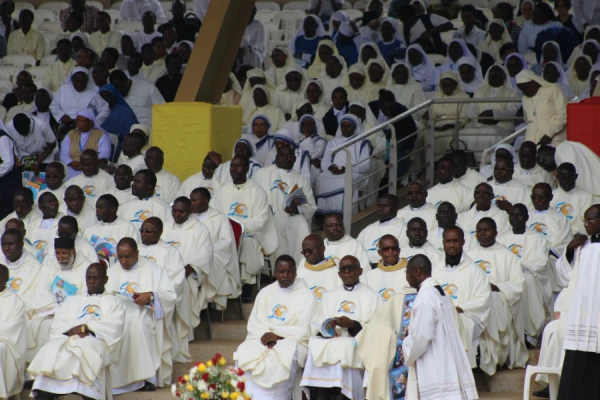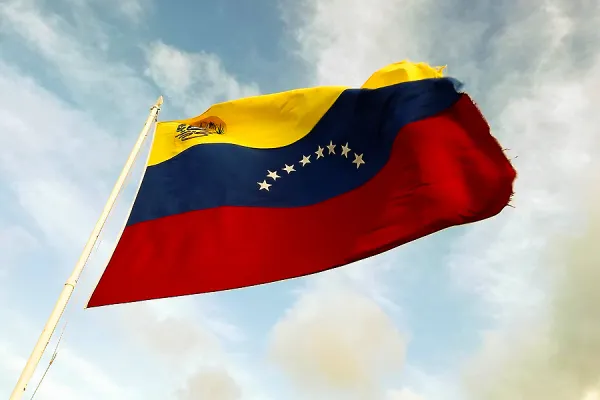
Caracas, Venezuela, Jul 29, 2019 / 02:51 pm (CNA).- After visiting clerics and seminarians in Venezuela, the secretary for seminaries of the Congregation for the Clergy issued a hopeful message for the country, which is facing shortages of basic goods.
“There is no desert that doesn’t end,” Archbishop Jorge Carlos Patrón Wong said, adding that “experiences in the history of Venezuela, and also personal and familial experiences, show that you can move forward.”
Under the socialist administration of Nicolas Maduro, Venezuela has been marred by violence and social upheaval, with severe shortages of food and medicine, high unemployment, blackouts, and hyperinflation. More than 4 million Venezuelans have emigrated since 2015.
Archbishop Patrón spoke to Venezuelans through the “Voices of Hope” program of the Venezuelan bishops’ conference.
“I’m going to repeat the words of Pope Francis: let no one rob you of hope. Be free to live in hope, free to love, free to make decisions in favor of Venezuela, and very free to believe,” Patrón encouraged.
“You have also gone through not so easy other personal, familial and national experiences in the past, but Venezuela is great, very great,” exclaimed Patrón, who explained that he was referring to Venezuela as great “because it has the seed of the Kingdom, because it has the presence of God, and you have the love of Our Lady of Coromoto.”
Patrón also emphasized that “the Kingdom of God is growing” and added that during his time in Venezuela he met “young seminarians, priests of all ages and bishops who are very determined to be the presence of God in the current circumstances.”
“Any young man, priest, even the bishops themselves had other possibilities, which perhaps were much more comfortable, humanly understandable and justifiable, but it’s beautiful to realize that we have seminarians, priests and bishops that from within, from the heart, know that it’s worth giving their lives and going through a series of sacrifices, a series of inconveniences, but they are joyful because they are giving their lives so that the Kingdom of God, the values of the Gospel, are lived in Venezuela today,” Patrón said.
The prelate added that the clerics and seminarians “are very Venezuelan because from Venezuela, in Venezuela, from their vocation, they are the best citizens, the best Christians because they are giving their lives, their potentialities, their gifts, their lives, for the people of Venezuela.”
“That’s why, when you come to Venezuela you realize there’s life, there’s youth, there’s priesthood, there’s consecrated life, there are lay faithful who have freely decided to live, develop and give themselves totally to God, for the people of Venezuela and we can say there is a living present and it’s going to see a better future,” the archbishop said.
Finally, reflecting on the formation of seminarians and the ongoing formation of deacons and priests, Patrón stressed that it is necessary to be a pastor for the current situation and for future generations.
“The people of God and we need priests who are integrally formed. The people are praying to have holy, healthy priests, generous priests and this means that in formation we have ‘very human’ human beings, very close to the people of God, and at the same time very close to Jesus Christ, very spiritual. Men of God and men of their people, who give themselves to the people of Venezuela,” he concluded.
Earlier this month the Venezuelan bishops asked that Maduro resign from office, saying his exercise of the presidency is illegimate. They called for the election of a new president as soon as possible.
The bishops cited a July 4 report from the UN human rights commissioner which said the government has committed a variety of human rights abuses, including a high number of extrajudicial killings.
Maduro was sworn in for a second term as president Jan. 10, after winning a contested election in which oppositon candidates were barred from running or imprisoned. Venezuela’s bishops have called his new term illegitimate, and Juan Guaidó, head of the opposition-controlled legislature the National Assembly, declared himself interim president Jan. 23.
Guaidó has been recognized by a number of Western governments, but has been largely unable to secure the support of Venezuela’s military. He has pledged a transitional government and free elections.
Last week the US Treasury Department claimed that Maduro and his government have profited off a food subsidy program through a “vast corruption network,” in which a fraction of the food meant to enter the country was actually imported.
 […]
[…]