No Picture
News Briefs

Blessed Stanley Rother’s influence remains felt in Guatemala
July 30, 2019 CNA Daily News 1

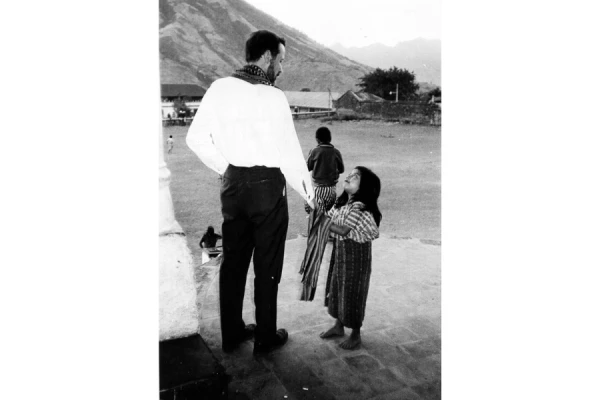
Sololá, Guatemala, Jul 30, 2019 / 03:20 pm (CNA).- There’s a black and white photo that holds a special meaning for those familiar with Blessed Stanley Rother— the farm-raised Oklahoma priest who gave his life for the faith 38 years ago while serving the poor in Central America.

The picture shows the tall, bearded priest standing on the steps of his mission church in Guatemala, holding the hand of an indigenous girl, probably four or five years old, who is gazing up at him.

“There’s actually a statue that was made based upon that photograph,” Archbishop Paul Coakley of Oklahoma City told CNA.

“No one really knew who that young girl was, but in recent months she has been identified and we had a chance to meet her [on Sunday].”

Coakley led a group of 53 pilgrims, most from his diocese, on a trip to Guatemala to celebrate Father Rother’s July 28 feast day in the parish where he served.

“She was there with her mother,” Coakley continued. “This woman is now in her 40s, her mother must be in her 60s or 70s, but we had a chance to meet her, greet her, and that was a beautiful moment because I’m very familiar with the photograph and the image.”

<blockquote class=”twitter-tweet”><p lang=”en” dir=”ltr”>LITTLE GIRL FROM FAMOUS ROTHER PHOTO FOUND!<br><br>SANTIAGO ATITLAN — The year before Blessed Stanley Rother was murdered in Guatemala, an iconic photograph of him holding the hand of a young girl was captured outside of… <a href=”https://t.co/YsFHLAJ275″>https://t.co/YsFHLAJ275</a></p>&mdash; Archdiocese of OKC (@ArchOKC) <a href=”https://twitter.com/ArchOKC/status/1156067756703395840?ref_src=twsrc%5Etfw”>July 30, 2019</a></blockquote> <script async src=”https://platform.twitter.com/widgets.js” charset=”utf-8″></script>

Portrait of a priest

Blessed Stanley Rother was from the small town of Okarche, Oklahoma, abour 40 miles northwest of Oklahoma City. He was born in 1935 and attended Holy Trinity Catholic Church and School his entire life before joining the seminary, where he struggled at first, but he eventually graduated from Mount St. Mary’s Seminary in Maryland. He was ordained a priest of the Diocese of Oklahoma City and Tulsa in 1963.

While Rother was in seminary, St. John XXIII asked the Churches of North America to send assistance to and establish missions in Central America.

Soon after, the Oklahoma diocese established a mission in Santiago Atitlan, Guatemala, a poor rural community of mostly indigenous people, a group called the Tz’utujil, who are descendants of the Mayans.

A few years after he was ordained, Fr. Rother accepted an invitation to join the mission team, where he would spend the next 13 years of his life.

The group from Oklahoma City, along with a number of other pilgrims from the US, went to Guatemala last week to visit some of the places where Rother served in the 1960s and ’70s, including his mission parish in Santiago Atitlan.

Archbishop Coakley celebrated Mass Sunday morning at St. James the Apostle Catholic Church in Santiago Atitlan.

“We had two beautiful Masses, and the people there are very traditional in preserving their Mayan culture, Mayan dress, and they came in great crowds to the Masses that we celebrated in both Santiago Atitlan and in Cerro de Oro,” he said.

Fruits of Blessed Rother’s ministry

A group from the archdiocese generally visits Guatemala every five years, and this was the first year the group has visited since Rother’s beatification in 2017. Last year Coakley had stayed home, because he wanted to be in the archdiocese for Rother’s first feast day.

“[On Monday] I met a priest who had been baptized by Father Stanley many years ago, and I think he was the first Tz’utujil priest to be ordained from the diocese,” Coakley said.

“That was a quite evident fruit of Blessed Stanley’s ministry. Many things are still flourishing there that he was a part of, that he helped to start. The parish is strong, many vocations have come from the parish, he developed a farming cooperative, some agricultural projects that are still going strongly.”

“One of the things that really helped him connect with the people is that he took the time and made the effort to learn their language, which was a very difficult Mayan dialect,” Coakley continued.

He also helped to translate the Bible into their language, organizing a team to translate the New Testament so they could read it at Mass. That translation is still used to this day.

“He acquired the skill and proficiency so that he could preach in it, could speak to the people in that, and that was really some of the key to his success. That and the fact that he just loved being with them. He would work with them, he would eat with hem in their homes, visit them, so it was a powerful witness that endeared him to the people and he had certainly fallen in love with the people themselves.”

Blessed Rother’s influence is still felt in the parish and in the town, especially since relics of the priest are kept in the church for the people to venerate.

“The love that the people of Santiago Atitlan have for Blessed Stanley is very apparent,” Father Josh Mayer, a priest of the Diocese of Gallup who was also visiting Guatemala for the feast day, told CNA.

“At the parish, his presence is everywhere – his heart and his blood are in the Church, the room that he was killed in has been converted into a chapel in his honor, the parochial school has been named after him. Blessed Rother is well-known all over town.”

Mayer is pastor of two parishes in the Diocese of Gallup – St. Mary in Bloomfield and St. Rose of Lima in Blanco – which have a partnership with a Guatemalan school called Escuela Integrada. Father Mayer said the vibrancy of the parish where Rother served is an inspiration to him, especially the Chapel of Perpetual Adoration, which he says is always full when he visits.

“The Catholic community in Santiago Atitlan is incredibly vibrant and active. I’ve never seen as many altar servers as they have at each Sunday Mass in Santiago – it’s incredible,” he said.

“The Eucharistic Ministers and lectors and catechists and other ministry groups are all incredibly well organized and everyone takes their roles very seriously. The people are very proud of what they do for Jesus and His Church. Every time I visit the parish of Santiago Apostol, I’m inspired with a vision of what we could do at our parishes back home.”

Despite the vibrancy of the parish, Mayer reflected that Guatemala is a “land of extremes”: a beautiful, rich environment populated by people notable for their kindness, warmth, and sense of community and family life. At the same time, material poverty, malnutrition, envy, extortion, and abuse are common.

“And yet, in the midst of these profound difficulties, the Guatemalan people have a profound sense of hope and joy,” he said.

“Their faith, hope and love shine forth in a way that really is miraculous…there are many Catholic and Christian groups that work, in ways big and small, to help our brothers and sisters in Guatemala.”

Martyrdom

In the early morning hours of July 28, 1981, three ski-masked men broke into the rectory of the mission where Rother was living. The men were Ladinos— non-indigenous men who had been fighting the native people and rural poor of the country since the 1960s.

The men attempted to kidnap Rother at gunpoint, but he refused and resisted, struggling but refusing to call for help so as not to endanger the others in the parish mission. Within fifteen minutes, the men had shot the priest twice and fled.

“What Blessed Rother did on the night of July 28, 1981, wasn’t essentially different from what he was already in the habit of doing – pouring his life out for the people that Jesus had called him to serve,” Mayer reflected.

“He died well because he lived well, for God and for the flock he was given. It’s a great inspiration and a deep challenge: if you want to die as a martyr, if you want to die like Jesus, don’t wait for some terrible opportunity to come to you. Pour your life out, now, for God and for the people that He’s put in your life, and then you will be ready if the ultimate sacrifice is demanded of you.”

Path to sainthood

The Oklahoma City archdiocese opened Rother’s cause for canonization in 2007.

Pope Francis recognized Rother as a martyr in 2016. He is the first martyr from the United States and the first U.S.-born priest to be beatified, the archdiocese says.

The Rite of Beatification took place Sept. 23, 2017, in downtown Oklahoma City with more than 20,000 people from around the world in attendance.

Rother is a well-known figure in the Oklahoma City archdiocese and throughout the state. Last week, Governor Kevin Stitt proclaimed July 28 Blessed Stanley Rother Day in Oklahoma. The day coincides with Rother’s feast feast day, the 38th anniversary of his martyrdom.

The Archdiocese of Oklahoma City is in the final stages of design of a 2,000-seat shrine church, museum, and campus in his honor, to be located in south Oklahoma City, according to the archdiocese website.

“Blessed Stanley is really, in my estimation, kind of an everyman’s saint. There’s something about him that everyone can relate to,” Coakley reflected.

“He’s very human, he struggled to get through seminary, he worked hard to get through seminary…he applied all that God had given him, developed those skills and talents, and everything came in handy when he found himself at the mission.”

“Family, community, parish life were all very important to him growing up, and so he embedded himself in the parish in Guatemala among the families that he served. He became a part of each family. So I think his dedication, his availability, his determination, his willingness to roll up his sleeves and work hard, he didn’t take himself too seriously…He was courageous when things got difficult, he knew what he was facing but he chose to remain there and stay with his people, and that’s what cost him his life— his love for his people and his love for the gospel, and his desire to be faithful to the end.”
[…]

No Picture
News Briefs

After John Paul II Institute students publish letter, president defends changes

July 30, 2019 CNA Daily News 2

Vatican City, Jul 30, 2019 / 01:37 pm (CNA).- The president of the Pontifical John Paul II Institute said Tuesday that despite recently published objections from students and alumni, he believes changes at the school are a move in the right direction.

Speaking July 30 to Vatican News, Msgr. Pierangelo Sequeri aimed to respond to a recently published letter, signed online by more than 250 students and alumni of the Institute, expressing concern about the dismissal of some faculty members, about new norms for governance and administration, and about shifts to the school’s curriculum, which will soon eliminate a chair in fundamental moral theology amid a new focus on the social sciences.

“We want to express our greatest concern: the loss of the formational approach, and therefore, of the identity of the Pontifical Theological Institute John Paul II,” the student letter, dated July 24, said.

“Many students have expressed their immense concern after the unexpected publication of the new statutes and the new program of studies for our new Institute, together with the sad news of the expulsion of two professors whose chairs have a central role in the formation offered by the institute,” the students added.

Sequeri said that a change to the Institute’s curriculum and direction, called for by Pope Francis in 2017, and delineated explicitly in recently approved statutes, “responds to the great impulse of Pope Francis, who encouraged the Institute from the outset to equip itself with all the tools necessary to fulfill the mission entrusted to it since its creation of John Paul II, in the new context in which the Church lives its bonds of love in the context of the transmission of human life and of the Christian faith that pertain to marriage and the family, according to God’s plan.”

“New tools mean instruments of knowledge: not only in the sphere of the so-called sciences and human rights, but also theological and pastoral studies, which must more closely be united to one another. New tools also mean adequate resources for updated information and practical training (international considerations, pastoral counseling, comparative law, family mediation, etc.). The meticulousness in the transparent and deep adherence to the richness of Catholic tradition and the authoritative magisterium, however, obviously does not represent an innovation,” he said.

Regarding the concerns of students and alumni, Sequeri said he had only been recently notified of “the arrival of a letter, signed by several dozens of ‘students and former students’ (we have had thousands, of course) which expresses concern about the possibility of losing the solid training guaranteed by the Institute and about their uncertainty concerning the passage and coordination of the new teachings.”

Its organizers say the letter was sent by email on July 25 to Archbishop Vincenzo Paglia, the institute’s grand chancellor, and to Sequeri, and by registered mail on July 26.

“I am a little surprised that the letter, addressed to me (and to Archbishop Paglia) has been made public even before the recipients gave feedback and had time to respond. In any case, many communications relating to legitimate requests for information and reassurance are already being fulfilled, at the same pace as the ongoing definition of the process. It will be my responsibility, of course, to draw up a final answer, based on the real data of all the formalities in full operation,” Sequeri added.

On the website publishing their letter, students of the John Paul II Institute say they have not yet received assurance that they will be able to continue in the academic programs they began, and that the dismissal of two theology professors suggests they will not be able to do so. They also expressed concern about whether dismissed faculty members had been treated with due process.

The students noted in particular the dismissal of two professors of theology: Msgr. Livio Melina, the school’s long-time president, and Fr. Jose Noriega, DJCM.

In a July 29 press release, the Institute said that Melina was dismissed because his chair in fundamental moral theology was discontinued, and that Noriega was being let go back because his position as superior of his small religious community is “incompatible” with his duties as a professor. Noriega has served as his community’s superior for 12 years; his term as superior concludes in January 2020.

Sequeri told Vatican News that although some students have raised concerns about the Institute’s direction, others “have already written expressing confidence in the renewal and expansion of research and training in theological-pastoral and anthropological-cultural fields,” at the Institute.

Sequeri lamented the controversy surrounding changes to the Institute’s identity.

“The polemics, more or less malicious, that in this regard, try to involve the many students that look with trust to the project of a truly ‘Catholic’ knowledge and formation, obviously cultivate other interests. They are not the ones of John Paul II, not the ones of Pope Francis, not the ones of the Institute.”

“Love must banish fear, communion must overcome distrust, and the beauty of our common cause must prevail over personal interests,” he added.

On their website, the students said they do not wish to cause discord.

Their aim, they wrote, is to share “objective facts based on the situation, without making judgments or considerations that could harm or go against the unity of our Church or against the image of the Holy Father, Pope Francis.”

The students added that they published their letter online to “inform the public about the serious situation that our Institute is now experiencing. Our wish is also to ask for justice and to see our rights and those of our professors guaranteed in a clear way.”

[…]

No Picture
News Briefs

Chinese officials claim most Xinjiang detainees have been released

July 30, 2019 CNA Daily News 0

Beijing, China, Jul 30, 2019 / 11:01 am (CNA).- Government officials from China’s Xinjiang Uighur Autonomous Region said Tuesday that the area’s re-education camps for Muslims have been successful, with most of those held having been reintegrated into Chinese society.

An estimated 1 million Uighurs, members of a Muslim ethnoreligious group, have been detained in re-education camps in Xinjiang, a region in China’s northwest that is roughly the size of Iran.

Inside the camps they are reportedly subjected to forced labor, torture, and political indoctrination. Outside the camps, Uighurs are monitored by pervasive police forces and facial recognition technology.

The Chinese government has said reports on the camps by Western governments and media are unfounded, claiming they are vocational training centers and that it is combatting extremism.  

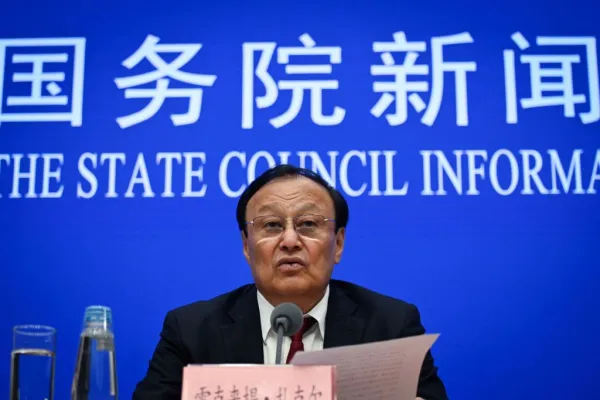
Shohrat Zakir, chairman of Xinjiang, said at a July 30 press conference in Beijing that “most of the graduates from the vocational training centers have been reintegrated into society,” according to the AP. “More than 90% of the graduates have found satisfactory jobs with good incomes.”

Xinjiang vice chairman Alken Tuniaz said detainees were allowed to “request time off” and “regularly go home,” the AP reported.

While they are not permitted to practice their religion during their “period of study”, he said, they may do so at home.

Tuniaz also said that “the majority of personnel who received education and training have returned to society and gone back to their homes,” according to the Wall Street Journal. “The majority have successfully secured employment.”

Neither Zakir nor Tuniaz provided figures to back up their claims.

The press briefing also included a performances by minority artists in traditional garb, highlighting Xinjiang as a tourist destination.

The Xinjiang officials’ claims were met with scepticism outside China; David Brophy, senior lecturer in modern Chinese History at the University of Sydney, said to the Wall Street Journal “How much of this employment involves forced relocation to elsewhere in China? How much of it is taking place in education camps that have now been repurposed as heavily surveilled factories?”

Uighurs can be arrested and detained under vague anti-terrorism laws. Violence in the region escalated in the 1990s and again in 2008.

In August 2014 officials in Karamay, a city of Xinjiang, banned “youths with long beards” and anyone wearing headscarves, veils, burqas, or clothes with the crescent moon and star symbol from using public transit. That May, universities across the region banned fasting during Ramadan.

Attention was drawn to the human and religious rights situation in Xinjiang at the recent Ministerial to Advance Religious Freedom held by the US State Department earlier this month.

US Secretary of State Mike Pompeo said July 18 at the gathering that survivors of the detention camps have described “a deliberate attempt by Beijing to strangle Uighur culture and stamp out” Islam.

In response, Chinese officials have been outspoken in defense of policies in the region.

In June, Rep. Chris Smith (R-NJ) told a congressional hearing that China’s campaign to “sinicize” religion is proceeding with brutal efficiency. “Under ‘sinicization,’ all religions and believers must comport with and aggressively promote communist ideology — or else,” Smith said.

“Religious believers of every persuasion are harassed, arrested, jailed, or tortured. Only the compliant are left relatively unscathed,” Smith stated.

[…]

No Picture
News Briefs

Bishops lament return of federal executions

July 30, 2019 CNA Daily News 0

Washington D.C., Jul 30, 2019 / 10:15 am (CNA).- Catholic leaders have condemned the federal government’s announcement last week that it will resume of executions after an almost two decade-long hiatus.

“I am deeply concerned by the announcement of the United States Justice Department that it will once again turn, after many years, to the death penalty as a form of punishment,” said Bishop Frank Dewane of Venice, Florida, chair of the U.S. bishops’ domestic justice and human development committee, in a statement released July 30. 

Attorney General William Barr on July 25 announced that executions of federal death-row inmates would resume for the first time since 2003, with five executions scheduled for December 2019 and January 2020.

“Under Administrations of both parties, the Department of Justice has sought the death penalty against the worst criminals, including these five murderers, each of whom was convicted by a jury of his peers after a full and fair proceeding,” said Barr, who is a practicing Catholic and a member of the Knights of Columbus.

Federal executions are rare, with only three occurring in the modern era and the last one being in 2003, the Death Penalty Information Center reports. The federal death penalty was ruled unconstitutional by the Supreme Court in 1972 in Furman v. Georgia, but revised federal death penalty statues were reinstated in 1988.

In 2014, President Obama ordered a Department of Justice (DOJ) review of the federal death penalty after several botched executions by lethal injection in states including Oklahoma and Ohio. However, executions will once again take place and more will be scheduled in the future, the DOJ said Thursday.

In 2018, Pope Francis approved updated language for the Catechism of the Catholic Church calling the death penalty “inadmissible because it is an attack on the inviolability and dignity of the person.”

In paragraph 2267, the Catechism acknowledges that the death penalty was “long considered an appropriate response” to grave crimes by legitimate authorities after a fair trial. However, it says, there is now an “increasing awareness” of human dignity even after such crimes have been committed, as well as more secure means of detention by societies that keep open the possibility of redemption.

When the change was announced, bishops across the United States welcomed the change. Archbishop José Gomez of Los Angeles said at the time that he was “grateful for Pope Francis’ leadership in working for an end to judicial executions worldwide,” and that the revisions “reflect an authentic development of the Church’s doctrine that started with St. John Paul II and has continued under emeritus Pope Benedict XVI and now Pope Francis.”

“The Scriptures, along with saints and teachers in the Church’s tradition, justify the death penalty as a fitting punishment for those who commit evil or take another person’s life,” Archbishop Gomez wrote.

In his statement on Tuesday, Dewane noted that last month, at their annual Spring meeting, the U.S. bishops States voted overwhelmingly to adopt updated language “reflecting this position” in the U.S. catechism for adults.

“I urge instead that Federal officials take this teaching into consideration, as well as the evidence showing its unfair and biased application, and abandon the announced plans to implement the death penalty once more,” he said.

The Federal Death Penalty Act of 1994, enacted as part of the Violent Crime Control and Law Enforcement Act of 1994, expanded the list of eligible death penalty offenses.

One of the five inmates, Daniel Lewis Lee, was convicted in 1999 by a federal court jury on “numerous offenses, including three counts of murder in aid of racketeering.” Lee was a member of a white supremacist group, robbing and killing a family of three in gruesome fashion, the DOJ said.

Lawyers for Lee said Thursday that the crime for which he was sentenced to death was actually orchestrated by a different member of a white supremacist group, who only received a life sentence; they argued that Lee did not conduct the murder, and that evidence used against him during the trial was later overturned by DNA testing.

Morris Moon, Lee’s attorney, stated that “the trial judge, the lead prosecutor, and members of the victims’ family all oppose executing him and believe a life sentence is appropriate,” but the federal government ordered prosecutors to proceed with a death sentence. Furthermore, Lee suffered “relentless” abuse and trauma as a youth, he said.

Another of the five inmates, Wesley Purkey, raped and murdered a 16 year-old girl and bludgeoned to death an 80 year-old woman, the DOJ said. Purkey’s lawyer said on Thursday that he suffered serious abuse and trauma at a young age, and now “suffers from a multitude of mental and physical disabilities, including dementia” at age 67.

According to the DOJ, inmate Lezmond Mitchell murdered a 63 year-old woman and forced her nine year-old granddaughter to sit beside her corpse on a 30 to 40-mile drive before murdering her as well. Mitchell’s attorney said that he is a member of the Navajo nation, which opposes the death penalty in its own jurisdiction, and which has opposed the sentence.

Mitchell is “the only Native American on federal death row,” his counsel said. He was eligible for the death penalty because carjacking resulting in death is a federal crime.

According to the Death Penalty Information Center (DPIC), Federal administration of the federal death penalty is geographically-concentrated in the South, with more than half of federal death sentences coming from just three states—Virginia, Texas, and Missouri. Additionally, the three federal circuit courts comprising that region—the Fourth, Fifth, and Eighth—are responsible for 42 of the 61 current federal death sentences.

More than half of current federal death row inmates are African-American, Latino, Asian or Native American, the DPIC said.

The Catholic Mobilizing Network last Thursday called the DOJ decision “unconscionable,” arguing that the death penalty system in the U.S. “is tragically flawed.”

“The actions of the Federal government are meant to represent the values of the American people — values of equality, fairness, and for Catholics, above all, a belief in the sanctity of human life,” stated Krisanne Vaillancourt Murphy, Executive Director of CMN.

“The resumption of executions at the federal level flies in the face of these values, and promotes a culture of death where we so desperately need a culture of life,” she said.

[…]

No Picture
News Briefs

John Paul II Institute responds to student and faculty criticisms

July 29, 2019 CNA Daily News 2

Vatican City, Jul 29, 2019 / 04:00 pm (CNA).- The Pontifical John Paul II Institute issued a statement Monday, defending recent changes at the school. But some students and faculty members say that explanations do not address the full picture of issues at the theological institute.

“The academic project of the new Institute, approved by the Congregation for Catholic Education, is designed as a widening of reflection on the family, and not as a replacement of themes and topics. Such expansion, showing even more the centrality of the family in the church and in society, confirms and relaunches with new vigor the original and still fruitful intuition of St. John Paul II,” the July 29 press release said.

The statement aimed to respond to concerns raised by students, alumni, and faculty members of the Institute following the recent approval of its new statutes, or governing documents. The new statutes were called for in 2017, when Pope Francis reestablished the institute, broadening its focus from theology to include “family sciences.”

The Institute was initially founded in 1981 as a center for the study of Christian anthropology and theology, especially in light of the philosophical ideas expressed in Pope St. John Paul II’s “Love and Responsibility,” and the set of his teachings that eventually came to be called the “Theology of the Body.”

When Pope Francis legally refounded the Institute two years ago, he said he hoped its work would be “better known and appreciated in its fruitfulness and relevance.”

Adding a focus on the social sciences, he said, would be an expansion of “the field of interest, both in terms of the new dimensions of the pastoral task and the ecclesial mission, as well as in the development of human sciences and the anthropological culture in such a crucial field for the culture of life.”

The July 29 press release acknowledged that while a chair of fundamental moral theology at the school will no longer exist, changes made to the institute’s curriculum are intended to ensure that “moral doctrine of marriage and family,” and “theological ethics of life,” remain a part of the institute’s coursework.

Fundamental moral theology is already required in the “first cycle” of theological studies required for admission to the Institute’s graduate programs, the press release said.

But a professor at the Institute told CNA that scholarship in the field of fundamental moral theology has been a long-standing part of the school’s identity, and that other subjects also covered in the first cycle, such as Christian anthropology, remain a part of the Institute’s curriculum.

The professor, noting that Humanae vitae is not expressly mentioned in the Institute’s new statutes, said that the school’s chair of fundamental moral theology was established at the Institute’s inception, at the insistence of the school’s founder, Pope St. John Paul II.

“It is important to know that in the old statutes of 2011, based on a few words from Ratzinger about the Institute’s contribution to fundamental moral theology, explicit mention of fundamental moral theology was included,” the professor added.

Regarding concerns raised about faculty dismissals, the press release said that because of its partnership with the Pontifical Lateran University, the Institute has reduced its number of course offerings, and therefore not retained some professors, “according to a policy of consistency and economy.”

Some professors may be eligible for rehire, according to the future faculty needs of the Institute, the press release said.

Among those no longer included among the Institute’s permanent faculty is Monsignor Livio Melina, who held a chair in fundamental moral theology and served as the Institute’s long-time president. The press release said that Melina would no longer hold a permanent faculty position because the chair in moral theology “no longer exists.”

Also dismissed is Fr. Jose Noriega, DCJM, a professor of moral theology at the institute.

Noriega is the superior general of the Disciples of the Hearts of Jesus and Mary, a Spanish religious community of 24 professed members. The press release said that Noriega could not continue on the faculty because of a provision in canon law which forbids holding two ecclesiastical positions which are “incompatible.”

Noreiga’s term as superior general of the Disciples of the Hearts of Jesus and Mary ends in January 2020.

Noriega has served as superior for 12 years. The priest told CNA that during his years as superior, including three years under the Institute’s current administration, the issue has not been raised to him by anyone at the Institute.

Noriega also said that there is no proof that his faculty position is “incompatible” with a leadership position in his religious community. He noted that during the time he has held both positions, he also served as editorial director of the Institute.

The press release took issue with reports that a new hiring process will be centralized in the office of the Institute’s Grand Chancellor, Archbishop Vincenzo Paglia, noting that “the appointment of new permanent teachers must be done through an open competition.”

Such a competition, according to the statutes, is judged by a commission constituted by the institute’s president, a faculty member, and an external member nominated by the Grand Chancellor or a vice-chancellor. Tenured faculty members can veto the commission’s decision by a two-thirds majority.

The faculty member told CNA that because the chancellor appoints the Institute’s president, the composition of faculty hiring commissions remains subject to his influence and control, noting that only one member of hiring commissions, the one appointed by the faculty, would have independence from the administration’s preferences and intentions.

“Analysis of the statutes shows that the concentration of power in the hands of the Grand Chancellor is true,” the professor told CNA.

The June 29 statement also disputed reports that 150 students had signed expressing concern about the direction of the school. The statement said that only a few representatives of the students had signed the letter, which “asked for explanations about the innovations taking place.”

“All students were promptly informed of the news and reassured, in accordance with art. 89 of the statutes, about the three-year validity of the old curriculum. Everyone will be given the opportunity to choose between old and new systems and to draft any new plans of study.”

The faculty member said that while the Institute has told students they may continue in their preferred curriculum, changes to course offerings will make that impossible for those students who wish to continue with the Institute’s traditional theological offerings.

One of the letter’s organizers told CNA that, to date, 246 students and alumni have added their signatures to the letter through a website set up for that purpose. Organizers say they intend to publish the letter in the coming days.

A student at the Institute, herself among the authors of the letter, told CNA that while students received communication from the Institute’s administrators before they sent their letter, they have received no response to their concerns.

“We students have expressed our reactions of pain and our request for clarification, addressing the academic authorities, to understand, to know what is going on; to express our support to the professors that have been fired overnight –and it is the time to say it, by an academic institution only because they were spiritual and cultural heirs of John Paul II, only because they believe in the teachings regarding marriage and family from Humanae vitae.
 
With the new order and the new statutes, we don’t have changes that have been shared and agreed upon, but replacements and expulsions. We are witnesses to a true coup d’etat; it is not an integration and alignment of new courses and professors to what already exists and works, but instead the end of an era, with the expulsion of serious and thoughtful persons,” she added.


[…]

No Picture
News Briefs

Poor and vulnerable most hurt by budget cuts, say Alaska’s bishops

July 29, 2019 CNA Daily News 1

Juneau, Alaska, Jul 29, 2019 / 03:41 pm (CNA).- Recent budget cuts resulting from the governor’s budget vetoes are having a “direct negative impact” on the homeless, poor, and vulnerable in Alaska, the state’s bishops said Thursday.

“Our Catholic social services agencies, along with other faith-based denominations and private nonprofits, can barely keep up with the current needs of people who live on the margins,” the July 25 statement reads.

“Across Alaska, thousands of low-income families now face new struggles through funding cuts to agencies that operate food pantries, shelter programs, and early childhood education. The millions of dollars cut statewide to homeless services will force the most vulnerable onto the streets. Cuts to senior housing grants and to the senior benefits program adversely affect our elders,” it adds.

The statement, published by the Alaska Catholic Conference, was signed by Bishop Andrew Bellisario, C.M, of Juneau and Apostolic Administrator of Anchorage; Bishop Chad Zielinsk of Fairbanks; and Bishop Roger L. Schwietz, OMI, Archbishop Emeritus of Anchorage.

It follows budget cuts made this month by Alaska Gov. Mike Dunleavy.

According to Anchorage Daily News, the governor cut $444 million from a proposed $8.7 billion state operating budget. The cuts will affect multiple education initiatives and Medicaid services, including adult dental coverage. A senior benefits program which paid cash to elders in need was cut from the budget, and millions were cut from services that aid the poor, blind, special-needs, or homeless populations, Anchorage Daily News reported.

The cuts were part of a plan to rebalance the budget without raising taxes or cutting the Permanent Fund dividend, an annual payout to permanent citizens of Alaska, funded by oil revenues.

The cuts will end daytime shelter at multiple Catholic homeless shelters and will drastically reduce the number of beds available, the bishops said.

“In Anchorage, Brother Francis Shelter will be forced to reduce its capacity from 240 beds to 100. Where will the other 140+ homeless go? The Shelter has now closed during the day to cut costs, forcing more people to wander the streets,” the bishops said.

“Clare House, which provides shelter to 90 at-risk women with children and to expectant mothers, 24/7, will be forced to reduce services to nighttime only. Where will these moms and their children go? Currently the shelter also provides day-care for their children allowing these women to work.”

The bishops also expressed their concerns for the livelihoods of the employees at these shelters, who face layoffs after the budget cuts. Anchorage Daily News reported that 14 people could be laid off from the Brother Francis shelter alone due to the cuts.

“We need to support these dedicated servants of the poor, not penalize them by laying them off from their jobs. After all, they work on our behalf. They assist those who are clinging to the last rung of the ladder in our society, many of whom, without assistance, have only to look forward to destitution and despair,” the bishops said.

“As the Catholic Bishops of Alaska, we are called to advocate and defend or speak against government policies and programs that directly affect the lives and dignity of the poor and vulnerable,” they said.

“We call upon all our elected officials to restore funds to agencies and services that provide for the needs of our children, our elders, the poor, the vulnerable, and the homeless. We ask Alaskans to reach out and contact their elected officials in support of restoring funds for services to the poor and vulnerable in our State,” the bishops added.

“We will continue to do our part to fund our agencies as best we can with our resources, our time and our talent, together with all those willing to support us. We will continue to collaborate with our local and state governments because we realize it is all of us, working together, who contribute to the solution of taking care of the most vulnerable in our State.”

Dunleavy’s vetoes met with strong opposition, and the Alaska House of Representatives voted July 29 to restore some of the vetoed funding.

In a 31-7 vote, the House voted to restore funds for college scholarships and infrastructure projects, among other things. The funds will come from the state’s Constitutional Budget Reserve.

The House bill will now go to Dunleavy.

[…]