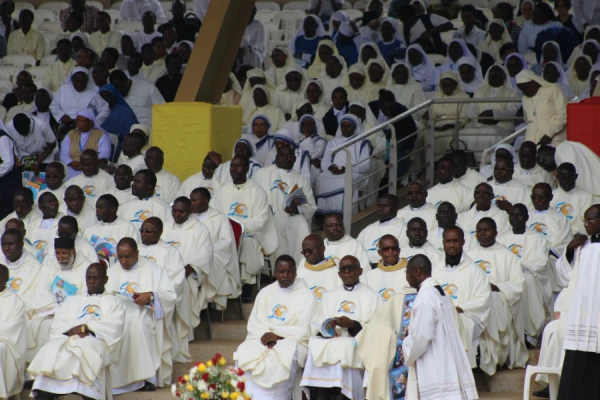
Kampala, Uganda, Jul 29, 2019 / 01:01 pm (CNA).- During the plenary assembly celebrating its golden jubilee, the leadership organization for bishops’ conferences in Africa elected Cardinal Philippe Ouédraogo of Ouagadougou as its president.
The July 19-29 plenary assembly of the Symposium of Episcopal Conferences of Africa and Madagascar was held in Kampala and was devoted to the theme “That they may know Christ and have life in abundance.”
In its closing message, given July 28, SECAM called its golden jubilee “a time of thanksgiving” and of communion.
The symposium said the jubilee is “a commitment to the service of reconciliation, justice and peace which promotes communion and pastoral solidarity which enables us to stand together against: ideological colonization, land grabbing, political and democratic destabilization, human trafficking, terrorism and arms trafficking, etc.”
The bishops added that SECAM is to be “a sign of hope, especially for families and our countries.”
They noted that “the family founded on the union of man and woman remains the first place of evangelization; that is why SECAM has kept insisting on its importance, vocation and nature as ordained by God.”
They highlighted the importance of integral human development, and “the socio-political dimensions of evangelization and calls on politicians and governments to work for the wellbeing of their people.”
The Ugandan martyrs, the bishops said, “remind us of the importance of remaining faithful to our faith in Christ and to our baptismal commitment. They are also models for all the baptized, especially the catechists.”
SECAM also noted that children “need to be given special attention and quality Christian education to make them effective witnesses to Christ.”
They drew attention to the “irreplaceable role” of women in the Church and society, saying, “their participation in education and evangelization is indispensable.”
At the plenary assembly, the members of SECAM also made a number of commitments and exhortations.
They committed to investing “ more deeply in the biblical, theological, moral and spiritual formation of all the baptized; to nourish them with the word of God and the sacraments, so that they may make the gospel penetrate all aspects of life,” and to making the jubilee “a springboard for the new evangelization.”
The bishops also committed themselves to promoting “ the human formation and the professional, moral and spiritual education of children and the youth and to help them to be more deeply rooted in the values of the gospel,” as well as deepening collaboration with political leaders and holding them accountable, “ so as to put our human and natural resources at the service of development, reconciliation, justice and peace.”
They exhorted religious communities to be true to their vocation and to engage in “missionary exchange” among dioceses, and recommended that “the formation of priests should aim at helping them to develop a deeper personal intimate relationship with Christ, human and spiritual maturity, a sense of service and accountability and passion for the mission of the church.”
“We encourage the particular Churches to engage in the formation, accompaniment and guidance of civil servants and politicians in their respective locations so as to fight against corruption, promote good governance and better management of human and natural resources,” the bishops added.
SECAM elected Bishop Sithembele Sipuka of Umtata (Mthatha) as its first vice president, and Bishop Lucio Muandula of Xai-Xai its second vice president. Fr. Terwase Henry Akaabiam was appointed secretary general.
The symposium grew out of the desires of the African bishops at the Second Vatican Council to speak with one voice. SECAM’s stated mission, according to its website, is to “to promote its role as a sign and instrument of salvation and to build the Church as a Family of God in Africa,” while also preserving and fostering communion and collaboration among its member episcopal conferences.
Cardinal Ouédraogo announced at the assembly that SECAM will be issuing a “Kampala Document” after the assembly, to “help the people of God to deepen their knowledge of Christ our Savior and make him known as the Way, the Truth and the Life.”
The symposium intends the document to “become a reference text for our mission.”
If you value the news and views Catholic World Report provides, please consider donating to support our efforts. Your contribution will help us continue to make CWR available to all readers worldwide for free, without a subscription. Thank you for your generosity!
Click here for more information on donating to CWR. Click here to sign up for our newsletter.

Monica Biboso and her employer, Ester Rot, while celebrating Rosh Hashanah (the Jewish New Year) in the dining room of Kibbutz Be’eri in 2022. “I don’t feel like a hero because I saved Ester” during the Oct. 7, 2023, massacre, Biboso told CNA. “I would do anything to save her. I just treated her like my mother. Every child would do the same.” / Credit: Photo courtesy of Monica Biboso
Jerusalem, Oct 7, 2024 / 05:00 am (CNA).
One year has passed since Monica Biboso, a 36-year-old Filipino woman who has worked as a caregiver in Israel for over 10 years, was suddenly awakened by the noise of bombs and gunfire in Kibbutz Be’eri, close to the Gaza border.
In a conversation with CNA, Biboso’s eyes moistened as she recalled that day. Hamas fighters surrounded the house, shattered the windows, and set the home ablaze. She still has nightmares and jumps whenever someone knocks on the door of her room at the David Dead Sea Resort by the Dead Sea, where she has been displaced for the past year.
An outing in Sderot of the caregivers who worked at Kibbutz Be’eri on Sept. 5, 2023. Biboso and her employer were transferred to a hotel on the Dead Sea, along with the surviving residents of Kibbutz Be’eri, after the attack on Oct. 7, 2023. About 10 of Biboso’s colleagues joined them, while two died in the attack and five returned to the Philippines. Credit: Monica Biboso
During the Oct. 7, 2023, massacre in Israel that took the lives of almost 1,200 people, 101 civilians were killed in Be’eri and 30 hostages were taken to Gaza, 11 of whom are still being held in captivity.
Biboso not only survived, but she also managed to protect the elderly lady she was caring for — Ester Rot, who is 81 and has dementia. They were the only two survivors from their neighborhood.
“I have never stopped praying because I have always believed that God was there,” Biboso, a Catholic, told CNA. “All the time, I prayed to God and asked him that if my time had come, he would at least protect my children. But God did not want to call me yet, and I survived.”
Biboso is married to a fellow countryman she met in Israel who had returned to the Philippines just a few days before Oct. 7. The couple has two children, ages 7 and 5, who are growing up in the Philippines under the care of Biboso’s sister.
Monica Biboso with her family in the Philippines in April 2024: her husband, Roberto; her daughter, Sofya; and her son, Clarence. In the first few hours of the Oct. 7, 2023, massacre by Hamas, she managed to stay in touch with them, then her cellphone ran out of power. “When I was able to turn my phone back on, I found video messages from my children, crying, kissing and telling me to take care of myself.” Credit: Photo courtesy of Monica Biboso
In the first few hours of being locked in the house’s safe room, Biboso stayed in touch with her family, her Filipino colleagues in the kibbutz, and Rot’s children, but then her cellphone battery died.
“When I was able to turn my phone back on, I found video messages from my children, crying, kissing, and telling me to take care of myself,” she recalled.
Biboso, who was locked in the shelter with Rot for 16 hours, has been trying to forget the experience, but from the start it was clear it would never be possible.
“All the time, I carry my bag with my documents and important things. I am afraid of losing them again. Every night before going to sleep, I need to check outside and lock the door.”
For the past year, Biboso has been undergoing psychological therapy, which is helping her cope with the memories, fear, anguish, and nightmares — and to talk about what she went through.
“When I heard the sirens, I woke Mrs. Ester up, changed her, and dressed her quickly. I gave her her medicine and something to help her sleep, and we took refuge in the safe room of the house. I understood that the situation was serious, as I could hear the gunshots getting closer and closer,” Biboso recounted to CNA.
The closed caption television cameras that Rot’s children had previously installed in the house showed Hamas militants coming and going until they managed to break into the house.
Screenshot of camera footage from Ester Rot’s home at 10:51 a.m. on Oct. 7, 2023, in Kibbutz Be’eri, where Monica Biboso lived and worked as a caregiver for the elderly woman. Two armed men can be seen in the lower left of the screen near the home. Around 11 a.m., Hamas fighters managed to break into the house by blasting a hole with explosives. Shortly afterward they set fire to the house. Credit: Courtesy of Monica Biboso
“For the entire time I was locked in the shelter, I kept praying and saying to God, ‘Help us, I know it’s impossible to save us, but I know you can save us.’”
Around 11 a.m., the Hamas fighters broke into the house by blasting a hole with explosives.
“Maybe God heard me because they couldn’t open the shelter door. I was holding the handle from the inside. He gave me incredible strength.”
The door to the shelter where Monica Biboso and her employer, Ester Rot, were barricaded for 16 hours during the Hamas attack on Kibbutz Be’eri, Oct. 7, 2023. The photo was taken by Biboso when she had the chance to return and check the situation in January 2024. “For the entire time I was locked in the shelter, I kept praying and saying to God, ‘Help us, I know it’s impossible to save us, but I know you can save us,’” Biboso told CNA. “Maybe God heard me because they couldn’t open the shelter door. I was holding the handle from the inside. He gave me incredible strength.” Credit: Photo courtesy of Monica Biboso
Then they set fire to the house.
“We could barely breathe, it was so hot. We had no water, no food, nothing. I thought we were going to die, but I kept praying.”
When asked how she was able to survive, Biboso said: “God saved me. No one was able to help us. I was weak, I couldn’t breathe, my body was shaking, and I was lying on the floor, but I kept praying. Because of him, I survived. I truly believe that. He was with me the entire time I was in the shelter. I could feel it. Without God, I wouldn’t be here.”
The living room of Ester Rot’s home in Kibbutz Be’eri, where Monica Biboso lived and worked as a caregiver for the elderly woman. The house was completely burned down during the Hamas attack on Oct. 7, 2023. The photo was taken by Biboso when she had the chance to return in January 2024. Credit: Photo courtesy of Monica Biboso
Biboso and Rot spent a day in the hospital, then they were transferred to a hotel on the Dead Sea along with the surviving residents of Kibbutz Be’eri. About 10 of Biboso’s colleagues were among them. (Two others died in the attack and five returned to the Philippines.)
“Together with my husband, we decided it was best for me to stay, at least for the time being. I could never have left Mrs. Ester or allowed her to end up in a nursing home after surviving all this. She is like a mother to me,” said Biboso, who lost her own mother at the age of 16.
“I don’t feel like a hero because I saved Mrs. Ester,” Biboso added. “I would do anything to save her. I just treated her like my mother. Every child would do the same.”
“I knew that if I wanted to have any chance of healing and overcoming this trauma, I could only do it here,” she said. “In Israel, psychologists could help me because they understand the context.”
Ultimately, economic reasons also motivated Biboso to stay. Currently, her salary is the only stable income for her family, whom she was able to reunite with for some weeks in April.
Life at the hotel follows a fairly regular routine. “When we get up, I help Mrs. Ester with breakfast, give her a bath, take her for a walk, and do exercises. After lunch, we rest. When I can’t sleep, I crochet. It helps me relax.” Sometimes the two walk along the sea, take a swim, and spend time with friends.
Four months after Oct. 7, Biboso visited Kibbutz Be’eri together with Rot’s children. “It was very hard. I couldn’t stay there for long.” The house was completely destroyed by the flames.
“All my things were burned, everything was reduced to ashes,” Biboso recounted, “But my rosary didn’t burn. I found it beside my bed. It was a little burnt, but the beads were intact, and the cross was still a cross. My husband gave it to me and I used to pray with it every day before sleeping. I know I’m safe because of it.”
Monica Biboso’s rosary, the only one of her belongings left intact after the home of Ester Rot, the elderly woman she cared for and where she also lived in Kibbutz Be’eri, was set on fire by Hamas fighters during the Oct. 7, 2023, attack. “All my things were reduced to ashes,” Biboso recounted, “but my rosary didn’t burn. My husband gave it to me and I used to pray with it every day before sleeping. I know I’m safe because of it.” Credit: Photo courtesy of Monica Biboso
To this day, every night, Bibosa prays the rosary before bedtime. “In the Philippines, when my mother was alive, every day at 6 o’clock we prayed the rosary together before having dinner. I kept doing it.”
After Oct. 7, a nun living in Tel Aviv called Biboso every day, and they prayed together. “She’s helped me a lot. If I can’t sleep, I call her, and we pray together over the phone.”
“Prayer is a big help to me in healing, lightening the burden on my heart, and freeing my mind from negative thoughts,” Biboso said.
Ester Rot, the elderly woman with whom Monica Biboso works as a caregiver, on the shore of the Dead Sea. After surviving the massacre carried out by Hamas on Oct. 7, 2023, the two were displaced to the David Dead Sea Resort along with the other surviving residents of Kibbutz Be’eri. Credit: Photo courtesy of Monica Biboso
In mid-October, Biboso and Rot are expected to move to Kibbutz Hatzerim, where new housing units have been built for the Be’eri survivors.
“First, you need to have faith in God and be thankful for everything,” Biboso said. “You just need to trust him, and he will make a way to save you. This war will also end because of him. He will find a way to bring good out of it all.”
A picture taken in the southern Israeli city of Ashkelon on Oct. 7, 2023, shows burnt-out vehicles outside a residential building hit in a rocket attack from the Gaza Strip. / Credit: AHMAD GHARABLI/AFP via Getty Images
The sisters Madeleine and Marie-Liesse together with Louis Antona at the entrance of Greece. The three young people covered the distance from Paris to Jerusalem on foot, arriving in mid-May 2024. “I needed to walk 4,500 kilometers to understand that Jesus is not just in Jerusalem, but was by my side every step of the way,” Antona told CNA. / Credit: Photo courtesy of French pilgrims Madeleine and Marie-Liesse
Jerusalem, Jun 18, 2024 / 06:00 am (CNA).
On Sept. 17, 2023, two sisters left Paris and walked for approximately eight months to Jerusalem. Madeleine and Marie-Liesse, 19 and 22, who grew up in a Catholic family, decided to become pilgrims to grow in their faith.
“We needed to make the faith our own,” they told CNA. “This pilgrimage was to discover God, to truly search for him and deepen our faith. We learned that we can trust God; he takes care of us in everything. The Gospel is not a joke.”
Two months later, in mid-November 2023, Louis Antona, 24, also left Paris on foot, bound for Jerusalem. The three young people met providentially in Albania, walked together through Turkey, then parted ways and reunited in Jerusalem. They shared the story of their pilgrimage with CNA.
“I needed to walk 4,500 kilometers to understand that Jesus is not just in Jerusalem but was by my side every step of the way,” Antona told CNA. He walked a total of 189 days and arrived in Jerusalem on May 18.
Madeleine and Marie-Liesse — who asked that their last name not be used to protect their privacy — left from the Basilica of the Sacred Heart of Montmartre in the center of Paris with the blessing of their parents and a priest.
“It was a calling from God,” Madeleine said of the decision she and her sister made to leave. “There’s no need for reasons when God calls; you simply need to follow what he tells you.”
Madeleine and Marie-Liesse during a moment of their journey, between Slovenia and Croatia. “The faith of the people struck us: during Advent, tradition dictates that Mass be attended every morning at 6, and every time we went, the church was packed with people,” they told CNA. The two sisters left Paris on September 17, 2023, and walked for about eight months to Jerusalem. Credit: Courtesy of French pilgrims Madeleine and Marie-Liesse
The sisters created a simple blog to keep friends and family updated on their pilgrimage. The photos and brief stories reveal all the freshness of two young people on a journey while not hiding moments of doubt and difficulty.
“We chose to embark on this journey as beggars,” Marie-Liesse told CNA. “We left with just a few clothes and nothing else — no food, no money. We wanted to surrender ourselves into the hands of providence. Every evening, we knocked on people’s doors asking for shelter, a bed, and food. The Lord always provided.”
Their days were marked by walking and prayer.
“We didn’t have a strict rule because we had to adapt every day to the people who hosted us, the place, and the situation,” Marie-Liesse explained. “But we had a framework: We knew we had to pray in the morning, at midday, at night… It was important for us to be faithful to God. Every day, we also recited a rosary, praying for the intentions entrusted to us.”
The most challenging moment was making the decision to continue the journey after hearing that war had broken out in the Holy Land. “We were in Germany and full of doubts about whether to go on.”
Their journey led them to cross Switzerland, Germany, Austria, Slovenia, and Croatia. In Croatia, “the faith of the people struck us: during Advent, tradition dictates that Mass be attended every morning at 6, and every time we went, the church was packed with people,” the sisters wrote on their blog.
They stopped for a month in Medjugorje (Bosnia and Herzegovina), where their family joined them for Christmas.
“It was a difficult time. Again, we didn’t know what to do. But after a period of discernment, we realized that Christ was calling us back on the road again,” Madeleine said.
Madeleine and Marie-Liesse crossed Montenegro and arrived in Albania, where they encountered Antona.
“I had just finished my studies and wanted to offer something to God,” Antona told CNA. “I wasn’t sure what, but I thought that the best thing I had at that time was time itself. So, I decided to offer God a year of my life by embarking on a journey. It was a challenge; I wasn’t sure if I would enjoy walking and being alone.”
Louis Antona, 24, during a moment of his journey. “I had just finished my studies and wanted to offer something to God,” he told CNA. “I thought that the best thing I had at that time was time itself. So, I decided to offer God a year of my life by embarking on a journey.” Credit: Photo courtesy of Louis Antona
Antona decided to leave, despite the war. “I believe the hardest part of a pilgrimage like this is deciding to start. I knew that if I gave up because of the war, I would never do it again. Anyway, I thought that by the time I arrived, the war would already be over.”
Madeleine and Marie-Liesse are filled with wonder at the manifestation of providence in every detail of their pilgrimage, in the beautiful weather and in the rain, in every small encounter — those who hosted them after seeing them at the bus stop, those who taught them how to make bread, the gentleman who opened his door just before a downpour. “If we had arrived a minute later, we wouldn’t have met him,” they said.
The encounter with Antona wasn’t coincidental either. The two sisters had prayed to God to give them a travel companion.
“We planned to not go through Turkey because we were two women alone, but we would have liked to go that way. So we asked God to meet one pilgrim, and we met him,” the sisters explained.
The three crossed Macedonia and Greece, arriving in Turkey on Palm Sunday. In this predominantly Muslim country, they celebrated Easter, warmly welcomed by the small French-speaking community there.
The sisters Madeleine and Marie-Liesse together with Louis Antona received a blessing from a priest during a Mass in Turkey. They arrived in Turkey on Palm Sunday 2024. In this predominantly Muslim country, they celebrated Easter, warmly welcomed by the small French-speaking community there. Credit: Photo courtesy of Louis Antona
“Every day of this pilgrimage was a miracle,” Antona said. “Every day we have met people who smiled or were nice to us. I have to say that in Turkey we found the most welcoming people.”
“It is not uncommon for the Turks to spontaneously lend us a hand,” Madeleine and Marie-Liesse wrote on their blog. “In Turkey, we encountered an infinite respect for passing strangers and for Christianity, even though Christians here are forced to protect themselves from regular attacks.”
The arrival of Madeleine and Marie-Liesse in Albania. In the photo, Marie-Liesse is in front of a statue of Mother Teresa, who was originally from this country. “Every evening, we knocked on people’s doors asking for shelter, a bed, and food. The Lord always provided,” they told CNA. Credit: Photo courtesy of French pilgrims Madeleine and Marie-Liesse
Upon leaving Turkey, the paths of the three pilgrims split again. The sisters’ route went through Cyprus but they could not find a way from there to Jerusalem by sea due to suspension of transportation because of the war. Providentially, they met someone in Cyprus who offered to pay for airfare, and the sisters arrived in Tel Aviv on May 6. Three days later, on the feast of the Ascension, they were in Jerusalem.
“Many times, we thought we couldn’t reach Jerusalem,” Madeleine said. “We learned that the journey is even more important than reaching the goal. Being here is a great gift, just to be here.”
“We unpacked our bags once and for all, knelt before this Holy Land, and prayed. What peace, what a moment of grace! As we admired the sunrise and the golden light that brought color to the roofs of the old city, we could reread the wonders of God and meditate on the Gospels. His infinite love overwhelmed us,” the two sisters wrote on their blog.
The sisters Madeleine and Marie-Liesse received a blessing from a Franciscan friar at the Basilica of the Holy Sepulcher after their arrival in Jerusalem. “The greatest gift is to be here and understand what happened here, to see with our own eyes, to witness the actual places,” Madeleine said. “We were able to pause in every place, to pray and meditate in silence.” Credit: Photo courtesy of French pilgrims Madeleine and Marie-Liesse
Madeleine has no doubts: “Prayer is what carried us. When you’re weak, that’s when you’re strongest because that’s when God can act in you; you don’t take up all the space. Trusting in God can be challenging, but when you understand that God only wants you to be happy and will give you everything you need, then you realize you have everything to be happy in this moment; you can trust him.”
Ten days later, on the eve of Pentecost, Antona also arrived in Jerusalem. “Even if I had to stop somewhere else, at least I would have aimed to reach Jerusalem. This is a very important city for Christians, but the journey you take to reach it is also very important.”
French pilgrim Louis Antona arrived in Jerusalem on May 18, at the vigil of Pentecost. “Every day of this pilgrimage was a miracle,” he said. Credit: Photo courtesy of Louis Antona
The three pilgrims are still in the Holy Land. They have had the opportunity to participate in various celebrations and to visit the holy places in addition to many other sites in the area.
“The greatest gift is to be here and understand what happened here, to see with our own eyes, to witness the actual places,” Madeleine said. “We were able to pause in every place, to pray and meditate in silence.”
A journey like this isn’t for everyone, but all three of the pilgrims agree that “if God calls you, go in peace. If God helps you, everything becomes possible.”
The French pilgrims rest under the portico of the Church of the Beatitudes on a hill overlooking the Sea of Galilee. In the photo is Louis Antona. A journey like this isn’t for everyone, but, the three young people said, “if God calls you, go in peace. If God helps you, everything becomes possible.” Credit: Photo courtesy of French pilgrims Madeleine and Marie-Liesse
Leave a Reply