No Picture
News Briefs

Theology in ‘dialogue with cultures’ renews humanity, Pope Francis says
November 9, 2019 CNA Daily News 1

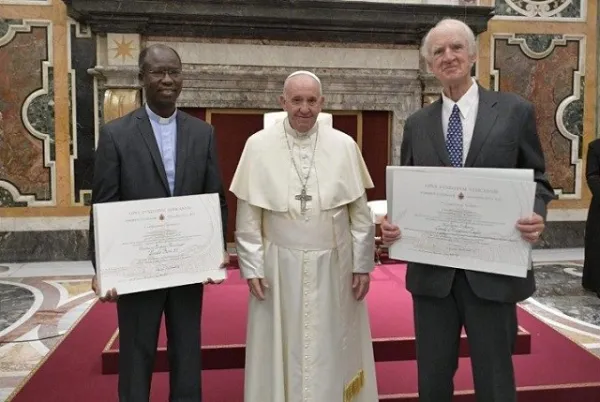
Vatican City, Nov 9, 2019 / 06:40 am (CNA).- When theology and philosophy engage with cultures in creative ways, they become a powerful tool for renewing humanity with the Word of God, Pope Francis said Saturday, during the awarding of the 2019 Ratzinger Prize.

“This is true for all cultures: access to redemption for humanity in all of its dimensions should be sought with creativity and imagination,” the pope said Nov 9.

He quoted St. Paul VI’s apostolic exhortation Evangelii Nuntiandi, which says, “Evangelizing means bringing the Good News into all the strata of humanity, and through its influence transforming humanity from within and making it new.”

“It is a duty for theology to be and remain in active dialogue with cultures, even as they change over time and evolve differently in various parts of the world,” he said. “It is a condition necessary for the vitality of Christian faith, for the Church’s mission of evangelization.”

“All the arts and disciplines,” Francis said, “thus cooperate in contributing to the full growth of the human person, which is to be found ultimately in the encounter with the living person of Jesus Christ, the incarnate Logos, the revelation of the God who is love.”

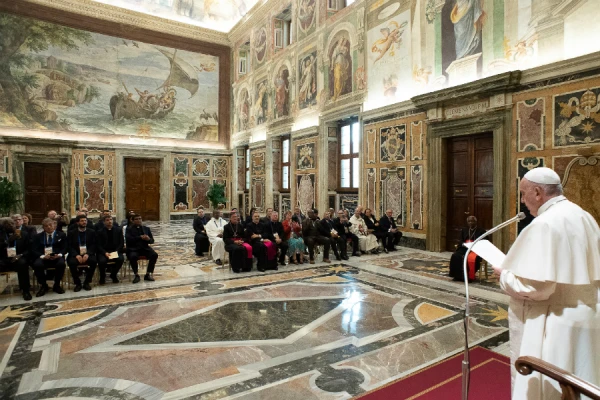
Pope Francis addressed members of the Joseph Ratzinger-Benedict XVI Foundation in the Vatican’s apostolic palace during the award ceremony for the 2019 edition of the prestigious Ratzinger Prize.

The Ratzinger Prize was begun in 2011 to recognize scholars whose work demonstrates a meaningful contribution to theology or philosophy in the spirit of Cardinal Joseph Ratzinger, the Bavarian theologian who became Benedict XVI.

The winners of the 2019 prize are Catholic intellectual Charles Taylor and Jesuit priest and theologian, Fr. Paul Béré.

Béré is the first African to win the prestigious Ratzinger Prize. A lecturer at the Pontifical Biblical Institute, he received the prize for his work on the figure of the prophet Joshua.

From Burkina Faso, Béré spoke in September on the need for an “Africanness” within the Catholic approach to addressing regional problems.

“Africa can find a solution to all its problems within, what we [Africans] simply need is the slightest desire to share the solutions across the continent,” Beré told ACI Africa Sept. 28 at the Nairobi tri-party conference on the status of the evangelization mission in Africa.

Beré is a member of several African theological associations and of the Anglican-Roman Catholic International Commission (ARCIC). He has also participated as an expert in several synods of bishops.

After the announcement that he had won the prize, he told Vatican News: “I think this is an encouragement for all theological work done in Africa.”

Pope Francis Nov. 9 praised Beré as a “renowned scholar of Sacred Scripture” and he expressed his appreciation and encouragement for all those who are “committed to inculturation of the faith in Africa through their original and deepened study.”

Contemporary African theology is still young, but it is “dynamic and full of promise,” the pope said. “Father Béré provides an example of this by his work on the interpretation of Old Testament texts in a context of oral culture, thus bringing to fruition the experience of African culture.”

Dr. Charles Taylor, 88, is an award-winning Canadian Catholic philosopher, who has taught at Oxford and at the University of Montreal and McGill University.

His focus has been in the areas of history of philosophy, most especially political philosophy and the philosophy of social science. One of Taylor’s many notable contributions was to the topics of religion, modernity, and secularization.

“During his years of active research and teaching, Professor Taylor has covered many fields, but he has particularly devoted his mind and heart to understanding the phenomenon of secularization in our time,” Francis noted.

“Secularization effectively poses a significant challenge for the Catholic Church, indeed for all Christians, and for all believers in God,” he said, adding that a priority of Benedict XVI’s pontificate was to “proclaim God anew” during a time “when that proclamation seems to be on the wane for a large part of humanity.”

The pope said, “few scholars in the present day have posed the problem of secularization with the breadth of vision as has Professor Taylor.”

“We are indebted to him for the profound manner in which he has treated the problem, carefully analyzing the development of Western culture, the movements of the human mind and heart over time, identifying the characteristics of modernity in their complex relationships, in their shadows and lights.”

Taylor’s work invites Catholics to seek “new ways to live and express the transcendent dimensions of the human soul,” he continued, which allows them to engage with secularization in the West “in a way that is neither superficial nor given to fatalistic discouragement.”

“This is needed not only for a reflection on contemporary culture, but also for an in-depth dialogue and discernment in order to adopt the spiritual attitudes suitable for living, witnessing, expressing, and proclaiming the faith in our time,” he stated.

Despite coming from very different backgrounds and continents, the two honorees of the 2019 Ratzinger Prize have dedicated themselves to seeking “the way to God and the encounter with Christ,” Francis said.

“This,” he added, “is the mission of all who follow the teaching of Joseph Ratzinger as theologian and Pope, to be “‘co-workers of the truth.’”

The honorees of the Ratzinger Prize are chosen by Pope Francis, based upon the recommendations of a committee composed of Bishop Rudolf Voderholzer of Regensburg and Cardinals Angelo Amato, Kurt Koch, Gianfranco Ravasi, and Luis Ladaria, who are heads of offices in the Roman Curia.

Pope Francis said Nov. 9, that “we are all grateful” for the teaching of Pope Emeritus Benedict XVI, “and for his exemplary service to the Church, demonstrated by his reflections, his thought and study, his listening, dialogue and prayer.”

“His aim was that we might consciously retain a lively faith despite the changing times and situations; and that believers could give an account of their faith in a language that can be understood by their contemporaries, entering into dialogue with them, together seeking pathways of authentic encounter with God in our time,” he said.

“This has always been a keen desire of Joseph Ratzinger the theologian and pastor, who never closed himself off in a disembodied culture of pure concepts, but gave us the example of seeking truth where reason and faith, intelligence and spirituality, are constantly integrated.”

[…]

No Picture
News Briefs

The Impossible Burger: Ethics and a CNA taste test

November 9, 2019 CNA Daily News 11

Washington D.C., Nov 9, 2019 / 05:00 am (CNA).- Food trends come and go, and the trend du jour is plant-based “meat” that is partially made in a laboratory.

Many vegans and vegetarians have rejoiced at the growing popularity and relative mainstream success of both the “Beyond” and “Impossible” brands, and there is a growing claim that eschewing meat choices in favor of these new products is a more ethical choice for consumers.

CNA spoke to Catholic moral theologians to discuss the ethics of eating meat, and the morality of eating faux meat during penitential fasts. And, lest CNA coverage of these products seem incomplete, we conducted a taste test.

According to Dr. Joseph Capizzi, a professor of moral theology at the Catholic University of America a person is not morally obligated to choose a vegan patty, like the Impossible Burger, over a beef or chicken burger.

“There’s no reason, in my opinion, to think the consumption of products so dependent upon technology are superior to the consumption of animal products,” said Capizzi.

“I do think, however, in both cases, ethically relevant issues include the production of the foods, including not merely the environmental impact, but also the ways technologies might distance the human being from creation,” he added.

Capizzi told CNA that while he does not think it is ethically superior for people to stick to eating mostly plant-based food, he does think that “people need to reflect on the ethical nature of eating.”

“Though eating is a basic human need, how we eat, what we eat, with whom we eat–including whom we exclude–are all questions that need our reflection,” said Capizzi. While these alternative products have done some work to address some of these concerns, there is much work to be done.

“One thing I’ve noticed is the lack of hospitality that can accompany over-restrictive diets,” he explained, recounting the experience of seeing a poor person offer meat to guests, presented as a luxury, only to see the meat rejected because of the guests’ vegetarianism.

Dr. Charles Camosy, a professor at Fordham University who has written extensively about veganism and vegetarianism, disagreed with Capizzi’s take. Camosy told CNA that these new products make it harder for American Catholics to justify eating meat.

“The Catechism of the Catholic Church insists we have a moral duty not to cause animals to suffer or die needlessly,” said Camosy.

“With good-tasting protein available from so many sources now, including from new imitation meat products, the teaching of the Church would seem to indicate that the necessity of participating in the suffering of death of animals, for most of us, isn’t what it might have been in the past.”

Camosy noted that the Bible states that in the new Kingdom of God that will come with Christ’s second coming, “animals are to be our companions, not our food.”

The new kingdom “will be a Peaceable Kingdom among all creatures: lambs, lions, snakes, and babies,” he said, and there will be no need to slaughter animals.

The faux hamburger market is dominated by two companies: Beyond Meat makes the Beyond Burger patty, Beyond Beef ground meat substitute, Beyond Sausage, and Beyond Beef Crumbles. Impossible Foods sells the Impossible Burger patty and the Impossible Sausage.

“Protein, fat, minerals, carbohydrates, and water are the five building blocks of meat,” says Beyond Meat’s website. Beyond uses plant-based versions of protein–including protein from peas, mung beans, fava beans, brown rice, and sunflowers–and fats to create its products. Additionally, Beyond uses beet juice to create a burger that “bleeds.”

Impossible Food uses “heme,” a protein that is found in nearly all living things, to make its plant-based burgers taste like meat. This heme also mimics a  “bleeding” effect.

“Impossible Burger gets its heme from the protein soy leghemoglobin, which is naturally found in soy roots. Impossible Foods produces soy leghemoglobin through genetic engineering and fermentation. Thanks to heme, Impossible Burger has a rich, beefy flavor that satisfies the most discerning meat-eaters — but it contains no animal products whatsoever,” the company’s website says.

Dunkin’, the restaurant once known as Dunkin’ Donuts, launched a Beyond Sausage sandwich nationwide Nov. 6 after a successful test market in Manhattan. Customers can choose to substitute a veggie egg white patty for the fried egg. CNA paid $3.99 for the Beyond Sausage sandwich.

An ordinary pork sausage, egg, and cheese sandwich on an English muffin from Dunkin’ costs $4.99.

CNA recruited three journalists for a blind taste test of the Beyond Sausage sandwich and pork sausage sandwich. Two out of the three testers were unable to determine at first glance if the sandwich they were eating contained Beyond or pork sausage, and one mistakenly thought the pork sausage she was eating was actually the Beyond Sausage.

Two out of the three testers said they preferred the pork sausage sandwich to the Beyond sandwich, but one said she liked that the Beyond sandwich reminded her of a falafel. This tester was the only one who said she would order the sandwich again in the future.

The sandwich was not extremely popular among testers. But some Catholics have asked whether it would be good enough to eat on a Friday, when Catholics are instructed to abstain from (actual) meat.

CNA asked Fr. Thomas Petri, O.P., the academic dean and vice president of the Dominican House of Studies, to weigh in on whether or not an Impossible Burger (or similar product) would be appropriate for a day when Catholics abstain from meat.

“The Church’s universal norms say that we should abstain from meat on Fridays, especially Fridays in Lent,” explained Petri. “The Impossible Burgers are not technically meat. So, of course, someone could argue that we can eat them on Fridays.”

Still, he said that “giving up meat but having Impossible Burgers that taste like meat seems to me to be a technicality to get out of the spirit of the penance,” he said.

“We should remember the point here is to give up something in union with Christ crucified. If a person is seeking Impossible meat to skirt the penance, it’s hard to believe they’ve really understood the point of it all.”

It is important for Catholics to remember that fasting and abstinence are not done for purposes of dieting, or to respect animals, said Petri. The purpose of fasting is to “unite our offerings to the perfect offering of Christ, and so to prepare for the great feast of his coming.”

And for those who are still struggling (or hungry) on a Friday, Petri had some advice.

“If you’re craving meat on a Friday, offer it up.” 


[…]

No Picture
News Briefs

Police raid former offices of Argentine bishop charged with fraud, sex assault

November 8, 2019 CNA Daily News 0

Orán, Argentina, Nov 8, 2019 / 01:01 pm (CNA).- Local civil authorities on Thursday raided the chancery of the Diocese of Orán, where Gustavo Oscar Zanchetta was bishop from 2013 to 2017. Bishop Zanchetta has been charged with sexual assault, as well as fraud and mismanagement of funds.

He was charged in June with assaulting two seminarians.

Orán’s Economic Crime Unit raided offices in the chancery Nov. 7. The raid was carried out to investigate Zanchetta’s alleged fraud against the state, according to El Oranense.

In addition to accusations of mismanaging church funds donated by the faithful in diocese, public records show that Zanchetta received more than 1 million Argentine pesos from Salta Province to restore a rectory and for lectures at the seminary which never occurred.

Four months after Zanchetta’s resignation as Bishop of Orán, Pope Francis appointed him to a newly-created position in the Administration of the Patrimony of the Apostolic See, which oversees the Vatican’s assets and real estate holdings.

Reporting from Argentine sources suggests that the bishop was first accused of sexually inappropriate behavior in 2015.

According to a February report by Argentine newspaper The Tribune, one of the Zanchetta’s secretaries alerted authorities after accidentally finding sexually explicit images sent and received on Zanchetta’s cell phone in 2015. The complaint says that some of the images depict “young people” having sex in addition to lewd images of Zanchetta himself.

The bishop claimed his phone and computer had been hacked, and that the accusations were motivated by people who did not support Pope Francis.

Pope Francis summoned Zanchetta to Rome for five days in October 2015. The pope appeared to have accepted Zanchetta’s excuse that his cell phone had been hacked, and dismissed the allegations.

The Vatican has stated twice that they did not know about Zanchetta’s misdeeds until 2018, a claim that is disputed by Fr. Juan José Manzano, the former vicar general of the Diocese of Orán. Manzano claims that he reported Zanchetta in 2015, after the pornographic images were found on his phone. Manzano says he also reported him again in 2017.

The report also says three of Zanchetta’s vicars general and two monsignors made a formal internal complaint before the Argentinian nunciature in 2016, alleging inappropriate behavior with seminarians.

This behavior included entering their rooms at night, requesting massages from them, waking up seminarians in the morning, sitting on their beds, drinking alcohol with them, and favoring more the more “graceful” (attractive) among them.

The 2017 internal accusation, which The Tribune says alleged more explicit abuse by Zanchetta of seminarians, resulted in Zanchetta’s exit from the diocese, though Zanchetta said he was resigning for health reasons. The Vatican did not open an investigation at that time.

Manzano said part of the reason the allegations against Zanchetta may have not been taken seriously by the Vatican was because of the bishop’s close relationship with Pope Francis, who appointed him Bishop of Orán in 2013. Still, Manzano said he didn’t believe the Vatican meant to lie or hide anything about Zanchetta. He said he believed Francis and other Vatican officials had also been victims of the bishop’s “manipulation.”

The Vatican acknowledged Zanchetta was under investigation in January 2019, and suspended him from his role at APSA.

Vatican Press Office spokesman Alessandro Gisotti in January “resolutely” repeated a Vatican statement that said no sexual abuse charges had yet emerged against the bishop at the time Pope Francis appointed Zanchetta his position at the APSA. Gisotti said the charges only emerged in the fall of 2018.

When asked at a Feb. 24 press conference about Zachetta’s case, Gisotti reiterated that an investigation was ongoing.

In late May 2019, Pope Francis announced that a preliminary investigation against Zanchetta had concluded and would proceed to trial at the Congregation for the Doctrine of the Faith.

If convicted by the civil court in Argentina, Zanchetta could face between three and 10 years in prison.

[…]

No Picture
News Briefs

Holy See won’t participate in Nairobi Summit

November 8, 2019 CNA Daily News 1

New York City, N.Y., Nov 8, 2019 / 12:01 pm (CNA).- The Holy See will not participate in next week’s Nairobi Summit, its mission to the UN announced Friday, saying next week’s international gathering is too focused on “reproductive rights”.

The Nov. 12-14 Nairobi Summit is sponsored by the UN Population Fund and the governments of Kenya and Denmark, and it marks the 25th anniversary of the International Conference on Population and Development, which was held in Cairo.

Its program includes five themes, among which are “Universal access to sexual and reproductive health and rights as a part of universal health coverage” and “Upholding the right to sexual and reproductive health care even in humanitarian and fragile contexts.”

“The organizers’ decision … to focus the conference on a few controversial and divisive issues that do not enjoy international consensus and that do not reflect accurately the broader population and development agenda outlined by the ICPD, is regrettable,” the Permanent Observer Mission of the Holy See to the United Nations said Nov. 8.

The Holy See had informed Kenya Oct. 24 it would not be participating in the summit.

“The ICPD and its encompassing Programme of Action within the international community’s broad development agenda should not be reduced to so-called ‘sexual and reproductive health and rights’ and ‘comprehensive sexuality education,’”, the Holy See stated.

Rather, there is an “urgent need to focus on critical aspects of the Programme of Action, such as women and children living in extreme poverty, migration, strategies for development, literacy and education, the promotion of a culture of peace, support for the family as the basic unit of society, ending violence against women, and ensuring access to employment, land, capital and technology, etc.”

The permanent observer mission said the Holy See cannot support the Nairobi Statement, citing that “no substantive and substantial consultations on the text were carried out. The Holy See notes that if more time and a truly inclusive approach had been chosen, broader support could have been ensured for the text and for the conference.”

It added that “the conference will be held outside of the United Nations framework, thus precluding transparent intergovernmental negotiations while conveying the misleading impression of ‘consensus’ on the ‘Nairobi Statement.’ Therefore, ‘The Nairobi Summit’ cannot be deemed a meeting requested by the United Nations or held under its auspices.”

The permanent observer mission added that “the Holy See is and remains a staunch supporter of ensuring the advancement of equitable, sustainable and integral human development that fosters human dignity and the common good of every man, woman and child.”

Several African bishops have also noted grave concerns with the gathering in Nairobi.

Bishop Alfred Rotich, Bishop Emeritus of the Military Ordinariate of Kenya and chair of the Kenyan bishops’ family life office, told ACI Africa: “We find such a conference not good for us, (and) destroying the agenda for life.”

Archbishop Martin Kivuva of Mombasa described the summit’s agenda as “unacceptable according to our teaching of the Catholic Church” and he encouraged Kenyan president Uhuru Kenyatta to be wary of the forum.

To counter the agenda of the Nairobi Summit, the Kenya Christian Professionals Forum, with the backing of Kenya’s bishops, has organized a parallel convention to be held Nov. 11-14.

[…]

No Picture
News Briefs

Prison ministry includes helping people after incarceration, Pope Francis says

November 8, 2019 CNA Daily News 0

Vatican City, Nov 8, 2019 / 11:01 am (CNA).- In addition to looking after the physical and spiritual needs of those in prison, Catholics have an obligation to recognize the humanity of those who have left the prison system and to help them get back on their feet, Pope Francis said Friday.

“As Christian communities, we must ask ourselves a question” about those who have been released from prison, the pope said Nov. 8, addressing Catholics involved in prison ministry around the world.

“If these brothers and sisters have already paid the penalty for the wrongdoing, why is a new social punishment placed on their shoulders with rejection and indifference? On many occasions, this social aversion is one more reason they run the risk of repeating their own faults,” he said.

Often when a person leaves prison, he or she finds themselves in a world which is foreign to them and which, at the same time, does not trust them, the pope continued. This can make it very difficult for them to find work and to make a decent living.

“By preventing people from regaining the full exercise of their dignity, they are once again exposed to the dangers that accompany the lack of development opportunity, in the middle of violence and insecurity,” Francis stated.

“True social reintegration,” he argued, begins with access to decent work, education, self-development opportunities, and health care.

But it is often easier and more comfortable to ignore or deny the injustices present in society than to try to create equal opportunities for all citizens, he said, calling it “a way of discarding.”

He said this is the same reason many places choose incarceration as a solution over trying to fix the root societal problems which lead people to crime.

Especially today, he said, societies are called to overcome the stigmatization of people who have served time in prison for their mistakes.

“Because instead of offering the right help and resources to live a dignified life, we have become accustomed to rejecting,” he underlined, and people do this instead of looking for and noticing what effort a person might be making to respond to the love of God in his or her life.

Pope Francis spoke about ministering to the imprisoned during an audience with participants in a two-day conference on Catholic prison ministry, organized by the Dicastery for Promoting Integral Human Development.

The pope said he entrusted to the dicastery the task of making evident the Church’s concern for those in situations of suffering, including the imprisoned, but added that “it is not a task indicated only for the dicastery, but it is for the whole Church in fidelity to the mission received from Christ.”

The Church “is called to act permanently the mercy of God in favor of the most vulnerable and helpless in whom Jesus himself is present,” he said. “We will be judged on this.”

The conference took place at the Vatican Nov. 7-8 and was held to learn more about diocesan and local prison ministry in countries around the world, so that they can strengthen and improve through sharing ideas and experiences.

Pope Francis argued that prisons themselves also fail to properly reintegrate people into society, because they lack the resources to address the social, psychological, and relational problems imprisoned people often face.

Prison verpopulation is also a problem, he noted.

Pope Francis thanked those who serve the incarcerated, noting Christ’s words that “what they did to one of the least of my brothers, they did to me.”

“With the inspiration of God, each Church community is taking its own path to present the Father’s mercy to all these brothers, and to make resonate a permanent call, so that every man and society seeks to act firmly and decisively in favor of peace and justice,” he said.

[…]

No Picture
News Briefs

N Ireland abortion law plans ‘devastating’, pro-life leader objects

November 7, 2019 CNA Daily News 0

Belfast, Northern Ireland, Nov 7, 2019 / 06:01 pm (CNA).- Northern Ireland’s proposed abortion law drew strong objections from pro-life advocates who said it removes almost all legal protection for unborn babies.

They added that it drops many safeguards provided in other parts of the U.K., allows non-doctors to perform abortions, and allows abortion of disabled babies as far as birth.

“Because of the pro-life laws previously enshrined in law in Northern Ireland, babies in the womb were given legal protection and progressive, compassionate care which we could be proud of,” Bernadette Smyth, director of Precious Life, said Nov. 5. “Against the democratic will of the electorate, who had persistently elected pro-life politicians, and against the principles of devolution, all meaningful legal protection for unborn babies and pregnant women has now been stripped away.”

Under the Northern Ireland (Executive Formation etc) Act 2019, passed in July by the British Parliament, the government is obliged to create legal access to abortion in the region by March 31, 2020. The legislation legalizing abortion took effect in part because the Northern Ireland Assembly, which has been suspended nearly three years due to a dispute between the two major governing parties, was not able to convene for business by Oct. 21.

The amendment to the NI EF Act obliging the government to provide for legal abortion in Northern Ireland was introduced by Stella Creasy, a Labour MP who represents a London constituency. The legislation has drawn some objections that it violates the letter or spirit of devolution agreements that grant the Northern Ireland Assembly power over important matters.

“The people of Northern Ireland have not given license nor approval to the new devastating abortion regime which will now be foisted upon them by a British Government which does not represent them,” Smyth said. “This proposed framework is a shocking and unconcealed attempt to further undermine the will of the people of Northern Ireland.”

The government proposes that abortion be available unconditionally up to 12 or 14 weeks gestation. In cases of fetal abnormality, the government is proposing that abortion without time limit be available. It also proposes that abortion without time limit be allowed where there is risk to the life of the mother or it is necessary to prevent grave permanent injury to her physical or mental health.

Previously, abortion was legally permitted in the region only if the mother’s life was at risk or if there was risk of long term or permanent, serious damage to her mental or physical health.

Smyth said the proposed framework goes “far beyond the requirements” of parliament’s legislation. In her view, it “removes virtually all meaningful legal protections for babies in the womb, and drops many of the legal safeguards provided by the 1967 Abortion Act in England and Wales.”

She warned of its effects on unborn babies with disabilities.

“The proposal would also mean the legalization of abortion for disabilities, including club foot, cleft lip, anencephaly and Down’s syndrome amongst other conditions, likely available right up to the moment of birth,” she said.

As a whole, Smyth said, “these proposals open the door wide to serious endangerment of women’s health and safety by opening abortion provision up to any healthcare professional, which could include nurses, midwives, pharmacists, healthcare assistants, art therapists and dieticians.”

“The framework further seriously jeopardizes the health and safety of women in Northern Ireland as it removes the requirement that two medical doctors sign off on an abortion,” she argued. “The proposal does not include a legal limit on the locations where abortions can take place, potentially permitting dangerous home use of both abortion pills along with abortion provision in school nurse clinics, (general practitioners’) surgeries, mobile abortion clinics and pharmacies.”

The government proposes that a medical practitioner or any other registered healthcare professional be able to provide abortions, provided they are appropriately trained and competent to provide treatment in accordance with their professional body’s requirements and guidelines.

Abortions past 22 or 24 weeks should be provided in hospitals, the government says.

While in England, Wales, and Scotland two doctors must certify that there were lawful grounds for abortion, the government is considering whether only one doctor’s certification should be required in Northern Ireland. It cited the likelihood of “a more significant number of people raising conscientious objections than in other parts of the U.K.”

The government proposal allows conscientious objection only for direct participation in abortion, but not “associated ancillary, administrative or managerial tasks.” This is the standard exception in other parts of the U.K.

The government’s proposed legislative framework is informed by a UN report based on the Convention on the Elimination of All Forms of Discrimination Against Women. The NI EF Act requires that the government implement the report’s recommendations.

The government consultation will close Dec. 16. It includes 15 questions regarding the details of how legal abortion provision should be made in Northern Ireland.

The government intends to published its response to the consultation and details of the action it will take within 12 weeks after Dec. 16.

The NI EF Act act also provides that since Oct. 22, abortion has been decriminalized in Northern Ireland, and a moratorium has been placed on abortion-related criminal prosecutions. Since Oct. 22, the abortion of a child capable of being born alive, except when the purpose is to preserve the life of the mother, remains unlawful.

Bills to legalize abortion in cases of fatal fetal abnormality, rape, or incest failed in the Northern Ireland Assembly in 2016.

In October, the High Court in Belfast had ruled that the region’s ban on the abortion of unborn children with fatal abnormalities violated the U.K.’s human rights commitments.

The women of Northern Ireland have been able to procure free National Health Service abortions in England, Scotland, and Wales since November 2017.

The Republic of Ireland legalized abortion by a vote of 66 to 33 percent in a 2018 referendum that removed the pro-life plank from its constitution.

[…]