No Picture
News Briefs

Cardinal Bo condemns police brutality in Hong Kong

January 3, 2020 CNA Daily News 2

Hong Kong, China, Jan 3, 2020 / 12:35 pm (CNA).- Burmese Cardinal Muang Bo has signed an open letter condemning police brutality in Hong Kong over the Christmas holidays.

“We have been horrified to see reports of police firing teargas, pepper-spray and rubber bullets at close-range at shoppers, peaceful protesters and innocent by-standers on Christmas Eve, Christmas Day, Boxing Day and again on Saturday 28 December,” said the letter.

The letter, dated Dec. 31, was addressed to Hong Kong’s Chief Executive, Carrie Lam, and was signed by more than 40 prominent political leaders from around the world, in addition to Cardinal Bo, who is head of the Federation of Asian Bishops’ Conferences.

“We are profoundly disturbed by scenes of children and young people being severely beaten, and of rubber bullets being fired into people’s faces, acts which any ballistics expert would confirm presents a serious risk of injury or death, and which therefore is a serious violation of international standards,” the letter said.

The letter called on Lam and the Hong Kong police force to use of “only proportionate measures.”

The signatories also asked for an independent inquiry into police brutality and the release of all “unjustly detained” protestors who were engaging in peaceful protests; “meaningful dialogue with the recently elected district councilors” and additional political reform.

The letter also noted an offer of assistance from the international community for “encouraging or facilitating a process of mediation and reconciliation.”

“We appeal to you to use your authority and exercise your responsibility to seek genuine ways forward out of this crisis by addressing the grievances of Hong Kong people, bringing the Hong Kong Police Force under control, ensuring accountability and an end to impunity for serious violations of human rights, and beginning a process of democratic political reform,” the letter added.

“It is clear to us that these steps offer some hope of a way forward out of the current crisis.”

Without efforts to end police brutality, the letter warns that there will be “further human suffering, fear, violence and instability” as well as “the tragic decline of your great city.”

It would be a “tragedy,” the letter said, if Hong Kong were to gain a “reputation for repression.”

Bo is not the first Catholic leader to raise concerns about police tactics in Hong Kong.

Hong Kong Auxiliary Bishop Joseph Ha Chi-shing, a supporter of the protest movement, called for an independent commission to look into police tactics, in an Oct. 21 Facebook post.

“I ask the Lord to move the government of the special administrative region to respond to the public opinion, and set up an ‘Independent Commission of inquiry’ so that the community can begin with the truth and begin the path of real reconciliation,” Ha Chi-shing wrote.

“During a gathering last Saturday, I am so moved by our young faithful who expressed their views on our Church’s participation in the society. Again, I am convinced that one of the necessary ways to resolve the current difficult situation in Hong Kong is the setting up of an ‘independent commission of inquiry,’” he added.

In October, the legislature of Hong Kong completed the process of officially withdrawing a controversial extradition bill, which would have allowed the Chinese government to extradite alleged criminals from Hong Kong to the mainland to stand trial.

The impetus for the bill was a case involving a young Hong Kong man whom Taiwan requested be extradited for an alleged murder. Hong Kong previously has no formal extradition agreements with mainland China or Taiwan.

Christians and advocates widely opposed the bill, fearing that the Chinese government, which already seeks to control and suppress Chistianity on the mainland, would use it to further tighten its grip on free exercise of religion in Hong Kong.

Hong Kong is a special administrative region of China. Hong Kongers enjoy freedom of worship and evangelization, while in mainland China, by contrast, there is a long history of persecution for Christians who run afoul of the government.

An estimated 1 million protesters turned out at the first major demonstration June 6. Catholics have played a major role in the protests, which continued after the extradition bill was revoked, with protestors largely calling for Lam’s resignation, more open elections in the region, and an investigation into police brutality allegations.

A former Anglican bishop is another signatory of the Dec. 31 letter, as well as John Bercow, the former speaker of the House of Commons in the United Kingdom, along with political leaders from across the globe.

Pope Francis has not yet commented on the situation in Hong Kong. On his traditional Christmas Day Urbi et Orbi blessing, Pope Francis made headlines for his omission of Hong Kong as a place of unrest in need of prayers.

In that blessing, Francis mentioned Venezuela, Ukraine, the Democratic Republic of the Congo, and Syria, among other nations.


[…]

No Picture
News Briefs

US bishops declare solidarity with immigrants, refugees

January 3, 2020 CNA Daily News 14

Washington D.C., Jan 3, 2020 / 10:43 am (CNA).- Anticipating its observance of National Migration Week, the US bishops’ conference said Thursday that it stands in solidarity with immigrants and refugees.

National Migration Week is observed this year Jan. 5-11, with the theme “Promoting a Church and a World for All.”

“As a founding principle of our country, we have always welcomed immigrant and refugee populations, and through the social services and good works of the Church, we have accompanied our brothers and sisters in integrating to daily American life,” Bishop Mario Dorsonville, auxiliary bishop of Washington and chair of the US bishops’ Comittee on Migration, said Jan. 2.

“National Migration Week is an opportunity for the Church to prayerfully unite and live out the Holy Father’s vision to welcome immigrants and refugees into our communities and to provide opportunities that will help them and all people of good will to thrive,” he added.

According to the USCCB, “For nearly a half-century, National Migration Week has been observed in the United States to highlight the situation of immigrants and refugees and unite in prayer to accompany them.”

The conference noted that globally, more than 70 million people have been forcibly displaced by political instability, violence, and economic hardship.

[…]

No Picture
News Briefs

Church in Mexico backs bill expanding freedom of religious groups

January 2, 2020 CNA Daily News 0

Mexico City, Mexico, Jan 2, 2020 / 05:51 pm (CNA).- The president of the Mexican bishops’ conference expressed his support for a bill that would grant more freedom to the Church in the country, loosening long-established restrictions on religious groups.

“I like the proposal a lot because it is framed in terms of human rights,” said Archbishop Rogelio Cabrera López of Monterrey at a Dec. 22 press conference.

He stressed that “citizens have the right to believe or not believe, the right to belong or not belong to a church or religion. This is the point of departure and it’s very important.”

The bill reforming the 1992 Law on Religious Associations and Public Worship was introduced last month by Senator María Soledad Luévano Cantú and is now being studied by Senate committees.

The AP reported Dec. 18 that “among specific measures, it would reportedly allow religious groups greater access to all manner of media, including TV, radio and newspapers, relax regulations on church ownership of property, provide for cooperation between church and state on cultural and social development and allow ‘conscientious objections’ to law on religious grounds.”

It would also let church authorities offer spiritual services in government facilities including hospitals, rehabilitation centers and military institutions.

The separation of church and state in Mexico traces back to the mid 1800s when a series of reforms were instituted, particularly under the presidency of Benito Juarez. Church properties not used for worship and instruction, such as cemeteries, were nationalized. Birth and marriage records were placed under civil authority.

Tensions heightened at the beginning of the 20th century with the enactment of the 1917 Constitution and the “Calles Laws” instituted by then President Plutarco Elías Calles, which banned religious congregations and imposed restrictions on priests and public worship.

The Calles Laws sparked the Cristero rebellion for religious freedom in the late 1920s, leaving tens of thousands of government and rebel fighters dead. Although the war ended in 1929, religious persecution continued for a number of years afterwards.

It was not until the constitutional reforms of 1992 and the enactment of the Law on Religious Associations and Public Worship that same year that the Catholic Church was able become a juridical person and monastic orders were no longer prohibited.

Catholic churches built before 1992 are still considered federal property and the Church cannot have radio or TV stations.

According to Archbishop Cabrera López, amending the religious associations law would give “freedom to citizens but it also gives the state freedom to be autonomous, to be independent against any reading of the law that would make a break with the secularity of the state.”

“I believe there is no law as secular as this one that has been introduced because nowhere do there appear privileges and cronyism between government officials and pastors.”

Luévano Cantú, who introduced the proposal, is a member of President López Obrador’s Morena political party. However, President Lopez Obrador recently came out against the proposed reform. At a Dec. 18 press conference he stated that “that issue should not be broached.”

“I consider that this has already been resolved for more than a century and a half, I believe this was resolved, the separation of the Church and the State. To God what is God’s and to Caesar what is Caesar’s,” he said.

López Obrador said the majority of Mexicans “agree that the secular state should prevail, which the Constitution establishes. And the secular state, it also has to be said, means guaranteeing religious freedom.”

“We shouldn’t sponsor anything that means confrontation,” the president said.

However, Archbishop Cabrera López argued that the reform bill does not harm the secular state.

“No priest, no bishop can claim to have power in the country,” he said, and stressed that the bill “is very good; although it does not expressly say that the separation of Church and State must be maintained, it is sufficiently clear that there can no longer be privileges, and of course it would be antiquated to imagine a government married with some religion.”


[…]

No Picture
News Briefs

207 Senators and Congressmen say Roe vs. Wade is ‘unworkable’

January 2, 2020 CNA Daily News 0

Washington D.C., Jan 2, 2020 / 04:40 pm (CNA).- Ahead of a Supreme Court hearing, more than 200 members of Congress have signed on to support Louisiana’s abortion regulations, and have asked the Court to address Roe’s “unworkable” finding of a “right to abortion.”

39 senators and 168 members of the House representing 38 states signed on to an amicus brief filed on Thursday by Americans United for Life, in the case of Gee v. June Medical Services, LLC. The brief argues that Louisiana’s safety regulations on abortion clinics are constitutional.

In the brief, the lawmakers “strongly urge the Court to uphold the decision” that kept in place Louisiana’s abortion regulations.

Furthermore, they argue that the Court’s current abortion jurisprudence, such as the Casey decision, which forbade states from putting “undue burdens” on abortion access, reveals that the “right to abortion” outlined in the 1973 Roe v. Wade decision is “unworkable.”

The Court, the lawmakers say, should “again take up the issue of whether Roe and Casey should be reconsidered and, if appropriate, overruled.”

Louisiana’s law, the Unsafe Abortion Protection Act, was sponsored by Democratic State Rep. Katrina Jackson and signed by then-Gov. Bobby Jindal (R) in 2014. It was immediately challenged in court.

The act requires abortion clinics, where surgical abortions are performed, to have the same safety standards as those of other ambulatory surgical centers. Abortion doctors must have admitting privileges at a local hospital licensed by the state health department and with the ability to provide necessary “surgical and diagnostic” care.

Louisiana’s current governor John Bel Edwards (D) has supported the law. Earlier this year, he signed a ban on abortions conducted after a baby’s heartbeat is detected in utero, before he was re-elected in November.

The abortion regulation was permanently barred by a district court, but that decision was reversed by the Fifth Circuit Court of Appeals in January. The Supreme Court temporarily blocked the law from going into effect in February, before deciding in October that it would consider a challenge to the law.

The plaintiff in the Supreme Court case June Medical Services, LLC, an abortion clinic in Shreveport, Louisiana.

The amicus brief by members was led by Sens. John Kennedy (R-La.) and Marsha Blackburn (R-Tenn.), House Republican Whip Steve Scalise (R-La.), and Rep. Mike Johnson (R-La.).

“I’m proud to lead the fight in Congress defending Louisiana’s pro-life law that will soon come before the U.S. Supreme Court,” Scalise stated in a press release on Thursday.

“Innocent life must be protected at every stage, and I urge the Supreme Court to uphold this law which ensures the health and safety regulations meant to protect Louisianans from the very abortionists who don’t want high standards,” Scalise stated.

The brief comes a month after national medical organizations, including the American Medical Association, the American College of Obstetricians and Gynecologists, and the American Academy of Pediatrics, filed an amicus brief against Louisiana’s law at the Court.

The law, the organizations said, is similar to Texas’ law that was struck down by the Court in 2016 in Whole Woman’s Health v. Hellerstedt, as an “undue burden” on a woman’s access to abortion. The Texas law required clinics to have the same standards as ambulatory surgical centers and required admitting privileges for abortionists.

However, supporters of Louisiana’s law say it significantly differs from Texas’ law that did not survive the Supreme Court.

As cited in the amicus brief on Thursday, the Fifth Circuit court ruled that Louisiana’s law not only presented evidence of health benefits, but did not treat abortion clinics inequitably in singling them out for adverse action. Rather, the court said, the law tried to align the clinics’ surgical abortion standards with those of ambulatory surgical centers.

In its ruling that kept the law in place, the Fifth Circuit stated that “the facts in the instant case are remarkably different from those that occasioned the invalidation of the Texas statute,” the amicus brief noted.

The “history” of health violations of Louisiana abortion clinics shows “an inherent conflict of interest between abortion providers and their patients regarding state health and safety regulations,” the amicus brief argued.


[…]

No Picture
News Briefs

Push for buffer zones in Ireland follows pro-life vigil outside Dublin hospital

January 2, 2020 CNA Daily News 0

Dublin, Ireland, Jan 2, 2020 / 02:29 pm (CNA).- A pro-life rosary vigil on New Year’s Day outside Dublin’s National Maternity Hospital sparked calls by abortion supporters for “exclusion zones” around clinics in Ireland.

On Wednesday, dozens of pro-life advocates—the Irish Times estimated “around 100 people”— gathered for a rosary vigil outside National Maternity Hospital on Holles Street in Dublin, on the one-year anniversary of a law allowing for legal abortion up to 12 weeks in Ireland.

“Today 1st Jan 2020, the feast of the Solemnity of Mary, Holy Mother of God, we gathered at the National Maternity Hospital for a public rosary vigil in memory of all the babies murdered this year across Ireland,” the group Our Lady of Lourdes Protectors tweeted. Another rosary vigil is reportedly planned for Saturday night.

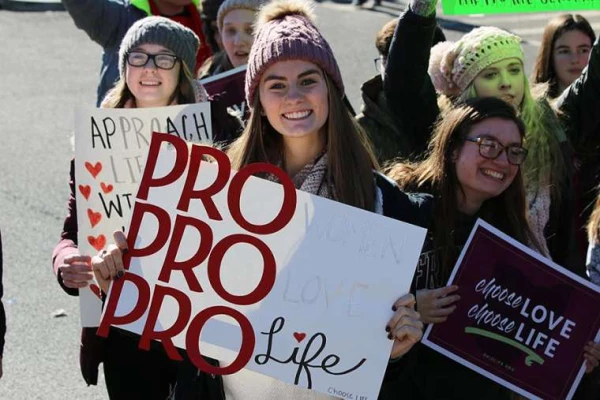
Another picture posted online showed several protesters holding pro-life signs outside GalviaWest Medical Centre in Galway, on Thursday.

Pro-life advocates have been protesting and praying outside abortion clinics and GP practices in Ireland since abortion was legalized in the country.

In May of 2018, the Irish voted overwhelmingly in a national referendum to repeal the Eighth Amendment and allow for legal abortions. Previously, abortion had been banned in the nation except when the mother’s health is deemed to be in danger.

The Eighth Amendment was officially repealed on Sept. 18, 2018, and a law was enacted in December legalizing abortion up to 12 weeks pregnancy, and thereafter in cases where the mother’s health is seriously at risk. The law went into effect at the beginning of 2019.

Professor Mary Higgins, a consultant OB/GYN at National Maternity Hospital who campaigned for legal abortion in the referendum, took video of the vigil outside on Wednesday and tweeted “wonder why we need exclusion zones.”

In a Thursday radio interview on RTÉ Radio 1’s “Today with Seán O’Rourke”, she acknowledged the protests were peaceful and involved singing and praying the rosary. The chants, singing, and rosary, however, were “disturbing” to the women in the post-natal ward two floors above the vigil, she said.

Higgins noted on Twitter that Wednesday’s protests occurred “beneath the windows of a postnatal ward, in front if people leaving after a miscarriage, with small coffins, crosses and unsavoury images.”

Since pro-life advocates began protesting outside abortion clinics in Ireland, exclusion zones have been discussed as a means of keeping the protests at a certain distance.

The Irish Council for Civil Liberties is campaigning for “safe zones” to “allow people to access healthcare in private and with dignity, as is their right.”

Ireland’s health minister Simon Harris said on Thursday that he is working on a “constitutional” way of setting up exclusion zones.

“Appalled to see,” he tweeted in response to Higgins’ video of the vigil. “I don’t wonder why we need it at all. Have been engaging with Attorney General, Gardai & service providers about how best to bring it in in a manner that is constitutional etc. Can assure you I am committed to it and will be meeting cross party on it this month”.

Senator Catherine Noone of the Fine Gael party also tweeted that “exclusion zone legislation” to establish a boundary outside abortion clinics and GP practices for protesters “needs to be a major priority for the start of the new term.”

“The danger is that it might never happen if there’s a change of Government,” she said.

Luke Silke, a spokesperson for Students for Life Ireland, opposed the imposition of exclusion zones while appearing on RTÉ Radio 1 with Higgins on Thursday.

He said that “introducing exclusion zones in Ireland, I feel, would create a very dangerous precedent for denying freedom of speech and the right to peaceful assembly, or protest, in public areas.”

Silke noted that he did not care for some of the “tactics” used by the pro-life protesters in Dublin. On Twitter, he specifically mentioned the use of small coffins right outside a maternity ward as problematic.

“Our goal would be to save lives and empower women,” he said.

Higgins, appearing simultaneously on the radio show with Silke, said the protests and the images used by them unnerved children and women and argued in favor of exclusion zones. The use of small coffins was “triggering” for women who have had miscarriages or babies stillborn, she said.

“I have no issue with peaceful protests. I do have an issue with where they are and how they’re directly underneath our post-natal ward with newborn babies,” she said.

[…]