
No Picture
News Briefs

Indian bishop condemns ‘shocking’ disinfectant spray of migrant workers
March 31, 2020 CNA Daily News 1

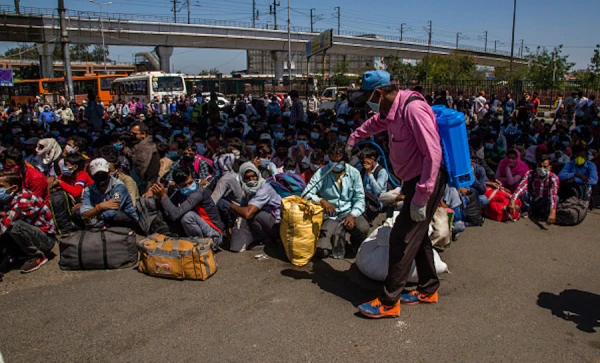
CNA Staff, Mar 31, 2020 / 03:30 pm (CNA).- A bishop in India has condemned the spraying of migrant workers and their children with disinfectant, after a video posted to Twitter showed public health authorities doing exactly that.

The video was posted to Twitter Sunday. The Times of India reported that families at a bus stand in the northern Indian city of Bareilly were told to sit on the ground, and were then sprayed with a bleaching agent mixed with water.

In the video, parents and their children sat on the streets of Bareilly and are showered with a chemical solution of chlorine mixed with water. Men in hazmat suits can be heard telling the migrants to close their eyes and mouths.

Bishop Ignatius D’Souza of Bareilly said spraying migrant workers with disinfectant was inhumane.

“This is inhuman, because these people are poor and marginalized and desperate our migrants labourers and their families. Their dignity cannot be violated in this inhuman and shocking manner,” the bishop said, according to Asia News.

Prime Minister Narendra Modi placed the country on lockdown as cases of COVID-19 in India have reached 1,251. The lockdown has closed down borders and forced migrant workers in India’s largest cities to return home to their villages.

Ashok Gautam, an officer in charge of COVID-19 operations in northern India, told CNN that as many as 5,000 people have been similarly disinfected before being allowed to return home.

“We sprayed them here as part of the disinfection drive, we don’t want them to be carriers for the virus and it could be hanging on their clothes, now all borders have been sealed so this won’t happen again,” he said.

Other government officials said the disinfectant was really meant for the buses and that the incident was a mistake. Lav Agarwal, an official of the Ministry of Health and Family Welfare, said Monday that workers involved in the incidents have been reprimanded.

“This is an overzealous action done by some employees at the field level, either out of ignorance or fear,” he said, according to CNN.

D’Souza emphasized the difficulties facing vulnerable people returning to their home villages, noting that the Church in Bareilly has been distributing food packets to those who arrive. He said they have delivered these packages to displaced people located at bus and train stations.

The bishop added that wealthy and well-known people with with COVID-19 have been treated differently than poor people in India, according to Asia News. He said everyone needs to be treated with human dignity.

“Each person has to be treated with human dignity, the celebrities who tested positive in India (who travelled to Lucknow), received best treatment, our poor people do not deserve this indignity, it’s an affront against the dignity of the human person.”

[…]

No Picture
News Briefs

Democratic Unionists lament introduction of elective abortion in N Ireland

March 31, 2020 CNA Daily News 1

CNA Staff, Mar 31, 2020 / 11:48 am (CNA).- Politicians of the Democratic Unionist Party, the leading pro-life party in Northern Ireland, along with other pro-life leaders, are lamenting that new laws permitting elective abortion in the region came into force Tuesday.

Paul Givan, a DUP member of the Northern Ireland Assembly, said March 31 that “here in Northern Ireland they have the most extreme, radical, abortion laws anywhere in Europe. It is a travesty that this has been allowed to happen.”

DUP leader Arlene Foster called it a “sad day.”

Jim Allister, the Traditional Unionist Voice’s sole member of the legislative assembly, said: “From today, what should be the safest place for an unborn, namely its mother’s womb, can become on a whim one of the most dangerous places – because we are going now to have utterly unfettered, uncontrolled abortion up to 12 weeks.”

The Abortion (Northern Ireland) Regulations 2020 also allow abortions up to 24 weeks “in cases where the continuance of the pregnancy would involve risk of injury to the physical or mental health of the pregnant woman or girl, greater than the risk of terminating the pregnancy.”

Abortion access is permitted with no time limit in cases of severe fetal impairment and fatal fetal abnormalities.

Previously, abortion was legally permitted in the region only if the mother’s life was at risk or if there was risk of long term or permanent, serious damage to her mental or physical health.

Both Lives Matter, a pro-life movement in the region, commented that “tragically, too many abortions happen because sadly women fear life and choose death. It is more important than ever before that those of us who recognise and value both lives in every pregnancy, offer better than abortion. Women and girls deserve access to all the practical, material and emotional services they need to choose life.”

Clare Bailey, the Green Party in Northern Ireland leader, welcomed the new regulation, saying that “access to abortion is a positive move.”

Sinn Féin has supported the liberalization of abortion law.

Northern Ireland’s new law allows doctors, registered nurses, and registered midwives to perform abortions.

Though in England, Wales, and Scotland, two medical professionals must certify in all cases that there were lawful grounds for abortion, in Northern Ireland only one medical professional is needed for certification in elective abortions or in cases of immediate necessity where there is a risk to the life of the mother.

The lower threshold in Northern Ireland was adopted at least in part because “it is likely that there will be a more significant number of people raising conscientious objections than in other parts of the UK.”

Consientious objection is allowed for direct participation in abortion, but not for ancillary, administrative, or managerial tasks associated with the procedure, because that “would have consequences on a practical level and would therefore undermine the effective provision of abortion services in Northern Ireland.”

Buffer zones have not been set up around locations where abortions are procured, barring protest in the locations’ immediate vicinity. The government has decided to wait and see what the situation will be, keeping the matter under review so it can “respond to any challenges as needed at the time.”

The new framework was adopted to implement Westminster’s Northern Ireland (Executive Formation etc) Act 2019, which decriminalized abortion in Northern Ireland and placed a moratorium on abortion-related criminal prosecutions, and obliged the UK government to create legal access to abortion in the region by March 31.

It was passed while the Northern Ireland Assembly was suspended, though the legislature resumed meeting in January.

Northern Ireland rejected the Abortion Act 1967, which legalized abortion in England, Wales, and Scotland, and bills to legalize abortion in cases of fatal fetal abnormality, rape, or incest failed in the Northern Ireland Assembly in 2016.

John Hayes, the Conservative MP for South Holland and The Deepings, said ahead of the regulations’ introduction that the process was “overriding devolution.”

“It seems likely this will be interpreted as the UK Government imposing its will on a reluctant part of the Kingdom which is doubtless disdainfully regarded by Whitehall’s liberal elite as antediluvian,” he wrote earlier this month.

The amendment to the NI EF Act obliging the government to provide for legal abortion in Northern Ireland was introduced by Stella Creasy, a Labour MP who represents a London constituency.

In October 2019, the High Court in Belfast had ruled that the region’s ban on the abortion of unborn children with fatal abnormalities violated the UK’s human rights commitments.

Northern Irish women had been able to procure free National Health Service abortions in England, Scotland, and Wales since November 2017.

[…]