No Picture
News Briefs

Australian journalists face court date over Pell trial coverage
May 26, 2020 CNA Daily News 1

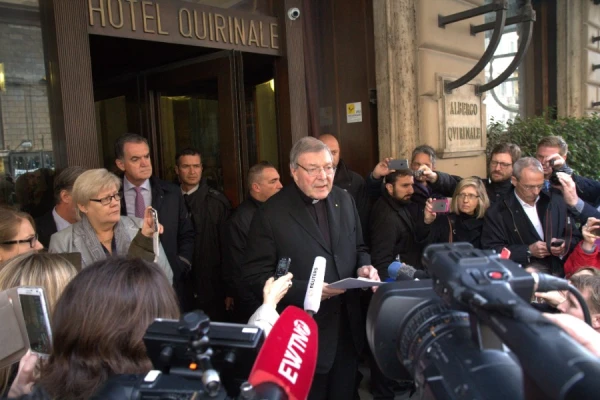
CNA Staff, May 26, 2020 / 12:00 pm (CNA).- A judge in the Australian state of Victoria has proposed beginning a trial in November to prosecute journalists and media outlets for violating a court-imposed reporting ban on the trial of Cardinal George Pell in 2018.

Victoria Supreme Court Judge John Dixon said Tuesday that the trial could begin as soon as November 9, but prosecutors and lawyers for the journalists are still disputing the terms of the trial, Reuters reported.

Prosecutors allege that 19 individuals and 21 media outlets assisted in the violation of the gag order by overseas media and are seeking a single trial. Lawyers representing the accused journalists contend that separate allegations need to be heard in individual trials. Penalties for violating court gag orders include fines of up to 100,000 Australian dollars ($66,000) and five years in prison for individuals.

In December 2018, Cardinal Pell was convicted on five charges of sexual abuse of minors by a court in Victoria. His case was heard on appeal, first by the Victoria Court of Appeal, which upheld his convictions before they were overturned by Australian High Court in April this year, freeing Pell after more than a year in prison.

In 2018, Victoria police brought several charges against Pell related to his time as Archbishop of Melbourne and as a priest in the Diocese of Ballarat. The charges were set to be heard in two successive trials, with the Melbourne accusations heard first. At the request of prosecutors, that trial was subject to a sweeping gag order, with media prohibited from reporting on anything to do with the case or even acknowledge that it was underway.

The ban was dropped in February, 2019, after prosecutors abandoned the Ballarat charges, admitting there was not enough evidence to go to trial.

Despite the order, several international outlets, including CNA, carried news of the trial and verdict in 2018, in some cases blocking that coverage from appearing online in Australia in order to comply with the court order.

Domestic media in Australia mostly complied with the court order, though some media outlets reported that an unnamed high-profile individual had been convicted on unreportable charges.

The Herald Sun newspaper ran a December 12 cover story under the headline “CENSORED” which said that “the world is reading a very important story that is relevant to Victorians.”

“The Herald Sun is prevented from publishing details of this significant news,” the front page read. “But trust us, it is a story you deserve to read.”

Coverage like that, according to Victoria prosecutors, amounted to offering support to overseas outlets in contempt of court.

At the time of Pell’s conviction, Judge Peter Kidd, who presided over the initial trial, said that “a number of very important people in the media are facing, if found guilty, the prospect of imprisonment and indeed substantial imprisonment, and it may well be that many significant members of the media community are in that potential position,” for violating the gag order.

On April 15, Victoria County Court held a first hearing in an effort by state prosecutors to bring charges against journalists and news outlets, including some of the largest names in Australian media, including The Age newspaper and several News Corp publications.

The next hearing it set for July.

The state of Victoria has faced sustained criticism for the use of suppression orders by the state’s courts.

Despite an Open Courts Act passed in 2013 aimed at improving judicial transparency, Victorian courts issued more than 1500 suppression orders between 2014-2016.

CNA has previously reported that in 2014, senior police in Victoria discussed using an investigation into Cardinal Pell to distract media attention from serious allegations of corruption in the force.

In a 2014 email exchange, then-Deputy Commissioner Graham Ashton and Charlie Morton, assistant director of media and corporate communications for the Victoria police department, discussed how to respond to a high-profile scandal which would hamper the credibility of Victoria police operations.

In an email dated April 1, 2014, Morton advised Ashton not to make a media appearance in response to the “Lawyer X” scandal, because forthcoming announcements about Cardinal Pell could distract media and public attention.

“The Pell stuff is coming tomorrow and will knock this way off the front page,” Morton wrote to Ashton.

In 2013, Victoria Police opened Operation Tethering, an open-ended investigation into possible crimes by Cardinal Pell, although no victims had come forward against him and there had been no criminal complaints made against him at the time. Although they had found no victims or criminal accusations, in 2015 the program was expanded and put on a more formal footing.

Ashton, is now the Chief Commissioner of Victoria Police. In 2019 he gave evidence at a Royal Commission inquiry into the use of police sources and the Lawyer X scandal, in which criminal defense lawyer Nicola Gobbo was recruited to work as an informant against members of the Calabrian mafia, while she was representing several of them as an attorney.

Much of Gobbo’s work as a lawyer was with Australian members of the Ndrangheta, the Calabrian mafia organization, which has established a deep presence both in Victoria and across the country, with allegations of multi-million dollar bribes to judges and close connections to local Victorian politicians in both political parties.

The link between the Italian and Australian branches of the organization is known to be close and ongoing.

The Victoria police force has been the subject of numerous scandals over the years. In addition to the allegations concerning Gobbo, a 2017 report found that nearly half (46%) of Victoria Police employees believe they would suffer personal repercussions if they reported corruption, with almost one in five saying it would cost them their job.


[…]

No Picture
News Briefs

Book calling for Catholic blessing of homosexual couples was requested by Austrian bishops’ conference

May 26, 2020 CNA Daily News 18

CNA Staff, May 26, 2020 / 11:02 am (CNA).- A book considering how homosexual couples might receive a formal, liturgical blessing of their union in the Catholic Church was written in response to a request from the liturgical committee of the Austrian bishops’ conference, according to the book’s principal author.

The work includes contributions by a number of German speaking theologians and a liturgical section, including a suggestion for how such a Church blessing of homosexual unions might be “celebrated” in Catholic churches.

The official title of the book is “The Benediction of Same-Sex Partnerships.” One of its principal authors and editors is Father Ewald Volgger, director of the Institute for Liturgical Studies and Sacramental Theology at the Catholic Private University of Linz.

Speaking to an Austrian diocesan paper, Father Volgger asserted he would like to see an introduction of an official benediction for homosexual couples “as soon as possible”, but conceded that “according to the Catechism of the Catholic Church, homosexual acts are in no way to be condoned and homosexual people are called to chastity”.

The 58-year-old priest added that “there has been movement on the subject,” and asserted that a rewrite of the Catechism of the Catholic Church might be in order to facilitate “an official liturgy” that would be “based on Church doctrine.”

As to why the Catholic Church would change her teachings on sexual morality, Father Volgger pointed to a shift in public perceptions, saying “the doctrine on homosexuality has been discussed throughout Europe in such a way that an opening up is not only debatable but can also be demanded.”

The priest added, “there are also a considerable number of bishops who would like to see a rethinking of sexual morality for the evaluation of same-sex partnerships”.

Furthermore, Volgger argued, such a change might make the teachings of the Church more acceptable and relevant. 

The diocesan paper pointed out that same-sex couples are apparently already blessed by a Catholic priest in Vienna’s St. Stephen Cathedral on occasion, and that one such couple was recently interviewed about the ceremony on Austrian TV.

Father Volgger said this was not the type of official benediction he had in mind.

“No, because that is probably the blessing of same-sex couples on Valentine’s Day. These are already widespread and in practice.”

“But a benediction, as it is proposed from a liturgical-theological point of view, would also have an official character, through which the Church expresses the obligation of fidelity and the exclusiveness of the relationship. By the way, it is a very beautiful message that in St. Stephen’s Cathedral everyone has a place and is blessed”.

Among the other authors of the book are several German theologians. In recent years, German bishops in particular have been increasingly outspoken in demanding “discussions about an opening” towards acceptance of practiced homosexuality and the blessing of homosexual unions in the Church.

Following consultations in Berlin in late 2019, the chairman of the Marriage and Family Commission of the German bishops’ conference declared that the German bishops agreed that homosexuality is a “normal form” of human sexual identity.

The topic also plays a central role in one of four forums that constitute the controversial “Synodal Process” under way in Germany.

Several members of the “Central Committee of German Catholics” (ZDK), in charge of running the process in tandem with the bishops’ conference, are members of parliament who have personally voted for the re-definition of marriage to include homosexual unions in a vote that legalized such partnerships as “marriages” in Germany in 2017, as CNA Deutsch reported.

Bishop Franz-Josef Bode of Osnabrück, vice-president of the German bishops’ conference has also previously called for a “debate” on the blessing of homosexual couples and a change of the Church’s teaching on sexual morality.

Speaking in an interview in January 2018, Bode said: “We need to reflect on how to evaluate a relationship between two people of the same sex in a differentiated way.” He also asked: “Isn’t there so much that is positive, good and right [about a homosexual relationship] that we need to do it more justice?”

The Archbishop of Munich and Freising, Cardinal Reinhard Marx, at Christmas 2019 expressed the view that homosexual couples can receive a Church blessing “in the sense of a pastoral accompaniment” in the Catholic Church.

In the same month, Archbishop Heiner Koch of Berlin stated that both hetero- and homosexuality are “normal forms of sexual predisposition, which cannot or should be be changed with the help of a specific socialization.”

Koch went on to say that “developments” were made possible by Amoris laetitia, Pope Francis’ exhortation of marriage and the family. The Berlin archbishop attended the Vatican Synod on the Family together with Marx and is Chairman of the Marriage and Family Commission of the German bishops’ conference.

He spoke publicly after the German bishops asserted they were committed to “newly assessing” the universal Church’s teaching on homosexuality – and sexual morality in general – during the two-year “synodal process.”


[…]

No Picture
News Briefs

California churches can reopen at 25% capacity

May 26, 2020 CNA Daily News 1

CNA Staff, May 26, 2020 / 09:00 am (CNA).- Churches in California can begin holding services again at a limited capacity, the state announced on Monday.

The California health department ruled that, subject to the approval of local authorities, churche… […]

No Picture
News Briefs

Bishop on Memorial Day: Sacrifice for others is at the heart of our faith

May 25, 2020 CNA Daily News 2

CNA Staff, May 25, 2020 / 10:54 am (CNA).- As Catholics celebrate Memorial Day this year, they should keep in mind not only the sacrifice of the men and women who gave their lives in service to the country, but also Christ’s sacrifice, which is at the heart of our faith, said Bishop David O’Connell of Trenton.

In a message to the faithful of his diocese, O’Connell noted that Memorial Day is often celebrated with cookouts, swimming, and parades, as well as visits to military cemeteries to honor veterans who have died in service to the country. He called on Catholics to remember the memory and sacrifices of those who have fallen.

“Memorial Day honors those brave women and men who proudly wore the uniform of our armed forces and made the ultimate sacrifices that have become the lifeblood of our republic,” he said. “It is entirely fitting that we remember them with gratitude and pride.”

The faithful can also see in the sacrifice of fallen veterans a reminder of the sacrifice of Christ, and a call to lay down their own lives in service to others, O’Connell said.

“For Catholics, sacrifice and dying for others is the very root of our faith,” he said. “We need look no further than the Crucifix that is the central symbol of our religious consciousness to remember how the Lord Jesus redeemed us through his death and freed us from sin.”

The bishop recalled Christ’s words that “No one has greater love than this, to lay down one’s life for one’s friends.”

“The sacrifices made by our countrymen and women throughout American history are a reminder of Christ’s message,” he said.


[…]

No Picture
News Briefs

Why medical students should learn about religion

May 25, 2020 CNA Daily News 2

Denver Newsroom, May 25, 2020 / 10:01 am (CNA).- Four medical school educators have said that fully to address a patient’s needs, physicians should begin asking questions about the patient’s spirituality and religion.

A May 19 opinion piece in the Annals of Internal Medicine was written by a group of medical educators: Doctors Kristin Collier, Cornelius James, Sanjay Saint, and Joel Howell.

Is It Time to More Fully Address Teaching Religion and Spirituality in Medicine?” said assessing a patient’s religious beliefs is important to understanding fully the person. They also highlighted the significance of spirituality in America.

“Today, approximately 90% of Americans believe in God or a higher power. Furthermore, 53% of Americans consider religion to be ‘very important’ in their lives,” they wrote.

“Because religious commitment is intrinsically connected to cultural, mental, spiritual, and societal aspects of wellness, many patients believe that any authentic approach to health care ought to engage their religious commitments.”

However, physicians often do not discuss spirituality with their patients. Physicians promote a medical education based on quantitative science, which ignores immaterial, spiritual realities, they said.
 
“Science became an almost unquestioned source of authority. Physicians started seeing patients less as social beings with families and faith being essential parts of their lives, and more as collections of malfunctioning organs defined by microscopic pathology and bacteriologic culture,” they said.

Kristin Collier, an assistant professor and the director of the University of Michigan Medical School Program on Health Spirituality & Religion, said patients want a deeper relationship with their physician.

“I’m a primary care doctor so I have relationships with people over time … As physicians, we are not technicians taking care of complex machines. We are taking care of human beings and we know from research that patients desire to be seen as whole persons,” she told CNA.

She pointed to the example of Cicely Saunders, an English nurse and a founder of palliative medicine. Saunders emphasized four dynamics: physical, social, physiological, and spiritual. Addressing only half of these needs will only acknowledge half of the person, Collier added.

“Patients have social needs, they have spiritual needs. Those needs actually can intersect for the physical. For example, patients who have under-recognized, undertreated spiritual needs at the end of life … can [contribute to] unremitting physical pain,” she said.

According to the opinion piece, there is a lack of training and mentorship fully to equip upcoming doctors to discuss spirituality. They said 78% of medical students reported that they have rarely or never seen their instructors discuss religion with their patients.

The Association of American Medical Colleges has required a core set of “spiritual competencies” for students to undertake in their medical education. The AAMC defines spirituality as an individual’s search for meaning through a participation in “religion and/or belief in God, family, naturalism, rationalism, humanism and the arts.”

Collier said a lot of medical schools have a curriculum for spirituality and described the curriculum at the University of Michigan Medical School. She said one of the examples is the FICA assessment, a questionnaire that assesses a patient’s beliefs, purpose, and community. Under the program, she said, the school will provide paid actors to play the role as patients and the students will then ask spiritual questions.

However, she said doctors and instructors need to be living out this example with real patients, which is a topic that is rarely discussed. She said that in the past it was taboo for doctors to discuss a patient’s sexual history, which is an essential aspect of understanding a patient’s physical health. She said that similarly, doctors will not approach the subject of spirituality because it is too private or considered to be unrelated to health care.

“In some ways, the spiritual history parallels that of the sexual history. For years, the sexual history was considered ‘off limits’ in the clinical encounter, perhaps because it was too private a subject or not relevant for most medical providers, or perhaps because providers were uncomfortable talking about a diverse range of sexual behaviors,” the opinion piece said.

To introduce the topic, she said, doctors could begin with a questionnaire, like the FICA spiritual assessment. But, this important topic should eventually transcend a questionnaire, she said, noting that a deep human interaction extends beyond the paper. She said understanding the whole person will help doctors best understand how to treat their patients.

“I think this best happens in a relationship and I have relationships with my patients… What gives your life meaning? That question can oftentimes open up a lot of really interesting insights into your patients,” she said.

“[These questions] can help inform your decisions when it comes down to end of life or goals of care conversation.”

She emphasized the importance of faith in her own life and how that has given her a valuable perspective on the treatment of patients. She said it is the responsibility of physicians to set an example of a medical practice that honors human dignity.

“I see patients made in the image of God and I want to be able to attend to everything that is causing them distress and to be able to use my team to be able to attend to that,” she said.

“We have a responsibility as medical educators to teach our medical students and residents and fellows how to deliver whole-person care because that honors the dignity of the person. And, we know that patients want to be seen as more than just their disease or their biology.”

[…]