No Picture
News Briefs

Papal envoy sees great fruits, but also challenges in Medjugorje

April 5, 2017 CNA Daily News 0

Medjugorje, Bosnia, Apr 5, 2017 / 12:10 pm (CNA/EWTN News).- Pope Francis’ envoy to Medjugorje said Wednesday that the site seems to be bearing numerous expressions of faith and vocations. However, he added, the final determination of the apparition’s authenticity remains to be seen.

Archbishop Henryk Hoser was sent by the Pope to evaluate the pastoral situation for residents and pilgrims in Medjugorje. He clarified that he was not tasked with anything beyond this scope.

“The same as you, I expect a final decision from the commission, and of course the Holy Father Pope Francis,” Archbishop Hoser said at an April 5 press conference in Medjugorje. “I do not know what the Holy Father thinks, he never told me,” he said. “The Holy Father also needs to see what are the conclusions of the commission.”

The apparitions are under investigation by the Congregation for the Doctrine of the Faith, which is to submit its final document to the Pope for a final decision.

The apparitions allegedly started on June 24, 1981, when six children in Medjugorje, a town in what is now Bosnia and Herzegovina, have claimed to have witnessed apparitions of the Blessed Virgin Mary.

According to the alleged visionaries, the apparitions conveyed a message of peace for the world, a call to conversion, prayer and fasting, as well as certain secrets surrounding events to be fulfilled in the future.  

These apparitions are said to have continued almost daily since their first occurrence, with three of the original six visionaries claiming to have received apparitions every afternoon because not all of the “secrets” intended for them have been revealed.

Since their beginning, the alleged apparitions have been a source of both controversy and conversion. More than 2.5 million go on pilgrimage to Medjugorje each year. Some claim to have experienced miracles at the site, while many others claim the visions are non-credible.

Skeptics of the apparitions include Bishop Ratko Peric of Mostar-Duvno, whose diocese includes Medjugorje. In a Feb. 26 statement, he said “these are not true apparitions of the Blessed Virgin Mary.”

“The female figure who supposedly appeared in Medjugorje behaves in a manner completely different from the real Virgin Mother of God in the apparitions currently recognized as authentic by the Church: usually she does not speak first, she laughs in a strange way, before some questions she disappears and appears again, she obeys the ‘visionaries’ and the local pastor who make her come down from the hill into the church even against her will. She doesn’t know with certainty how many more times she will appear, she allows some of those present to step on her veil extended on the ground, and to touch her dress and her body. This is not the Virgin of the Gospels.”

Bishop Peric also pointed to a sense of nervousness rather than peace among the seers.

As for the papal envoy, Archbishop Hoser, he said Wednesday that he had contact with the reputed visionaries of Medjugorje. This contact was “completely normal,” but not in-depth.

“Let us remember they are no longer boys and girls,” he said. “Some of them are already grandmothers.”

“We should note that they are immersed in the normal regular, everyday life of the family. They need to work and support their families. They have a similar life to many of us,” he said.

He repeated that his role was not to speak about the apparitions and said the Church has not made the relevant statements yet. Nonetheless, questions at the press conference raised the issue.

Archbishop Hoser compared and contrasted the apparitions with the Marian apparitions at Kibeho in Rwanda, which began in October 1981. An apparition of the Virgin Mary had warned about a coming genocide, years before the mass killings of 1994.

The archbishop had served on a medical commission evaluating that apparition.

“The message was similar to the message that was said here in Medjugorje,” the archbishop said. “it was a calling to conversion …it is a calling to peace, an invitation to peace”

Unlike Medjugorje, the Rwanda apparitions have already received Church approval for having nothing that contradicts the faith.

“In the beginning there were doubts whether those visionaries were authentic,” he said of the Rwanda apparitions. “That is why I ask you for your patience. The more complex a phenomenon is, it takes more time to achieve valid conclusions.”

He noted some differences between the Medjugorje apparitions and other Marian apparitions. Some have counted 47,000 claims of individual apparitions related to Medjugorje, while other Marian apparitions are much fewer in number.

In other Marian apparitions, the Virgin Mary appears only in one place. At Lourdes, she always appeared in the cave that later became the famous grotto. In Fatima, she always appeared above the oak tree.

“Here, according to what visionaries are saying, the apparitions follow the person, where the person goes,” Archbishop Hoser said. “This could be at home, when they are traveling, in the church.”

“These are all specifics that make the work of a final decision more difficult,” he explained.

Archbishop Hoser, who holds the title of archbishop as a personal recognition from Pope John Paul II, heads the Polish Diocese of Warszawa-Praga.

When the archbishop’s appointment as papal envoy was announced in February, Holy See press officer Greg Burke stressed that his mission was pastoral, not doctrinal, and would not consider the substance of the Marian apparitions there. That topic is under the competence of the Congregation for the Doctrine of the Faith.

Archbishop Hoser praised various expressions of faith he found in Medjugorje: the centrality of the Celebration of the Holy Eucharist, devotion to the Word of God, adoration of the Blessed Sacrament, devotion to the rosary, and meditation on the mysteries of the faith and the Way of the Cross. He also praised the frequent use of the Sacrament of Reconciliation.

“From the religious perspective Medjugorje is very fertile grounds for religious vocations,” he said. About 610 priests have cited Medjugorje as a motivating force in their vocation, with the greatest number of these vocations coming from Italy, the U.S. and Germany.

For the archbishop, this is a significant contribution given the crisis of vocations in some countries.

Medjugorje is only about 36 years old, he observed, but it attracts an estimated 2.5 million pilgrims each year. By comparison, Lourdes, France attracts 6 million people per year, 150 years after the apparition.

Archbishop Hoser noted the need to consider parish life for those who live there and the effects of the many pilgrims.

The number of pilgrims poses “a huge challenge” for the priests who serve in Medjugorje, with expansions to the church infrastructure needed to accommodate them. The number of pilgrims has also caused an increase in the number of hotels, restaurants and other facilities to accommodate them.

Some people have come from elsewhere to settle in Medjugorje.

The archbishop noted the various humanitarian groups and activities in Medjugorje, some of which have roots in the town. There is the Franciscans’ Domus Maria, Mary’s House, which serves orphans, young people in difficulty, persons struggling with drug and alcohol addictions, the disabled and handicapped. The retreat house Domus Pacis provides spiritual exercises, serving over 42,000 participants in 1,200 groups each year.

There are also various seminars dedicated to priestly formation, married couples, doctors and medical professionals, people with disabilities, and a new pro-life seminar.

All of this activity could be applied in other parts of the world, the papal envoy said.

“People perceive there things that they don’t have at home,” Archbishop Hoser said of Medjugorje. “In many old Christian countries, individual confessions do not exist anymore. In many countries, there is no Adoration before the Blessed Sacrament. In many countries, there is no Way of the Cross anymore. There’s no rosary anymore. In Britain, in France, they told me the last time they prayed the Way of the Cross was 30 years ago. And such dryness of sacred space obviously leads towards a crisis of the faith.”

He praised the emphasis in Medjugorje on the Virgin Mary’s title “Queen of Peace,” especially during the period which Pope Francis has called a “piecemeal Third World War.”

He cited the Balkans’ suffering of a civil war in the 1990s with the breakup of Yugoslavia. In addition, he cited his own experience in Rwanda, and the destruction in Syria, which hosts the oldest Christian presence in the world.

“To invoke the Queen of Peace, the Mother of God: this is the specific role of Medjugorje. It is most important.”

“My friends, you should be carriers of joyful news,” he told the press conference. “And you can say to the whole world that in Medjugorje, there is a light… we need these spots of light in today’s world that is going down into darkness.”


[…]

No Picture
News Briefs

Dialogue is essential, Pope Francis tells British Muslim leaders

April 5, 2017 CNA Daily News 0

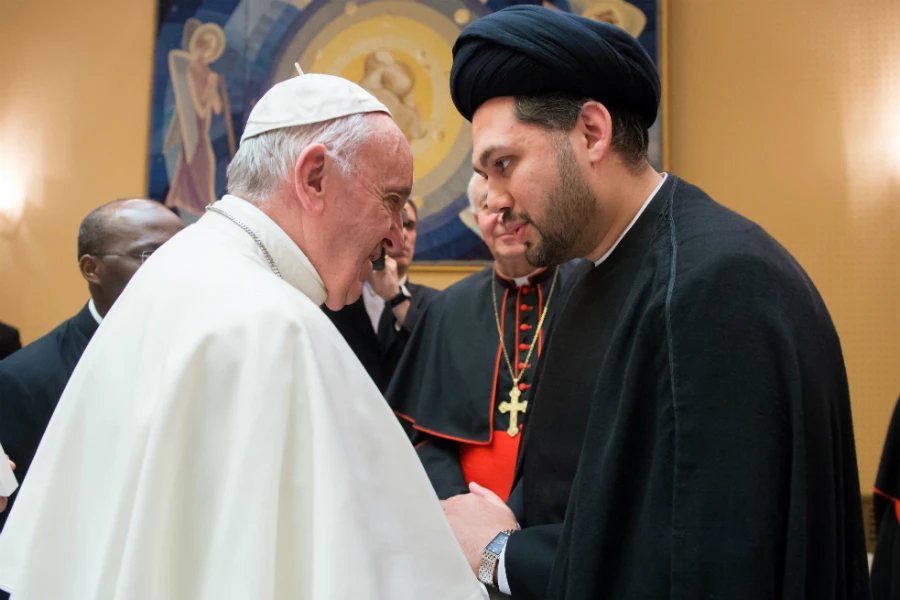
Vatican City, Apr 5, 2017 / 11:56 am (CNA/EWTN News).- Pope Francis met Wednesday with a delegation of Muslim leaders from Great Britain along with Cardinal Vincent Nichols of Westminster to promote dialogue and collaboration following the deadly attack in London last month.

During the private meeting at the Vatican’s Paul VI Hall April 5, Pope Francis said the most important job everyone has in this moment is to listen to each other.

“I like to think that the most important work that we must do among us today, in humanity, is the work ‘of the ear:’ to listen to each other,” he stated. “To listen to each other, without rushing to answer.”

Following the audience with Francis, the group also met with Cardinal Jean-Louis Tauran, president of the Pontifical Council for Inter-religious Dialogue.

The meetings at the Vatican were organized following an attack on London’s Palace of Westminster March 22.

According to the Guardian, four people were killed in the attack, including the police officer who was stabbed and one man believed to be the assailant. About 20 others were reported injured, some severely.

Wednesday’s delegation consisted of Muhammad Shahid Raza, chairman of the British Muslim Forum; Ali Raza Rizvi, president of Majilis e Uluma Europe; Sayed Ali Abbas Razawi, director of the General Scottish Ahlul Bayt Society; and Ibrahim Mogra, co-chair of the Christian Muslim Forum.

“The ability to listen, this is so important,” the Pope said during the meeting. “It’s interesting: when people have this capacity to listen, they speak in a low tone, calmly… Instead, when they do not have this, they speak loudly and shout as well.”

“Between brothers, all of us need to talk, to listen to each other and speak slowly, calmly, to search for the way together. And when you listen and speak, you are already on the way,” he said.

According to a statement from the Catholic Church in England and Wales, Cardinal Nichols said they were all “deeply moved” to meet with the Pope.

“We draw great inspiration from his leadership and his encouragement to walk together on the road of profound spiritual dialogue.”

“I also hope that this moment will help the voice of authentic Islam to be heard clearly. We look forward to our continuing promotion of collaboration at a local level at the service of all in society,” he continued.

Moulana Muhammad Shahid Raza called the meeting “a historic moment,” bringing together Christians and Muslims in “unity and solidarity for peace.”

“I could see the sincerity and love in his eyes as he offered words of encouragement to all of us as we came together in unity,” said Moulana Sayed Ali Abbas Razawi. “This is an important meeting offering hope for everyone, regardless of religion.”

“There is a common humanity to all of us. Some seek to divide people, religions, east versus west, but there is no east or west; there is just our common humanity as we seek a peaceful future for all based on justice and compassion.”

Pope Francis sent a letter the day following the London attack expressing his sorrow and solidarity for the victims and their families, and entrusting them and the nation to God’s mercy.

“Deeply saddened to learn of the loss of life and of the injuries caused by the attack in central London, His Holiness Pope Francis expresses his prayerful solidarity with all those affected by this tragedy,” a March 23 letter signed by Vatican Secretary of State Cardinal Pietro Parolin read.

The Pope commended the souls of those who died “to the loving mercy of Almighty God,” and prayed for “divine strength and peace upon their grieving families,” while assuring of his prayer for the entire nation.

[…]

No Picture
News Briefs

Venezuela cardinal says supreme court revisions don’t go far enough

April 5, 2017 CNA Daily News 0

Caracas, Venezuela, Apr 5, 2017 / 06:02 am (CNA/EWTN News).- Shortly after Venezuela’s supreme court revised its decision effectively stripping the legislature of its powers this weekend, one of the country’s cardinals responded by calling the reversal a mere “cosmetic retouching.”

Venezuela’s Supreme Court, packed with supporters of president Nicolas Maduro, announced March 29 that it would assume the functions of the National Assembly, where the opposition holds a majority.

The move was denounced domestically and internationally as a coup and a blow to democracy. In the face of this criticism Maduro asked the court to revise its rulings, which it did April 1.

“The corrections to the rulings are cosmetic retouchings that do not resolve the situation in the least, because the measures that shut down the National Assembly as an autonomous power continue, and confound the population,” Cardinal Baltazar Porras Cardozo of Merida responded April 2.

Cardinal Porras said that there remains the request “made last year that the legislature be restored to its full authority. This is a universal demand of many countries.”

The Archbishop of Merida said the lack of popular sovereignty and refusing participation to any group dissenting from the central government is reprehensible.

“If this continues, it can be an invitation to chaos and disorder and provoke an unnecessary bloodbath. If there are reasons to disown the legislature, it’s the people who have to decide that. At this time the real needs of the people are the lack of food and medicine,” he noted.

Similarly, Cardinal Jorge Urosa Savino of Caracas pointed out that “the blockade of the National Assembly persists.”

“I’m still worried that the country has been in a state of emergency regarding economic matters for about a year. This is not normal,” he said April 2.

He likewise noted that the government’s controversial measures “such as the cancellation of the (presidential) recall referendum, that the problem of the representatives from Amazonas state has not been resolved, that the election of governors has been postponed. All this sets up a dictatorship.”

One of the most contentious issues the country faces is the economy, where the world’s highest inflation rates, price controls, and failed economic policies have resulted in severe shortages of basic necessities like medicines, milk, flour, toilet paper, and other essentials.
Venezuela’s socialist government, in power since 1999, is widely blamed for the crisis.
The shortages have their roots in policies enacted by Hugo Chavez in 2003 that control the price of nearly 160 products such as flour, milk, oil and soap. While these products are affordable at the government listed price, they are in short supply and fly off the shelves, ending up on the black market at much higher rates.

[…]

No Picture
News Briefs

Pope Francis condemns deadly attacks in Syria, Russia

April 5, 2017 CNA Daily News 0

Vatican City, Apr 5, 2017 / 05:47 am (CNA/EWTN News).- On Wednesday Pope Francis expressed his horror at a chemical weapon attack in the province of Idlib in Syria on Tuesday, also expressing his sorrow for the victims of an attack April 3 in St. Petersburg, Russia.

“We witness, horrified, the latest events in Syria,” the Pope said April 5. “I strongly deplore the unacceptable massacre that took place yesterday in the province of Idlib, where dozens of civilians were killed, including many children.”

“I pray for the victims and their families, and I appeal to the conscience of those who have political responsibility, locally and internationally, so that this tragedy may come to an end and relief be brought to that beloved population who for too long have been devastated by war,” he continued.

Francis also offered encouragement to those who, even in a time of insecurity and discomfort, are working to bring help to the people of that region.

Reports differ, but at least 70 people, including children, were killed April 4 after being exposed to a toxic gas said to have been dropped from warplanes, the Guardian reports. At least another 100 people are being treated in hospitals in the region. Hours after the initial attack, one hospital treating the injured was also hit.

This attack followed one day after a bomb exploded between two metro stops in St. Petersburg, killing 14 people and injuring dozens more. Authorities have determined the attack was carried out by a suicide bomber originally from the central Asian Republic of Kyrgyzstan, CNN reports.

Another explosive device was later found in the metro system and safely disabled.

Pope Francis said Wednesday that his thoughts go out to all those involved in the serious attack. “I entrust to God’s mercy those who have tragically died, I express my spiritual closeness to their families and to all those who suffer because of this tragic event,” he said.

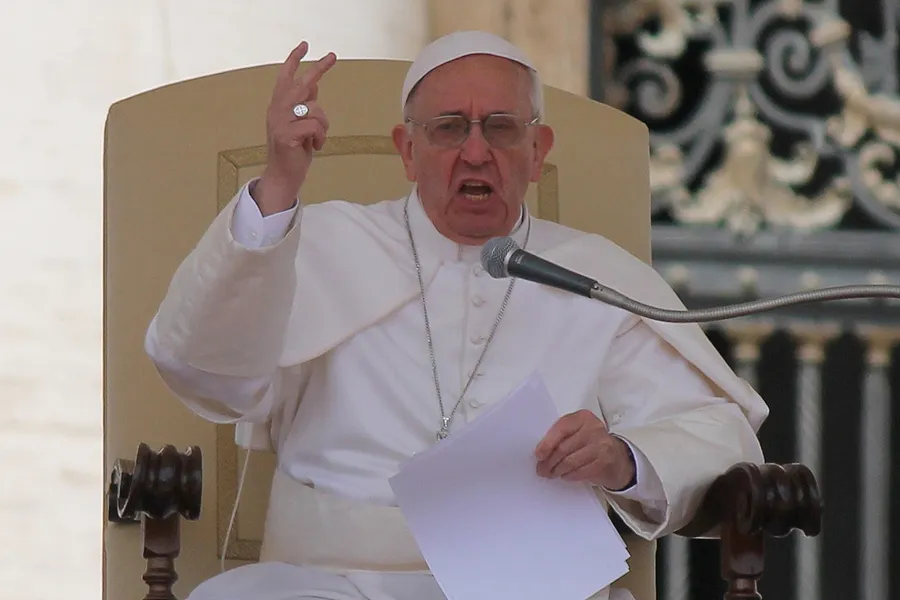
The Pope’s appeal followed his usual Wednesday general audience in St. Peter’s Square, where he spoke about what it means to accept suffering in our lives, uniting it with the suffering of Jesus on the Cross.

St. Peter tells us it is better to suffer “for doing good…than for doing evil,” Francis said. “He does not mean that it is good to suffer, but that, when we suffer for the good, we are in communion with the Lord, who consented to suffer and be placed on the cross for our salvation.”

“When then we too, in smaller or larger situations in our lives, accept to suffer for the good,” he continued, “it is as if we sow around us seeds of the resurrection, seeds of life, making shine in the darkness the light of Easter.”

This is why the Apostle urges us to not return “evil with evil,” he said, but instead to always wish the other person well.

“This blessing is not a formality, is not only a sign of courtesy, but is a great gift that we ourselves have receive and have to ability to share with others,” he said. “It is the proclamation of God, an immense love, that does not end, it never fails, and which constitutes the very foundation of our hope.”

Every time we suffer “for righteousness,” we become an “instrument of peace,” the Pope said. This is why the Apostle Peter calls us “blessed” for doing so.

St. Peter also tells us to “always be ready to give an explanation to anyone who asks you for a reason for your hope,” but this hope is not just a concept or a feeling, but a person, Pope Francis said.

Because “Christ is risen,” we recognize that he is not only alive, but present in us and in our brothers and sisters, as well, he said. This means that we must be Christ’s visible signs on earth, taking him as our model of how to live and learning to always act as he would act.

We must “emanate” the gentleness of Christ, always showing respect towards others, forgiving those who hurt us, the Pope said.

“Yes, because that is what Jesus did, and continues to do through those who make room for him in their hearts and in their lives, aware that evil does not win with evil, but with humility, mercy and meekness.”

[…]

No Picture
News Briefs

A letter from the Pope to the US president sunk in the Titanic

April 5, 2017 CNA Daily News 0

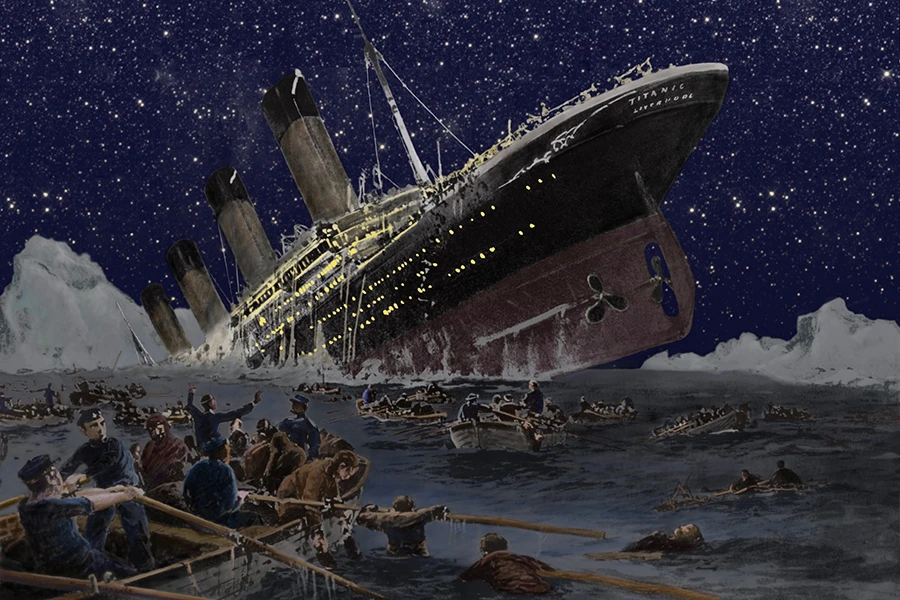
Denver, Colo., Apr 5, 2017 / 03:02 am (CNA/EWTN News).- On the fateful voyage that embarked from Southampton and never made it to New York City, a passenger on the RMS Titanic named Major Archibald Willingham Butt was tasked with a special mission.

He was to carry a letter from Pope Pius X and personally deliver it to United States president William H. Taft.

But the 45-year-old major perished along with more than 1500 other passengers the night of April 15, with the contents of the letter never to be known.

Born in 1865 in Augusta, Georgia, Major Butt began a career in journalism after graduating from the University of the South, in Sewanee, Tennessee. He later worked as first secretary of the United States Embassy in Mexico. During the Spanish-American war, he joined the army and was later appointed in 1908 by Theodore Roosevelt as his military aid. When President Taft was elected, Major Butt was kept on staff and promoted to the rank of major in 1911.

By the next year, his health began to deteriorate – some speculating that this was due to him wanting to stay neutral and supportive amid tense political rivalry between Taft and Roosevelt, the latter of whom was planning a re-election campaign.

On a leave of absence, Major Butt embarked on a six-week tour of Europe in March of 1912 with his friend, artist Francis Millet. President Taft gave the major a letter to deliver to Pius X while in Rome, which he did on March 21. In return, Pius X gave him a letter to deliver to the president, according to the U.K. National Archives.

The major boarded the RMS Titanic in Southampton on April 12.

When the ship struck an iceberg in the waters of the Atlantic on the evening of April 15, he was seen in the smoking room, playing cards with Millett, the two ostensibly making no attempt to save themselves. Other sources, however, report his heroism.

According to Biography.com, The New York Times reported survivor Renee Harris as saying that he helped the sailors place women and children safely into lifeboats – even threatening bodily harm to any man who tried to circumvent the process.  

“Women will be attended to first or I’ll break every…bone in your body,” he told one such unfortunate gentleman, according to Harris. The major helped “frightened people so wonderfully, tenderly, and yet with such cool and manly firmness. He was a soldier to the last,” Harris reportedly said.

[…]

No Picture
News Briefs

Forced abortion in China cost a UN agency millions in US funds

April 4, 2017 CNA Daily News 0

Washington D.C., Apr 4, 2017 / 05:55 pm (CNA/EWTN News).- The United States has ended funding for the United Nations Population Fund (UNFPA), saying the agency’s support for Chinese population control programs violates an amendment banning funds for partners of coercive abortion or sterilization programs.

“This determination was made based on the fact that China’s family planning policies still involve the use of coercive abortion and involuntary sterilization, and UNFPA partners on family planning activities with the Chinese government agency responsible for these coercive policies,” the U.S. State Department said in a letter to U.S. Senate Foreign Relations Committee Chairman Bob Corker.

The move ends $32.5 million in funds for the 2017 fiscal year, Reuters reports. The money will instead go to the State Department’s Global Health Programs fund. Those monies are used by the U.S. Agency for International Development to support family planning and maternal and reproductive health.

In 2015, the U.S. government was the fourth-largest voluntary donor to the Population Fund, giving $75 million.

The population fund said the claims were erroneous, saying its entire work “promotes the rights of individuals and couples to make their own decisions, free of coercion or discrimination.” It said its work has saved tens of thousands of mothers from preventable deaths and disabilities.

The Kemp-Kasten Amendment bars funding for any organization or program that the U.S. President determines to support or participate in coercive abortion or sterilization programs.

Women’s Rights Without Frontiers founder and president Reggie Littlejohn, a longtime critic of the Population Fund, said the fund “clearly supports China’s population control program, which they know is coercive.”

Littlejohn had called for further investigation into the Population Fund at a March 23 panel her organization held at the United Nations Commission on the Status of Women. Her remarks cited several instances of coercion in abortion and sterilization.

She cited a sterilization campaign begun in April 2010 in  Puning City in China’s Guangdong Province, which set a goal of sterilizing 9,559 people. Littlejohn charged that those who refused were detained, along with their family members.

She also cited a May 4, 2016 article from BBC News, “Reinventing China’s abortion police,” which describes a Chinese official in Shaanxi province as a “birth-control enforcer” screening women for illegal pregnancies and telling women who cannot afford the fines to have an abortion.

The coastal province of Shandong is particularly strict, with illegal detentions for those accused of having children without official approval.

“Under China’s One (now Two) Child Policy, women have been forcibly aborted up to the ninth month of pregnancy,” Littlejohn said April 4. “Some of these forced abortions have been so violent that the women themselves have died, along with their full term babies. There have been brutal forced sterilizations as well, butchering women and leaving them disabled. Where was the outcry from the UNFPA? In my opinion, silence in the face of such atrocities is complicity.”

In 2002 the U.S. ended federal funding for the Population Fund after an investigation under then-Secretary of State Colin Powell found that it was complicit with Chinese officials’ coercive implementation of the country’s one-child policy.

The Obama administration had restored this funding in 2009.

Women’s Rights without Frontiers offers a support network to Chinese women pressured to abort or abandon their daughters, providing monthly support for up to a year. It aims to combat the practice it characterizes as “femicide” or “gendercide,” the selective targeting of baby girls for abortion.

Littlejohn has said the Chinese government should implement a similar program to save baby girls.

[…]