Marawi, Philippines, Jun 27, 2017 / 09:04 am (CNA/EWTN News).- Captured priest Father Teresito “Chito” Suganob was seen alive on Sunday in a part of a Philippines city under Islamist militant control, Agence France Presse reports.
“We don’t have details of his health. We were just told that he was sighted alive,” military spokesman Lt. Col. Jo-Ar Herrera told reporters in Marawi, citing reports from rescued civilians.
Militants of the Maute group stormed the city of Marawi, on the island of Mindanao, May 23. The group, formed in 2012, pledged allegiance to the Islamic State in 2015.
The militants still have about 100 civilian hostages, whom they use as human shields, ammunition carriers, and stretcher-barriers.
Father Suganob, who is vicar general of the Marawi territorial prelature, was featured in a video released one week after his capture. He appealed to President Rodrigo Duterte to withdraw the army and stop the airstrikes.
Most of the city’s 200,000 people have fled since its occupation. Nearly 400 people have been killed in the fighting in Marawi.
The city is mostly Muslim. An eight-hour truce on Sunday allowed residents to celebrate the end of Ramadan, but military air and artillery bombardment of militant enclaves resumed with the truce’s end.
The government has said some of the militants appear to be from abroad, including countries like Russia, Indonesia, and Malaysia. Herrera said there are indications other slain militants have come from the Middle East.
The militants’ violence began after a failed army and police raid to capture Isnilon Hapilon, a local Islamist leader. Their initial attack burned several buildings, including the Catholic cathedral and the bishop’s residence.
If you value the news and views Catholic World Report provides, please consider donating to support our efforts. Your contribution will help us continue to make CWR available to all readers worldwide for free, without a subscription. Thank you for your generosity!
Click here for more information on donating to CWR. Click here to sign up for our newsletter.
St. Paul’s Church, in Imphal, capital of Manipur state, after the church was set on fire in 2023. / Credit: Anto Akkara
Bangalore, India, Mar 28, 2024 / 12:30 pm (CNA).
After Indian officials’ announcement that Easter Sunday would be a “working day” this year was met with widespread protests from Christians, the governor of the state of Manipur in northeast India issued a statement reestablishing the annual holiday.
The March 28 reversal by the Manipur government, which is led by the Hindu nationalist Bharatiya Janata Party (BJP) came within 24 hours after Manipur Gov. Anusuiya Uikey canceled the Easter holiday.
“In partial modification of the government order … dated 27th March, 2024, the governor of Manipur is pleased to declare that only the 30th March 2024 [Saturday] will be working day for all government offices,” the order read.
The previous day the government had announced that “the governor of Manipur is pleased to declare 30th [Saturday] and 31st [Sunday] March 2024 as working days for all government offices.”
Christians account for nearly half of Manipur’s population of 3.7 million.
Archbishop Linus Neli, who heads the 100,000-strong Catholic Church in the state, told CNA that the Church had protested the cancellations of the Easter holiday to government officials.
“We are storming the competent authority, awaiting reply,” Neli said.
A half an hour later, the archbishop shared with CNA the government’s “revised order regarding [Easter] working day.”
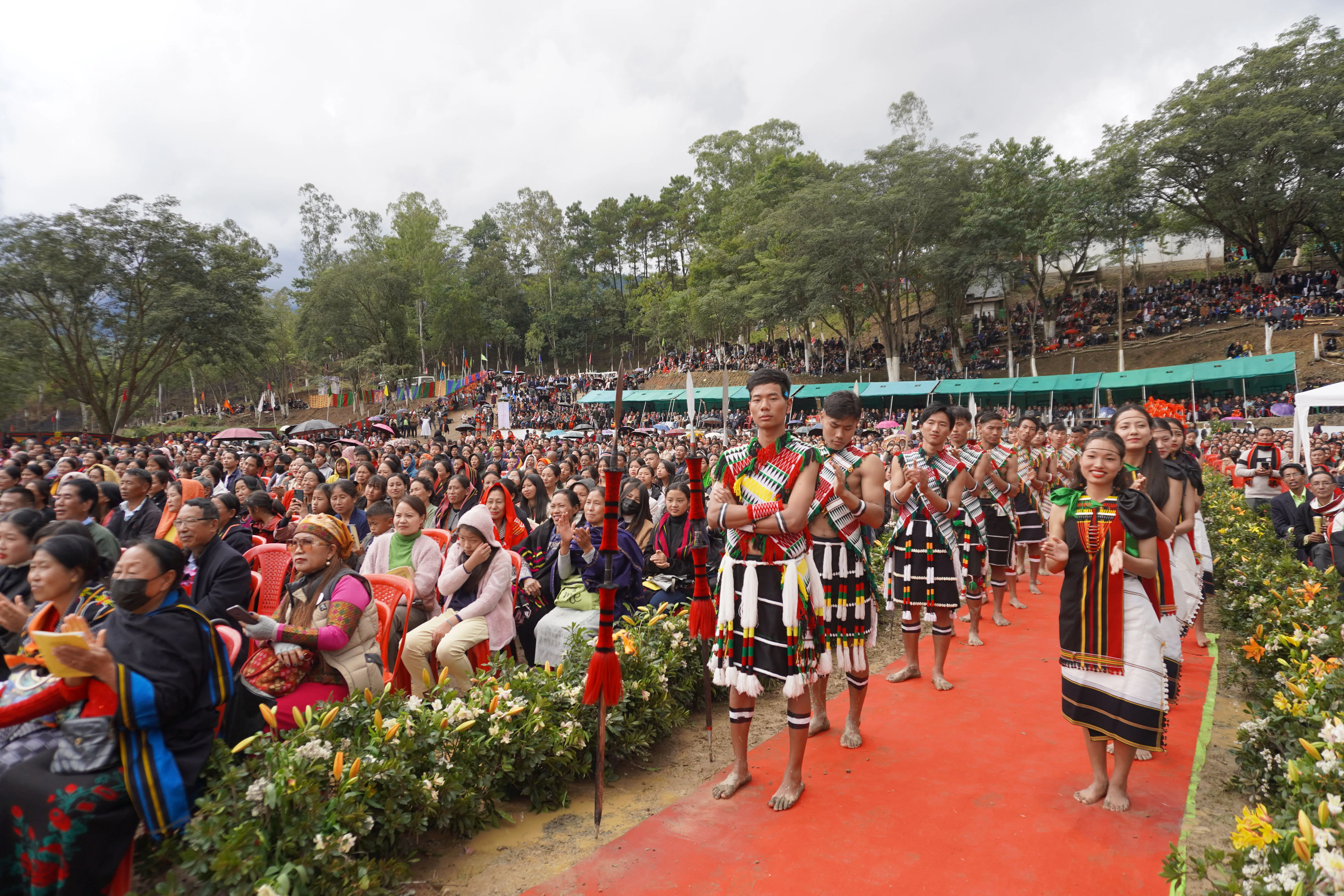
Tribal dancers waiting their turn at the celebration following the installation Mass of the new archbishop of Imphal Archdiocese, Linus Neli. Credit: Anto Akkara
Prior to that, several Christian groups including those in Manipur had called for the cancellation of the order that stunned the Christians across the country.
“The decision to declare these sacred days as regular working days is not only insensitive but also disrespectful towards the religious sentiments of the significant portion of the population in Manipur,” lamented the Senapati District Catholic Union of Manipur in its condemnation of the governor’s order on the morning of March 28.
Of the 3.7 million Christians in Manipur state, 26% are ethnic Naga tribals, 16% are members of Kuki tribes, and more than 10% of the nearly 2 million Meiteis have also embraced the Christian faith in Manipur.
“By compelling government offices to operate on these holy days, the order not only disregards the religious rights of the Christian community but also fails to recognize the cultural diversity and religious pluralism that should be upheld and respected in democratic society,” the Senapati district Catholic forum pointed out.
“Height of insanity of the Manipur government,” a Christian pastor from Manipur who runs a theological college outside Manipur told CNA.
“What is happening is Manipur is nothing new,” John Dayal, an outspoken Catholic columnist and activist, told CNA.
“The BJP governments both at the national level and in several states had tried to insult and tinker with Christian holy days like Christmas, Good Friday, and Easter several times in the past,” Dayal pointed out.
“In 2002, I moved the Delhi High Court successfully against the bid to make Good Friday and Easter Sunday ‘working days’ against the Atal Behari Vajpayee [who was the BJP prime minister then],” said Dayal, a former member of the National Integration Council headed by the prime minister.
“This Manipur move is keeping with [Prime Minister] Modi’s consistent scheme to whittle away rights of Christianity and Islam in new ‘Bharat.’” (Bharat is the new name the Hindu nationalist BJP has proposed for India).
Since May 2023, Manipur has seen a protracted violent clash between the majority Meiteis, most of them Hindus, and the minority Kukis (all of them Christians) that has left more than 230 dead by the official conservative death toll. Over 50,000 Kuki Christians have been chased out from the Imphal valley along with over 10,000 Meiteis who were driven out from Kuki strongholds.
Amid the violence, over 600 churches have also been destroyed. The majority of them were Kuki, but 250 Meiti Christian churches were destroyed as well in what is seen as an attempt to stop Meiteis from embracing the Christian faith.
Meanwhile, in another piece of good news for the Christian community, Carmelite Sister Mercy, who had been arrested on a charge of “abetting the suicide” of a sixth-grade girl at the Carmel School in Ambikapur in central Chattisgarh state, was released on bail on March 28 by the trial court.
The girl student committed suicide at home after the nun had questioned her and two other girls for being together in the bathroom for a long period of time. After other students complained to the nun, she asked the girls to bring the parents to school the next day.
Following the suicide of the girl, Hindu nationalist organizations promptly organized a huge crowd to march to the school. Police were brought in and arrested the nun the next morning. Although the large crowd tried to storm the school on Feb. 8, police prevented an arson attack.
Weihui, China, Jun 8, 2018 / 03:39 pm (CNA/EWTN News).- The sanctuary of Our Lady of Mount Carmel in China’s Henan province is a popular pilgrimage site for many Catholics, where thousands have journeyed since its founding in 1903 to pray and walk the shrine’s Way of the Cross.
However, on the evening of June 5, local government authorities tore down the sanctuary’s images of Christ along the Way of the Cross, only weeks after Chinese officials told Bishop Joseph Zhang Yinlin of Weihui (Anyang) to dismantle the Way of the Cross without any given reason.
The Way of the Cross was demolished during the night on Tuesday, said Bishop Zhang, when “excavators and pickup trucks were driven to the site at night because authorities feared there would be too many church members in the daytime,” according to UCA News.
Local nuns took videos and pictures of the damages and sent them to chat groups to record the vandalism. One religious source said the Communist Party was making an example out of the sanctuary, saying the government would “allow Catholicism to exist but not develop.”
The sanctuary of Our Lady of Mount Carmel is the only pilgrimage site in Henan province and is located in Tianjiajing village. It was a product of the vision of Bishop Stefano Scarella, P.I.M.E., who was vicar apostolic of Northern Honan from 1884 until his death in 1902. He dedicated the shrine to Mary, in gratitude for protecting missionaries during the Boxer Rebellion.
Every year, the sanctuary hosted an annual celebration July 16, where thousands of pilgrims visited from nearby provinces, such as Hebei and Shanxi. However, in 1987, the government banned large pilgrimage gatherings and limited the number of pilgrims to 300.
Despite the shrine’s rooted history in the province, the future of the sanctuary after the recent vandalism is unknown.
The damages sustained at Our Lady of Mount Carmel is indicative of mounting strikes against religious freedom in China. Last fall, one Protestant church was dismantled in the same province, and in February, towns throughout Henan were notified of a ban against publicly posting religious pamphlets.
Crosses at Catholic churches have also been removed and demolished by government officials in Henan, which is believed to have the second largest Christian population in the country, with roughly 2.4 million Christians as of 2009. Church-run kindergarten schools were additionally taken over by officials and closed without further notice, and one bishop’s tomb was desecrated.
Eight of Henan’s ten dioceses have been ordered to be suppressed since Wang Guosheng became the Communist Party Secretary of the province in March.
Zhejiang province has also been a focus for local government persecution of Christians. There have also been reports of church demolition or removal of crosses in Shaanxi province and the Xinjiang Uyghur Autonomous Region.
The U.S. Commission for International Religious Freedom recently published its 2018 report in April, in which it identifies China as a Country of Particular Concern. This label is given to foreign governments that engages in or tolerates “systemic, ongoing, and egregious” religious freedom violations.
In April, a Chinese government official who oversees religious affairs said that government restrictions on bishop appointments are not a violation of religious freedom, as he emphasized that religions in China must “adapt to socialist society.”
President Xi Jinping, who was granted lifelong rule in March has urged greater government control and less foreign influence over religions in China. New restrictions were put in place by the Chinese government Feb. 1 making it illegal for anyone under the age of 18 to enter a church building.
There were widespread reports earlier this year that the Holy See was close to coming to an agreement with the Chinese government over bishop appointments.
The Church in China is split between an underground Catholic Church and the officially recognized Chinese Patriotic Catholic Association. Every bishop recognized by Beijing must be a member of the association, which is now under day-to-day direct supervision of the Chinese Communist Party.





Leave a Reply