


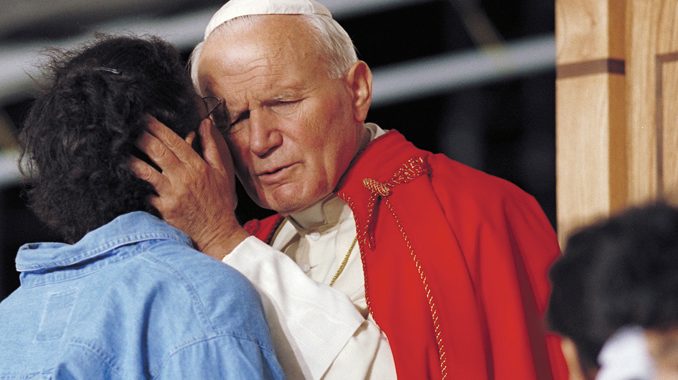
Next year, the bishops of the United States, in regional groups, will make their ad limina visits to Rome: the quinquennial visit that every bishop is obliged to make to “the thresholds of the apostles.” The ad limina visit is intended to be a spiritually enriching pilgrimage, but it’s also an opportunity for bishops to meet with the pope and with curial officials.
In those meetings, I hope World Youth Day 1993 and some of its fruits are discussed. For even as that epic event recedes further into the memory bank, it becomes increasingly clear that WYD 1993 was a critical turning point for the Catholic Church in the United States.
And it almost didn’t happen.
John Paul II was eager to bring a World Youth Day to America; the leadership of the bishops’ conference in those days was unenthusiastic, to put it gently. But the Pope kept pressing and Denver’s archbishop, J. Francis Stafford, stepped up and said his archdiocese would host it — a decision John Paul much appreciated, as he relished the challenge of bringing a young adult festival built around catechesis and the sacraments into a self-consciously secular environment, thereby demonstrating that the thirst for an encounter with Christ was universal.
In the event, it was a triumph, over which the Pope was still enthusiastic eleven years later, chortling to me over a pre-Christmas dinner, “The bishops of America said it couldn’t be done. I proved them wrong!”
He certainly did. That something extraordinary was afoot was clear from the extraordinary welcome John Paul received when he was helicoptered into the old Mile High Stadium to open WYD 1993; the chopper pilot, a combat veteran, remembered that the cheering created such air turbulence as he hadn’t experienced since being under fire in Vietnam. The city’s police chief, who had been fighting a crime wave, said afterward that there hadn’t been a single felony arrest in Denver while the young pilgrims and the Pope were in town.
Innumerable vocations to the priesthood, consecrated life, and matrimony trace themselves to WYD 1993. So do some of the most impressive pastoral initiatives in the country, including the FOCUS and the Augustine Institute. And the Archdiocese of Denver became, quite arguably, the model New Evangelization diocese in the country, after years of treading water in the evangelical doldrums of Catholic Lite.
World Youth Day 1993 was the hinge event on which the Catholic Church in America turned from living in a defensive crouch into being the local Church most effective in living the New Evangelization in the so-called “developed” world. This needs to be better understood throughout the Church’s central administration in Rome, and I hope the bishops make it a point to bring this up time and again during their 2027 ad limina visits.
Another pastoral initiative that can trace its origins to the evangelically supercharged experience of World Youth Day 1993 is “Christ in the City” — perhaps less well known than FOCUS and the Augustine Institute, but just as impressive. For its people embody a synthesis of the two great saints of the late twentieth century, Pope St. John Paul II and St. Teresa of Calcutta — the saint of the New Evangelization and the saint of the Church’s commitment to the poorest of the poor, or those whom Mother Teresa described as Christ in a distressing disguise.
“Christ in the City,” which began in Denver and is thriving there, invites young Catholics to become street missionaries: men and women who bring Christ to the homeless by simply meeting them, interacting with them as “immortal beings with a destiny that will outlast the universe” (to quote Jonathan Reyes, the ministry’s founder), and thereby affirming the human dignity that is theirs, but which is so often denied by their daily experience.
These young Catholics, themselves conquered by the love of Christ, thus demonstrate with their lives that there are not “New Evangelization Catholics” and “pro-life Catholics” here, and “social justice Catholics” there. In a Church permanently in mission, in which everyone is a missionary disciple and everywhere is mission territory, it’s all of a piece. Because the Gospel is all of a piece, and so is Christ, whose mystical body is the Church.
Take a moment, especially during the Thanksgiving holidays, to learn about “Christ in the City” here
Keep “Christ in the City” in mind as you consider your end-of-the-year charitable giving. And lift up a prayer of thanksgiving for World Youth Day 1993, when much of what is living and thriving in U.S. Catholicism was born or re-energized.
If you value the news and views Catholic World Report provides, please consider donating to support our efforts. Your contribution will help us continue to make CWR available to all readers worldwide for free, without a subscription. Thank you for your generosity!
Click here for more information on donating to CWR. Click here to sign up for our newsletter.



Leave a Reply