

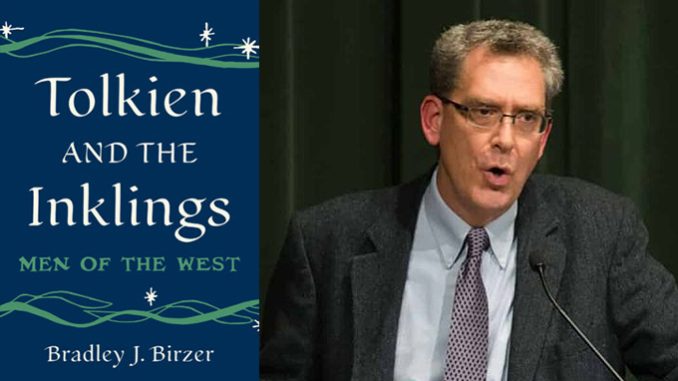
Bradley J. Birzer is the Russell Amos Kirk Chair in American Studies and professor of history at Hillsdale College. A prolific author, he has written books on Charles Carroll of Carrollton, Russell Kirk, Christopher Dawson, Andrew Jackson, Neil Peart, and Christian humanism. He is also a longtime friend, whose love for music, literature, history, and the Catholic Faith is inspiring to me.
His most recent book is Tolkien and the Inklings: Men of the West, published by Encounter Books. We recently corresponded about Tolkien, Lewis, the Inklings, and Western civilization.
CWR: When did you first read Tolkien, Lewis, and other Inklings? And what drew you to their writings?
Bradley J. Birzer: My reading of Tolkien goes back to the fall of 1977. On September 6 of that year, I turned ten. On September 15 of that year, The Silmarillion appeared in bookstores. On September 23 of that year, my oldest brother, Kevin, turned 18 and received a copy of the new book. I was totally mesmerized by the cover—one of Tolkien’s own called The Mountain-Path—and I tried about twenty times to read it. I never got past the creation story, but I read that creation story over and over again as a ten-year-old. It became etched in my mind. To this day, I can’t teach Genesis 1-3 to my Western Heritage students without being very directly influenced by Tolkien’s version.
Two years later, after earning enough lawn-mowing money, I rode my bike down to an incredibly nice bookstore in my hometown of Hutchinson, Kansas, Crossroads, and purchased a box set of The Hobbit and The Lord of the Rings. To say that I devoured them would be a gross understatement. I fell absolutely in love with them and with everything Tolkienian. As you know, I had a pretty rough childhood—things were pretty brutal on the domestic front—and Tolkien allowed me the greatest escape possible. I didn’t even know he was Catholic at the time, but I thought of him very much as a grandfather figure, and I prayed to him and for him every night.
I soon founded a Dungeons and Dragons group, and we played non-stop, again a brilliant way to escape, and our campaigns were extremely Tolkienian. We only allowed “good” aligned characters on our adventures, and we conquered evil on a weekly, sometimes daily, basis.
My love of Tolkien remained throughout high school. Then, during my junior year at Notre Dame, I took an excellent course, “Philosophy and Fantasy”, by a very prominent Platonist. I wrote my semester-long research paper on Tolkien’s Catholicism. It was, by far, the best thing I wrote in college, and my professor even invited me to present it to the class as a whole. Crazily enough, that paper became the basis of my first book, J.R.R. Tolkien’s Sanctifying Myth, published way back in late 2002. I must also note, here, that in addition to my own paper on Tolkien, I was incredibly motivated by Joseph Pearce’s Tolkien: Man and Myth [2000]; it was the direct inspiration for my own book.
It was also in that class that I first encountered C.S. Lewis as a science fiction writer. One of my best friends, Jim Otteson, has already introduced me to Abolition of Man, but Lewis as fantasist was new to me. Again, I simply devoured Lewis’s Space Trilogy, and I’ve tried to re-read it about every three years of my adult life. In fact, I just finished That Hideous Strength a few weeks ago.
Then, many years ago now, I picked up Owen Barfield’s Poetic Diction. To say that I was gobsmacked would be a gross understatement. That book—which argues that our greatest faculty of knowing is the imagination—has shaped everything I’ve taught, thought, and written since. It’s a top-ten book of all time for me, and I read it again and again.
CWR: There have been numerous books written about Tolkien, so what is different about this particular book?
Birzer: A great question. Yes, there’s lots and lots of stuff about Tolkien out there. Much of it is extremely good. As soon as I published Tolkien’s Sanctifying Myth in late 2002, I wanted to write a sequel. Through Gleaves Whitney and Winston Elliott, I had recently encountered the Christian humanism of Christopher Dawson, and I knew that Tolkien and Dawson were friends. At the time—now a quarter of a century ago—it felt like there was much that needed to be done on Tolkien’s relationships with Lewis, with Barfield, with Dawson, etc.
I immediately began to outline the sequel—what would eventually become the new book—and came up with a 120-plus page outline. However, an opportunity to write a solo work on Dawson came up. Then I had the opportunity to write on Charles Carroll of Carrolton, Russell Kirk, Andrew Jackson, and others. With each new opportunity, I kept putting off the Tolkien sequel, while always keeping up with the latest on Tolkien’s own works being released by his brilliant son, Christopher, as well as those being written by other scholars such as Carl Hostetter, Holly Ordway, Michael Drout, and Beppe Pezzini.
Finally, in August 2015, being inspired by the vast number of books coming out from Christopher Tolkien, I realized it was time to write the Tolkien sequel. So it’s taken me about a decade to write it—again with some healthy publishing distractions along the way.
What’s original in my book? Well, a couple of things. First, as far as I know, no one has written a history of the Inklings from Tolkien’s perspective. Second, I’m extremely interested in the Christian humanism of the Inklings as well as their traditional and bardic defense of the best of Western civilization. I really throw down the gauntlet, and I argue that Tolkien’s entire mythology should best and most accurately be compared with the greatest myths of Homer, Virgil, Dante, and Milton.
As a group, the Inklings began around 1931—evolving out of Tolkien’s other group, the Koalbiters—and lasted until late October 1949. During the academic year, Tolkien and Lewis would meet on Monday mornings for beer, meet at the Bird and the Baby pub on Tuesdays, 11-1 (anyone could attend those meetings), and on Thursday nights for a select few in Lewis’s Oxford rooms. To realize that they did this for eighteen years is extraordinary—they were with one another almost constantly. The Tuesday meetings continued after October 1949 until Lewis’s death in the fall of 1963.
CWR: The West was changing rapidly—and with dramatic violence and destruction—in the early 20th century. How did those upheavals shape and inform Tolkien and the Inklings? How did they understand the West?
Birzer: Another excellent question. One of my favorite scholars of the Inklings was an evangelical professor of English from Wheaton College, Clyde Kilby. He’s the founder of Wheaton’s Wade Center, dedicated to Inklings scholarship. In his own writings, he described Lewis and Tolkien as “Old Western Men”—a term taken directly from Lewis. From my own reading, the Inklings are very much in the line of Western greats such as Socrates, Cicero, Virgil, Tacitus, Livy, St. Paul, St. John, St. Perpetua, St. Augustine, Petrarch, St. Thomas Aquinas, Thomas More, and Edmund Burke. In the twentieth century, they are best grouped with Willa Cather, Jacques Maritain, Dawson, Etienne Gilson, Thomas Merton, Russell Kirk, John Paul II, and Benedict XVI.
They loved the West. Not the West of Machiavelli and Hitler, but the West of Socrates and Cicero. In their understanding, the West was best defined by its pursuit of universal human dignity—going back all the way to the first Greeks in Miletus.
The Inklings, not surprisingly, were, on the whole, rather traditional, rather conservative, and rather orthodox in their Christianity.
While Tolkien disliked allegory, for example, he loved applicability. As such, Sauron isn’t Stalin, but the two share much in common. The Lord of the Rings isn’t about World War I or World War II or the Cold War, but they all share something in common—the struggle of Good to persevere against wickedness. To the Inklings, sitting in England, the world looked insane in 1939, and their works reflect that insanity.
To be sure, the Inklings despised ideology and progressivism, and they sought a return to a more humane West.
CWR: Mythology, literature, and imagination were key to Tolkien, Lewis, and Company—to the degree that they created entire worlds. Why was that so important to them? And what should they be important to us today?
Birzer: For the Inklings, there was no higher way of knowing a thing than through the faculty of imagination. It was, for them, real and tangible, not something merely fanciful, superior to both rationality and passion, the other two ways of knowing. Tolkien, in particular, noted that our ability to imagine—to see things as they are—is godly. God is, of course, the Creator, but man is, made in God’s image, a sub-Creator. Of recent Tolkien scholars, no one has done a better job of explaining this than Pezzini in his Tolkien and the Mystery of Literary Creation.
Barfield, though, made the strongest case for the imagination. He argued that a poet sees things as they are in creation, though he may be the very first to see it—it has always existed. Take, for example, an airplane. All the laws of physics necessary for flight existed at the time of Adam and Eve, but no one quite saw or understood them until the Wright Brothers (and maybe Leonardo da Vinci previously). The Wright Brothers didn’t see anything new in creation. Instead, they saw what was already there. A poet does the same thing. He sees what has already existed but has never been recognized before. As Barfield wrote:
Men do not invent those mysterious relations between separate external objects, and between objects and feelings, which it is the function of poetry to reveal. . . . it is the language of poets, in so far as they create true metaphors, which must restore this unity conceptually, after it has been lost from perception.
In more pedestrian terms, Lewis agreed, noting that he never intended to write a Christian story for children with The Lion, the Witch, and the Wardrobe, but had the image of a faun carrying Christmas packages. From there, he unpacked his vision, and it led to his story and, thus, to the novel and the series.
CWR: Owen Barfield is not well-known to most readers today, but he was essential to the Inklings. Who was he? And what sort of influence and impact did he have on that group of friends?
Birzer: Barfield was simply brilliant. He wasn’t always orthodox in his Christianity, however, even though he was a practicing Anglican. He seems to have believed that Jesus was superior to God the Father because Jesus was fully God as well as fully man. It’s a strange belief, to be sure, but it did allow him to offer a number of profound insights on the Logos and the Incarnation.
As mentioned above, Barfield argued that imagination was our most tangible faculty of knowing. He and Lewis were best friends in college, and, in the late 1920s, his book, Poetic Diction (originally his senior thesis at Oxford—it’s never been out of print), profoundly influenced Tolkien. Tolkien, it seems, had already agreed with much of Poetic Diction, but he acknowledged that Barfield gave his own thoughts not only shape but the proper vocabulary.
Though Barfield only attended about 10% of the Inklings’ meetings, his spirit hovers over everything the Inklings did and wrote. He was also the last Inkling to die, outliving Lewis by a good three decades. In his last years, he continued to write and lecture, and he served as one of the most prominent anti-abortion voices in the U.K. Today, his grandson, also named Owen, has done everything to keep his grandfather’s vision alive. (Our Owen, not surprisingly, is a devout Catholic.)
CWR: As most readers surely know, Lewis was a convert to the Anglican Communion while Tolkien was a lifelong Catholic. In what ways did these differences shape their friendship? And how did it affect their respective approaches to writing and the life of imagination?
Birzer: A number of folks—including some close friends—have tried to argue that had Lewis lived beyond 1963, he would’ve converted to Catholicism. I strongly disagree. Lewis was proudly Protestant, and his reservations about Catholicism were deeply held—sometimes, from my perspective, outrageously wrong—but still honestly held and heartfelt.
Sometime in 1964, Tolkien wrote either a long article or a short book called “The Ulsterior Motive,” a blistering critique of Lewis’s Anglicanism. Not surprisingly, the Tolkien Estate has guarded this writing rather closely, and only two paragraphs of it have ever seen print. As much as Tolkien loved and admired Lewis, he felt that Lewis’s reservations about Catholicism amounted to sheer bigotry.
Again, though, these feelings were deep and heartfelt on both sides. If Lewis could be anti-Catholic, Tolkien could be equally anti-Protestant and bigoted in the other direction. He very much felt that his mother died because of her Catholic faith, and he spent his entire adult life trying to live up to his mother’s Catholic example. In Tolkien’s Sanctifying Myth, I offered an early analysis of how Catholicism permeated his mythology, but Holly Ordway’s Tolkien’s Faith has bested and surpassed my earlier work. She’s brilliant, and I have nothing but immense respect for her and her work, even if we disagree on a point here or there.
To be sure, though, Christianity permeated everything that Tolkien and Lewis (after 1931) wrote. The same is true for Barfield and for Charles Williams (though he was truly weird) and for one of the least-known Inklings, Lord David Cecil, arguably the finest biographer of the 1930s and 1940s.
CWR: Who are some Inklings who, in your estimation, deserve more attention or study? And why?
Birzer: Well, I just mentioned Lord David Cecil. Almost no one has written about him, but, in his day and age, he was regarded as the greatest living biographer. Our recent equivalents would be David McCulloch or Stephen Ambrose, though I’m dating myself a bit. In the 1930s, though, Cecil was the most prominent of the Inklings, far more so than Lewis, though Lewis would surpass him in the 1940s.
Also, it’s always good to remind folks about Barfield. It’s stunning to me that he was one of the single finest minds England has produced in the last 150 years, and he’s almost entirely unknown in the U.K. Frankly, that’s a scandal.
And, frankly, there’s still a lot to be written about Lewis.
CWR: On one hand, an account of the Inklings can seem like a warm and wonderful story of a bygone era. But you clearly see it as far more than that. Why is that? And what do you hope readers will gain from your book?
Birzer: Well, I had a total blast writing this book. Indeed, I could’ve kept writing, and I could’ve made the book twice as long as I did. In every way, the Inklings were brilliant. Not only were they interesting men, but they were terribly interesting thinkers, some of the most creative minds to emerge, really, since Edmund Burke and John Adams. I admire everything they did and everything they promoted and produced. They tried to make our world so much brighter as they fought against the horrors of ideology, terror, and progressivism. They fought, in every way, for the dignity of the human person, and they fought against materialist conformity. Their very existence and their works call on us to be better than we are, to be worthy of ourselves, each made uniquely in the image of God.
CWR: And final thoughts?
Birzer: Carl, thank you so much. It’s such an honor to talk with you and to be a part of Catholic World Report. In 1940, Barfield wrote a gorgeous article in which he argued that the only way to defeat progressive ideology was through friendship and community, “a commonwealth of the soul in which there is not copyright.” We need that now, more than ever.
If you value the news and views Catholic World Report provides, please consider donating to support our efforts. Your contribution will help us continue to make CWR available to all readers worldwide for free, without a subscription. Thank you for your generosity!
Click here for more information on donating to CWR. Click here to sign up for our newsletter.


Leave a Reply