

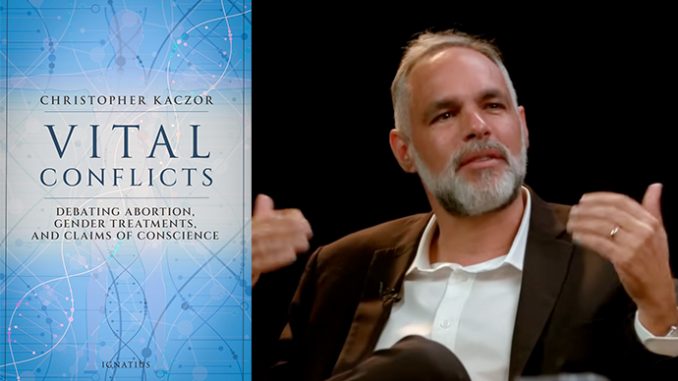
There is perhaps no more polarizing issue in American society than abortion. Other contentious issues include so-called gender issues, sexual morality, and the role of and rights related to conscience. A new book by Christopher Kaczor approaches these and related matters from the perspective of philosophy in a meaningful and productive way.
Kaczor is a professor of philosophy at Loyola Marymount University, Honorary Professor at the Word on Fire Institute, and President of the American Catholic Philosophical Association. He is the author of twenty books, including The Seven Big Myths about the Catholic Church, The Seven Big Myths about Marriage (written with his wife, Jennifer), and Jordan Peterson, God, and Christianity, among others.
His new book is Vital Conflicts: Debating Abortion, Gender Treatments, and Claims of Conscience (Ignatius Press, 2026). It explores three of the most important, controversial, and contemporary issues in bioethics, grappling with the legal and ethical issues involved. Kaczor’s arguments are rooted in the inherent dignity of all human beings and their right to be protected in law.
Kaczor recently spoke with Catholic World Report about his new book, the state of the abortion debate in a post-Roe world, and how a philosopher approaches some of the most important topics of our time.
Catholic World Report: How did the book come about?
Christopher Kaczor: In Vital Conflicts, I have chosen to focus on three topics that have received increasing attention in public discourse—a discourse that has criticized, implicitly and explicitly, the teachings of the Catholic Church. These three topics—abortion, gender treatments, and conscience for health care professionals—are flashpoints of controversy between secular and Catholic voices.
Indeed, the continued existence of Catholic health care in the United States depends, in part, on how these questions are answered. For if secular answers to these questions are made the basis of law, Catholic health professionals and institutions would be asked to act against their consciences. Such a situation would imperil the mission of the Church in continuing the healing actions of Jesus in health care.
These three topics are also flashpoints of controversy among Catholics. Dissenting moral theologians seek to “update” Catholic teaching to bring it into conformity with secular opinion on abortion, gender, and conscience. These progressive Catholic voices hope to change Catholic teaching to make it like the teaching of liberal Protestant communities. So, part of my effort in this book is to call these proposed revisions into question.
CWR: Much has transpired in the past decade. Before the Dobbs decision, many people hardly dared to hope Roe and Casey would ever be overturned. How has the debate about abortion changed in recent years?
Kaczor: For obvious reasons, Dobbs has stimulated debate about abortion, reviving old arguments and inspiring new ones.
This book grapples with the legal, but especially the ethical, discussions arising from the Dobbs decision. In the essays in this book, I argue that all human beings— from the very beginning of their lives to the end—have inherent dignity and so deserve to be protected by law and welcomed in life.
This view, fully compatible with faith, is also able to be accepted by people of goodwill, as the atheist philosopher Don Marquis makes clear in his case against abortion, which I examine in Vital Conflicts.
CWR: The dominant culture approaches the question of so-called “gender identity” in a very different way than it did just a few years ago. But things already seem to be changing; there appears to be more of an outcry against the horrors of gender ideology and so-called “gender-affirming care”. How do you approach this topic in the book, considering it has been such a moving target lately?
Kaczor: Political circumstances are indeed a moving target, but the underlying ethical principles are not.
Those identifying as transgender deserve love, respect, and the very best care that they can receive. The suffering caused by gender dysphoria can be debilitating and life-threatening. So, the middle section of this book explores this issue in hopes of finding an ethics of compassionate care that does justice to the embodied vulnerability of those suffering from gender dysphoria. We can, I believe, both recognize that men and women live out their masculinity and femininity in a variety of ways and accept the reality of the biological givenness of human beings as male or female.
Vital Conflicts offers a defense of the teaching of the Catholic bishops of England and Wales in their document “Intricately Woven by the Lord”. This book also defends the Committee on Doctrine of the United States Conference of Catholic Bishops’ text entitled “Doctrinal Note on the Moral Limits to Technological Manipulation of the Human Body”. These positions on gender treatments are not only in accordance with faith but also reasonable.
CWR: The third section of the book is on “Claims of Conscience”, which isn’t as obvious a battleground as abortion and gender. What does that section address, and how did it come to be grouped with these other battleground topics?
Kaczor: The last section of the book is closely related to the first two sections. Imagine a Catholic physician who views abortion as a violation of his duty to care for two patients—a mother and a developing human in utero. Imagine that this same doctor believes that surgical interventions for gender dysphoria are morally wrong and medically contraindicated.
If this Catholic doctor is working in a secular hospital, should he have a right of conscientious objection to performing the abortion or doing the surgery?
On the other hand, imagine a secular physician who works in a Catholic hospital. He views performing abortion as not just morally permissible but an ethical obligation. Likewise, he is convinced that surgery is the best treatment for gender dysphoria in some cases. If this secular doctor is working in a Catholic hospital, should he have a right of conscientious provision for performing the abortion or doing the surgery? Is there a contradiction in being in favor of conscientious objection but opposed to conscientious provision? Are the objection and the provision symmetrical?
In this book, I defend conscientious objection in health care. But I also criticize the claim that conscientious provision in health care is justified.
CWR: You are a professor of philosophy. When it comes to abortion, gender, and many of these other issues, it has become common to say, “I can’t speak to that, I’m not a doctor”. Can you explain why this doesn’t make sense?
Kaczor: There are, of course, issues that only doctors can speak about with the authority that comes from clinical experience. If a patient has a disease and there are three medical treatments that offer tradeoffs of burdens and benefits for someone’s physical well-being, then the doctor is the right person to consider the clinical implications of various options.
But doctors as doctors are not experts in ethics. Doctors can use their skills in an ethical way, but history shows us repeated examples of physicians who use their skills in an unethical way.
Philosophy seeks insights into what is right and what is wrong, and this book is an effort to have insight about abortion, gender treatments, and conscience.
CWR: Is this book just for Catholics, or does it have a broader appeal and value than that?
Kaczor: This book appeals to principles that any person of goodwill can accept. A Catholic approach to bioethics does not rely on revelation, as if only a person of faith could accept its teaching.
Rather, just as any person of goodwill can, in principle, understand and accept that theft, or slavery, or murder is wrong, people of goodwill can in principle accept Catholic teaching about abortion, gender treatments, and conscience.
Even if they don’t end up fully agreeing, I hope people who disagree can come to a better understanding of the views I defend.
CWR: What do you hope readers will take away from the book?
Kaczor: I am aware that the issues treated in this book are among the most controversial in bioethics. I want to echo what O. Carter Snead says in his award- winning book What It Means to Be Human: The Case for the Body in Public Bioethics: “In the end, this book is a proposal offered in the spirit of friendship, anchored in the firm belief that we can only govern ourselves wisely, humanly, and justly if we become the kind of people who can make each other’s goods our own.”
If you value the news and views Catholic World Report provides, please consider donating to support our efforts. Your contribution will help us continue to make CWR available to all readers worldwide for free, without a subscription. Thank you for your generosity!
Click here for more information on donating to CWR. Click here to sign up for our newsletter.


Leave a Reply