


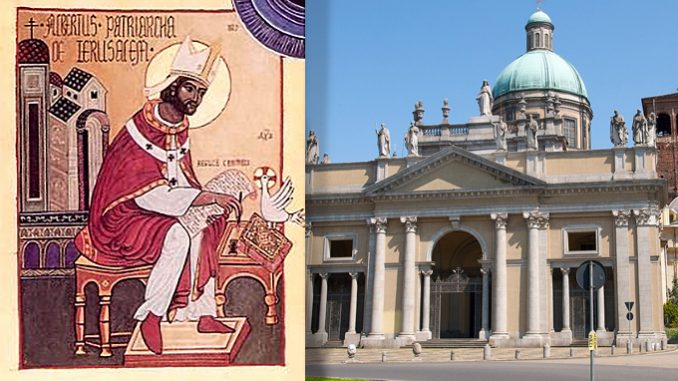
In addition to the Feast of the Exaltation of the Cross, today the Roman Martyrology also commemorates the death of St Albert of Jerusalem. If this early 13th-century prelate is remembered today, it’s mostly for codifying in law the manner of life lived by a group of Western hermits (perhaps including former Crusaders) who were living on Mount Carmel in the Holy Land—the group that would become known as the Carmelites.
Yet there is much more to St Albert’s story than just the “lawgiver” of the Carmelites. He is a saint not just for one spiritual family but for the entire Church. Albert was born in or around 1150 near the town of Parma in northern Italy. Some accounts name him as a member of the noble Avogadro family; whether that is true or not, at least his family seems to have been well off. But Albert thought to serve others by joining the Canons Regular at the church of the Holy Cross in the town of Mortara, Lombardy, in 1170. The Canons Regular flourished during the Gregorian reforms of the clergy, promoting a manner of life where clergy lived in common and kept the evangelical counsels according to the rule of St Augustine.
He studied for the priesthood and seemed to have distinguished himself both in his learning and his leadership abilities, because around 1178, his community elected him to be prior for life. Nor did his abilities as an administrator go unnoticed by the broader Church of the Italian peninsula. He was elected bishop of Bobbio in 1184, but before he could be consecrated, he was elected bishop of the city of Vercelli. He received his episcopal consecration there in 1185.
Various political and religious uncertainties plagued the northern part of the Italian peninsula in this period. Northern Italy was home to a movement of laymen and women who rejected certain aspects of contemporary religious life that they saw as ostentatious and contrary to the spirit of the Gospel, instead wearing simple clothes and trying to follow an evangelical way of life. Their plain garb gave rise to their name, the Humiliati. The Humiliati thus rejected both religious and cultural norms, sometimes in ways that brought them into conflict with the authorities. This led to their ecclesiastical condemnation in 1184.
The larger part of the condemned group sought reconciliation with the broader Church. Around the year 1200, Pope Innocent III appointed Albert as part of a commission to investigate the Humiliati’s way of life. Albert was one of those who helped codify their way of life into church law, preparing the way for papal approval in 1201. Thus, Albert helped the Humiliati find a way to live their penitential spirituality within the broader Church, without going down the path of the Waldensians and similar groups.
Albert’s abilities as a negotiator also brought him into the complicated relationship between the pope and the Holy Roman Emperor, who laid claim to much of northern Italy. His office as bishop of Vercelli carried civil as well as ecclesiastical responsibilities. He used that authority to give just settlements in both church and civil cases. He helped negotiate peace in two regional conflicts, one between Pavia and Milan and another between Parma and Piacenza. Both papal and civil authorities valued his wisdom and skills as a negotiator.
In his twenty years as bishop of Vercelli, Albert’s fame spread beyond his native land. In the year 1205, the Canons of the Holy Sepulchre chose him as the Patriarch of Jerusalem. The challenges facing the new Latin Patriarch were formidable. The Third Crusade had recaptured the city of Acre and a strip of land along the coast, again giving Christians a foothold in the Holy Land. But the Crusaders failed to recapture Jerusalem, so Acre became the de facto capital of the re-established Kingdom of Jerusalem.
This Kingdom was beset by enemies without and threatened by divisions within. Soldiers from various European countries did not always trust each other, bringing national tensions to the Holy Land. The various military orders, especially the Templars and the Hospitallers, were embroiled in disputes over property and privileges. So the new Latin Patriarch needed to be a man of proven wisdom and diplomacy. The canons thought Albert of Vercelli was the perfect choice.
Albert seems to have been reluctant to take the position, but the pope enthusiastically ratified the choice, naming Albert papal legate to the Latin East. By early 1206, he was in the Holy Land. Since the Holy City was still under Muslim control, he took up residence in Acre, though his official title was Patriarch of Jerusalem.
The new Patriarch had the unenviable task not only of helping ensure that the unsteady peace between Christians and Muslims endured, but also of keeping the Christians from fighting amongst themselves. In addition to Mass and daily prayer, Albert’s life was filled with lawsuits, property disputes, church administration, correspondence, and political crises.
And he was deeply involved in the question of who would rule the re-established Kingdom of Jerusalem.
When Albert arrived in Acre, the Queen of the Kingdom of Jerusalem was the young Maria of Montferrat, her half-uncle serving as regent. In 1208, as Maria neared marriageable age, the Patriarch led a meeting of political and ecclesial leaders to discuss finding a spouse for Maria who would help strengthen the Kingdom. After lengthy negotiations, which included an embassy to the King of France, the choice fell on John of Brienne, a decision supported by the pope. Albert officiated at the wedding of Maria and John on September 14, 1210. On October 3, the Patriarch crowned them King and Queen of Jerusalem.
In the midst of this busy life, a group of hermits of Western European origin living on a mountain near Haifa asked Albert to give a canonical form to the way they had been serving God in solitude by providing them an official “formula vitae”—similar to what he helped do for the Humiliati some years ago. This group eventually became known as the Order of Our Lady of Mount Carmel, and the document (with certain later modifications approved by the pope) as the Rule of Saint Albert.
The traditional account dates the Rule of Saint Albert to the year 1207, though it may have been written any time between about 1206 and Albert’s death in 1214. The precise date is less interesting than the fact that, in spite of how busy Albert obviously was, he took the time when asked to help an obscure and relatively small community of hermits within his jurisdiction. This reflects a pattern we see again and again in Albert’s life. He appears to have truly been a bishop deeply concerned for the souls under his care, willing to expend himself for the good of their souls.
Albert himself was not a hermit or even a monk, but he seemed to get at the heart of the life that the hermits on Mount Carmel were trying to lead. Some of his advice is practical. Much of it is drawn straight from Scripture. But one might also see the context of the Crusader States in the text of his Rule. I find it striking, for example, that out of all the passages he could have chosen from Scripture, Albert draws extensively on the armor of God passage in Ephesians to highlight the virtues the Carmelites need to cultivate.
But perhaps most striking is the way he describes the nature of the life of a Christian near the beginning of the text. There are various ways of living as a Christian. The Carmelite way is only one of them. Yet every Christian path is ultimately a way to “live a life of allegiance to Jesus Christ.” Jesus is Lord. To be a Christian is to receive our marching orders from Him. Regardless of our place in the Church or the world, the Christian lives under the banner of the Cross.
Albert’s life was marked with the Cross to the very end. On September 14, 1214, during a procession for the Feast of the Exaltation of the Cross, Albert was attacked and murdered. His attacker was the former Master of the Hospital of the Holy Spirit, whom Albert had stripped of his office for misconduct (later sources disagree about the exact nature of his crime). The Patriarch died as he had urged the nascent Carmelites to live—in allegiance to the Lord Jesus Christ.
As a faithful and wise bishop, Albert of Jerusalem is a saint for everyone, and a saint we need in our own day perhaps more than ever. Yet the Carmelites naturally have a special fondness for this man who was not part of their order but who has shaped their character in such a profound way.
Since September 14 is already occupied by the Feast of the Holy Cross—and the following days by Our Lady of Sorrows and Saints Cornelius and Cyprian—the Carmelite calendar observes the Feast of St Albert on September 17.
At the Mass in his memory, the Carmelites pray:
Lord God,
through Saint Albert of Jerusalem
you have given us a Rule of life according to your Gospel,
to help us attain perfect love.
Through his prayers may we always live
in allegiance to Jesus Christ,
and serve faithfully until death
him who lives and reigns with you and the Holy Spirit,
God, forever and ever.
Amen.
If you value the news and views Catholic World Report provides, please consider donating to support our efforts. Your contribution will help us continue to make CWR available to all readers worldwide for free, without a subscription. Thank you for your generosity!
Click here for more information on donating to CWR. Click here to sign up for our newsletter.

Leave a Reply