


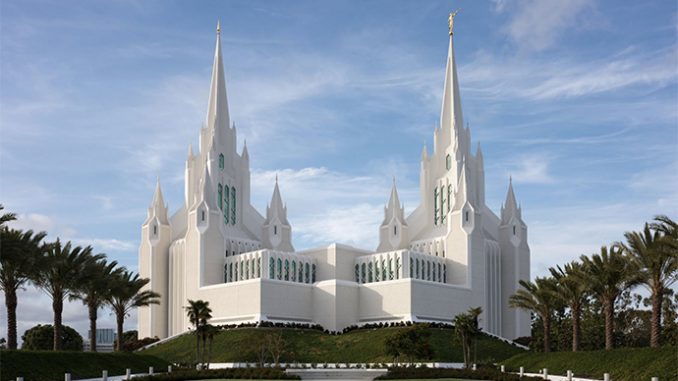
Today, my wife and I toured the recently renovated San Diego temple of the Church of Jesus Christ of Latter-day Saints (commonly known as the Mormons).
The LDS church just finished a nearly three-year renovation project, and because of it, the temple needs to be rededicated. Before that occurs, non-Mormons are allowed to tour the property. The open house lasts several weeks, and the expectation is that 700,000 people will come through.
Once the temple is rededicated, it will be closed to all non-Mormons, as it had been closed for the three decades before the renovation.
Our guide told us that 1,200 visitors are taken through the temple each hour, with 40 people in each tour cohort. The process requires considerable coordination, since the interior rooms of the temple are surprisingly small, but the dozens of volunteers managed to pull it off well. Our tour took about 45 minutes.
No photos or videos may be taken inside, so the photos I give here are from the official LDS website for the San Diego temple. Let me walk you through them.
1. The exterior (see photo above), with mirror-image wings except that the tower on the right has the statue of the Mormon angel Moroni on top. The temple complex is located hard against Interstate 5 and so is seen by tens of thousands of people each day.
2. The entrance. If it reminds you of a hotel entrance, that’s because the entirety of the interior has that flavor.
3. The foyer/reception area. Notice the paintings. There are many biblical scenes throughout the temple, all painted in what I think of as the “Mormon style.” You no doubt are familiar with the kitschy style of Thomas Kinkaid, whose paintings appear in far too many American homes. The “Mormon style” is different but, to my mind, of equally modest artistic merit. The Catholic equivalent might be Italian holy cards of a century ago.
4. The grand staircase.
5. Another staircase. Notice the beige carpet. It’s used throughout the temple. All guests and all volunteers were issued white booties, which were placed over shoes by volunteers sitting near the entrance. I don’t know if church members are obliged to wear the booties at all times or if they wear them only during the open house. Given how light and easily stained the carpet is, I wouldn’t be surprised if it were the former.
6. Patterned windows, in colors similar to the walls and carpets. There were no clear windows and no windows that told stories, the way stained-glass windows do. Each window consisted only of geometric shapes.
7. An “instruction room.” There is a small chapel in the temple—not much larger than this room—but nothing remotely comparable to the nave of a Catholic church, even of a small Catholic church.
8. The baptismal font, on two levels. The font stands on the backs of twelve oxen, a biblical motif. We were guided along the upper level. It is in the font that Mormons are baptized “for the dead,” a chief goal being to see that all of their ancestors, as far back as they can be traced, are baptized into Mormonism.
9. The Celestial Room. This is the main room of the entire temple. If it reminds you of a hotel lobby, well … Our guide invited us to sit for a few minutes here, without talking to one another, so that we could meditate and feel uplifted by the surroundings. There are other rooms, such as where marriages occur, but this is the focal point of the architecture.
As you would expect, all the LDS volunteers were upbeat, smiling, and polite. They excelled at shepherding thousands of people daily through what really is a fairly cramped space. They clearly were proud of their temple.
I have to acknowledge, though, that Bramante and Michelangelo and the others responsible for St. Peter’s Basilica need not worry about latter-day competition.
I accept that devout Mormons feel uplifted when they visit their temple, the way I feel uplifted when visiting a finely designed Catholic cathedral. I say I accept that, but I have trouble understanding it, since their temple seems so non-religious to me.
In Japan, which I have visited about 30 times, I have been to Shinto shrines and Buddhist temples, the “religiosity” of which I could sense immediately, even though the religions were so foreign to my own in terms of doctrine and history.
I just didn’t get that sense at the Mormon temple. To me, it felt cold, not comforting. There was nothing to inspire awe. It isn’t just that there is a Real Absence. That can be said also of Protestant churches, but even in Protestant churches, I get an immediate sense that the place has been set aside for religious rites that I can have some sympathy with, some appreciation for. I just didn’t feel any of that on this tour.
In its spires, the Mormon temple mimics Catholic cathedrals built in the Gothic style. At a distance, the pure-white temple catches the eye, particularly when illuminated at night, but up close the exterior architecture strikes me as artificial, as make-believe, as something that might have been constructed on a Hollywood back lot. Similarly with the interior, which consists of rooms that Conrad Hilton might have ordered up for some of his nicer hotels.
We live down the street from the nearest LDS “ward,” which is the term for what Christians call a neighborhood church. I’ve never been inside, though I understand that “Gentile” visitors are welcome. I understand the building consists of a single “worship room” and multiple small offices. It is at the wards that Mormons perform their weekly religious duties; the temple is for marriages and baptisms of the dead and for not much more.
I have written elsewhere that Paul Claudel underwent an instantaneous conversion in 1886, while standing within Notre Dame Cathedral during Christmas vespers. I have read of other people coming into or back into the Catholic Church largely because of how its grand edifices moved them.
Of course, I can’t know whether any visitor to the San Diego temple will be so taken by the experience that his mind and heart will be moved to embrace that very American faith, but I can say that if such a thing happens, I won’t be able to understand how it can happen.
(Editor’s note: This piece was posted originally on Facebook and is re-posted here with the kind permission of the author.)
If you value the news and views Catholic World Report provides, please consider donating to support our efforts. Your contribution will help us continue to make CWR available to all readers worldwide for free, without a subscription. Thank you for your generosity!
Click here for more information on donating to CWR. Click here to sign up for our newsletter.



Hey everyone! We’re going to Kolob!
On a more serious note, thanks for an interesting and humorous read.
Reading this, one feeling that comes to me is a cross between a sciencetology building and a masonic temple! It’s a cult!
Spot on, dear J Mcallion. However: let’s not worry about the architecture!
It’s not nearly as weird as the joke history/theology that the fallen angel Moron-I is supposed to have revealed to LDS founder, Joseph Smith;
Here is a small snippet off the web:
“The historicity of the ‘Book of Mormon’ often focuses on archaeological issues, some of which relate to the large size and the long time span of the civilizations mentioned in the book.
After Joseph Smith founded the movement in upstate New York in the 1820s, the faith drew its first converts while Smith was dictating the text of the Book of Mormon from golden plates with reformed Egyptian writing on them, which he said he found buried after being directed to their location by the Angel Moroni.
The book described itself as a chronicle of early indigenous peoples of the Americas, known as the Nephites, portraying them as believing Israelites who had a belief in Christ many hundreds of years before Jesus’s birth. According to the book, the Nephites are one of four groups (the others being the Lamanites, Jaredites, and Mulekites) who settled in the ancient Americas.
The Nephites are described as a group of people that descended from or were associated with Nephi, the son of the prophet Lehi, who left Jerusalem at the urging of God c. 600 BC and traveled with his family to the Western Hemisphere, arriving in the Americas c. 589 BC.
Smith said, after the translation was complete, he returned the golden plates to the Angel Moroni!
A contemporary Mormon view is that these Israelite civilizations rose and fell in Mesoamerica. Civilizations of their magnitude and duration would be expected to leave extensive archaeological records. Several Mesoamerican civilizations did exist in the time period covered by the Book of Mormon, including the Olmec, Zapotec and Maya.
The Book of Mormon mentions several animals, plants, and technologies for which there is no evidence in pre-Columbian America. These include asses, cattle, horses, oxen, sheep, swine, goats, elephants, wheat, barley, silk, steel, brass, breast plates, chains, plows, swords, scimitars, and chariots. The Smithsonian Institution stated in 1997 that: ‘none of the principal food plants and domestic animals of the Old World (except the dog) were present in the New World before Columbus.’
Adherents of the Latter Day Saint movement give varied responses to these criticisms. Some invoke the limited geography model, regarding the events of the Book of Mormon as taking place in such a geographically limited area that no evidence should be expected. Some counter that the words used in the Book of Mormon refer not to the animals, plants and technologies that they do presently but to other similar items that did exist at the time.
A 2023 survey of over 1,000 former church members, in The Mormon Corridor, found the Book of Mormon to be the second most commonly cited criticism that led to disaffiliation.”
Dear friends: notice the similarities between Mormonism and Muslimism.
Their founders both interspersed well-known chunks of Jewish and Christian biblical data with exotic novelties to create ‘The Quran’, as also with ‘The Book of Mormon’, etc.
Perhaps it was the same ‘angel Moron-I’ that Mohammed mistook for ‘Gabriel’!!! Maybe that was the prince of fallen angels, who Jesus Christ named: “A liar from the start and the father of lies.”
In regard to the observation: “Mormon people are good!” (or “Muslim people are good!”) a Catholic or other true Christian will ask if all that goodness is not negated by gross misuse of the Apostolic Witness of the 9 authors of the 27 books of ‘The New Testament’ {inspired by The Holy Spirit of GOD, given by our Resurrected and Ascended King Jesus Christ}.
Misuse of GOD’s Word is a capital offence.
Surely, we sin if we admire the goodness of synthesised faiths (& architecture) that is misleading many millions & divorcing them for all eternity from the beauty and saving power of the unadulterated Gospel of Jesus Christ that the Catholic Church has been guarding and sharing with the world for 1990 years.
No amount of ‘good works’ (or architecture) can compensate for sending millions of human beings to hell.
It’s good to be friendly to all human beings but never to false faiths.
Then here is the problem: no matter how much good a Mormon or Muslim is doing; no matter how much we like them; they will always be spreading falsities that contradict the truth we have from Christ’s Apostles, so that they are inevitably destroying souls that GOD wanted to save in Christ.
We Catholics & other true Christians need to be careful not to be gulled by the many lying perversions of the fallen angel ‘Moron-I’.
“At that time, if anyone says to you: ‘Look, here is the Christ!’ or: ‘There He is!’, do not believe it.” Bíblia Católica Online – Matthew 24:23
They are drastically different to us; indifferentism is a deadly heresy.
We read: “Perhaps it was the same ‘angel Moron-I’ that Mohammed mistook for ‘Gabriel’!!!” But how these things came about in Arabia is an intriguing story.
At first, Mohammed was startled and perplexed by his experience in Mt. Hira…
“…Again, not knowing at first what to think of his experiences at Mount Hira, Mohammed consulted his possibly Christian wife (Kadijha who had one somewhat Christian cousin in Mecca and another in Constantinople) and then sought the advice of her trusted and aged cousin, Waraqua ibn Naufal, an Arabian monotheist and Jewish convert to Christianity. Because of the very central role of Gabriel to Mohammed’s message and in the Qur’an, the complete quote from Denny is provided here: … ‘Waraqua knew something of the older scriptures and declared that what had come upon his cousin’s (Khadijha’s) husband was none other than what had previously descended upon Moses, the ‘namus’. This term seems to have been understood by the Arabs as meaning an angelic messenger, especially Gabriel, but it is a corruption of the Greek nomos, meaning ‘law,’ or Torah” (Frederick Denny, “An Introduction to Islam,” New York: Macmillan, 1994, p. 64). Is it possible that Waraqua correctly interpreted the visitations as similar to the law, while from Waraqua’s words Mohammed might just as easily have heard an additional reference to angels? The later Qur’an is based largely on the Law, the Pentateuch of the Old Testament delivered to Mohammed, it is believed, by the angel Gabriel. Recall (oral recall, as occurs with epileptic seizures?) of countless stories gathered on the trade routes to Mecca could have equipped Mohammed to recount the law with the help of a vivid memory thought to be the work of an angel” (overall citation from Beaulieu, “Beyond Secular-ism and Jehad: A Triangular Inquiry into the Mosque, the Manger & Modernity,” University Press of America, 2012, chapter 2).
By one documented but controversial account (Cowdrey/ Davis/ Vanick , “Who really wrote the Book of Mormon: The Spaulding Enigma,”, Concordia, 2005), Joseph Smith also started with an embryonic notion and then fell into it as a reinforcing audience swelled up around him.
SUMMARY: The recurring catalyst involves reinforcing and crystalizing dialogue (or even just a word!), between the inquirer and his sympathetic circle of contacts. In some instances, even today. Think der Synodal Weg and other roundtables, and “expert” Study Group #9!
All your observations and “feelings” about the temple and all the anti LDS comments here are based on your prejudices and biases against this religion. You reaffirmed to me how other so called Christian religions have only hate in their hearts for the LDS. I the biased ‘reporting’ is so rampant. Fear of our growth, taking away paying attendees which affects the pastor’s successful purse is the basic your hatred. It is not a cult. Members can leave anytime, have agency to decide for themselves how they will live and worship. We are not tied to relics, icons(idols), infallible corrupt popes(view history of popes paying for their popehood), etc. but Gid bless your journey in this mortal life. I am not the judge, God will judge your words and intentions.
Thank you, dear J. Graesser, for your response.
All I can say in rebuttal is that both my comments & (I think) those of dear Peter D. Beaulieu, are based on information gleaned from ‘The Book of Mormon’ & other LDS literature.
As a Catholic Christian (and a scientist-theologian) I work hard to be free of prejudices and biases.
Maybe if you could kindly point out anything that’s inaccurate in what I (or other commenters) have written, we could dialogue in a rational manner.
I wonder if you’ve ever considered the claims of the Catholic Church?
Always in the love of King Jesus Christ; blessings from marty
Unfortunately, the LDS strikes me as a cult where upon entry into the “temple” one leaves one’s discerning judgment at the threshold.
If you had not written and shown that it is an LDS temple, I would have thought it is a very luxurious spa.
Mormon architecture looks like it is created by AI, relying on a composite of images of what religious buildings are supposed to look like, but without any belief in religion at all.
Yes, it is very strange.
Maybe Bishop Weisenburger should pay a visit. Based on his infatuation with the new mosque in Detroit he seems more ecumenical, or interreligious, or whatever.
I grew up in The Church of Jesus Christ of Latter-day Saints, where temples, while differing in beauty, are all simple in design and exist solely to perform ordinances, or sacraments. LDS members strongly believe in priesthood authority, holding that without it, baptisms (and all sacraments/ordinances have no value). They see the priesthood as the authority that allows God’s servants to seal ordinances on earth, so they are sealed in heaven.
Most modern temples are small and modest in architecture, yet still serve their purpose: performing sacraments like baptism and marriage on behalf of those who never accepted Jesus Christ in life, so they may still be taught the gospel in the spirit world and choose to accept it before the Lord’s second coming. I’ve always seen this belief and temple work as an act of charity.
Before becoming Catholic, as a Mormon, I came to despise the offensive and ignorant accusations religions often make about each other. Many have heard the false claims that Catholics are cannibals for eating God during Mass, or that we lack spiritual awareness to the point of needing a red light to know if the Holy Ghost is present. I reject such comments about any faith.
It is far better to learn about other religions in order to discover what makes them attractive and how we might more easily build bridges between us. It will also allow us to know how best to teach the gospel of Jesus Christ to all. One thing I know does not work is to denigrate the beliefs of others. That goes over like a lead balloon and only closes the door on any possibility of sharing the Good News of the Church with them.
Thank you Michael B & God bless you.
Thank you for this kind and enlightened comment. I wish more people shared this perspective.
We read: “LDS members strongly believe in priesthood authority, holding that without it, baptisms (and all sacraments/ordinances have no value).”
We do have this in common: The LDS baptism is invalid (but may have some subjective “value”) since Mormonism has nothing at all to do with the Apostolic Succession conferred by Jesus Christ. (Same is true for Protestant “ecclesial communities,” not “churches”—Dominus Iesus, Congregation for the Doctrine of the Faith, 2000).
Yes! it’s non-starter to “denigrate” others, but this is not quite the same as critiquing their religion or system of beliefs–as such.
Which is to say, that the 19th-century LDS religion/members denigrate the Catholic Church and its members as an “apostasy” since the time of Diocletian and, therefore, that it has been replaced by a self-appointed frontier cult in North America. (See note, below). In a parallel case, 7th-century Islam claimed that the apostasy came at about the same time, but under Byzantine fragmentation, then to be replaced by an earlier frontier cult, in Arabia, and mysteriously gifted with the Qur’an (replacing Christ) rather than the Book of Mormon (replacing the Church)…
Might we suspect that natural or eclectic religions are to be better understood through cultural anthropology rather than comparisons with faith in the Incarnation and then fidelity to the Church founded by Christ(!)–the validly sacramental “Mystical Body of Christ”?
NOTE: Elder B. H. Roberts, “New Witness for Christ” (Salt Lake City: George B. Cannon and Sons, 1875). For a detailed Mormon rendition of the “apostasy” see James E. Talmadge, “The Great Apostasy” (Salt Lake City, Utah: The Deseret News, 1909). The apostolic/papal Catholic Church affirms that rather than succumbing to the apostasy of some or even many of its members, the living and charismatic Church—also as an institution—is indwelled by the Holy Spirit and always lives on within earthly history.
There are more similarities between the Catholic Church and Mormonism than many realize. However, what stands out here is that rank, often ignorant attacks on other faiths are simply beneath Christian people. Are there legitimate doctrinal disagreements? Absolutely, and those should be openly discussed and understood. But attempting to condemn other religions, whether Catholicism, Mormonism, Protestantism, SSPX, or Islam through petty smears (‘they are a cult,’ ‘they are cannibals,’ etc.) should never fall from the lips of anyone in the Body of Christ. When we find ourselves falling into that trap, let us repent and seek charity. The very foundation of charity is to love one another.
I totally agree. But, when is the shoe on the other foot?
Mormonism, for example, would not even exist except for the damning doctrine that the real Church of two millennia fell into apostasy in the second century. Hence the self-validating frontier replacement under the term “Latter Day Saints.” Likewise, Islam is quite certain that both Judaism and Christianity are apostate (worshiping the golden calf, and the polytheism of the Trinity) and, therefore, are corrupted versions of original Islam which predates all human history (!) and is recovered only in the “uncreated” Qur’an dictated in Arabic.
Is the precise distinction between supernatural “faith” in the person of the incarnate Jesus Christ, as compared to what amount to natural religions as, yes, heartfelt and sincere expressions (!) of “belief”? Categorically different than the alarming and singular “self-disclosure” (!) of the Triune One in the Incarnation.
It gets more interesting when we understand, however, that the Holy Spirit in some way is not quite confined to the sacraments conferred by Christ on his apostles and their successors in a Church that is both institutional and charismatic.
But then, what is to be said about the sacramental Mystical Body of Christ as compared to, say, the Muslim transnational umma or even the Protestant congregations self-amputated from the apostolic succession? To what extent are natural religions actually valuable expressions of the universal natural law—however poorly understood and overlaid with localisms. Should some “interreligious” dialogue be focused more at this level? A distinction arrived at in the Christian West by the historically unique effort toward a coherence of faith & reason. According to Benedict XVI, we might consider the “providential” opening within universal human history when St. Paul crossed over into Macedonia to have a chat with the Greeks and Romans. Christianity is not simply one of the many mystery religions that erupted at the collapse of the Roman Empire.
To explore questions such as these is not a smear, and the word “cult” is not necessarily demeaning (check the definition). Why doesn’t someone construct a triangular inquiry into Christianity, Islam and (say) the modern religion of Secular Humanism? In place of the familiar and stalled three two-sided dialogues? Would this be less an “ignorant smear” than simply interesting? Maybe grounded in over a hundred pages of source material in fine print, from all kinds of credentialed sources? Oh, wait, as a non-credentialed layman like yourself, yours truly actually tried this. A daily mini-vocation consuming over five years. (more than a terse comment in a CWR thread). The topic is candid and I hope is not flippantly accusing. And yet it does not “fall into the trap” of presuming an equivalency of religions or lapsing into failed “charity” by discounting truth where we find it.
In the interests of the “open discussion” which you also legitimately call for, try this: “Beyond Secularism and Jihad: A Triangular Inquiry into the Mosque, the Manger & Modernity,” (University Press of America, 2012). https://www.catholicworldreport.com/2017/04/29/the-mosque-the-manger-and-modernity/
Michael B: totally agree. Although one has to make a distinction between architectural styles and the people who religion they house. I have found the Mormons I’ve met to be gentle, balanced, and kind persons who are terribly family-oriented. I have commented in the past that their two-year commitment to missionary work is a model Catholics ought to emulate. (Bishops take note.)
My wife and I just visited the new temple in the cleveland area . I would agree with Karl’s views 100% I do respect the young missionaries who volunteered from Arizona, Utah, etc;,. and empathize with the LDS folks in Congress who were recently posted as “non Christian”/ While this may be theologically correct, I know Mr. Keating has spent decades refuting Fundamentalist who believe that we (Catholics) are not Christian.
I have dear Mormon friends & have visited their church in the past. I was very impressed by the monthly evenings the LDS set aside for women’s fellowship & classes in homemaking & First Aid. I loved those & learned a lot. And I was never approached by anyone in hopes of conversion.
I’m not sure we have much of a leg to stand on when it comes to Catholic architecture over the past 50 plus years.For every Mormon temple that resembles Oz we have Catholic worship spaces that look like the mother ship in a sci-fi film.
God bless the LDS. I don’t begin to understand their theology but I wish we had the same missionary spirit, courtesy, & concern for members facing hard times in our parish communities. The LDS take care of each other & when things like Covid or natural disaster strike, they’ve already got months of provisions stored away.We can learn things from them even as we differ in teaching.
“’I’m not sure we have much of a leg to stand on when it comes to Catholic architecture over the past 50 plus years.For every Mormon temple that resembles Oz we have Catholic worship spaces that look like the mother ship in a sci-fi film.”
LOL. And the Mormons do luxury sci-fi pretty well. No fan of their theology, but they do temples right. Just wait till the Salt Lake Temple extravaganza next year. Holy smoke.
I am an active member of the LDS church. Thank you for taking the time to visit the temple. I can understand your perspective, as the design features of the temple when you visited were not tied to the doctrinal learning of the temple. For members of the Church of Jesus Christ of Latter-day Saints, the temple experience is centered on the teachings of the temple and the covenants one makes with God. That is the edification of the temple, rather than the edifice itself. I wish you the best in your life!
I know little about Mormon theology (and don’t need to know), but every Mormon that I have known over the years is a good person.
You don’t know that any person, Mormon or otherwise is a “good person”. The most you can say is they are amiable, polite charitable and civil. That said, my limited interactions with them have been amiable, polite and civil. When their missionaries come to the door, I simply say “thanks, not interested” and they move on, unlike some solar panel sales people and political canvassers.
I give you the following example:
Twenty-five years ago, my then boss told me to dress to impress the following day, because the CEO and his heir apparent, a fellow with with title Chief Operating Officer (COO) would be visiting. I was introduced to both, and both were polite. Mark, the COO had the confident and imposing bearing all Harvard MBAs had. 9/11 caused the sale of the company and the elimination of my position.
Before Harvard, Mark distinguished himself as the former student body president of a small Christian college in Kansas.
His last name was Mangelsdorf. Imagine my wife’s surprise when we were watching a cold case show and I blurted out, I met that guy, I worked for him. She thought it was a weird joke until I said “you don’t forget a name like Mangelsdorf” and hunted up an article that showed his time at that company.
Now 66, assuming he’s still alive, he received a ten year sentence for his hideous crime and was released ten years ago.
From my experience with psychopaths, which thankfully is limited, they don’t tend to raise red flags when interacting with most of us.
Perhaps those who study criminal psychology have better detection systems.
I don’t know that he was a psychopath, just that he couldn’t murder by proxy as King David did. The diagnosis is rather exacting.
Now if he is (or was) a psychopath, not surprising, a lot end up as C-Suiters. I suspect that they are over-represented in the episcopacy. McCarrick certainly had some attributes.
Ironically this was covered in the Harvard Business Review in 2004:
“Executive Psychopaths”
by Gardiner Morse
“Chances are good there’s a psychopath on your management team. Seriously. I’m not talking about the “psycho” boss that employees like to carp about—the hard-driving supervisor who sometimes loses it. He’s just difficult. Nor am I referring to the sort of homicidal “psychopath” Hollywood likes to serve up—Freddy Krueger, say, or Brando’s Colonel Kurtz. Neither is, clinically speaking, a psychopath.”
Also Robert Royal, The Catholic Thing September 12 2023.
“Psychopaths in Power”
In sunnier days, the Church would have had a steadying, counterbalancing public effect. Instead, much of what we see coming out of Rome wants to “dialogue” with or accompany the psychopaths and their enablers. “Trans” people meet with the pope, radically pro-abortion “Catholic” politicians are granted cheerful audiences, a slippery American Jesuit, whose doubletalk is intended to reverse Catholic teaching on LGBT matters, is told by the highest authority in the Church that he has “the style of God.”
Dear TPR: “accompany the psychopaths and their enablers.”
Rather than psychopaths: maybe anyone & everyone who opposes the glorious Truth revealed by our LORD Jesus Christ & His Apostles, [together with all those who pervert His teachings & commandments, or set up alternatives that block people from the Truth] show that they are students of Moron-I, aka the false Gabriel of Islam, aka the ‘G’ of Freemasonry, aka Scientology’s Reincarnationism, aka the Deceiver of all humankind, aka Satan-the Devil-Father of lies.
The Apostles warn us against: “The doctrines of demons”. Not something to panic about but also not something to be ignorant of.
Every act of opposing or distorting the teachings of our LORD Jesus Christ reveals the hand of the bitter Enemy of humankind.
Sadly this tar besmirches Bergoglio, Fernandez, James Martin, Rowland & the Communio mob & even Robert Barron – in fact all who have been deceived by Speyr-Balthasar-spiritism; plus Rohr & other Buddha-worshippers, & so many who’re misleading our lovely Church.
As Saint Paul instructs: “Have nothing to do with the futile works of darkness but rather expose them.” {see Ephesians 5:10}
Remembering: “Christians aren’t instructed to win but to witness.”
My thoughts too, William.
Dear annonymous ‘William’ & ‘Mrs Cracker’ – “Mormons are good people” -those words are redolent of a standard phrase used by freemasons when greeting each other: “You are a good person!”
Could we actually know that any person is ‘good’ simply by casual social encounter? For example: fraudsters would fail if people did not perceive them as ‘good’.
Jesus taught: “GOD alone is good.” GOD alone decides if we are good.
Is it good that, as a Mormon, they are part of a very large organisation that, worldwide, blocks its members from finding the saving Gospel Truth that Catholics & other true Christians have been openly witnessing to for nearly 2,000 years?
Do you think the ‘Book of Mormon”s gross fictions are ‘good’?
Will this ‘goodness’ of yours save them (or you) from the One & Only Just Judge who warns us (John 12:48):
“The one who rejects Me and does not receive My words has a judge. The Word that I have spoken will judge them on the last day”
This emphasizes that ALL of Jesus’ teachings carry Divine Authority, and those who knowingly reject His words of instruction (or pollute them with falsehoods) will be held accountable by a Final Judgment that is not arbitrary but based on the truth & the guidance contained in His words.
Jesus told Pilot: “I have come into this world to bear witness to the truth.”
Humans have only one way to be good: “To hear Christ’s Word & obey it.”
Please read John 10:27-30 for the concise, central, saving truth that Mormons, Freemasons, Moslems, & others (including some Catholics) frivilously and fatally ignore.
Ever seeking to hear & obey King Jesus Christ; blessings from marty
All if what you say can be reversed onto the Catholic Church.
Sounds different in style from the new Muslim mosque in Detroit area then?
I worked with a Mormon and he would explain about the temple (they would take a day off from time-to-time and spend a day there), their baptisms effort, charity planning and work etc.. He used to have to go and hoe crops which were planned for storage and charity. He explained that they did not waste efforts for charity work, but would coordinate with others like Catholic charities if they were already present in an area or situation.
The LDS organization is one of the largest farm land owners in the country.
“…one of the largest farm land owners in the country.”
And reportedly, once upon a time (1844), Joseph Smith presented himself as a candidate for President of the United States.
He was following the tactics of the abolitionist Liberty Party, in an effort to affect the national outcome by possibly swinging the votes in a swing state: “we have as good a right to make a political party to gain power to defend ourselves, as for demagogues to make use of our religion to get power to destroy us” [citation: “History of the Church,” vol. VI, pp. 188,243].
Smith’s platform advocated a nation “which acknowledges Almighty God as their lawgiver [like Islam, a fused church-state?], a President for a non-party United States (“Damn the system of splitting up the nation into opposite belligerent parties.”), reduction of Congress by two thirds, rehabilitation of the jail system into a seminary for learning with imprisonment only in cases of murder (pardon every convict: “Go thy way and sin no more.”), and emancipation of slaves! (like the Liberty Party in 1839), combined with admission of a free-state Texas (Fawn Brodie, “No Man knows my History: The Life of Joseph Smith the Mormon Prophet,” 1945/Alfred Knopf, 1995, pp. 362-5).
I don’t think Mitt Romney wanted those ideals? The fight/differences amongst the states still is there, though.
They don’t drink alcohol or caffeine either. He used to give speeches and didn’t stumble, and I wondered if those abstentions had that effect later in life. Should have won that election.
I didn’t know that about Joseph Smith. Thank you.
The LDS church coordinates with established charities all the time especially in areas where the church itself is not established but desires to help people in those areas. But the LDS church gives and does charitable works on its own in the majority of its giving. Just now they have sent out 250 huge 18 wheelers loaded with tons of food staples to each State to local food banks. 40, 000 lbs. were just given to one food bank in Spokane, near where I live.
Beloved J. Graesser: “the LDS church gives and does charitable works”.
Facing Judgment Day & wanting approval from The Judge (King Jesus), Mormons may say: “Look, we did many kind acts in the name of Moron-I.”
To which The LORD may reply: “Should not all people do good acts?”
“Have you placed your faith in Me, listened to My voice, obeyed the commands I gave you in The New Testament provided by My Church, been filled by My Holy Spirit, and taught all nations The Truth?”
“Haven’t you preferred to listen to the voices of false shepherds, who have invented fake, anti-Apostolic ‘gospels’; setting aside some of My commandments and inventing their own; and, worse, energetically spreading these falsehoods to the nations so as to block millions of good people from finding salvation in authentic Apostolic Christianity; so that you deeply grieve The Holy Spirit of GOD?”
Let’s leave it to the reader to think what the outcome might be . . .
Hebrews 9:27 – “We only die once, and then the Judgment.”
Surely over-serious? Yet is anything more serious than personally gaining Eternal Life. The awesome Life Jesus promises us in John 10:27-30.
Love & blessings in King Jesus’ Name; from marty
Thank you for sharing about the LDS food bank donations. God bless them for that.
A Call for Higher Context: Building Brotherhood in a Fractured World
It is revealing to read Karl Keating’s recent critique of the San Diego LDS temple open house. Unfortunately, his reflection seems entirely uninterested in building bridges or fostering brotherhood. In a modern world increasingly touched by secular decay and moral confusion, religious bodies—despite our deep theological differences—should be seeking ways to lift one another up rather than tearing each other down.
This call to mutual respect does not require a compromise of core doctrines. I have met wonderful, devout Catholics who beautifully uphold the principles of their faith, and the exact same can be said of dedicated members of the Church of Jesus Christ of Latter-day Saints. At our foundational cores, both faithful Catholics and Latter-day Saints accept and worship Jesus Christ as the Savior of the world. Frankly, I would far prefer to live in a neighborhood filled with devout, God-fearing believers of either faith than in a godless community that has completely discarded the divine.
As we celebrate America’s 250th anniversary of independence, we must remember that religious freedom is not merely a legal footnote—it is the very heartbeat of our nation. For two and a half centuries, this land has thrived because people of diverse convictions could worship according to the dictates of their own conscience. Our shared Judeo-Christian values have historically built a better, more charitable, and more resilient populace. This remains true even when we do not fully agree with or understand the distinct religious practices of our neighbors.
Rather than dismissing a sacred structure by comparing it to a “Conrad Hilton hotel,” Karl would benefit from stepping back to seek a higher context.
Karl, I invite you to look at the temple again, but this time through a lens of true spiritual curiosity:
What are these families trying to become?
What attributes of character are they cultivating?
Who are they doing their absolute best to worship?
If you strip away the layers of counter-narratives and anti-LDS literature that cloud your perspective, you will find a people striving to anchor their lives in God.
It is time for Christians of goodwill to unite in elevating our communities. The world desperately needs the light of Christ. For me, whatever door brings a soul closer to the Savior is a far greater victory than leaving them to a world devoid of eternal values, divine principles, and sacred truths.
We read: “A Call for Higher Context: Building Brotherhood in a Fractured World.”
About the goodness of Mormons as persons, yes, but about the ultimately natural religion of Mormonism…we “look[ing] at the temple again, but this time through the lens of true spiritual curiosity.”
The syncretism of creedal Mormonism with the divine Self-disclosure, as witnessed in Christianity, curiously doesn’t quite hold. Mormonism holds, instead, that within an eternal cosmology, Christ and even God are the end state of a linear and evolutionary process by which even we are to become God. In this, where is the truly vertical ontological (what’s that?) of a transcendent God, or then of the incarnate Second Person (two natures in one person) of the Triune One? Where is the real “light of Christ” or real “salvation”?
Yours truly proposes that the curious “lens” of a religious typology reveals Mormonism and Islam as polar opposites on this central point—that Mormonism sees everything as ultimately natural and at the hand of an eternal evolutionary process, while Islam sees everything as ultimately a miracle at the hand of a totally inscrutable and arbitrary and deterministic Allah.
Above and prior to both imaginings is the real and singular event, within universal human history, of the irreducible Incarnation–as expressed in the Nicene Creed of Christianity. Where, truly, we are not left in “a world devoid of eternal values, divine principles, and sacred truths.”
But, yes, about persons as such and apart from their architecture, who are we to judge?
“Lights”, lamps, gateways and windows, pillars and squares, earth and numbers -all feature in the architecture. “Scripture under interpretation”.
Perhaps Smith and followers took some inspiration from John Ruskin, also?
https://www.dialoguejournal.com/articles/mormon-architecture-today-the-lamps-of-mormon-architecture-a-discussion/
https://cianalighting.com/lightingtheway/
https://simplycelestialdesigns.com/collections/frontpage?page=1
https://oneclimbs.com/2011/11/14/discovering-sacred-teachings-in-lds-chapel-architecture/
https://en.wikipedia.org/wiki/The_Seven_Lamps_of_Architecture
‘ The essay was published in book form in May 1849 and is structured with eight chapters; an introduction and one chapter for each of the seven ‘Lamps’, which represent the demands that good architecture must meet, expressed as directions in which the association of ideas may take the observer:
1. Sacrifice – dedication of man’s craft to God, as visible proofs of man’s love and obedience
2. Truth – handcrafted and honest display of materials and structure. Truth to materials and honest display of construction were bywords since the serious Gothic Revival had distanced itself from the whimsical “Gothick” of the 18th century; it had been often elaborated by Pugin and others
3. Power – buildings should be thought of in terms of their massing and reach towards the sublimity of nature by the action of the human mind upon them and the organization of physical effort in constructing buildings
4. Beauty – aspiration towards God expressed in ornamentation drawn from nature, his creation
5. Life – buildings should be made by human hands, so that the joy of masons and stonecarvers is associated with the expressive freedom given them
6. Memory – buildings should respect the culture from which they have developed
7. Obedience – no originality for its own sake, but conforming to the finest among existing English values, in particular expressed through the “English Early Decorated” Gothic as the safest choice of style. ‘
About John Ruskin, and long ago as a five-year architecture student in the Fine Arts tradition, I came under the influence of an eccentric architect quite alienated from industrial modernity and especially the International Style of design.
A recommended reading was John Ruskin and his “Seven Lamps of Architecture”. This I remember:
“It is not calumny nor treachery that does the largest sum of mischief in the world; they are continually crushed, and are felt only in being conquered. But it is the glistening and softly spoken lie; the amiable fallacy; the patriotic lie of the historian, the provident lie of the politician, the zealous lie of the partisan, the merciful lie of the friend, and the careless lie of each man to himself, that cast that black mystery over humanity. . . .” (Ruskin, “The Lamp of Truth,” in The Seven Lamps of Architecture).
I like the British Arts and Crafts movement. It’s one of my favorite things but it had its own tendency towards caricature.
Dear annonymous ‘William’ & ‘Mrs Cracker’ – “Mormons are good people” -those words are redolent of a standard phrase used by freemasons when greeting each other: “You are a good person!”
Could we actually know that any person is ‘good’ simply by casual social encounter? For example: fraudsters would fail if people did not perceive them as ‘good’.
Jesus taught: “GOD alone is good.” GOD alone decides if we are good.
Is it good that, as a Mormon, they are part of a very large organisation that, worldwide, blocks its members from finding the saving Gospel Truth that Catholics & other true Christians have been openly witnessing for nearly 2,000 years?
Do you think the ‘Book of Mormon”s gross fictions are ‘good’?
Will this ‘goodness’ of yours save them (or you) from the One & Only Just Judge who warns us (John 12:48) “The one who rejects Me and does not receive My words has a judge. The Word that I have spoken will judge them on the last day”
This emphasizes that all of Jesus’ teachings carry Divine Authori
This emphasizes that all of Jesus’ teachings carry Divine Authority, and those who knowingly reject His words of instruction (or pollute them with falsehoods) will be held accountable by a Final Judgment that is not arbitrary but based on the truth & the guidance contained in His words.
Humans have only one way to be good: “To hear Christ’s Word & obey it.”
Please read John 10:27-30 for the concise central truth that Mormons, Freemasons, Moslems, & others (including some Catholics) fatally ignore.
Ever seeking to hear & obey King Jesus Christ; blessings from marty
FYI – An interesting fact about this temple. The architect and interior designer are both … Catholic. Dennis Hyndman (project architect) and Shelly Hyndman (interior design architect).
I’m not surprised.
🙂
Dear J.R.Ellingson & dear annonymous ‘MrsCracker’: “The architect and interior designer [of new SanDiego, Ca Mormon temple] are both Catholic.”
What on earth is that supposed to mean?
For goodness sake: Catholic architects, designers & other experts built & embellished vast amounts of grandiose infrastructure to further the wicked ambitions of Adolf Hitler & Benito Mussolini, etc.
Many ‘catholic’ architects, engineers, architects, etc., are secretly committed to Freemasonry & thus not proper Catholics at all! They would be all too ready to build temples that glorify false religions.
Am sorry to question your ebullience; just that facts-am-facts.
Ever in the grace & mercy of King Jesus Christ; love & blessings from marty
“What on earth is that supposed to mean?”
In the case of mrscracker, an advanced case of allophilia.
Putting on my research lab jacket, I looked that up.
The Bahai religion knows all about it. They even have an article about Its Five Deadly Stages.
I got a message for everyone: one day you’ll all realize what was true. Promise
Regretfully: I doubt you can keep that promise, dear Shane McClune.
Certainly true for those living in *The Heavenly New Jerusalem*, who are graced to see King Jesus Christ, face-to-face.
Those who end up in hell (the hellish remnants of our space-time universe?) have no access to truth. Satan, the Great Deceiver, has firm hold on them.
Time we faced up to New Testament uncompromising reality. It’s SERIOUS!
Ever in King Jesus Christ; love & blessings from marty
Mormons can certainly be nice people, like anyone else, including pagans. The Church Fathers talk about virtuous pagans, who followed the natural law “written on their hearts”. But they have only natural virtue. No one can have the supernatural virtues of faith, hope, and charity without valid Baptism (which Mormons cannot give) and staying out of mortal sin. These supernatural virtues are simply not the same as beleiving in religiousy thing that one likes, staying optimistic or cheerful, and being nice and friendly to others.
Their religion is false and it destroys those who deliberately chose it over Catholicism.