


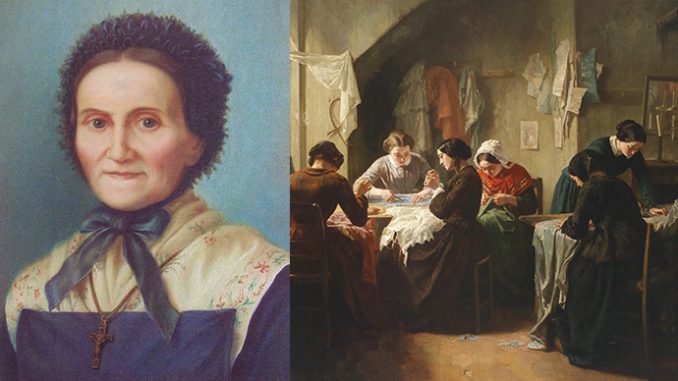
When little Marguerite Bays was born on the birthday of our Blessed Mother in Switzerland in 1815, her parents had no idea of the impact she would have on their community and now on the world.
Marguerite, who was declared a saint in 2019 and whose feast day we celebrate on June 27, was a seamstress by trade. But the love and faith she knitted together created an environment where the light of Christ shone, where the poor and sick were cared for and nurtured, and where people were drawn to Christ.
Through holy examples like Marguerite, we can learn important lessons to implement in our own lives. The example she lived and the good she did for those around her, help us understand that one person truly can make a difference.
Growing in faith
Marguerite was devout from the time she was a child, and though in her teen years she apprenticed as a seamstress—a trade she would practice for the rest of her life—she consecrated her life to Christ, chose to remain celibate, and became a member of the Secular Franciscan Order. She lived her faith openly. She created an altar in her room and dedicated it to Mary, attended Mass daily and Adoration weekly, regularly invited others to pray with her, and prayed the rosary as much as she could.
And when people told her of their troubles, she would often tell them: “Do as I do, pick up your rosary, things will get better afterwards.”
But service to others was the cornerstone of the practice of her faith. Every day of her life, Marguerite worked tirelessly to bring others to Christ. Even though she held what some may consider a mundane job, there was nothing mundane about her. She not only dedicated herself to teaching children about the Catholic Faith, but she cared for the poor, whom she referred to as her “favorite friends of the Lord,” often sewing their clothes at no charge and taking them food when they were hungry. It is said that “she strove to follow Jesus in His humility and His poverty, choosing to live with only the bare necessities, and giving the poor the best of herself.”
In her small town, the people all knew and loved her because she lived her faith well. In her, they could see Christ’s love. And through her, they could feel Christ’s love.
Suffering for the reparation of sins
Additionally, it is said that Marguerite greatly “suffered from the sight of the weak faith she saw around her and prayed that it would be strengthened.” One biography shares:
She cared very deeply about the conversion of sinners and the salvation of souls. Her experience was not limited to her own personal salvation, and it deeply hurt her to hear of or see people living in sin, and not practicing their Catholic faith. So she would take these persons to her prayers, praying for their conversion. She offered her sacrifices and sufferings for them.
And that suffering became intense. In her 30s, Marguerite began experiencing terrible stomach pains. For a while, she suffered in silence, offering up the pain for others, but when it became unbearable, she relented and saw a doctor, who eventually diagnosed her with incurable intestinal cancer.
Always faithful, Marguerite prayed to the Blessed Mother, asking her to pray for her healing. God answered “Yes” to this prayer and took the cancer from her, but Marguerite didn’t only ask to be cured. She also prayed that she would grow closer to Christ, and she asked for an opportunity to unite her suffering to His on the cross.
Not too long after, she received the stigmata—the wounds of Christ’s crucifixion on her hands and feet. These would become more visible and painful on Fridays, as that was the day our Lord was crucified. And at 3:00 pm each Friday, Marguerite would enter into an ecstasy that lasted anywhere between 20 and 60 minutes. Through it all, she never complained; she just united her suffering to Christ’s, and until the day of her death in 1879, she offered up the pain for sinners.
Lessons from St. Marguerite
Looking around our world today, we can choose to wallow in sadness about current events, about the state of our country, about family or financial problems, or about our health.
Or, as Marguerite did, we can choose to unite our sufferings to Christ’s and offer them up for souls in purgatory or for those here on earth who need our prayers. We can live by her example as we stand firmly and courageously in our faith, despite what those around us are doing. We can show that God must be our center, even when others are making worldly things their center.
And we can combat injustices by speaking out in truth and charity, by helping the homeless and the poor, by reaching out to moms experiencing a surprise pregnancy, or by simply sitting with someone who is sick or lonely.
Marguerite understood that we are not meant to hide our faith or to live it in the safe confines of our homes. We are to evangelize to those around us, to care for the sick and the poor, to live out the Church’s teachings about protecting the vulnerable, and to spread Christ’s peace within our communities.
Indeed, peace is integral, but it is contingent upon us doing good for others. As the Catechism of the Catholic Church teaches, we cannot attain peace on earth “without safeguarding the goods of persons, free communication among men, [and] respect for the dignity of persons and peoples.”
The preborn, the sick, the elderly, and those with disabilities are part of the delicate fabric of society today, just as they were in Marguerite’s time. And they, more than many, need us to knit together a society that protects them. Only then can we truly attain the peace that Christ wants for us, the peace that Marguerite worked tirelessly for, and the peace we all deserve as children of God.
If you value the news and views Catholic World Report provides, please consider donating to support our efforts. Your contribution will help us continue to make CWR available to all readers worldwide for free, without a subscription. Thank you for your generosity!
Click here for more information on donating to CWR. Click here to sign up for our newsletter.

Uniting our suffering, our pain, to Christ’s on the cross gives meaning and purpose to our affliction that it would not otherwise have. It is a great gift to know we can do this, rather than to only endure our agonies without praying for others, interceding for others. Uniting our suffering with Jesus takes us beyond ourselves and our personal hurt to the greater world of suffering that is all around us. This doctrine is yet another truth given to us by the scriptures and taught to us by Holy Mother Church.