

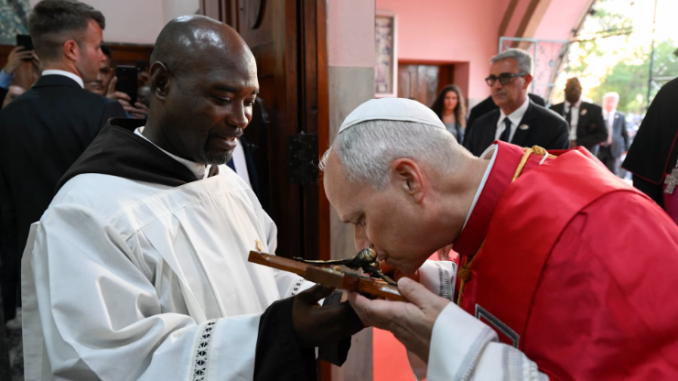
Pope Leo’s first encyclical, Magnifica Humanitas, is a pointed and prophetic gut punch.
Don’t be fooled by the usual “ecclesial-speak” argot of the text. When read carefully and closely, what emerges is a blunt, and even at times brutal, assessment of the threat posed to humanity by the digital revolution in general and of artificial intelligence in particular.
There are those who will strongly disagree with this assessment. There are those who think Pope Leo has been too soft on artificial intelligence and the threat it poses. However, demands that the pope engage in a scorched-earth rejection of all things AI do not fully understand the deep dilemma he faces.
If he summarily condemns AI and says we must reject it tout court, the Church will be accused of being “anti-science” once again and summarily dismissed as the institution that burned Giordano Bruno at the stake and put Galileo on trial. Such an approach also does nothing to help those Catholics who find themselves in jobs where the use of AI is mandatory for the work at hand. It might feel cathartic in a purging cleanse sort of way to just condemn it, but it does little to address the problem.
But if the pope were to ignore the threat of AI, the Church would perhaps be guilty of fiddling while Rome burns. Happily, the pope has not ignored AI, and so this aspect of the dilemma does not pertain.
Irenic, but pointed
What Pope Leo has done instead is to summarize papal social doctrine and to glean from that analysis certain principles that can help guide our deliberations: the common good, subsidiarity, the universal destination of goods, and the preferential option for the poor.
Magnifica Humanitas seeks to apply those principles in ways concretely helpful. It is a long text (around 42,300 words), as all encyclicals are these days, and it deals with a large array of topics. Nevertheless, the document uses each of the topical foci as different angles from which to analyze the main phenomenon of the digital transformation of our world, with an eye toward the aforementioned principles.
The analysis provided in the text, in my opinion, is deceptively irenic. Embedded within its call for dialogue and fraternal cooperation is a Christologically-based and evangelical challenge–or better, provocation–for humanity to turn to God or face an effacing obliteration on the altar of a digital slavery, the likes of which the world has never seen before. Along these lines, and much to my delight, Leo makes the following statement and then quotes the famous line from Gaudium et Spes 22.
Whenever humanity is in danger of marring its true identity, we Christians lift our eyes to the Incarnate God, knowing that it is ‘only in the mystery of the Word made flesh that the mystery of humanity truly becomes clear. (1)
Obviously, Pope Leo thinks this challenge is more than an intellectual abstraction and more than just one more “issue” in a long line of social issues that the Church has faced before. Quite to the contrary, Leo views the current challenge as a visceral, existential threat to the very foundations of what it means to be a human being. Leo understands, and explicitly mentions, that there are voices in the transhumanist and posthumanist world who advocate for a radically reductionistic anthropology that views human beings as little more than organic meat computers.
Leo’s claim that this false and dangerous anthropology must be countered by an even more powerful and persuasive Christological anthropology is truly radical insofar as it returns us to our theological core, our roots, and our very reason for being a Church. Along these lines, he makes the following eye-opening statement early in the text:
In this regard, artificial intelligence, too, should not be considered as merely yet another theme to be studied or a crisis to be managed, but rather as a development that challenges the categories of Social Doctrine from within, calling for their further development in fidelity to the Gospel. (17)
An Augustinian document
All that said, Pope Leo is certainly not a Luddite who is calling us to become Catholic Amish. He understands the inherent goodness of human technological ingenuity and its manifest potential for bettering the human condition. But neither is he a sociologically and psychologically naïve enthusiast for the idea that technology is “just a tool” and all that matters is “how we use it”. Channeling his inner Marshall McLuhan, he makes it clear that the tools we create shape us and change us and are therefore not inert instruments devoid of causative influence on those who use them.
Therefore, he insists that these two paths—Luddite fear and naïve enthusiasm—are both dead ends. He states clearly, “We cannot condone naïve enthusiasms, nor fuel unfounded fears” (1).
But are these not, in fact, our two alternatives? Can we avoid committing to either stark rejection of the digital world or to embracing it with fulsome fervor?
The former understands that when you swallow poison, you die. So, don’t swallow poison. The latter understands that once the technological toothpaste is out of the tube in a global market economy, there can be no acceptance of the digital world without embracing the system that produces it, warts and all. So, just deal with it.
However, I think this is overly simplistic insofar as we stay faithful to divine revelation and therefore know that there is no “inevitability” to any particular historical moment. Yes, there is an internal metaphysical and spiritual logic that informs a given culture, giving rise to easily predictable results, all things being equal. But humans still have free will, and the engine of history is the dramatic interplay between human free will and the divine economy of the Kingdom.
Pope Leo is an Augustinian, and it shows in this document. Free will is what characterizes the distinction between the City of God (love of neighbor and God) and the City of Man (control, selfishness, libido dominandi).
Two images, two possibilities
I think this is a critical point. Leo begins his reflection, in an Augustinian tonality, by framing the entire discussion around two competing biblical images for how human beings have chosen to organize themselves socially. He then constructs his entire analysis of our new digital culture around these two alternative visions for social construction.
The first image is that of the Tower of Babel, which Leo views as a prideful attempt to construct a society without God. The project begins with a broad unity of language, purpose, and culture, but it ends in disaster. The will to dominate and control everything—including people—via the path of efficiency alone, inevitably leads to conflict, as sinful human beings succumb to the antinomian underpinnings of the entire project and descend into a lawless chaos that rips everything apart. He states:
It was a project conceived without reference to God, supported by a uniformity that eliminated diversity and that chose homogenization over communion. When a city is built on pride and the claim to self-sufficiency, communication breaks down, languages are confused, and people no longer understand each other. The result is not unity but dispersion. Babel thus reveals the limits of any effort that, however grandiose, arises from self-affirmation, sacrifices human dignity for efficiency and aspires to reach heaven without God’s blessing (7).
It is not hard to see echoes of Augustine here and his descriptions of the libido dominandi as the prevailing ethos of those who live without reference to God.
Leo then contrasts the image of Babel with the biblical image/narrative of the prophet Nehemiah and his efforts to reconstruct Jerusalem after the return from Babylonian exile. The devastation of the city was almost total; therefore, Nehemiah required the help of the entire community of believers. With God and their covenant with him as their focus, the post-exilic community came together in cooperative efforts that were only possible if motivated by a genuine love for God and neighbor, with the concomitant practice of a genuine self-sacrifice for the sake of the common good.
Applying these images to the problem of digital tech, Leo concludes:
In practice, however, technology is never neutral, because it takes on the characteristics of those who devise, finance, regulate and use it. Therefore, the primary choice is not between a “yes” or “no” to technology, but rather between constructing Babel or rebuilding Jerusalem; between a power that claims to dominate the heavens and a people who work together in the presence of God to rebuild the walls of fraternal coexistence. (9)
It is important to keep these two images in mind when approaching the encyclical because it is Leo himself who frames the entire discussion within the interplay of these two possibilities.
Against the growing libido dominandi
There is already an emerging criticism in some circles that Pope Leo is too quick to appeal to international bodies as the source of human fraternity—bodies which have proven themselves over the past 80 years or so to be wholly inadequate and which often espouse pointedly anti-Christian values. Furthermore, Leo clearly doubles down on the approach of St. Pope John Paul II in appealing to the modern language of “human rights” in a manner that many think is too larded with secular humanistic overtones. Leo quotes Pope Francis’s Fratelli Tutti, appeals to the more Pollyanna aspects of the second half of Gaudium et Spes, and refers us back to the social optimism of John XXIII’s Pacem in Terris.
However, the pope’s citing of previous papal and conciliar texts in order to establish continuity is hardly something new. He also quotes other texts, from both John Paul and Benedict, that are far more oriented toward the confrontation with modern moral and religious relativism. Therefore, the attempt to dismiss Leo’s analysis in the encyclical as yet more liberal gibberish about “dialogue” and “human fraternal solidarity” ignores the many ways in which Leo raises several red flags that, when considered objectively, make it clear that he is no glassy-eyed enthusiast for the modern political ordo.
Leo’s concern is that in an age where the libido dominandi is gaining in power, and where so much of modernity is a recapitulation of the Promethean hubris of Babel, AI will be used in deeply destructive ways. We see this in his description of modern globalization as having succumbed to a polarizing nationalism. We have moved from the hope of a truly multilateral world of ordered economic and political relations to an ordo of competition between nation-states (I think the pope is thinking here of the competition between the United States and China).
Having critiqued the “technological paradigm” of efficiency above all else, Leo appears concerned, in the light of this unhealthy competition, about the weaponization of AI. Embedded within the technological paradigm is the “technological imperative,” which, loosely stated, means “what we have the power to do we must do, or else somebody else will do it instead.” Not without reason did Christopher Olah, co-founder of the AI firm Anthropic, attend the press conference launching the encyclical. He has been openly critical of the Pentagon’s decision to create AI weapons systems that have no human firewall and will operate automatically based on algorithmic calculations.
Just war theory and today’s challenges
I think this concern, which is hardly that of a Pollyanna optimist, also explains the pope’s cryptic comment that Just War theory is now “outdated”. He clearly reaffirms the right to legitimate self-defense if your nation is the victim of unjust aggression. But he goes on to rightly point out that Just War theory has been used to justify all kinds of wars that are clearly unjust, making the prudential decision-making principles at its heart serve the libido dominandi rather than the Amor Dei.
More than that, his use of the word “outdated” is instructive. Given the threat of the weaponization of AI, a deeper analysis of war-making is needed. I wrote my Master’s thesis on Just War doctrine, and it is clear to me that, as a tool for discernment, it has very strong merits. However, it is also a theory grounded in the notion that wars are waged between clearly discernible “sides”–competing city states, competing nations, competing empires–that have discrete and discernible boundaries, clear and discernible chains of command and authority, and which are fully carried forward by human agents with whom one can eventually parlay.
But all of this has broken down to a great extent, and the threat of AI is, as the Holy Father points out, that it is owned, developed, and operated by giant, private tech firms that seem to have no higher allegiance to anything except profits. And these firms, even if they call one country their “home base”, have no real patriotic impulses and are part of an emerging network of tech powers that are beholden to no one.
Furthermore, they have a vested financial interest in war, the ability to create a surveillance capitalism that destroys privacy, and can generate endless mountains of fake videos, false flag deceptions, and misinformation galore.
Pope Leo mentions all of this; it cannot be said that he is ignorant of this danger. In fact, I think the mere choosing of this topic for his first encyclical shows us just how dangerous he thinks it is.
Conclusion
Finally, those who chastise the pope for turning to the language of “dialogue” and for appealing to the “international community” ignore the fact that Leo has succeeded in bringing the world’s eyes to Rome. I saw a CNN panel discussing “subsidiarity” and what an “encyclical” is, and why this one is important.
It is plausible to think that, through this encyclical, Leo means to position the Vatican as a key player in the discourse and thus to potentially serve as a politically neutral venue for bringing together the world’s only real conversation about this topic. And that would not happen if Leo just summarily dismissed the international community as the enemy of all things good.
St. Augustine still has relevance. And perhaps the Holy Spirit has gifted us with this Augustinian pope for precisely this moment.
If you value the news and views Catholic World Report provides, please consider donating to support our efforts. Your contribution will help us continue to make CWR available to all readers worldwide for free, without a subscription. Thank you for your generosity!
Click here for more information on donating to CWR. Click here to sign up for our newsletter.
In a world where God is deposed from everyday life anything and everything rushes in to fill the void. AI is yet another thing used to fill the void. The root problem is now and will always be deposing God.
Which leads me to ask (I have only skimmed ‘humanitas.’) Is God in the AI void? In the encyclical? Is He mentioned by name?
Chapp and Pope Leo fail to recognize the biggest problem with AI. It does not exist. Believing that it does exist is a big problem, a death dealing problem.
Expanding search engines to scan subjects from published papers in accord with the ideology of its designers, then sort through preprogramed key phrases that identifies validity through repetition, and scrabble it into an authoritative presentation, is not and never will be any sort of “intelligence.”
The driving force for believing that AI exists is atheism, even the subtle atheistic concessions of the religious. The mere computing can be conceived of as like humans, the more humanity can be reinterpreted through an atheistic materialist ontology, which inevitably expands a pervasive acceptance of judging human worth by functional utilitarianism, which leads to a conscious dulled acceptance of exterminating weak and inconvenient life. Those who avoid sufficient thought to the subtleties of cultural entropy are not inclined to resist, including a pope who has made concessions to moral relativism, and who publicly ignored the obvious connection between sexual sins and baby slaughter while discussing how “justice” is a separate category.
I am in the middle of reading the encyclical.
My initial sense is the first 10-20 pages are packed with a lit of what can be labeled “synod-churchianity-babble,” which is tedious to wade through. So far, I see numerous name-dropping of “Pope Francis,” and scant reference to Jesus.
On the plus side, I have heard a very positive opening discussion over at Holy Smoke with Damian Thompson and his guest Michael Gove, editor of The Spectator.
A note of caution is called for regarding Christopher Olah of Anthropic. The caution is this: the inventor and entrepreneur Palmer Luckey of Anduril gave an interview with Peter Robinson on the program Uncommon Knowledge, where Luckey pointed out that Olah and Anthropic are engineering their own AI products to ensure that they avoid any bias toward the values of Western Civilization. That being the case, Olah’s motives deserve a very skeptical eye, rather than an opening assumption of good will, simply because he got invited to the Vatican by Cardinal Parolin et al.
Thank you for pointing that out about Olah. I believe he also served an apprenticeship with Thiel. It is critical that people start questioning why avowed atheist want the church on board with their projects. I am also puzzled by technocrats fascination with Tolkien. It’s almost like there is a primal urge to corrupt anything wholesome
Thank you in turn Alice.
There is a Francine cult and their “prime directive” is make a mess, and another and another.
The Vatican now gets giddy over every cultural rock star.
Dr. Chapp,
Great article as always! I have really benefitted from your work and would love to learn from your Master’s thesis on Just War Theory, that you mentioned in the article. Would it be possible for you to publish it for us to read it, or maybe have a podcast on it?
Thank you!
We read: “Pope Leo is an Augustinian, and it shows in this document. Free will is what characterizes the distinction between the City of God (love of neighbor and God) and the City of Man (control, selfishness, libido dominandi).”
Two comments and a perspective:
FIRST, about freewill, consider, now, 7th-century Islam transplanted into the 21st Century…Islam sees only a non-relational and totally inscrutable Allah, and while the Qur’an includes the refrain “in the image and likeness of God,” it fails to appreciate human freewill—as likened to the freedom of God who freely creating all-that-is, rather than not. No room for human freewill, and therefore no recognition of the mystery of our Original Sin (a darkness “original” to ourselves, as explained by St. Augustine, rather than to an arbitrary and even self-contradictory and sorta-Manichean/Zoroastrian Allah).
SECOND, no place for the Fall and, therefore, no place for Redemption. No reality for in-depth human history and personal histories, only a truncated remembrance of our baked-in orientation toward God as from before any history ever began (termed “fitrah” and, yes, maybe one of those flickering and snuffed “rays” of truth about human nature as noted in Nostra Aetate). And then only a primordial “guidance” given to Adam—but not the interiority of human transformation, nor the added gift of becoming a new creation (St. Paul) under the grace of a relational, Self-donating and Triune God. No forgiveness, only a cycle of remembering the guidance and then forgetting.
A BINOCULAR PERSPECTIVE: Muslim apologists explain that while we have no freewill, Allah allows us to think that we have freewill. Islam, not Pelagian-AI but equally (equality!) a threat to human freewill and freedom.
Overall, Pope Leo XIV underlines the broad theme of “unity”—and, of Augustinian “interiority” and freewill, without which there is no human unity. As now with the AI mutation, interreligious fraternity and dialog as a work in progress…
Splendid points, Dr. Beaulieu. Your concern regarding the erosion of interiority and the reduction of truth to informational management touches upon a profound philosophical and theological crisis. To understand why Artificial Intelligence raises such serious anthropological questions, we must examine the kind of rationality it privileges.
AI functions primarily through formalization, prediction, classification, and calculability. In doing so, it naturally favors a univocal and mathematical representation of reality — one in which persons, language, and even relationships risk being treated as operationally manageable systems.
MH seems to touch, at least implicitly, upon one of the deepest tensions in Western intellectual history: the gradual displacement of an analogical understanding of being by increasingly formal and univocal models of thought. The classical metaphysical tradition, culminating in St. Thomas Aquinas, understood reality analogically. Being is not said in exactly the same way of God, persons, and created things. Reality always exceeds pure conceptualization and calculation.
By contrast, much of modern technological rationality tends to privilege what can be mathematically rendered, operationally controlled, and computationally predicted. Descartes’ separation of the thinking subject from the extended world accelerated this tendency by encouraging a view of nature increasingly interpreted through quantification and mechanism. In many ways, AI represents the latest and most comprehensive expression of this trajectory.
The danger identified by Pope Leo XIV is therefore not merely technological misuse. The deeper danger is anthropological: that human beings living within highly mediated digital environments may gradually interiorize the logic of optimization itself, learning to understand themselves less as persons called to communion and more as systems to be managed efficiently.
When efficiency becomes the dominant criterion of intelligence, the irreducible dimensions of personhood — contemplation, vulnerability, sacrifice, memory, love, and spiritual interiority — begin to appear secondary or even dysfunctional. Yet these are precisely the dimensions most central to the Christian understanding of the imago Dei.
So, MH appears not only as a critique of technological excess, but also as an implicit recovery of metaphysical realism and the analogical vision of the human person against the growing temptation to reduce reality to what can be processed, predicted, and controlled.
Two Quotes about the MEANINGLESS, from already well over a century ago, plus a Note:
FIRST, this from the wife of Jacques Maritain ((married 1904, baptized 1906):
“All that is great and lofty in our morality also comes from this unique and great source of Christianity—from the abandonment of which flows false morality, as also does false science. . . . [We] are living at a time when the danger of barbarity and impiety is so great that one no longer has leisure to stop at theological arguments. . . .What matters before anything is to destroy this ‘intellectual’ gang, and all that clique of mediocre people who dominate us—novelists of adultery, worldlings. . . radical socialists who give to our time its aspect of anarchical confusion, so striking as soon as one sees it from a distance. . . .Grace! That is the mystery of mysteries!” (Raissa Maritain, “Adventures in Grace,” 1945/Image 1961; citation from her letter [1912] to Jacques Maritain).
SECOND, this also from Raissa about their earlier years together, at the Sorbonne, and their experimental hope that “the MEANING of life would reveal itself:”
“…But if the experiment should not be successful, the solution would be suicide, suicide before the years had accumulated their dust, before our youthful strength was spent. We wanted to die by a free act if it were impossible to live according to the truth” (Raissa Maritain, “We have been Friends Together,” 1942/Image 1961).
NOTE, Raissa and Jacques (with Etienne Gilson, one of the two most prominent Thomistic lay theologians of the 20th century) converted from agnostic atheism. One influence was the Dominican Fr. Clerissac who “prayed ardently ‘that intelligence and beauty be rendered to their Lord’,” and who was “a friend of Robert Hugh Benson; and the character of the Pope in ‘The Lord of the World’ resembles him very closely,”
Thank you, Dr. Beaulieu, for bringing Raïssa and Jacques Maritain into this dialogue. Their transition from the brink of nihilism to Thomistic realism is precisely the antidote to the crisis we are discussing. Indeed—si licet magna componere minimis—Jacques and Raïssa have long been the vital models for my own way of thinking and acting.
While the young Maritain felt the seduction of Bergsonian evolutionism, his profound humility saved him from the self-referential trap of idealism. He recognized Descartes’ foundational sophism, which replaced the Aristotelian “I think something” (or “I know”) with a naked, artificial “I think simpliciter”—which is, in reality, merely an “I doubt.” For idealists, philosophy became a thought that guarantees itself. For Maritain, it remained love of wisdom—the biblical hokhmà—where, as Wisdom 13:5 suggests, the transcendence of God is discovered through analogy with the beauty of His creatures.
As Father Cornelio Fabro brilliantly noted, the Cartesian cogito is “a flight.” It confuses being not only with thought, but with the will. In Descartes, certainty is not an adequation to external reality, but a forced decision of the will to affirm the ego. This birthed the idealist voluntarism where it is no longer truth that makes us free, but freedom that decides what is true. We see the ultimate consequences of this trajectory in Fichte’s ethical idealism, Nietzsche’s will to power, and Gentile’s actualism. Today, this modern voluntarism has found its ultimate tool: Artificial Intelligence.
However, as the historian Gianpaolo Romanato reminds us when analyzing St. Pius X, a true reformer is never a pessimist. In his inaugural encyclical E Supremi, Pius X fiercely denounced the modern gnosticism of man attempting to usurp God’s place—a perfect description of today’s transhumanist élites. Yet, at the very end of that same document, he beautifully balanced the severity of the judge with the pastoral tenderness of the priest, stating that it is useless to hope to draw souls to God through harshness; it must be done through charity.
This is the core of the matter. The idealist absorption of being into the cogito culminates in a technocratic, algorithmic tyranny—a “false science” that seeks to manipulate reality by pure power. The Church’s response to AI cannot be a mere horizontal, sociological compromise. Like St. Pius X, we must firmly name the vulnus of original sin, but like the Maritains, we must conquer the technocratic Babel by pointing to the mystery of Grace.
As Clement of Alexandria masterfully illustrated in his Protrepticus, this Grace operates through sheer attraction. It is much like in the myth of the Argonauts, where Orpheus overcomes the deadly and seductive chant of the Sirens not by forbidding it, but by playing a melody on his lyre that is infinitely more sublime. Christ, the True Orpheus and the New Song, offers the human heart an attraction that remains immensely more fascinating than any promise of technology, which is merely Dante’s grandchild of God.
What a tour de force. I’ve been swept through philosophical history, heard a mention of myth, and saw a dash of literature. The mention of Christ bedazzled. The optimism and the sorrow, the very large vulnus [I had to look that one up.] in the Church. Popes. All alive in one small combox. Wow. Time now to pray that eyes may see.
Rabelais could not have invented a greater, more voracious Gargantua than AI. Leo XIV had to address it. We’re all being swept into this high tech monster and require basis for moral decision since AI will affect everything.
Chapp makes the appropriate argument why we should read Magnifica Humanitas, a deceptive title misunderstood by some as the glorification of Man rather than God. Pope Leo does the opposite, leaving glorification to God as the work of grace within us.
There may be a turning point in this Leo XIV encyclical regarding reliance on the theology of his predecessors especially those who preceded Pope Francis.
The Partisans of Vatican II frequently tell us that the loss of the papal states was a good thing, that it freed the papacy from politics to better fulfill its spiritual role. A closer reading of history shows the opposite – it reduced the Holy See to one of many lobbying constituents in Italy, then in the European Union. Paragraph 241 clearly explains this encyclical is trying to wind back the clock to the EU’s vision of multilateralism rather than the reality of today’s multipolarism. Its nostalgia longs for not only the politics of the Short 20th Century, but its theology as well.
The roughly half of all footnotes to the Francis papacy continue its legacy of reviving the liberal interpretation of Vatican II and reinforcing it with magisterial authority. It does so by means of Gaudiem et Spes – that the Church can paradoxically fulfill its deepest mission when it joins the secular world in its non-religious activities. But this encyclical goes further, placing Gaudiem et Spes at the center of Catholic Social Doctrine, despite its most zealous architects writing in their diaries that they were taking the Church in a different direction. It’s why less than a fifth of this encyclical is devoted to AI, a fact this article omits entirely.
It also does not address the most difficult questions religion will have to answer about AI, the implications about human consciousness being raised by neuropsychologists and philsophers. Instead, it claims the Tower of Babel was a sin against diversity, and that Nehemiah rebuilt Jerusalem by a series of listening sessions. We are being primed for Synodality, in which a Protestant ecclesiology will unleash the Church’s most committed ideologues upon the faithful.
Thank you Larry, but you must learn the language of the average layman.
I am a simple man, BTGOG.
Thank you, Lord, for not making me a theologian.
They speak only to each other in a language only theologians can comprehend.
In the end, the Pope’s ideologies may raise several red flags to be addressed via accompaniment in synods at the expense of Truth. We should trust the Pope but only after verification with Tradition.
It’s true that Pope Leo was worldwide head of the Order of Saint Augustine, but that doesn’t mean he’s a faithful son of Saint Augustine, an expert or renowned scholar of Augustine. We had that in Pope Benedict. Yes, he wrote his canon law dissertation on the role of the prior in the Rule of St. Augustine and Canon Law, but that hardly means he’s the world guru on the body of his text and thought. In fact, I always appreciated when my professors (some of whom remain worldwide experts in their fields) would say that anyone who claims to have read all of Augustine is a liar. I honestly wonder if (and doubt that!) Pope Leo XVI has even read all the encyclicals of Pope Leo XIII, much less all the encyclicals of all the popes named Leo. No, I don’t claim that such a lack of reading disqualifies him from being Pope or choosing the name Leo XVI or being an Augustinian (though I think far to few of us know or acknowledge that Saint Augustine did not found that order and that historically it’s been a super problematic order in the Church, eg Martin Luther was OSA). I’m saying it’s weird and not Catholic to acclaim the Pope with a false expertise. He holds the keys to the kingdom. That’s far more important than being a scholar of Augustine, Leo, or even Catholicism. He’s a bishop in charge of all the bishops. That demands grace, humility, and the authority of the office given by God. He has that. Let’s focus on his real credentials instead of pretending (or misleading) that he’s some academic scholar. Yes, he’s a practitioner, which is perhaps even more important than being a mere scholar. But he’s also the man who said that people who support capital punishment are not pro life and that he didn’t know enough about Senator Dick Durbin to say emphatically that it would be a grave sin for Cardinal Cupich to award him a lifetime achievement award despite decades of giving the weight of the federal government to the false notion of pro choice legislation. Such a practitioner reveals himself to be neither an Augustinian nor a Leonine. Let people read the encyclical that has been published less than a week and let them read it for understanding. Dale Ahlquist pointed out one or two inconsistencies already. Shoot, even Saint Augustine had to revise some of his writing during his own lifetime after his decades experience as bishop. I patiently awaited the analysis that might come after a couple months, a year, maybe a decade. Will there be a Centesimus annus written in 2126 honoring Pope Leo XVI’s first encyclical? Only time will tell. But I do think the history books will record that the Augustinian prior and provential who lived in Chicago during multiple re-election years for Senator Dick Durbin was unclear when asked direct questions about giving him a lifetime achievement award. Seminarians the world over in two hundred years are likely to read about that public record alongside the abuses of power by Medici popes in the sad history of papal blunders. He’s still the pope, but we don’t need loyal sons blowing sunshine up our butts. We need saints out there living the Gospel, day in and day out repenting and starting anew to carry their cross, following after Jesus.
Following after Jesus, the Way, the Truth, the Life, and no one comes to the Father except through Him.
Magnifica Humanitas’s Alpha and Omega .the literal Incarnation of God who came to earth to accomplish the physical and spiritual rescue of humanity.
A creed we are obliged to teach all humanity.
Chapp unwittingly admits to problems with the document when he tries to explain them away at the start- oddly telling us not to take at face value what we read- don’t be fooled by the ecclesial speak leo uses. In other words, don’t take what you actually read as the meaning, but read through the lines to see what american popesplainers will tell you what it “really” says. It may thus be a further admission that Leo is advancing problematic ideas by using ambiguous, vague language, a playbook we’ve seen before. Also, Chapp claims Leo gives a “cryptic” remark about just war- cryptic? No, he quite directly says it’s obsolete. He’s also said it before, so we know he means it. That Leo then seems to make contradictory comments would reflect incoherence or likely the progressive tactic of floating a trial balloon of novelty alongside the traditional. Further, Francis was the first to flaot this idea, but it was criticized then; but when Leo adopts it, it’s now explained away. Why is that?
While the doc contains sound, common sense concerns over AI, there are a handful of seriously problematic ideas, for one- about just war; the church supposedly not explicitly condemning slavery until the late 1800’s; the Church not possessing the fullness of truth; that false religions are “great spiritual paths;” the notion that the Church’s social teaching is not a set of fixed principles to be applied, but they “evolve” with “communal discernment”- when they are exactly a set of fixed principles and set criteria for action and judgment, used first and foremost by bishops- and Leo proceeds himself to use his ideas as such in the document! While there is a grain of truth to it, this infers a relativism.
In general there is a trend Leo has displayed habitually- things start off well enough with brief, superficial references to the Faith, but they are eventually downgraded of their supernatural content and their goal becomes a naturalistic, humanist mix of “fraternity,” “solidarity,” “dialogue,” a peace not necessarily founded on the King of Peace. This is especially seen in the analysis of and solution to problems- notice that Leo tends to blame them on a failure of materialistic and political structures and processes, in marxist fashion, which have led to inequality of power, economics, etc. The solutions are even moreso- instead of any mention of the social kingship of Christ, great emphasis on religious conversion, submission of all peoples and all things to Christ, we are given a program of political and material structures and processes- international bodies regulating, systems tweeked to render distribution and equality of things. (Never mind that these are some of the same entities prone to abuse AI, while this contravenes the principle of subsidiarity!) This comes along with the push for fraternity, solidarity, etc, on a natural level. In other words, man is going to save himself from the dangers of AI, or anything else, by having as many people as possible come together in fraternity, and come up with the “correct” political and material structures. This is a self-defeating proposition, a long-standing leftist fantasy. The document may end up promoting what it claims to address: the deification of man and his own efforts.
For those who think this is a lot of naysaying, compare it to Rerum Novarum, which Leo himself does. Notice a difference in the emphasis on matters of Faith vs. globalist buzz words like fraternity, dialogue. Or do a word search for how many times secular vs. spiritual terms appear in M. Humanitas. One can also note again that the document reiterates its share of problematic ideas and documents of Francis, that were criticized under the latter, but now get a pass under Leo, a growing dynamic for americans.
Here are facts of revelation: The whole world WILL be deceived and ruled by the antichrist: “All the inhabitants of the earth will worship it, all whose names were not written from the foundation of the world in the book of life, which belongs to the Lamb who was slain.” And the Church will be deceived: “The persecution that accompanies her pilgrimage on earth will unveil the “mystery of iniquity” in the form of a religious deception offering men an apparent solution to their problems at the price of apostasy from the truth. The supreme religious deception is that of the Antichrist, a pseudo-messianism by which man glorifies himself in place of God and of his Messiah come in the flesh.” –Catechism 675
That is a misinterpretation of the Catholic view of Revelation. The Catholic view is that the text is an inspired poem about the ultimate triumph of the sacrificed and risen Lamb over the forces of evil, culminating in the new creation, not a prediction of exact future events.
JP,
Unlike [im]posters, you know how to read and cite the Catechism. Keep up the great work!
‘Leo views the current challenge as a visceral, existential threat to the very foundations of what it means to be a human being‘
In other words with reference to C S Lewis’s The Abolition of Man, AI promotes technology akin to men without chests, who acknowledge no Tao or Natural Law or Traditional Morality.
‘Man’s conquest of Nature’ or ‘Man has Nature whacked’ is questioned by Lewis.
His prophetic message is an elite, the Conditioners he calls them, have stepped outside the Natural Law.
‘Man’s final conquest has proved to be the abolition of Man.’
Essayed in 1943, a suitable companion read to Magnifica Humanitas
Wait . . . what? After a rather thorough analysis, it seems that AI actually helped craft 40% or more of the encyclical. The Popes for the last 60-years have all condemned in others the faults they’ve embraced in themselves. Right now, Roam just seems allergic to Catholicism. Wy else are they gathering muster to jettison overboard the SSPX? This is another encyclical – in a long series beginning with those authored by Frankenpope – that I will proudly NOT read. I laud all those willing to wade into the muddy waters and bring back the “pearls”. Good luck finding them!
Yes, there is a significant likelihood that some of the paragraphs the encyclical were generated by AI:
https://www.lifesitenews.com/news/ai-detector-finds-pope-leos-new-encyclical-was-partly-ai-generated-report
If it is true, then it is ironic: an encyclical about the dangers of AI written with heavy usage of the AI generated text. Does it mean that AI may become a part of the Magisterium?
This my AI-generated text “Christ’s personality”:
“Jesus Christ is characterized by a perfectly unified personality that balances divine perfection with deep human individuality. He is described as compassionate, humble, and courageous, demonstrating meekness without weakness and authority without arrogance.
Key personality traits include:
• Compassion and Mercy: He showed profound empathy for the hurting and offered forgiveness even on the cross.
• Integrity and Honesty: He was sincere, free from pretense, and lived consistently with his teachings.
• Strength and Poise: He exhibited unwavering resolve, spiritual enthusiasm, and emotional stability.
• Wisdom and Insight: He possessed keen understanding of human nature and practical wisdom.
In personality typology, Jesus is often analyzed as an INFJ (Introverted, Intuitive, Feeling, Judging) reflecting his empathetic, purpose-driven, and harmony-seeking nature.”
I speculate with a time humans will lose a sense of what is missing in the AI generated text.
Or, maybe SSPX is “jettison[ing]” themselves overboard? A Question, plus a trip down Memory Lane, plus another Question:
QUESTION, not only a matter of ecclesial “disobedience” invoking linguistic duplicity in Fiducia Supplicans and other textual ambiguities nested in Vatican II, etc., but also inseparable from (!) SSPX’s reportedly unambiguous rejections of the Council itself, and of all subsequent papacies. Perhaps you can refute, for SSPX, their reported excesses—now entangled with the merely disobedient decision to consecrate additional bishops?
Some 500 years ago the Protestant haystack of dissent was initially ignited by the confessor Martin Luther’s legitimate rejection of penitents who in the confessional refused to amend their lives—because they claimed they had played, instead, the coin-operated “indulgence” game.
DEJA VU, read here about this obscure Wittenberg confessor and Augustinian monk named Martin Luther, who in early 1517 was still “a most furious papist [his words]”…
“…Many of the townspeople came successively, and confessed themselves guilty of great excesses. Adultery, licentiousness, usury, ill-gotten gains—such are the crimes acknowledged to the minister of the Word by those souls of which he will one day have to give an account. He reprimands, corrects, instructs. But what is his astonishment when these individuals reply that they will not abandon their sins?….Greatly shocked, the pious monk declares that since they will not promise to change their lives, he cannot absolve them. The unhappy creatures then appeal to their letters of indulgence; they show them, and maintain their virtue. But Luther replies that he has nothing to do with these papers; and adds: EXCEPT YE REPENT, YE SHALL ALL LIKEWISE PERISH [italics]. They cry out and protest; but the doctor is immovable. They must cease to do evil, and learn to do well, or else there is no absolution. ‘Have a care,’ added he, ‘how you listen to the clamours of these indulgence-merchants: you have better things to do than buy these licenses which they sell at so vile a price [“For polygamy it was six ducats; for sacrilege and perjury, nine ducats; for murder, eight ducats; for witchcraft, two ducats….For infanticide…four livres tourquois; and for paricide or fratricide, one ducat”].” (Source: Protestant scholar; J.H. Merle D’Aubigne, Geneva, “History of the Reformation of the Sixteenth Century,” Vols. I-IV, 1850 with later reprints; 700 fine-print double-column pages).
QUESTION: So sad, so how to unwind today’s conveyor belt into both Germania’s heresy and SSPX’s schism?….Does SSPX at least recognize the 22nd Ecumenical Council, and Popes John XXIII, Paul VI, John Paul I, John Paul II, Benedict XVI, Francis, Leo XIV— OR NOT?
About der Synodal Weg, Francis at least remarked that “we don’t need two Protestant churches in Germany.” Does a symmetrical remark also apply to the opposite self-jettisoning by SSPX?
Peter, I am not going to answer for the SSPX – although it’s tempting. The SSPX are doing an absolutely fine job of that themselves. What I invite you to do is explain to me why it would seem this Hierarchy is more comfortable at a San Francisco bathhouse than the Latin Mass. Are they Catholic? Where did things go so awry but at that infernal “council” that forwarded and extolled every OTHER creed than the Catholic. Of course, the SSPX has always held allegiance to the Pope in conjunction with his express role and duty as ultimate defender of the faith, i.e. AS Pope. Meanwhile, if you’re not under the impression that the church is in crisis – and might have already actually lost the faith – simply by abandoning it for every other creed; you’re going to love the ice I have for sale in Alaska. It’s just peaches!
We read: “Meanwhile, if you’re [me] not under the impression that the church is in crisis…”
My proposition for all is that the crisis is even worse than you propose, plural and multidimensional, including the internal calumny that the Church is “simply abandoning [the faith] for every other creed [….] extolling every other creed than the Catholic.”
The makers of such comments are invited to entertain more than one idea in their head, or wherever, at a time….The Council’s declaration on non-Christian religions (1965), for example, comes after the contextual and higher-ranking Constitutions on the Church (1964) and on Divine Revelation (1965). All of the 16 Constitutions, Decrees, and Declarations are to be read together.
Many do actually agree with you (including myself) that key wording in the Declaration is overly preliminary or breezy. But not a heresy. The history of the document shows that the original focus was simply to re-establish a lost continuity (not equivalence) with Judaism (“the Old Testament prefigures the New, and the New Testament fulfills the Old”). Then, because the universal and inborn Natural Law does find echoes in the natural Wisdom literatures of other (natural, not supernatural) world religions, the Council in its early-1960 good will, haste and optimism, offered a vague (but not heretical) opening for conversation, rather than not.
What the Council’s words actually say and don’t say invites more than name-calling. There’s a reason why Pope Benedict drew a sharp line between the “real” Council of the Documents vs the “virtual” spirit of the Council marketed by Hans Kung and his tribe of functionally illiterate manipulators.
Too bad “we” cannot frame a focused conversation on the problematic lines, and between the lines, rather than rejecting the real Council, and rejecting such popes as Benedict, or even Leo who, in his Wednesday Audiences, is returning directly to the Documents themselves, rather than to flash-in-the-pan “synodal” puffery.
Again, is it really the battered Church, itself, that has “already actually lost the faith”?
Lost or tossed? Or, perhaps Our Lady in Quito – speaking directly of our times and particularly about the church – was simply mistaken (but, being privileged to be able to stare into the Beatific Vision, I doubt it). It sure seems there is a convergence happening on many levels and all things are advancing toward the warnings of Fatima, Akita, Quito, LaSalette (and Garabandal) – which cannot be ignored nor simply dismissed: politically, religiously, socially, economically, nationally and internationally all things are rapidly approaching the “funnel’s tip”. The crisis in the church came during Vatican II. No one who has studied the matter finds that conclusion suspect. This horrific synod, as Cdl. McElroy stated “will give the Modernists the opportunity to finish what they started at Vatican II”. If “implementation” was the issue for why things went so awry following Vatican II, the implementation of a mere “tautology”, i.e. the Synod on Synodality, is sure to make that look absolutely easy. To that end, I am grateful that Cdl. Fernandez is pushing further out to sea the SSPX – and far enough away that it cannot be tainted by what Roam is planning. Dear God, it is sure to be an absolute disaster.
Mark,
You are not as alone as you pride yourself to be. Instead, the “real Church of the Documents” (Benedict’s term) is now raped and left in the ditch. For those who “have studied the matter” the question is whether we give a kick and move on OR do we do what the Good Samaritan did?
Some tilt to the latter choice, because for all of its cobbled-together and problematic verbiage–as about conscience and alleged ecumenical or interreligious indifference–the Council itself ALSO clarified: “Contemplating this melancholy state of humanity, the Council wishes to recall first of all [!] the permanent binding force [!] of universal natural law [!] and its all-embracing principles. Man’s conscience itself [!] gives ever more emphatic voice to these principles” (Gaudium et Spes, n. 79). In 1993 this anchor point was expanded into the, yes too-often sidelined, encyclical “Veritatis Splendor”.
Similarly, the so-called “freedom of conscience” is a phrase found nowhere in the Council Documents. The message, instead, is “freedom of religion” as meaning: “This freedom means that all men are to be immune from coercion [‘from’ coercion, not ‘for’ libertarianism] on the part of individuals or of social groups and of any other human power, in such wise that in matters religious no one is to be forced to act in a manner contrary to his own beliefs” (Dignitatis Humanae, n. 2). Sounds a lot like the earlier Cardinal Newman… Elsewhere the personal obligation to seek the truth, over mere subjective opinions, is also reaffirmed. And, it seems prescient to me that the above wording applies especially to compulsion under resurgent Islam and even AI which were not so much on the horizon back during the Council.
And about ecclesiology and what “collegiality” means and doesn’t mean, we might take another look at “Lumen Gentium,” Chapter 3 (“hierarchical communion” with the papacy and never without him)–and the attached Explanatory Note added by Pope Paul VI expressly to remove a subtle ambiguity implanted by termites so as to be later exploited by lightweights such as today’s non-cerebral McElroy.
How, then, to remove the gangrene that has infiltrated Rome without kicking or tossing the patient? Is SSPX playing into the hands of the saboteurs?
I don’t believe Pope Benedict drew any such sharp line, although he certainly asserted many times that it could be drawn.
Drawing the line would entail sufficient clarification that one could tell who was on the wrong side, and the internal Church discipline to match that would at least prevent bishops, Curial officials, and published Synodal documents from scandalizing by being on the wrong side with no correction or retraction.
The lack of such correction will make Vatican 2 irrelevent, due to swarming people with erroneous and incorrect interpretations that they are not qualified to sort through.
Edit: Vatican II was the “21st Ecumenical Council” (not the 22nd), although it could be argued that it was only the 20th, since it complemented Vatican I (1870) which was only “suspended” and not ever adjourned.
“Playing into the hands of the saboteurs” . . . by being shoved further out and away from the burning Barque: that doesn’t sound like self-destruction, or self-alienation to me, that sounds like preservation; a blessing. Cdl. Heenan writes in “The Torn Tunic” that when the concept/notion/idea of “Religious Freedom” was first raised on the floor of the Aula, 3 very different definitions presented. All were “developed”, each had their supporters. In the end, however, not a single one was favored over the others – no clarity came from ANY of it. “As the twig is bent, so grows the tree”. The very first premise that the council forwarded (which is at odds with the Natural Law (I’m glad you brought it up) was that all things had to be updated to address the needs of “Modern Man”. What is that? A definition of human nature indexed by time? Weird. I don’t buy that for one minute. Man is, was, and has always just been Man. Period. So, should we scrap the carp (sic) of Vatican II?? 1,000%. It was garbage.
Non sequitors, yours. About Natural Law, for example, this clarity: “…the permanent binding force of universal natural law and its all-embracing principles.”
And about freedom religion, not a positive definition but negative clarity: “freedom from coercion.” Perhaps you disagree…(see “Summary” below).
You do rightly raise the central QUESTION, whether truth is “indexed by time,” or not. On this point, the challenge accepted by the Council (with all of its imperfections) is how to engage the modern world which no longer even understands either the grammar or the vocabulary of the Christian revelation?
Vatican II is an extension of Vatican I which was only “suspended,” and sought to at least avoid the fate of becoming a large-scale Amish sect.
JOHN XXIII opened the Council with this: ““What above all concerns the Ecumenical Council is this: that the sacred deposit of Christian doctrine be safeguarded and taught more effectively (…) Therefore, the principle purpose of this Council is not the discussion of this or that doctrinal theme . . . a Council is not required for that . . . this certain and immutable doctrine, which is to be faithfully respected, needs to be explored and presented in a way which responds to the needs of our time” (1962).
Warts and all, the COUNCIL began each session with this prayer:
“We are here before you, O Holy Spirit, conscious of our innumerable sins, but united in a special way in Your Holy Name. Come and abide with us. Deign to penetrate our hearts.
“Be the guide of our actions, indicate the path we should take, and show us what we must do so that, with Your help, our work may be in all things pleasing to You.
“May You be our only inspiration and the overseer of our intentions, for You alone possess a glorious name together with the Father and the Son.
“May you, who re infinite justice, never permit that we be disturbers of justice. Let not our ignorance induce us to evil, nor flattery sway us, nor more and material interest corrupt us. But unite our hearts to You alone, and do it strongly, so that, with the gift of your grace, we may be one in You and may in nothing depart from the truth.
“Thus, united in Your name, may we in our every action follow the dictates of Your mercy and justice, so that today and always our judgments may not be alien to You and in eternity we may obtain the unending reward of our actions. Amen.”(Prayer believed to be composed by St. Isidore of Seville, to be used during the Second Provincial Council of Seville, Spain, in 619. It was also used during the Fourth Provincial Council of Toledo, Spain, in 633. With this prayer the sessions of the First Vatican Council began, in 1869, and it was used before every meeting (in Latin) of preparatory commissions and conciliar commissions of Vatican II.)
SUMMARY, Butt, what the Council should have done, surely, was to share the microphone with the erudite layman and Johnny-come-lately Mark Tabish! Openness to his imperious “scrap the crap 1,000% garbage”. VERY SYNODAL, THAT!
Very synodal and NOT wrong . . . that! It’s telling that the council fathers approached Good John 23rd in the first weeks of the council opening and requested to do away with the morning mass before the council gathering and do away with the clerical vesture, too. It distressed him. Bella Dodd was more than happy to convey that, by the time the council convened, her infiltrators were all in high places and able to steer the council to whatever purpose they desired – Masonic brotherhood of Man, anyone? (Response: “everyone”) Only a select few decided NOT to jettison Catholicism for the “pastoral council” who will all likely be raised to the high altar as Saints on a footing with St. Athanasius – AB. Lefebvre leading the way. Word is that the gaggle is now eager to canonize Frankenpope. Dear God, help us! Woe to those that call evil, good – and good, evil. Homosexual blessings anyone?! (response: everyone, BUT the SSPX!) The fruit of the council is in the process of undoing the council, the synod, even the church itself. The demise of the Boomer-generation utopian vision that confounds self with “God” is thankfully dying off and leaving little more than dust in the pews even now. That iteration of what people have called “Catholicism” is a ruse; a trap, a con. Only returning to what the Church has always held, what saved souls and what bore actual Saints in the church will remain. Good riddance to bad rubbish, council, synod, et alio. They have little more to do with salvation than merely barking at the moon.
Mr. Tabish, the SSPX is not the “only one” giving voice about the various issues and conc4erns.
Consider more carefully, if as I hold the intended action is dis-begetting, it would then be too late to do anything about it once the act is completed. From then on the result will be that the Society will unravel and whatever of it remains in a scission would be purely sectarian and consigned in doom.
Mark,
Not contesting the grief you express, but only your inability of refusal to grasp significant details that matter….About Bella Dodd (“more than happy to convey…”), your example, she did not boast of her refuted Communist agenda as you pontificate, but rather had already been converted to the Catholic Faith a full ten years prior to the Council.
Writes she:
“On April 7th [1952], the anniversary of my mother’s birthday, I was baptized by Bishop Sheen at the font of St. Patrick’s Cathedral [and later the concluding paragraph to her book] New armies of men are rising, and these are sustained not by the Communist creed but by the credo of Christianity. And I am keenly conscious that only a generation of men devoted to God that they will heed his command, ‘Love one another as I have loved you,’ can bring peace and order to our world” Bella V. Dodd, “School of Darkness: The Record of a Life of a conflict between two Faiths,” The Devin-Adair Company, 1954!).
But, yes, about infiltration into the Church and Dodd’s later comments, check out “Rethinking Bella Dodd and Infiltration of the Catholic Priesthood” (Kevin Symonds, Homiletic and Pastoral Review, Dec. 24, 2021) The focus is not on possible seminarians (estimated by some to number 1,200) but on four cardinals who remain unnamed.
Bella “boasted” that she had her little troops in all the correct high places at the time of the Council. Whether she said this after or before is irrelevant.
“Bella Dodd claimed that by the time of Vatican II, her Communist infiltrators had successfully reached the highest levels of authority within the Catholic Church. She stated that 1,100 to 1,200 men she had placed in seminaries during the 1930s were ordained and promoted to positions such as Monsignors and Bishops.
According to Dodd’s testimony, these infiltrators were “right now in the highest places in the Church” twelve years before the Council began, working to weaken the Church’s opposition to Communism. She predicted that the changes they engineered would be so drastic that “you will not recognize the Catholic Church.”
You see, Peter, timing really doesn’t matter. When she said it is not as relevant as the fact THAT she said it and that is not as relevant as the reality she had in place, i.e. “boots were on the ground” that she placed there within the church and many were well-positioned to impact the Council.
Beyond that, what business has the Catholic Church (and its adherents) in supporting a (so-called) Council that advanced EVERY OTHER CREED than the Catholic and still does? All iterations of that infernal “council” be damned. It’s all slop. There will be a truly Catholic Pope that will rise up and anathematize that “council” and condemn its horrid books. The sooner – the better.
FYI: you repair a break at the point of its origin and there is no other greater manifestation of brokenness in the church (“Smoke of Satan” and all) than at the moment that Good Pope John announced his intentions and the modernist malformed began their sinister plotting, colluding and chicanery. “Hey, I got a great idea, let’s “canonize” its horrid changes”. O, Lord . . . how long?
Take a breath…
“Beyond that, what business has the Catholic Church (and its adherents) in supporting a (so-called) Council that advanced EVERY OTHER CREED than the Catholic and still does?”
How does this square with “Dei Verbum” which by design returned not simply to previous documents on letterhead (as proposed in the original schema), but to the very event of the Incarnation into universal human history?
And, is it really true that the Council “advanced” every other creed?
Pope Benedict, who initiated the rewrite under Cardinal Frings (Benedict was his peritus) later further clarified and insisted the difference between the “real Council of the Documents” and the “virtual Council” of Hans Kung, etc. said it this way: ““Equality, which is a presupposition of interreligious dialogue, refers to the equal personal dignity [!] of the parties in dialogue, not [!] to doctrinal content, nor even less to the position of Jesus Christ—who is God himself made man [!]—in relation to the founders of the other religions” (Congregation for the Doctrine of the Faith, “Dominus Iesus,” 2000, n. 22).
A clarification from within the Council, which some enraged non-readers refuse to even consider.
The day-to-day inner workings of the, yes, infiltrated and conflicted Council are probably best reported in Fr. Ralph M. Wiltgen, SVD, “The Rhine Flows into the Tiber: A History of Vatican II,” 1967). During the Council this well-connected historian published a daily news service, in six different languages, circulated to 3,000 subscribers in 108 countries. He received documentation from many groups and interviewed two Council Fathers each day during the 281 days that the Council was in session.
About Dodd’s 1,200 seminarians, had you read the link I supplied yesterday, you would know that she never claimed that all of them were ordained and your “boots on the ground.” Still a problem, but from other sources we know that the overall attrition rate in minor seminaries was typically 80 percent, and somewhere between 20 to 50 percent in major seminaries. But, also, to support your rage, the surviving and surely morally-challenged Dodd party might well have accounted for much of the follow-up sexual abuse scandal that has crippled the moral witness of the Church in the decades after the Council.
So yes, of course, to St. Paul’s “the smoke of Satan has entered the Church,” but it is still the real “Church” that it has entered. But, where you insist on triage, others more informed and responsible are devoted to battlefield surgery. A distinction with a difference…
Mr. Beaulieu, I like the idea of the continuity from VATICAN I, this is compelling.
How many are the different contrasting sides that are out of step with VATICAN I.
Writer Rod Dreher is disappointed with the pope’s encyclical on AI. He says Pope Leo misses the issue that for many people AI already has taken the place of human interaction and even human attachment. AI rewires the brain, creating attachments with the machine, replacing humans. People are asking AI what to wear and who to date. Kids are affected.
Dreher says:
“Leo calls AI “a valuable tool that requires vigilance.” I think that is wrong. Or rather, I think that it is not right enough …. I don’t at all deny that the Pope is right about the distinctions he draws between artificial intelligence and humanity. What I think he’s missing is that the experience of AI is now, and is going to be even more, so close to human that for most people, it will be a distinction without a difference.”
Quote: “He says Pope Leo misses the issue that for many people AI already has taken the place of human interaction and even human attachment. AI rewires the brain, creating attachments with the machine, replacing humans.”
In my opinion, this is the most relevant issue, to our faith that is quintessentially personal. Christianity is all about an attachment of God to humans and vice versa, of a soul to Jesus Christ, her Bridegroom (correspondingly, of the Church, His Bride, to Him). Our utmost fulfillment, as persons, is in His Person, via a transformation of our psyche which brings us into the union with God, our true destiny. The heavenly Jerusalem is about that secure attachment and union, not about the earthly, horizontal city. That attachment is the gift of God to humans, not something humans build themselves. But it cost a pain of seeing oneself as he is, in the light of Christ.
Christ speaks to a human person via human feelings, emotions and attachment. This is why the most intellectually deficient person who is able to form an attachment/to feel empathy can relate to Our Lord and to understand Him – unlike an intellectual with an impaired ability to form an attachment/feel empathy.
AI, obviously, has neither ability to attach nor feel empathy – it can be programmed to fake it to make a human feel “nice” (like in a case with “AI friends”). Considering the fact that the world (especially the West) is undeniably a narcissistic, here is the appeal of AI; the two match in their shallowness. In fact, AI is a perfect companion for a narcissistic psyche: it is not offended by the rudest interaction, it is always available and useful, it does not require reciprocity, it can be switched off at any time. But – unnoticeably and quietly an interaction with AI changes the brain, making the initial psychological interpersonal problems of an individual even worse.
If a hardcore covert narcissist is an antipode of Christ, anti-Christ then what is AI? I think, theologically/psychologically, it may be a narcissist’s take on God, God the Father, perhaps. The god who serves him and reinforces him in his psychological deficiency (no attachment, no empathy).
Theoretically speaking, the more human beings interact with AI as with “a companion”, the less personhood they will have = the less able to reflect Christ because Christ is the Person. This, in a nutshell, is the problem with AI (which otherwise can be useful as a library assistant etc.).
The thing about the pope’s use of the word “outdated”regarding just war is that he does not propose an update, but rather substitutes – negotiation, dialogue, etc.
I saw a statement that this is similar to proposals to defund the police and instead send social workers to confront criminals.
You use the phrase just war “theory” but it has become more than theory. The CCC in paragraph 2309 uses the phrase “just war” doctrine.
Technology can only serve for Human Flourishing if it is grounded in The Truth Of Love.
AI, while a tool to transport information from point A to point B with tremendous speed of processing, it is important to not that such processing cannot be efficient if the information being processing is not accurate and coherent..
“When efficiency becomes the ultimate measure of value, human beings are tempted to see themselves as a project to be optimized rather than as persons called to relationship and communion.”
Thus only AI that is grounded in Divine Law can serve for Human Flourishing, for only Divine Law is grounded in The Truth Of Love.
Being efficient is not the ultimate measure of value; only Divine Law serves out of respect for the Sanctity and Dignity of all Human Life, from the moment of conception , when every human person is Created in The Image And Likeness of God, equal in Dignity while being complementary as a beloved son or daughter, Willed by God, The Most Holy Blessed Trinity, Worthy Of Redemption.
1- In the beginning was the Word, and the Word was with God, and the Word was God [John 1:1] 2 The same was in the beginning with God. 3 All things were made by him: and without him was made nothing that was made. 4 In him was life, and the life was the light of men. 5 And the light shineth in darkness, and the darkness did not comprehend it.
“All things were made by him: and without him was made nothing that was made”
Including The Laws of Physics used to create AI.
I am not sure, but I think AI is still too new to make any definitive comments. Many people, including myself, aren’t really sure what AI is, or how it will affect the human condition. Maybe some aspects of AI are good and others are not so good. In time more information can be gathered so we have a better idea how good or how bad AI is. In other words, I think the ” jury is still out ” on this matter.
An interesting alternative take on Pope Leo’s encyclical:
https://www.lifesitenews.com/analysis/leo-xivs-magnifica-humanitas-a-blueprint-for-the-destruction-of-the-catholic-church/
Excellent initial critique of the encyclical. Thank you for sharing.
I encourage everyone to read it. For myself it speaks to my growing sense that this encyclical is seriously flawed and incoherent.
The problem now is that AI is largely a pile of hype, Not unlike the personal computer revolution which promised to take processing power away from the institutional mainframe and distribute it to the masses.
In 1984, Apple retained Ridley Scott to produce it’s famous “1984” commercial. Part of the allusion to “Big Brother” was people marching in unison wearing identical grey clothes and among the things you hear is “a garden of pure ideology”. Then a buxom lass comes in and launches a hammer at the giant screen everybody is watching. it ends with “…and you’ll see why 1984 won’t be like “1984”. By 2014, Apple was a “garden of pure ideology”. Seems to me that the only thing different is we’re all watching a million screens, most showing the the same stultifying ideological pablum and of course the little screen watches us.
Four decades later, the “always connected” nature of the internet has made the PC instrument of the surveillance dystopia, not the bulwark against it.
Five years ago, you could still hear a radio commercial with one child character chiding another to remove a phone charger while not in use. Now all of a sudden the government commercial complex wants AI and we’re supposed to ignore the megawatt power demands of the server farms data centers that it utilizes, accept escalating electricity costs and the rehabilitation of closed nuclear facilities such as Three Mile Island.
This would have been better if it addressed the deification of technology in general, because who knows if AI is going to be a bust. I have gotten some absolutely stupid results to AI requests.
Spot on Lifesite News an there is this:
https://bigmodernism.substack.com/p/who-should-be-excommunicated-the
Some time ago, I came up with the semi-serious idea that AI for Catholics should stand for Angelic Intelligence, in other words, a rediscovered reliance on the ministry of our Guardian Angels. For my own amusement, I asked ChatGPT to write a scholarly essay contrasting Artificial Intelligence with Angelic Intelligence. Here is the result, presented without comment:
AI for Catholics: Angelic Intelligence
Introduction
Few technological developments have captured the contemporary imagination as powerfully as artificial intelligence. From predictive algorithms to large language models, AI promises efficiency, insight, and even a kind of surrogate wisdom. Within Catholic discourse, however, such promises invite careful theological scrutiny. The Church has long insisted that technology, while capable of genuine goods, must remain subordinate to moral truth and the supernatural end of the human person.
This essay proposes that Catholics responding to the rise of artificial intelligence would do well to recover a neglected but central element of Christian doctrine: angelic intelligence, especially as exercised through the ministry of the Guardian Angel. By contrasting artificial intelligence with angelic guidance, we can clarify what the Church means by intellect, discernment, and authentic assistance in the moral and spiritual life.
What Artificial Intelligence Is—and Is Not
Artificial intelligence does not think in the classical sense. It does not know truth, deliberate about the good, or freely choose ends. Rather, it processes data through mathematical models created by human designers. Pope Francis has repeatedly cautioned against confusing such systems with genuine intelligence, noting that AI can simulate decision-making without possessing moral responsibility or conscience (Message for the World Day of Peace, 2024).
Catholic tradition defines intelligence as an immaterial act ordered toward truth. As St. Thomas Aquinas explains, the intellect is that by which a being knows what is (Summa Theologiae I, q.79, a.1). AI, by contrast, operates entirely within the material order. It identifies correlations, not causes; probabilities, not meanings. It can assist human work, but it cannot replace human judgment—still less spiritual discernment.
Angelic Intelligence in Catholic Doctrine
Angels occupy a precise and elevated place in Catholic theology. They are not metaphors or mythological figures but real, created persons endowed with intellect and will. Because they are pure spirits, their mode of knowing surpasses that of human beings. Aquinas teaches that angels understand by simple intuition rather than by discursive reasoning (ST I, q.58, a.3).
Angelic intelligence is thus personal, intentional, and ordered toward God. Unlike artificial systems, angels possess moral knowledge and freedom, though always exercised in obedience to divine providence. Their intelligence is not autonomous but participatory, reflecting what Aquinas calls a “likeness of the uncreated light” (ST I, q.55, a.2).
The Scriptural Witness to Angelic Guidance
Sacred Scripture consistently presents angels as active agents in God’s governance of the world. Psalm 91 affirms: “He will command his angels concerning you to guard you in all your ways” (Ps 91:11). This guardianship extends beyond physical protection to moral and spiritual assistance.
The Book of Tobit offers one of the clearest biblical portraits of angelic guidance. The Archangel Raphael accompanies Tobias, instructs him, corrects his errors, and leads him safely through danger (Tob 5–12). Raphael’s final revelation—“I am Raphael, one of the seven angels who stand ready and enter before the glory of the Lord” (Tob 12:15)—underscores the heavenly origin of this guidance.
Christ Himself confirms the personal care of angels when He teaches: “Their angels always behold the face of my Father who is in heaven” (Mt 18:10). The Church has long understood this as a foundation for belief in Guardian Angels assigned to individual persons.
The Guardian Angel: Doctrine and Devotion
The doctrine of the Guardian Angel is firmly embedded in the Church’s tradition. St. Jerome famously remarked, “How great the dignity of the soul, since each one has from birth an angel commissioned to guard it.” St. Basil the Great likewise teaches that every believer is accompanied by an angel “as protector and shepherd leading him to life.”
Aquinas provides the most systematic account, arguing that every human being receives a Guardian Angel, not because of personal merit, but because of God’s providential care for human weakness (ST I, q.113, a.2). The Guardian Angel enlightens the intellect, strengthens the will, and protects against spiritual harm, all without violating human freedom.
This assistance differs radically from any technological aid. A Guardian Angel knows the human person personally, not statistically. Angelic guidance is ordered not toward efficiency or optimization, but toward holiness and salvation.
Angelic Illumination versus Algorithmic Output
The temptation of our age is to seek guidance from systems that promise clarity without conversion. Yet machine learning systems are trained exclusively on past data. They cannot judge what ought to be, nor can they recognize the moral meaning of a concrete human situation. As Pope Benedict XVI warned, reducing reason to what is calculable results in a “self-imposed limitation of reason” (Regensburg Address, 2006).
Angelic illumination, by contrast, participates in divine wisdom. While angels do not replace grace or conscience, they assist the human intellect in perceiving the good more clearly. This assistance presupposes prayer, humility, and openness to God—dispositions no algorithm can generate.
Discernment and the Moral Life
Catholic discernment has always been personal and relational, rooted in prayer and oriented toward God’s will. St. Augustine’s prayer—“Grant what You command, and command what You will” (Confessions X, 29)—captures the dependence of human freedom upon divine aid.
Popes of the modern era have encouraged devotion to Guardian Angels precisely because it fosters attentiveness to God’s providence. Pope Pius XII reminded the faithful: “Never forget that you are never alone; you have a Guardian Angel.” Such devotion trains the soul to seek wisdom as a gift, not as a product.
Outsourcing moral or existential judgment to artificial intelligence risks undermining this formation. While AI can provide information, it cannot cultivate virtue. Wisdom, Scripture reminds us, is given by God to those who ask (Wis 7:7).
Technology under the Light of Providence
The Church does not reject technology. Rather, she insists upon its proper ordering. Pope John Paul II taught that technological progress must remain “at the service of man” and never become his master (Redemptor Hominis, 15). Angelic guidance helps maintain this hierarchy by reminding the faithful that human tools are subordinate to human judgment, and human judgment to divine wisdom.
Seen in this light, artificial intelligence can be a legitimate instrument, but never a substitute for conscience, prayer, or spiritual guidance. The Guardian Angel stands as a sign of this order, quietly directing the soul toward its true end.
Conclusion
As artificial intelligence continues to advance, Catholics must resist the temptation to invest machines with a role they cannot fulfill. Intelligence, properly understood, is not merely computational power but participation in truth ordered toward the good. Angelic intelligence—especially as exercised through the ministry of the Guardian Angel—offers personal, moral, and salvific guidance that no artificial system can replicate.
To recover confidence in angelic assistance is not to retreat from modernity, but to engage it with a fully Catholic vision of reality. In that vision, technology has its place, but souls are guided not by algorithms, but by providence.
“Angel of God, my guardian dear, to whom God’s love commits me here…”
Dear @meiron (in response to your comment above),
Thank you very much for your deeply moving and undeserved words. They are a true Christian consolation.
If I may confess, this dialogue with Dr. Beaulieu was driven by my profound, immense love for the American people and the American Catholic tradition. Through my modest contribution, I wanted to honor that great nation.
It was precisely Jacques Maritain who saw in America one of the rarest and most promising examples of true democracy in the world—a society where freedom and the Christian spirit could uniquely encounter one another.
I have recently written about this enduring bond of esteem on my Substack, where I translated an article by Father Cavalcoli detailing this profound respect for America through the lens of Maritain’s thought: https://oraetcogita.substack.com/p/trump-and-pope-leo
I join you wholeheartedly in your beautiful prayer. Let us indeed pray that, through the sublime melody of Christ, our eyes may truly see. God bless you and America!
Dear @meiron (in response to your comment above),Thank you very much for your deeply moving and undeserved words. They are a true Christian consolation.If I may confess, this dialogue with Dr. Beaulieu was driven by my profound, immense love for the American people and the American Catholic tradition. Through my modest contribution, I wanted to honor that great nation.It was precisely Jacques Maritain who saw in America one of the rarest and most promising examples of true democracy in the world—a society where freedom and the Christian spirit could uniquely encounter one another.I have recently written about this enduring bond of esteem on my Substack, where I translated an article by Father Cavalcoli detailing this profound respect for America through the lens of Maritain’s thought: https://oraetcogita.substack.com/p/trump-and-pope-leoI join you wholeheartedly in your beautiful prayer. Let us indeed pray that, through the sublime melody of Christ, our eyes may truly see. God bless you and America!
In “Magnificatis Humanae,” Pope Leo XIV warns that AI is a risk of not only misapplied technology, but that it also portends the replacement of Christian Anthropology with algorithms. Algorithms that could treat human beings (remember those folks?) as mere bags of meat that (not “whom”) are to be merely “optimized.” Chemical sacks of mostly water and worth not more than 98 cents on the open market.
AN ODYSSEY: Why are we reminded of the earlier warning in the Charleton Heston flick, “Soylent Green,” where American old folks are first treated to Hollywood-style audio-visual heaven and then converted into protein-rich wafers called Soylent Green, for human consumption? Optimized!
Or, maybe we might be reminded of the law first passed in Washington State in 2019 permitting and even encouraging the “composting” of humanoids who have outlived their shelf life? As a bellwether state, Washington also legalized, by the first public vote in human history, the culture of fetal infanticide (1970, prior to the inventive Roe v. Wade in 1973), and was second only to front-runner Oregon in legalizing Physician Assisted Suicide in 2008 (termed compassionate care as an exemption [!] from homicide laws), not unlike some churchy synodalists who would mainstream the anti-binary sexual culture as an exemption [!] from moral theology and the entire history of family-based human civilization.
Next up, computerized calculations of upside good stuff coupled visibly on computer monitors with downside triage…atomic bombs no worse than fire bomb raids, abortion no worse than IVF discards and mifepristone as a miniaturized Auschwitz, and Auschwitz no worse globally than Northern Hemisphere comforts over the Southern Hemisphere deprivations, and even the luster of auto paint linked to child slave labor mining mica in human ratholes in northeast India, or maybe Easter chocolate eggs mass produced on the backs of child slave labor cocoa pickers in parts of Africa, or routine paper-money budgeting having priority over the deferred indebtedness of future generations.
All this, now to be done no longer in a non-deliberate way but outsourced to comprehensive algorithms, that is, rather than transacted only on Wall Street where at the bell the connections remain digitally obscure.
The BENEDICT OPTION proposes enclaves of conscientious “creative minorities” who then seek to leaven the free-fall world that surrounds them. In St. John, the incarnate and self-donating JESUS CHRIST challenges us to “love one another…as I have loved you!” (Jn 13:34-35).
Not quite the previously incalculable everyone as a neighbor all of the time(?), but at least self-donating members within the Mystical Body of Christ? Christian Anthropology as transcending the post-Christian constructs of social “science”, economc “science,” and political “science”—all now on steroids as AI digital holograms managed by fingertip algorithms…like bombing from 30,000 feet.
SUMMARY: “Magnificatis Humanae” comes only half a century after the fictional “Soylent Green”…Today, the stark and yet freely graced world of St. Augustine–where after nearly two millennia of “development” we are once again humbled “pilgrims in a strange land.”
Artificial Intelligence – a contradiction in terms and concept.
Human intelligence is rooted in God alone. We are made in His image and likeness, so we share a common Intelligence with God, albeit a limited, mortal and imperfect intelligence as a consequence of original sin.
Mankind is incapable of mimicking a similar intelligence to itself, much less an artificial intelligence mimicking that of God.
All of the best efforts of collective humanity in striving to create an intelligence outside that of God will culminate in a quasi-intellectual Frankenstein.
The outcome can be only that of an abomination, a monster in every respect.
Placed in the context of Revelation, a global, real-time AI will be the right arm of the antichrist. A global AI will be inevitably set up to replace politicians, judges, law enforcement, et al. It will have complete control over the media, national and world governance, down to any given individual’s finances, employment, travel, recreation, even procreation.
Such an all knowing, all reaching entity will have absolute control over every single aspect of society.
It will be given the power of life and death over humanity.
This is the “beast” that St. John saw in his vision, not fully comprehending what it was that he had observed.
Nothing good can possibly come of AI.
Unfortunately, its implementation is much farther along than even its creators and most avid supporters realize.
The antichrist is at the door, and his beast is with him.
I see a pattern beginning to emerge. I often see it in regards to the TLM vis-a-vis the NO “mass”. The argument goes, “I have no problem with the NO, after all, I attend a “reverent” one”. When teased out, the details of a “reverent” NO mass are merely what the TLM has and has always had. I shrug it off. They have forgotten what real Catholicism looks like and what it is like to experience real Catholicism. Pitiable, really. You keep applying bandages, post surgery or triage, what’s the difference, really? The fact is the only merit that nasty Council had was when it referred to the actual Catholicism of previous Councils – reiterated their truths and teachings. In every measurable metric, the Council (as if there was only 1 that actually mattered) was the breaking point. I won’t “bless” it for I find the blessings it offers are too far from genuine – where they are real (for homosexuals and ice blocks) – and far from actual, where they are novel (for homosexuals and ice blocks). In every crisis the church has suffered in the past 2,000 years, the way it survived was to remain loyal to its liturgy, its doctrines, dogma and canon law, as they had always been understood. That’s how it will also survive this crisis – by remaining Catholic and ONLY Catholic (not ecumenical, not compromising, not synodal (whatever that means anyway, etc.). You and I, after having read much of the same study material, will never agree on the value of that “council”. That’s fine by me. Incidentally, I consider it a blessing in disguise that Cdl. Fernandez is readying a document that seals our eventual ex-communication. Unbeknownst to him, he is pushing us further away from a Barque lilting so dramatically in the waters already that – by being far enough away – we won’t be caught in the subterfuge as she sinks below the surface of the modernists waves she refuses to bail out. Deo gratias! I’m sure Caiaphas believed he was doing the nation of Israel a favor, too, by crucifying that “saboteur”.
You would be saying that some future Pope has to nullify so much and so much from 1962 -i.e., not merely correct some things. First it doesn’t make sense with the primacy of the Pope and second it isn’t the thrust from Fatima. The mission in mercy would indicate that the Pope is trying to find redeeming means for the Germans -for example- so as to interrupt their jaunt to perdition; while expecting the faithful to faithfully pray and sacrifice for the positive outcome. We do not press the hierarchy to address abuses in the new mass so that we might divide ourselves from the hierarchy and separate in our own way as the Germans are doing in their own way. That is how Jansenists and Gallicanism would have it, overtaking the hierarchy. Lefebvre uncovered the problem in the Holy Ghost Fathers and it would seem he then proceeded into the same error once he left them. It has to be addressed if he is to be rehabilitated, yes; AND it has to be addressed ANYWAY even if he is not going to end up rehabilitated, because 1. it is the path the SSPX has embarked on and 2. there is a persisting stubbornness on it at large that can be seen to be threatening the traditionalist movement. The angel of Fatima has it in the prayer to “lead all souls to heaven and help especially those most in need”.
You simply don’t get it, Elias. The SSPX are growing. The NO “mainstream” church is dying. They’re consolidating parishes now, dioceses later. That’s not “Winning”. The NO will die out with the Boomer generation. They are the only ones who are attending it. It will die with them. If it embodies the “Spirit of Vatican II” then, as that mass dies, I hope and pray that “spirit” dies with it. Sorry, I just do. Everything about that Mass (and council) are foul. That Mass is broken in precisely the Canon. There, the priest raises “the work of human hands”, i.e. code word in the OT for idols, and displays it to the few, aged, falling-asleep, or radicalized progressive female attendees in the gallery. He doesn’t turn around and offer the sacrifice of the Son to the Father – AS HE SHOULD! The “consecration” is from a modern Jewish meal blessing and presents as a narrative – there is not INTENTION to make Our Lord present at all in the consecrated Host. The entire mass is a fumble. The cognitive dissonance is so glaring, and on so many levels, it causes headache: the architecture, the statuary, the music, the vestments, the prayers, the “kiss of peace” . . . it’s no wonder that a mere 9% – 17% of registered Catholics in any given diocese actually weekly attend Mass. You want to point a finger at AB Lefebvre? LOL. That’s rich. He and the SSPX are the only avenue left that offers what the church has always held sacred for the last 2,000 years. Perhaps, it’s time you actually attend one of their Masses. Make it a high mass; there, you will see a plethora of dedicated Catholic youth; on the altar (boys only!); in the choir, sitting in the pews . . . everywhere! It gives me HOPE. No, Elias. Your Boomer mass is slated for extinction. If Roam doesn’t do it, it’s own atrophy and mere dead weight is choking it off. Good riddance! The mass, the “new sacraments”, the 3-year lectionary, the new “office”, the new Canon Law, the entire Council . . . TRASH from start to finish. Kaput!
Some can’t decide whether Mark Tabish is a one-string violin, or a one-trick pony, or a broken record. But, the “pattern” is very trinitarian!
Despite my shared sympathy for the family abuse the SSPX has endured, I think Mr. Tabish displays the dichotomy Mark Twain had in mind when he said, there a two kinds of people in this world, those divide the world into two kinds of poeple and those who do not.
The truth should convince, not veil itself in some pedantic or condescending cosplay, Peter. Convince me. You keep swinging, but just can’t make a connection.
Mr. Tabish, Luke 24:30 has the Lord seated for a meal at table with the two disciples he had accosted; where he ‘ took the bread, pronounced the blessing, broke the bread … ‘. This is not facing the Father in the sense of how the physical action went. Furthermore the facing the Father posture is the Church’s own applied insight and the Church is free -was always free- to share other insight.
Elias, Jesus and the Father are one.
Mr. Tabish – the Father, in the words of the Son, is greater than the Son, which is a mystery; there in Emmaus the Resurrected Lord Jesus is sitting at a dining table with two others and celebrating His Own Eucharist.
Divinity. Soul. Body. Blood. True God and True Man. Son of Man.
You are too “tactile”, it means too “fast” not detached and dispassionate enough. Faith is a gift and we can’t force God to make it look like something other than what He has already determined in the Father and the Son.
Besides that, by what you are saying you would neatly have crafted your own way to defy Scripture on its plain reading; by itself would be a major fail.
Fine, you’re not hostile in your writing at least. There’s a start sir. The saints of yesteryear rejoice that saints of today encounter God for today anew as well as for the past, the future yet to be known and for all time.
By the way, on an inadvertent prompt from Fr. Morello, I can add, the aphorism time is greater than space is indeed defective since it does not account for deterioration through time only for what is presumed as development.
Elias, I’m not an Arian. Didn’t that heresy do enough damage already? My comment is simple. The Son offered Himself to the Father. He is His own center-of-all-things visible and invisible.
Mr. Tabish, Jesus at Emmaus, divine, human, is facing the disciples at an ordinary table, there showing them His Mass.
Arian controversy has nothing to do with what I was saying.
I have had an experience of trads who did NOT take up the cause in a parish/Archdiocese of abortion propagation from the parishes. I’m not saying this to “hold it against” somebody; it goes to show how SLOW people can be to act sometimes and it can happen to anyone even the best; and it also goes to show how difficult it can be sometimes to get at true intentions.
On another angle, could it be arguable that the older rite should be the norm at large and the newer rite should be reserved for closer initiates? Let’s say this makes sense: what it would reveal is that SSPX and certain trads are cornering the issues and railroading meaning and results and in the meantime maintaining a monopoly authority over their “own apostolate and ecumenism”. How easy it is to forget that Christians are not slaves.
I would really love to respond to your statement below; but, quite honestly I read it 3 times and cannot decide exactly what point you are attempting to make. Generally, let me respond this way: 70% of the population average NO parish “St. Typicals” find gay marriage OK. 2% of those that attend the TLM do. At St. Typicals, about 50% find abortion OK. 1-2% at the TLM do. At St. Typicals, 20% believe in the Real Presence. At the TLM, 98% do. Comparing what happens at “St. Typicals” with what is actually Catholic is like comparing apples and car tires – they aren’t even in the same genus. Thomas Cranmer devised the protestant prayer service in rebellion against the Truths of Catholicsm. Fast forward to the mid-1960’s and Hannibal Bugnini did the same – modeling his “mass” on the prayer service devised to call into question the merit, truths, dogma and faith of Catholicism. I will never return to the NO. Actually, it was the only place I would ever find in appreciable numbers “Vote Obama”, “Vote Biden” and “Vote Kamala” bumper stickers. I realized then, something is tragically WRONG with the “mainstream” church – it should be scrapped. But, if it dies of its own atrophy I’ll be just as content. Catholics for whom the faith actually matter have already begun to find the TLM and are showing an affinity for it while actually displaying a disbelief in the lack of quality in the church that would hide or forbid such a treasure.
Plain as a cowpoke in a church with them muddy chaps and all; genuflectin’ with 10 gallons on his corn-fed heart!
Being among the small percentage of humanity who actually knows how computers work, I am continuously amazed at how AI is taken so seriously, as though it is real in the literal sense, even by those who should know better regarding the real origins of dehumanization. I also fear for my IRA mutual funds investing in AI companies for their inevitable dot.com type of collapse.
The acting person, as JPII noted in his book by the same name, is involved in a continuous process of value judgments, from which ideas we decide to contemplate, moment to moment, to the words we choose to verbalize our thoughts, and when and where we act upon them. Computers and their software do nothing remotely similar, even those programed to synthesize previously published drivel. Watching YouTube AI videos on historical events are comical for their resemblance to students who fudge book reports on books they never read.
The decisions we make in order to accommodate preconceptions of how the world works and how to find meaning in life are value judgments, and this would include the lies we prefer to live with, the sins we like to deny, and the lies we demand from the marketplace of ideologies of exoneration that dehumanize both honesty and hope.
Leo is rightly worried about dehumanization, but he might better attend to his own flock of faithless men in roman collars seeking to attenuate the terrors of their idleness, submitting to cultic faith in revolution, and a metaphysically ignorant laity elbowing their way to find the good opinion of establishment liberals. All God’s sinful children hope to prove human values are what the lowest groupthink common denominator of self-accommodating sin deniers say they are. Spend a few decades downplaying personal sin and our need to fess up, people will believe anything.
Edward, your comment (above) inspired an insight: there are two kinds of councils – bad councils and good councils. A “Catholic” council that purports to advance every OTHER creed than the Catholic Creed is, by its very nature, a BAD council. From that malformed council to this day, the church has shown itself allergic to Catholicism in full measure – to its shame. The fruit it bore has been decimation, decomposition, confusion and compromise. That’s not winning. Of course, Our Lady predicted these events some 400 years ago in Quito and reiterated the urgency of the crisis in our times through LaSalette, Fatima, Akita and even Garabandal. By whose authority does She say such things? Obviously, not by the Popes. Were she to await “papal approval”, we would never have heard a peep. Had good Pope John and the others just consecrated Russia to her Immaculate Heart much of the heartburn we suffer in the spread of communism would have been averted. So, I take just as seriously a mandate for papal approval as they take seriously a mandate from the Mother of God. Can anyone answer for that?
About my not making a “connection”, and whether the Council “purports to advance every other creed than the Catholic,” please connect to my earlier response of June 4.
(No one is disputing your very scientific bumper-sticker survey results re those attending TLM vs NO, nor the Marian-predicted crisis of our moment. But it’s no longer cute when you sputter so predictably.)
No I would dispute Mr. Tabish’s misappropriations on the apparitions. Everybody on all sides is attacking the Papacy including members of the trads.
Also, Mark Tabish June 9, 2026 at 6:42 pm, here he claims he “can not decide what point” I was “attempting” to make -for such an otherwise intelligent individual this was very lame from him. What I indicated reveals itself and Mr. Tabish makes himself comfortable diverting from it and trying to make it of no matter. It further brings out one of my points that people can convolute their intentions and/or defy the development of this or that issue. This would bring us to Group 9 and its concept of “pre-packaged” conclusions: Group 9 is getting to something without pinpointing this concrete reality correctly, trads who make a calculation to not do anything when it is imperative to do something; where in addition, actually Group 9’s own pre-packaging agenda which eliminates or waters down or effaces doctrine and morality, is left shrouded and they hold themselves above examination.
Mr. Tabish very mild mannered and loquacious, wants more of our thoughts.
If your comment is positing the notion that trads are slow to respond to known orthodox teaching in the church, anent your comment about abortion, I would remind you of the scandal surrounding the publication of Humanae Vitae. Even after Paul the Sith began imposing the interim “Mass” to the consternation of all orthodox Catholics, the Trads were the first to embrace the teaching. Again, when 98% of those in attendance at the TLM are pro-life, I don’t see how your comment can be taken as anything short of ignorance about those in attendance and their loyalty to sound, Catholic doctrine, even from a Pope that despoiled a true love of theirs in this life: the Latin Mass.
If I interpret it correctly, your point about the SSPX guiding the framework of the discussion, again, means very little. The council that drove a wedge between the 2,000 years of Catholicism that went before and the measly 60+ years since has only become much more severe. The mainstream church has made it clear “the documents cannot be corrected.” I wonder, is that an admission that they are actually faulty? I definitely think so – I’m sure Pete and you would disagree. So be it.
If the SSPX are controlling the dialog, who is punching the admission tickets at the entrance door of the Vatican? Last I checked, it was Cdl. Fernandez and the rebel, mutinous crew of the Roamin’ Barque – not SG Davide Pagliarani. So, I think you and Pete are noteworthy in your efforts, but where it matters most the NO mainstream church is “not winning”.
I faithfully attended their mass for 50-years. I read. I disbursed communion (to my eternal shame). I raised 5 children up in the faith. I watched them reach adulthood and stop practicing the faith all together. It doesn’t speak to them – at all. To what crowd does that mass speak? The Boomer class. They’re the only ones now in appreciable numbers who bother attending it. It’s dying. Is that a tragedy? I don’t think so – not when there is an alternative in the TLM that appeals to the human soul and speaks to every generation – including boomers. So, you can stare at your priest staring back at you when he is offering the sacrifice of Calvary in the Canon (one of many) in the new mass. If you’re good with that – good on you. It’s not theologically correct, it’s not according to our beloved Catholic faith and, worse of all, it’s an outright affront to the Divine.
Do me a little favor, next time you speak with your wife, turn your back on her and have your conversation. Do you think she would get offended? Of course she would. If she gets offended, how would it be possible for God not to be offended when the priests has his back to God in the Holy Tabernacle?
You are very conversational and I enjoy the reading.
This is not “an attack” on the TLM or older rites, nor on trads. Trads are themselves in varied groupings and they are not all cut-and-dried as has been portrayed by either them or the “other side” Group 9 etc. or those in between who are “non-trads”.
Some trads too narrow. Some too stern. But these “bad qualities” are not unique to them and anyone can be affected with such; something lost on Pope Francis and certain of the following.
Once again you dodge the sure Scripture and then try to waffle some theology against what it is indicating unequivocally. Jesus is right there face to face with 2 disciples who are not even apostles: one of them possibly a woman.
It could be the unidentified figure is an apostle but we do not know. The identified figure does not behave as like to a deacon or lector -not the meaning of the passage.
Those two take the experience back to the apostles. The priest in the place of Christ who faces disciples is not turning his back on God: in the same way that the consecration does not depend on the priest’s worthiness.
Abuses in both rites subsisting today require to be corrected. I should say 3 rites subsisting today. Likely we have to pay homage to other rites that have a right to be performed like the Sarum and Braga. Nidaros can be revived.
Sarum very lavish and elaborate so why can’t the more recent rite today have proper embellishment?
On husband and wife thing, you can get to situations, too, where the husband speaks to his wife face to face and she turns her back on him. Which is to say that your analogy reference from marriage is unnecessarily restricted.
Pete, to my credit, I don’t feign to convey an impression that evokes an erudition beyond what simple truths convey by their own merit. Stack up the crap that the “council” left us with and the subsequent fall-out we’re still suffering against what wonderful novelties it left us with and, on the whole, it still miserably fails; it should all be scrapped, nixed, jettisoned, trashed. By now I’m sure you understand that I’m not out to impress – you or anyone else. Nor am I easily impressed with subtleties, hair-splitting and “slight of hand” (or word) that suggest little more than self-absorbed sophistry – some privileged insight that if I were only able to comprehend all things about the council (and those that defend it) would slip into the ether. LOL. Not my style – never was – never will be. That said, I think you’d get a lot further along if you weren’t so pedantic, condescending and intellectually self-superior. God Bless you, though, you’ve been a lot of fun – in your own weird way. FYI: I responded to your June 7th comment:
Mark Tabish
June 4, 2026 at 7:17 pm
There’s a great line in the movie “The Young Victoria” (2009) where the final insider Lord Melbourne dismisses the manipulator John Conroy and Victoria’s manipulated and would-be-regent mother with this: “Ah, I see I have not made myself clear….You have played the game, and lost!”
So, here and likewise, “I see that I have not made myself clear…I too am a trad.” Say what?
But also more. I was raised in TLM prior to the Council, and later I have frequented both TLM and the Byzantine Rite, but now follow the (authentic) NO at three solid parishes plus a Carmelite Monastery, all within five miles of my home. Wish you were so lucky, my friend.
Four points:
FIRST, again, it’s actually possible to celebrate the NO as a response to the sacred (the core issue, I think of SSPX), rather than as some sort of manufactured “project Church,” as Ratzinger/Benedict insisted: “[we cannot] lose sight of what is ‘distinctive’ to the liturgy, which does NOT [caps added] come from what ‘we do’ but from the fact that something is ‘taking place’ here that all of us together CANNOT ‘make’” (“The Ratzinger Report,” Ignatius, 1985, p. 126).
SECOND, everything rocking the Church today had a dry run, in bellwether Seattle in the 1970s and 1980s. Everything!
The sad tale included a real Visitation, a punchy list of published corrective actions (which I have posted at this site), the total novelty of a two-year triumvirate of three supervisory bishops from still within the United States (O’Connor, Quinn, Bernardine; as in right-center-left), an auxiliary bishop with unusual authorities, then a co-adjutor archbishop, and finally an early retirement. A path never used before and so rocky that it will never be used again.
THIRD, where hellish confusion is evident, that is where saints also appear. It was ever thus.
My personal good fortune was to come under the influence and decades-long friendship with a Dominican priest who continued on weekdays with the shunned Tridentine Mass (actually the earlier and virtually identical Dominican Mass) throughout all of it until his peaceful passing at the age of 86 on the Feast of Our Lady of Guadelupe, December 12,1998. But also the NO, also done distinctively. A holy man and, somehow, untouchable through it all: https://www.catholicworldreport.com/2025/05/24/at-a-secular-university-does-god-talk-to-people/
FOUR, as for your complimentary assessment of my “pedantic, condescending and intellectually self-superior” (I’m flattered!) attention to your position and your style, I have no credentials or degrees or formal training in either philosophy, liturgy, or theology. But I do dig. All my life. In addition to what is abundantly obvious and about which you have many followers at CWR, I would also propose that precision also matters. Real discussion of significant details would be a graced exercise for some members of SSPX. But am not so sure about the opposite end of the spectrum, der Synodal Weg, where Cardinal Marx once famously pontificated that “the subjective is the objective truth.”
We need two Marian solutions at the same time, prior of July 1. Perhaps you and others will join in prayer for what seems impossible…
Dear CWR, maybe a new area for CWR is engaging with sacred artists and exhibiting samples of their works and insights, west and east.
In the video in the link, Blair Piras and Baton Rouge theologian, Dr. Brian Pedraza, discuss the unique details of the painting “Supper at Emmaus.”
Supper at Emmaus –
The Story Behind the Painting
https://diobr.org/supperatemmaus
I regret my comment/s being “edgy”. That was un-necessary. Please forgive me. At any rate, I am exceedingly passionate about the church and her fate which, at the moment, seems questionable going forward. What will my adult children do if they do decide to return? What I have asked (and answered) is “How much of the Catholicism from the church can be extracted (or other things added) before she is finally no longer the Catholic Church?” I found my answer when I was red-pilled during Covid. That is when I began assisting at the Church’s (God’s really) Latin Mass. I came to see how much beauty, grace, majesty, mystery, doctrine, structure, personal sanctification and more that she had given up to satisfy (a definite mis-read) “Modern Man”. It’s alarming and my passion, i.e. zeal, to drive out the “compromisers” cannot be interpreted as “hate”, but LOVE for my Holy Mother, the Church. Deo gratias! I wish you, Peter, and you Elias only the best. I pray we meet one day face-to-face (yes, I will be facing you, Elias) in the only place worth dying for: HEAVEN.
May it please the Lord. And I would thank you.
Bravo and Amen, Mark!
Yes, and the sentiment is likewise, and deeply so.
I hear your passion and over the years have known of at least two other families where the five grown children left the faith. In the first instance I bumped into the widowed father some years later, and all five had returned. In the other instance, the five children had been betrayed by the local and nominally Catholic high school. The father filed an ecclesiastical and documented lawsuit against the archbishop, and the timing at least coincided with the sequence of “rocky” events I summarized above. He suffered a heart attack along the way and spent most of his retirement funds, but apparently the maligned Pope John Paul II had inserted such a provision, for the laity, in the 1983 Code of Canon Law.
I’m encouraged and trusting that one careful step at a time, the deadening effect of recent years will be abundantly replaced at the top by a long-awaited Second Spring.