


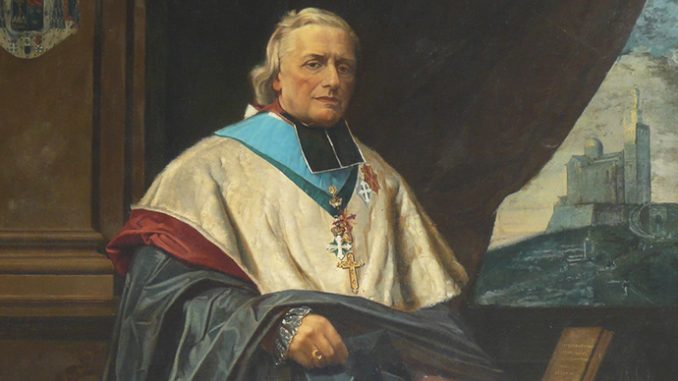
When he died on May 21, 1861, Charles-Eugène de Mazenod was mourned by French Catholics as a steadfast bishop, a zealous religious founder, and a humble and inspirational preacher. A century later, Pope Saint John Paul II named him a saint.
Charles-Joseph-Eugène de Mazenod—not to be confused with his father, Charles-Antoine, or his uncle, Charles-Fortuné—was born in 1782 into a family that could trace its noble lineage back for more than a century.1 But it was difficult to live up to the high standards of eighteenth-century French aristocracy. Or, rather, it was not cheap. To keep up appearances for the sake of the Mazenod name, the family had fallen deeply in debt.
That’s why thirty-three-year-old nobleman Charles-Antoine de Mazenod agreed to marry Marie Rose Eugènie de Joannis, the pretty, eighteen-year-old daughter of a medical doctor. Although Marie Rose’s father was a highly respected man, he was still a commoner. But he was wealthy, and Marie Rose brought a small fortune to the marriage, including capital from the family estates, ready cash, and diamonds.
Four years later, Charles-Joseph-Eugène was born (hereafter referred to as Eugène), followed several years later by his sister, Ninette. As the President of Accounts, Aids, and Finances in Provence, Charles-Antoine and Marie Rose lived a comfortable, upper-class life in Marseille. Eugène had a happy childhood; his only character flaw was said to be an impulsive, fiery temperament. He started attending an elite boarding school in 1789.
But in that fateful year, the violence of the French Revolution began. Two years later, it had become too dangerous for the Mazenods to remain in France. Eugène was sent to school in Nice, which was then part of Sardinia, while his parents lived in Turin, Italy. Bored with Turin, Marie Rose insisted that the family relocate to Nice so she could receive mail more regularly from her mother. Two months later, the entire family had to run for their lives as the French armies invaded Nice.
The Mazenods probably believed that their forced exile from France was temporary. Surely the revolutionary government would fall apart, a new king would take control of France, and all would return to the pre-revolutionary status quo. They did not count on the brutality of the Reign of Terror or Napoleon Bonaparte.
Eugène’s family moved to Turin, then Venice, Naples, and Palermo over the next decade. During his childhood and teenage years, his parents were too preoccupied with their changed circumstances to pay much attention to their children. Eugène, by all accounts, was bored. And bored children get into trouble.
Fortunately, when his family was living in Venice, the house next door (only separated by a narrow alleyway) was occupied by a priest named Don Bartolo Zinelli. One day, Don Bartolo saw the lonely, daydreaming boy sitting by the window. He opened his own window and offered the child a book. Eugène happily accepted it. For the next three years, Eugène went every day to Don Bartolo’s home for a structured education in languages, literature, history, and religion, and he developed a regular practice of receiving the sacraments. Eugène later said that this experience “[built] the edifice of my spiritual life.”2
Meanwhile, his family had exhausted their financial resources. When Eugène was thirteen years old, his mother decided to return to France, taking only his sister Ninette with her. Although Eugène was always reticent about his parents’ troubled relationship, it’s easy to piece together what happened.
Charles-Antoine knew how to be a nobleman, not a breadwinner. He did make one attempt at running a business with a few other noble émigrés, but it was time-consuming, illegal, and not ultimately successful.
Marie Rose did not like living in poverty and wanted to get her property back from the French government. That’s why she returned to France, applied for a divorce, became Citizen Joannis, and lived with her mother. Once Marie Rose had settled herself comfortably, she continued to correspond with her (former) husband and son, but she gave them endless reasons why they should not return to France. The fact that they were living in poverty did not seem to bother her.
Several years later, Marie Rose changed her tune and encouraged Eugène to return, and so he did. But she couldn’t be bothered to meet his ship when it arrived. Instead, she sent Eugène to live at a run-down manor on his own, where he was, once again, lonely and bored. He wondered why he had left his father in Italy to be abandoned by his mother in France.
The Joannis family encouraged Eugène to marry an heiress (just as his father had done) since he had a noble title. For a few years, he tried making the rounds of social engagements, and twice he came close to marrying.
But then he changed his mind. This was not because he heard echoes of his parents’ unhappy marriage in their plan. Instead, it was because God had granted him a profound experience of His presence at a Good Friday liturgy. At age twenty-five, moved by grace, Eugène recognized God’s infinite love for him, and he was moved to tears when he realized how he had allowed himself to live only for the pleasures of the world.
Eugène tactfully told his family that he wanted to become a priest. His father accepted this more readily than did his mother. He entered the Saint-Sulpice Seminary and endeavored to develop a structured spiritual life. Seminary life also forced him to confront his longstanding mental habit of dividing all people into two classes—nobility and commoners—and instead think of others as equals. Proving that this was a difficult transition for many Frenchmen, when Eugène later chose to preach using the local French dialect, rather than the French of the aristocracy, some were shocked. They saw this as an “outright renunciation”3 of his noble heritage, while he merely saw it as the most effective way to reach the poor with the Gospel.
And bringing the Good News of Christ’s love to everyone was exactly how Eugène wanted to spend his priestly life. Having turned down the promise of a life of comfort for the sake of Christ, he did not want to spend his priesthood serving only the rich and well-educated.
After all, the French Revolution had changed more than the political landscape of France. The Revolution had killed bishops, priests, and nuns; swept away Church institutions that served families and the needy; and taught ordinary Frenchmen to dismiss God and the Church as irrelevant. Faithful French Catholics had spent years without regular access to the sacraments, without priests they could trust, and without religious education for their children.
That’s why Eugène invited some like-minded priests to join him as he preached parish missions in rural areas. He and his brother priests would enter a poor village, visit each family in the town, preach the Gospel, and encourage everyone to love Jesus Christ and live faithful, virtuous lives. He also established ministries to youth and to those in prison.
This simple pattern of evangelization was repeated in one village after another in the region of Provence, which is why, as the number of his followers grew, they became known as the Missionaries of Provence. His religious order began spreading all over the world during his own lifetime. After all, there were poor people in Algeria, Canada, England, Ireland, Mexico, Sri Lanka, South Africa, and the United States who needed to be evangelized and re-evangelized, and enough men decided to follow Eugène’s example that he could send them to those faraway places.
By 1823, Eugène’s uncle, Charles-Fortuné, had been welcomed back from exile and was made the bishop of Marseille. (His father, Charles-Antoine, had died in 1820.) About a decade later, Eugène succeeded his uncle as bishop. During the twenty-three years that Eugène served the Catholics of Marseille, he somehow managed to administer and restructure a large diocese while simultaneously directing an expanding religious order.
While Eugène’s accomplishments as a religious founder and archbishop are certainly remarkable, those achievements are not necessarily what make him such an inspirational saint to ordinary Catholics today.
Eugène grew up with constant tension between his parents, no parental supervision, a lack of financial insecurity, almost no opportunities to make friends as a child, and in imminent danger of lifelong poverty, arrest, and death. It does not take much to imagine how such a tragic childhood could have produced a bitter, unhappy, or troubled adult if, by God’s grace, Don Bartolo had not appeared in his life.
As a young man, Eugène was an outspoken monarchist and a true child of the nobility who only wanted to destroy the Revolutionaries whose actions had destroyed his life. But his time in the seminary, surrounded by faithful Catholic teachers and men from different backgrounds, helped to him to achieve a better balance between his faith and his politics. During his long life, Eugène often had to deal with people of varying political persuasions, and he did not let his private opinions (if he had them) get in the way of the greater good of spreading the Gospel and loving every person with the Heart of Christ.
It was on Good Friday in 1807 when Eugène learned to accept poverty rather than seek worldly success. Through a deep spiritual experience of God, he recognized the debt that he owed to Jesus Christ for his sins. After that, it seemed only fitting to renounce his noble title and serve a heavenly King instead of a human one.
On August 15, 1822, thirty-two years before the papal proclamation of the doctrine of the Immaculate Conception of Mary, Eugène prayed fervently in front of a statue of the Immaculate Conception in a mission church in Aix, France. He begged the Blessed Mother for a particular grace for his young religious congregation and for his own future. He didn’t tell others what he asked for, but the experience—perhaps a vision?—convinced him that she was watching out for his missionaries precisely “because she is our Mother.”4 He then renamed his order the Oblate Missionaries of Mary Immaculate, and the order was formally approved by the pope four years later.
Today, the priests and brothers Oblate Missionaries of Mary Immaculate serve the poor in dozens of communities all over the world. As oblates, they believe in “the complete giving of oneself in a spirit of generous devotion to the glory of God, the good of the Church and the salvation of souls,”5 just like the Immaculate Virgin Mary.
Eugène’s life reminds us that not every saint is devout from birth and grows up in an idyllic home and free from trauma. Whatever brokenness we may experience in childhood and adult life, we can try to imitate Saint Eugène de Mazenod and turn to our Blessed Mother for her comfort, protection, and maternal love, particularly when we need to forgive our far-from-holy families.
Endnotes:
1 Since the earliest noble member of the family was named Charles, subsequent generations followed suit.
2 Jean Leflon; Francis D. Flanagan, OMI, trans., Eugene de Mazenod, Bishop of Marseilles, Founder of the Oblates of Mary Immaculate, vol. I (New York: Fordham University Press, 1961), 106.
3 Ibid., 409.
4 Alfred A. Hubenig, OMI, Living in the Spirit’s Fire: Saint Eugene de Mazenod, Founder of the Missionary Oblates of Mary Immaculate (Ottawa: Novalis, 1995), 305.
5 Ibid., 286.
If you value the news and views Catholic World Report provides, please consider donating to support our efforts. Your contribution will help us continue to make CWR available to all readers worldwide for free, without a subscription. Thank you for your generosity!
Click here for more information on donating to CWR. Click here to sign up for our newsletter.

Excellent essay on a great saint who is not as well known as he merits.
Dawn, thank you and nice to meet you at Little Way Café last month. This is certainly not my only take away; however, it’s important to note the power and impact of the Traditional Holy Week and Triduum liturgies of the past, here converting a man deep down to compunction. People write off the TLM as not for today or only for a certain class. Well, an upperclass man came to believe Jesus died for him through this liturgy. That’s real.