

 By
By Just war is “a very complex problem. You have to analyze it on many levels,” Pope Leo XIV said.
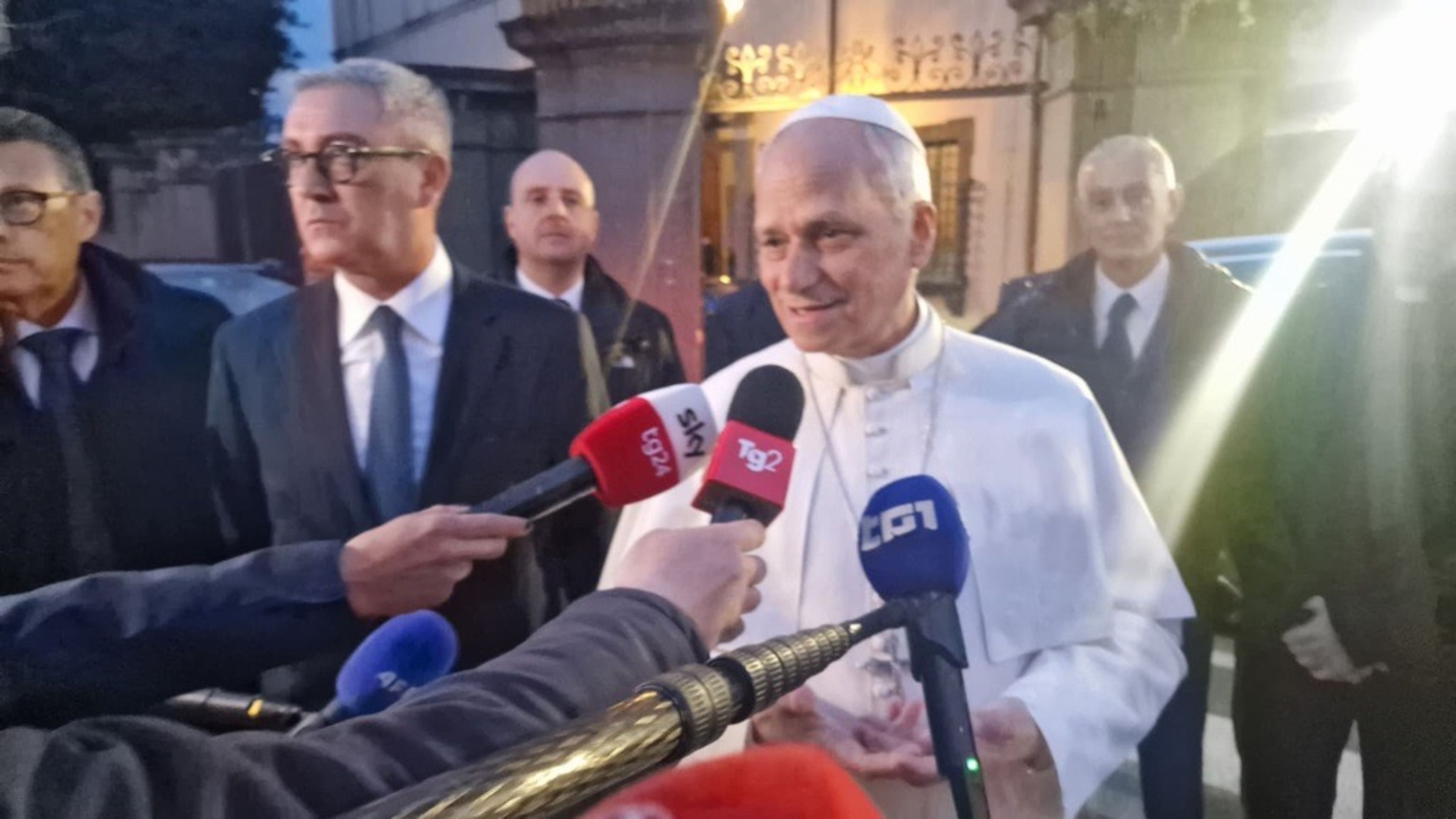
CASTEL GANDOLFO, Italy — Pope Leo XIV said violence must always be a last resort and dismissed President Donald Trump’s false claim that he supports Iran having a nuclear weapon.
Trump has repeatedly said he doesn’t want a pope who thinks Iran should have a nuclear weapon, even though the pope has never endorsed that view and has consistently spoken against nuclear arms.
Pope Leo XIV said May 5: “I have already spoken from the very first moment of being elected, and now we are close to the anniversary. I said, ‘Peace be with you,’ and the Church’s mission is to preach the Gospel, to preach peace. If someone wants to criticize me for proclaiming the Gospel, let them do so truthfully.”
“The Church has spoken for years against all nuclear weapons, so there is no doubt there. And so I simply hope to be listened to for the value of God’s words,” Leo said to the press outside the papal villa of Castel Gandolfo before returning to Rome after a daylong stay there, two days before a scheduled meeting with U.S. Secretary of State Marco Rubio.
Trump said May 4 on the “The Hugh Hewitt Show“: “The pope would rather talk about the fact that it’s OK for Iran to have a nuclear weapon. I don’t think that’s very good. I think he’s endangering a lot of Catholics and a lot of people, but I guess if it’s up to the pope, he thinks it’s just fine for Iran to have a nuclear weapon.”
“I donʼt want a pope who thinks itʼs OK for Iran to have a nuclear weapon,” Trump wrote April 12.
Leo has never said that Iran should have nuclear weapons, and he has spoken specifically against nuclear weapons:
- “May the nuclear threat never again dictate the future of humanity,” he said in a March 5 video message.
- Leo’s X account on March 8 encouraged prayers “for the roar of bombs to cease.”
- In June 2025, he called for a world free from nuclear threat in appealing for peace between Iran and Israel.
Pope Leo answered an EWTN reporter’s question about whether his statement that “God does not listen to the prayers of those who wage war” applies to all who take up arms, even in self-defense, or only to unjust aggressors.
Self-defense has always been allowed, Pope Leo XIV said.
“To talk about just war today, itʼs a very complex problem. You have to analyze it on many levels, but ever since the entrance into the nuclear age, the whole concept of war has to be reevaluated with terms today,” Leo said.
“I always believe that itʼs much better to enter into dialogue than to look for arms and to support the arms industry, which gains billions and billions of dollars each year, instead of sitting down at the table solving our problems and using money to solve humanitarian issues, hunger in the world, et cetera,” he said.
For a war to be justified, according to the Catechism of the Catholic Church, it must be waged to fight against a grave evil, the damage caused by waging the war cannot be graver than the evil it is meant to eliminate, there must be a serious prospect of success, and all alternatives to war must have already been tried. The decision to go to war must be made by a lawful authority responsible for the common good. All criteria must be met to qualify as a just war.
Meeting with Rubio
The pope’s meeting with Rubio this week follows a period of tension between the Holy See and Trump. In April, Trump publicly attacked the pontiff on social media, calling him “weak on crime and terrible for foreign policy” in response to the pontiffʼs appeals for peace amid the U.S.-Israel war on Iran. The pope told reporters he “perhaps” may comment on the meeting with Rubio afterward.
Brian Burch, U.S. ambassador to the Holy See, was asked May 5 about how the U.S.-Vatican relationship can be repaired.
“I donʼt accept the idea that somehow thereʼs some deep rift,” Burch said. “I think nations have disagreements and I think one of the ways that you work through those is, as the Holy See says, is through fraternity and authentic dialogue. I think the secretary is coming here in that spirit, to have a frank conversation about U.S. policy, to engage in dialogue, to better understand each other and to work through — if there are differences — certainly to talk through that.
The meeting will focus on “Middle East policy and our efforts there to bring about a more peaceful world,” Burch said, areas of “deep cooperation, shared interests, and in many ways, I think, shared goals.”
Burch said, “His visit I think speaks to our deep desire to engage in exactly what the Holy See has called for: fraternity and authentic dialogue.”
The Church’s stance toward war is that it must be avoided. The Church has long held concerns about war to be a moral subject, with St. Augustine writing extensively about it in the early fifth century and popes and theologians both commenting on just war doctrine generally and speaking out about specific wars for centuries.
Popes seldom issue blanket rulings but Pope Benedict XV made clear World War I lacked moral legitimacy given its scale, civilian toll, and lack of proportionate ends. Pope John Paul II warned the Gulf War did not meet just war criteria. And the Vatican formally stated in 2003 the invasion failed just‑war standards, especially preventive war doctrine.
‘Enough of war’
The pope earlier has condemned war. He has said:
“God does not bless conflicts.”
“No cause can justify the shedding of innocent blood.”
Pope Leo XIV earlier has indicated the Iran war fails core just‑war criteria, saying diplomacy has not been exhausted, civilian harm is disproportionate and morally unacceptable, and the conflict lacks a clear, achievable moral objective oriented toward peace.
In multiple homilies and public statements, the pope has warned against invoking God to justify military violence, and Leo already had said the Iran war fails the core just war criteria, especially:
- Last resort (diplomacy not exhausted). He urged: “Come back to the table.”
- Proportionality (civilian harm is extensive). He cited “children, the elderly, the sick” are bearing the cost of the war and stated that attacks on civilian infrastructure violate international law, underscoring disproportionate harm.
- Clear and achievable moral objectives. Leo stressed that military action in Iran has produced “a chaotic, critical situation” and that negotiations are unclear and inconsistent. He said: “This war … is continuing to escalate and is not resolving anything.”
U.S. Catholic bishops publicly backed him, emphasizing that just-war doctrine is never a blank check for violence and that the Iran conflict lacks a clear moral endgame. The archbishop of Washington, D.C., Cardinal Robert McElroy, who holds doctorates in both political science and moral theology, called the war “morally illegitimate.”
The U.S. and Iran entered a ceasefire on April 8, and a long-term peace deal has not been reached. On April 7, President Donald Trump had promised on social media the annihilation of the “whole civilization” of Iran if the country fails to reopen the Strait of Hormuz.
The pope called threats to destroy Iran’s civilization unacceptable and urged U.S. citizens to plead with elected officials to work for peace in remarks to the press April 7.
The pope has said war is a moral failure rooted in abuse of power and domination rather than dialogue. He urged those “who have weapons to lay them down” and those with power “to choose peace — not peace imposed by force, but through dialogue.”
Leo also conveyed his understanding of just war doctrine in an April 10 post on X that said: “Anyone who is a disciple of Christ, the Prince of Peace, is never on the side of those who once wielded the sword and today drop bombs.”
In his Easter Sunday urbi et orbi message, Leo asked people of goodwill to search always for peace and not violence. He again asked people April 7 “to reject war, especially a war which many people have said is an unjust war, which is continuing to escalate and is not resolving anything,” the pope said. “We have a worldwide economic crisis, energy crisis, situation in the Middle East of great instability, which is only provoking more hatred throughout the world.”
Pope Leo XIV in his Easter homily called for peace throughout the world, urging Christians to carry the hope of the Resurrection into a world wounded by war, violence, and injustice.
Javier Romero and Brian Schumacher contributed to this story.
If you value the news and views Catholic World Report provides, please consider donating to support our efforts. Your contribution will help us continue to make CWR available to all readers worldwide for free, without a subscription. Thank you for your generosity!
Click here for more information on donating to CWR. Click here to sign up for our newsletter.

Leave a Reply