

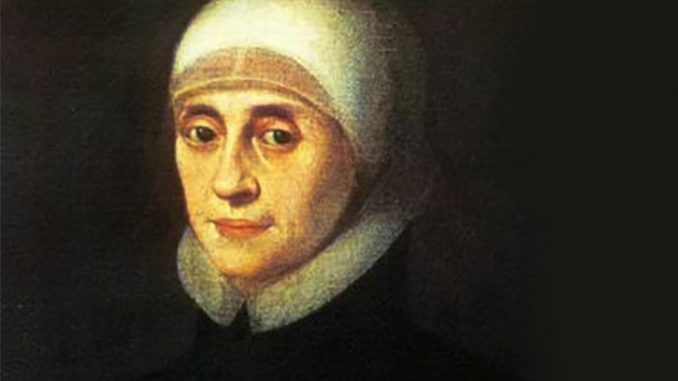
Few American Catholics have ever heard of Mary Ward. The more recent books and articles about her tend to portray her as a proto-feminist, a seventeenth-century Catholic woman who spent her life fighting for the rights of women and being persecuted by men.
However, the truth about Mary Ward has nothing to do with feminism and everything to do with good, old-fashioned holiness.
Mary’s early life and devotion to Christ
Although Mary Ward was born in 1585 and died in 1645, she was only declared a Venerable Servant of God under Pope Benedict XVI in 2009. To understand the reason behind the delay, it is helpful to remember that heroic virtue, not proof of a miracle, is the first criterion in the Church’s canonization process. Is there evidence that Mary was a faithful Catholic who demonstrated virtue to a heroic degree during her life?
At birth, she was given the name Joan Ward. But she took the name Mary at Confirmation and became famous (or notorious, according to her enemies) under the latter name.
Mary was born in Yorkshire, England, and her parents were members of the nobility and were faithful Catholics. However, remaining faithful Catholics during the reign of Queen Elizabeth I was difficult, dangerous, and socially unacceptable. Because her family refused to attend Protestant worship services, they were constantly forced to pay exorbitant fines.
When Mary was five years old, her parents decided to send her to live with her grandmother, who lived in a remote area of Yorkshire. They were concerned that the smart but innocent little girl would inadvertently reveal that clandestine Masses were being said in their household, that they were hiding Catholic priests from the authorities, and that their lands were a safe place for Catholics to live and work.
Mary grew up in the homes of various relatives. Over the years, she learned how risky it was to be a Catholic in Elizabethan England. Mary’s own grandmother spent years in prison for her faith and showed young Mary the chew marks on her walking stick that had been made by the rats in her prison cell. But persecution only deepened her faith.
And she fell in love. Not with the multiple prospective Catholic suitors that her parents picked out for her, but with Jesus Christ. Mary loved to pray and loved the Mass. Even as a teenager, she began her own ascetic practices and looked for quiet ways to practice humility. Once she snuck into the bed of a servant girl who was sick with a disfiguring rash because she hoped to be afflicted with the same condition. (It worked.)
The fact that Mary was devout did not disturb her relatives. After all, only a faithful Catholic could endure so much persecution. But her family could not understand why a beautiful, intelligent young woman would not obey her parents, marry a good Catholic man, and raise her children to become good Catholics too.
From convent to founding an institute
Mary, however, could not forget the stories she had heard from an old servant who could remember the days when Englishwomen were allowed to become nuns and could spend their lives as brides of Christ. Mary was certain that God was calling her to do the same. Her father spent years begging and threatening his daughter to marry. Finally, he gave in. When Mary was about twenty years old, he bribed a sea captain to take her to Saint-Omer, France, so that she could become a nun.
As is often seen in the lives of saints, Mary did not complain when she was mistreated, and she always obeyed rightful authority, insofar as it would not offend God. So when she arrived in Saint-Omer, and the priest associated with a Poor Clare monastery insisted that it was God’s will that she become a lay sister—not a cloistered nun—in that community, she obeyed.
For a long, painful year, Mary spent all day begging for food and carrying it back to the convent. Although she was barely given enough food to eat, was not used to manual labor, and was rarely able to enjoy the solitude with God for which she longed, she never complained. Her superiors, on the other hand, were delighted. People were very generous in giving alms to such an attractive young woman.
But Mary became increasingly convinced that this was not her vocation. The only thing keeping her as a lay sister was her desire to remain obedient. When the Father General of the order arrived at her community for a visitation, he asked to see her. After speaking with her for a time, he told her, “My child, you are not for this state of life. Make your choice. I will serve you in whatever way I can.”1
Mary made her choice immediately, and in less than two months, she had managed to leave the convent. Taking the generous dowry that had been granted her by her father—which is perhaps what the first priest had been trying to obtain all along—she began visiting noble relatives in Belgium to arrange for the foundation of her own community.
Then she returned to England, where she appeared to be merely a well-spoken young woman who liked to attend parties. But she wore a hair shirt under her lovely gowns and unobtrusively talked to both men and women about God, faith, and the Catholic Church.
By the time she returned to Saint-Omer, seven women had decided to give their lives to Jesus Christ under her leadership in her new institute. Thus began the School of the Blessed Mary, an institute for the “sanctification and salvation of the members, by a ‘complete renunciation of the world’, and the education of young girls to the end that they may learn to know and love God and live in obedience to him and their parents.”2
Success, severe trials, and death
Even though she was only twenty-five years old, Mary was intelligent, insightful, spoke several languages, and was a strong leader. She was also a mystic who sometimes seemed to know about future events, and she had been training herself to practice virtue since she was small. Her institute began to grow. She charmed members of the nobility to support her work and inspired young women to want to follow her. She also gave many young girls the opportunity to receive the sort of high-quality Catholic education normally reserved only for boys. She and her “English Ladies,” as they were called, established many schools for girls.
But Mary also faced severe trials over the years. A disgruntled member of her institute left the community and spread malicious lies about her. Powerful Church leaders in Rome resented her success, and they privately (and constantly) vilified her to the pope. At one point, Mary, who was so seriously ill that she could not even walk, was declared a heretic and imprisoned in a filthy, dark, rat-infested cell in a convent, where she was spied upon and initially barely given enough food to eat. Her congregation was formally suppressed by the pope, which forced her schools and communities to close and her sisters to be ridiculed and cast out.
In all these trials, multiple witnesses attested to Mary’s unfailing forgiveness toward those who injured or maligned her, her uncomplaining acceptance of suffering, her obedience to rightful authority, and her tender concern for those under her authority. As her struggles mirrored those of Christ’s Way of the Cross, so did her acceptance of unjust treatment. Like Jesus, she forgave from her heart and placed all her trust in God.
Mary was eventually able to convince Pope Urban VIII of her faithfulness and reopen some schools. She returned to England in 1637, founded free schools for the poor, and died in 1645.
Controversies and legacy
The hostility toward Mary endured after her death, and it took a half-century for Pope Clement XI to approve a Rule based on that of Mary’s institute. For many years, writings about her life were censured because of the controversy surrounding her name. However, scenes from her dramatic life were later depicted in paintings (which are harder to censure) and can be found here and here.
Until recently, two orders claimed Mary as their foundress: the Congregation Jesu and the Institute of the Blessed Virgin Mary. The latter order has been commonly known as the Sisters of Loreto and has taught innumerable girls in many schools over the centuries. One famous Sister of Loreto left the order to found her own and is now known as Saint Teresa of Calcutta. The two orders merged in November of 2025 to form one new order called the Congregatio Jesu.
It is not difficult to see that Mary Ward deserves the title of Venerable Servant of God. Only a couple of miracles stand between her and the title of Saint. But she certainly made some decisions that were countercultural for her time and might confuse our contemporaries.
It must be admitted that Mary’s plan for her institute was revolutionary. She and her companions wore simple, dark dresses, not habits. They did not take formal vows of poverty, chastity, and obedience, but they lived as if they were bound by such vows. They had specified hours of prayer and lived ascetic lives, but they did not live enclosed in their community. In retrospect, all these practices make perfect sense for a woman who grew up in a virtual police state of Catholic persecution. Such practices do not seem revolutionary to us because they are practiced in some orders of religious sisters today.
Put another way, rather than being a proto-feminist, Mary Ward was a proto-religious sister. That is, it was the ideas of Mary’s institute that helped to inspire thousands of women to serve as active religious sisters, women who live in religious communities but who also serve “in the world.” Dozens of women who lived after Mary Ward founded teaching orders, which are organized much like hers (setting aside the issue of habits and vows), and have already been acclaimed as blesseds and saints. They include Saints Elizabeth Ann Seton, Julie Billiart, Theodore Guerin, and Katharine Drexel.
Another controversial decision of Mary’s was her adoption of the Rule of Life of the Society of Jesus. She claimed that this was the result of a mystical experience, in which she heard the words in her spirit, “Take the [rule] of the [Jesuit] Society.”3 Obedient to that voice, she decided to adopt “the rule of the Jesuits both in matter and manner, as far as is possible for us as women to do.”4
Even if she had not had such a vision, Mary would have been attracted to the Jesuit Rule for her own order. After all, while there were secular priests who risked their lives to provide the sacraments to English Catholics, it was largely Jesuit priests, such as Saint Edmund Campion, who bravely died as martyrs in England. One of Mary’s strongest supporters was Fr. John Gerard, an English Jesuit priest who was arrested, tortured, escaped from prison, traveled to Europe, and spent the rest of his life training other priests to follow in his footsteps.
However, Saint Ignatius of Loyola explicitly stated that the Society of Jesus was designed for men only. Some of Mary’s most vigorous opponents appear to have been leaders of the Jesuit order who were infuriated that she would alter the Jesuit Rule for her own purposes. When they and others called Mary and her followers “Jesuitesses,” it was not meant as a compliment. Some of them apparently considered it contemptuous that a woman would dare to adopt a way of life meant for a man.
An implied argument by those who consider Mary a proto-feminist is the idea that Mary faced so much persecution from Church leaders because she was a woman. This is patently laughable. Male and female religious founders throughout history have encountered mistreatment just like Mary’s; the life of Saint John of the Cross is perhaps the most obvious example.5 Ordinary people, even faithful Catholics, tend to dislike and resist change, while saints are focused on doing God’s will, not their own comfort.
In retrospect, the censure of Mary and her work could have been avoided if she had spoken less bluntly with the pope and had a few good Italians from the Vatican at her side to help her with legal details and diplomacy.6 Also, if some of the powerful men who respected and admired Mary had been willing to stand up publicly to her equally powerful enemies, the tragedy of her institute’s suppression might not have happened.
But Mary knew that the real source of the many problems she faced was not the tension that exists between men and women. Instead, she understood that she experienced trials in her life because of the tension between God and the children of Adam and Eve. It is our sinful, fallen nature that causes us to trust in ourselves, not in the God who loves us, who died on the Cross for us, and who waits to welcome us into heaven.
Someday, God willing, prayers for the intercession of this heroic Englishwoman will result in a few inexplicable miracles, and we will know—and the Church will affirm—that Mary Ward is waiting for us there too.
Endnotes:
1 Mary Oliver, IBVM, Mary Ward, 1585-1645 (New York: Sheed and Ward, 1959), 57.
2 M. Emmanuel Orchard, IBVM, ed., Till God Will: Mary Ward through her writings (London: Darton, Longman and Todd, 1985), 35.
3 Ida Friederike Goerres, Elsie Codd, ed., Mary Ward (London: Longmans, Green and Co., 1939), 104.
4 Ibid, 104.
5 Saint John of the Cross was imprisoned and beaten by Carmelite leaders for trying to reform the Carmelite order. Saint Alphonsus Ligouri was forced out of his own order by the pope. People rioted when Saint Teresa of Avila opened a new convent in their city. Saint Ignatius of Loyola was initially imprisoned by the Spanish Inquisition for his novel ideas.
6 See Mary Oliver, IBVM, Mary Ward, 1585-1645 (New York: Sheed and Ward, 1959), 216.
If you value the news and views Catholic World Report provides, please consider donating to support our efforts. Your contribution will help us continue to make CWR available to all readers worldwide for free, without a subscription. Thank you for your generosity!
Click here for more information on donating to CWR. Click here to sign up for our newsletter.

Hi Dawn
You comment that it was mainly Jesuit priests who died in England in the period 1535 to ~ 1690. That is not quite correct. There are 352 martyrs of that period ( laymen and women, religious and priests.)
and many more seminary priests died than Jesuits although there were many Jesuits too. The first three were Carthusian monks from the London chapter house and the last was St Oliver Plunkett, Archbishop of Armagh
Thank you for this superb article. It’s nothing new that often those most holy and obedient in a religious order will be excoriated. Anyone who knew the late, great Paul Mankowski, SJ is well aware of what he endured and there are others unnoticed, unmentioned who bear those crosses. It’s a story old as time. Human nature has a great deal to do with it, unfortunately.
“A man’s enemies will be those of his own household.” — Matthew 10:36
Fr. Mankowski, pray for us.
Reading your story, Mary was clearly a feminist. Why take that away from her? Women are equal to men in the eyes of God. Are they not?
Equal but not identical.
But Mary Ward was persecuted by churchmen specifically because women were not supposed to be doing what she was doing, especially not offering a fine classical education to girls. (Ironically, noble Englishmen, including Queen Mary and Elizabeth, had formerly enjoyed that via tutors.) Equal education opportunities for girls and women is a basic feminist cause even if the label “feminist” is deplored by many Catholics. (Carrie Gress in this publication, for instance.)
The Counter-Reformation Church demanded that religious women be strictly cloistered, thus foiling the original plans of SS. Angela Merici and Jeanne de Chantal. St. Vincent de Paul evaded the restrictions by claiming that his Daughters of Charity weren’t actually a religious order.
It’s disheartening to see female writers diminish women’s roles, portraying them as mere servants. The Venerable Mary Ward was not just a servant of God; she was a leader of strong, capable women who understood their power to be persuasive leaders in their communities. This is feminism, and to label it otherwise is disingenuous.
In Catholicism, men and women share equal dignity, are equally loved by God, and have the same inherent human rights. While their roles in the Church may differ, they are meant to be complementary. Unfortunately, many Church leaders still seem to believe that women should be seen and not heard. The author of this piece appears to find comfort in that belief, twisting facts to minimize the Venerable Mary Ward’s personal power and leadership.
Women can and should be strong leaders within their communities. This is feminism—a desirable trait, not a negative one. Women in the Church can only be whole when they have independence, a voice, and the freedom to develop their own leadership roles. Believing in women is the first step toward a better society.
“It’s disheartening to see female writers diminish women’s roles, portraying them as mere servants.”
If that’s what you got from this essay, I suspect you reading into it rather than really reading it.
Aren’t Christians first called to serve others?
I eagerly read anything that Dawn Beutner writes for CWR. In my opinion she is the finest writer on the saints today. Thank you for publishing her work!
Yes, thank you CWR.
🙂
Mary Ward would be a feminist by today’s terms, and holy. She responded to God and her society, and clearly pushed the bounds of what women were allowed to do, while continuing to work for change. I think there may be some confusion on what feminism is about. Her life is quite a testimony.