

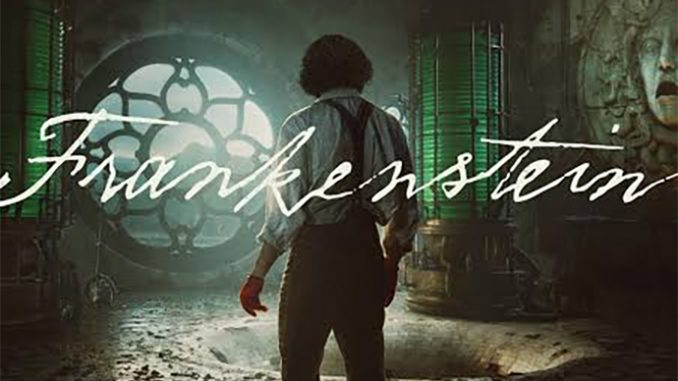
Guillermo del Toro was born to make a Frankenstein movie. Growing up in Guadalajara, Mexico, he divided his time between the Catedral de la Asunción de María Santísima and local cinemas, where he was exposed early on to the classic horror films of Universal Pictures. Nowadays, the monster stories have only grown in del Toro’s imagination, as he has made many of them. He even has a Frankenstein-themed room in one of his homes.
His Catholic formation, however, has receded. In an interview with NPR in 2017, he described himself as a “very lapsed” Catholic, adding, “I don’t think there is life beyond death.”
Investigating the human and the monstrous
After years in development, del Toro finally inked a deal with Netflix and released his Frankenstein in the autumn of 2025. And although he did not fetishize Shelley’s novel to the point of slavish faithfulness to all its details, he clearly set out to make a film that captured the book’s major themes in a way that other adaptations have not. Moreover, despite public reticence about his Catholic faith, his Frankenstein reveals the soul of a man on the road to discovery.
Describing his early imagination as part Catholic and part Hollywood, he said at the Venice Film Festival in August 2025, “I never quite understood the saints. And then when I saw Boris Karloff on the screen, I understood what a saint or a messiah looked like.” What he meant by mashing monsters with “messiah” is inscrutable, but del Toro’s fascination with the shadow side of reality may be closer to an enduring belief in Original Sin, and even a Catholic worldview, than he would be comfortable admitting. He wrote in the Introduction to Leslie S. Klinger’s New Annotated Frankenstein in 2017:
Shelley’s book moved me to tears. I wept for the monster and admired his thirst for revenge. It spoke to me about the essential contradictions of the spirit and the world. And beyond the tragedy of it all a notion emerged that was demolishing to me: the villain of the piece was life. “Being” was the ultimate punishment and the only blessing we receive. And in the absence of love, it was Hell.
Del Toro’s films have always had a gothic aesthetic, and they explore the realm of the metaphysical more deeply than most artists today, investigating the intertwined nature of the human and the monstrous—Heaven and Hell have come near, often via technological innovation. In his first feature film, Cronos (1992), an old man rediscovers a centuries-old eternal-life machine that gives him a taste for human blood. In Pan’s Labyrinth (2006), mythical creatures help a young girl achieve the tragic defeat of her particularly wicked Falangist stepfather. In Hellboy (2004) and Hellboy II: The Golden Army (2008), a demon defends good humans against bad ones like Rasputin and occultist, scientistic Nazis. In The Shape of Water (2017), however, del Toro’s rethinking of monstrosity reached a ludicrous “love is love” conclusion, and despite how admirable most of del Toro’s work up to that point was, it was disappointing to see this particular film rewarded with statues for Best Director and Best Picture at the Academy Awards.
Fortunately, with the exception of The Shape of Water, del Toro’s work has tended to let him express a nuanced account of sin and grace, often looking backward to make a point about the present. In his gripping remake of Nightmare Alley (2021), the viewer is disturbed to realize life is something like a carnival, where “the Geek” could come and go within any one of us. His stop-motion Pinocchio from 2022 features one-dimensional Fascist villains, but it is also a tale of real love in a cruel world. Indeed, it prefigures his Frankenstein in depicting an example of how even an expression of near-despair (making a wooden boy to replace a dearly departed flesh-and-blood son), can be re-purposed as a sign of hope.
The cinematic Frankenstein lineage
Del Toro’s Frankenstein builds not only his own cinematic legacy but also on one hundred and fifteen years of other filmmakers’ interpretations of Mary Shelley’s great novel.
In 1910, Thomas Edison’s studio produced a one-reel silent feature directed by James Searle Dawley, who prioritized the psychological aspects of the story while making use of an innovative, fiery special effect to depict the creation of the monster, played by Charles Ogle. The film was thought lost for decades until a print was discovered in the 1970s and eventually restored in a very good version by the Library of Congress on the occasion of the two-hundredth anniversary of the publication of Shelley’s book in 2018.
For del Toro and most everyone else, however, Frankenstein’s life on screen began with James Whale’s famous 1931 version, starring Boris Karloff as the creature. Based primarily not on Shelley’s work, but rather on Margaret Webling’s 1927 play Frankenstein: An Adventure in the Macabre, Whale’s film diverts in many ways from Shelley’s vision, referring to both the creature and the doctor as “Frankenstein,” and introducing a strange, humpbacked assistant, a diseased criminal brain in the creature, as well as other hammy elements for which the story has become infamous. Whale and Karloff worked together again for the 1935 sequel Bride of Frankenstein, before Universal spawned five more films with a wide variety of characters and scenarios, culminating in the farcical 1948 finale Abbot and Costello Meet Frankenstein.
Britain’s Hammer studio made several vivid, low-budget Frankenstein films that vary in quality from the fairly serious 1957 feature Curse of Frankenstein featuring Peter Cushing and Christopher Lee, to a madcap body-snatching spinoff from 1974 called Frankenstein and the Monster from Hell, featuring David Prowse, who is best known for filling out the black suit of Darth Vader in the original Star Wars movies. Then comes perhaps the most famous screen adaptation of all time, Mel Brooks’ comedy classic Young Frankenstein, which enshrined in the popular imagination all the comical, shock-value innovations that ensured most movie-watchers would remain a long distance away from Shelley’s serious critique of modernity.
Kenneth Branagh’s 1994 version, which sought to be faithful to the original novel and reset public perceptions by deliberately including Shelley’s name in the title, is unfortunately widely regarded as tedious and a missed opportunity. In her review in the New York Times, Janet Maslin described it as “a bland, no-fault Frankenstein for the ’90s, short on villainy but loaded with the tragically misunderstood.” The 1996 Burt Reynolds vehicle Frankenstein and Me has mercifully been largely forgotten. Likewise, we may dismiss offhand Fred Olen Ray’s racy 2010 movie for Cinemax called Bikini Frankenstein. The 2015-2017 series The Frankenstein Chronicles, starring Sean Bean, was excellent, but it was more of a period crime thriller than a commentary on humanity’s relationship with science and progress.
Without a heft of recent, worthy expressions of Frankenstein, there have been numerous films that have treated seriously the dilemma of human identity and flourishing in the wake of technological revolutions. The richness of Shelley’s ideas is not only on display in many of del Toro’s earlier films, but also in movies like Ridley Scott’s Blade Runner (1982), Tim Burton’s Edward Scissorhands (1990), Steven Spielberg’s A.I. Artificial Intelligence (2001), and Alex Garland’s Ex Machina (2014). More recently, I wrote here at Catholic World Report about Yorgos Lanthimos’ brilliant but revolting 2023 film Poor Things, about “a woman named Bella, played by Emma Stone, who has been formed and kept by the misanthropic vivisectionist, Dr. Godwin (‘God’) Baxter,” an obvious homage to Mary Shelley’s atheist, utilitarian father, William Godwin.
A return to serious moral and philosophical engagement
These films remind us that the digital age has now brought forth a scientism which threatens humanity itself, demanding the serious moral and philosophical engagement that Shelley’s novel proposed for the Industrial Revolution. Again, as del Toro wrote in his introduction to The New Annotated Frankenstein, “the birth of the monster coincides socially with these modern concerns—it comes to be at the exact moment at which machines of our own creation usurp our function and surpass our skill and speed, displacing us into anonymity.” Shelley’s questions are ours, only more so, beginning and ending with man’s most timeless and perplexing concern: What does it mean to be alive?
Under the circumstances, the days of pseudo-Frankenstein kitsch are now over. Del Toro’s moment for an intense anthropological investigation clothed in bright Victorian garb has arrived.
At the beginning of del Toro’s film, we meet Dr. Victor Frankenstein, played by Oscar Isaac, who is the one glaring miscast, at times overplaying his role in the vein of both the sillier and more horrific aforementioned cinematic expressions of the character. I can only dream of what a Daniel Day-Lewis or a Christian Bale would have done with the role. This casting mistake notwithstanding, the film draws the audience in immediately and places us in a setting roughly equivalent to that of the novel, with the beleaguered doctor taking refuge on an Arctic exploration vessel. Interwoven with Victor’s initial account to the captain of his ruinous scientific achievement is the violent approach of the creature, played by the 6’6” Australian actor Jacob Elordi, whose big performance is actually quite subtle and tender.
Elordi has described how spending up to ten hours a day in the make-up chair, being transformed for his role, prepared him to show the camera his own humanity emerging from within the monster. Del Toro is known for preferring prosthetics, meticulously-designed costumes, miniature models, elaborate sets – namely, pointing cameras at physical objects instead of letting computers do the work – and the predominance of the real continues throughout the film, including during scenes on the giant nineteenth-century replica boat which engineers built on an open-air lot in Toronto.
And what of the creature’s origin?
In his introduction to the Ignatius Critical Edition of Frankenstein, Joseph Pearce notes that Shelley’s novel demonstrates how “the Monster is not a mere product of science but is the consequence of satanic choice.” Pearce may be right, but Del Toro clearly means to say something more complex, connecting the first steps of the doctor’s maniacal quest to a mystical encounter with the Archangel Michael, who appears to young Victor as a startling consolation after the death of his mother. Here, we get a first glimpse of the saint-monster association del Toro has long held, but also, we are invited to feel some sympathy for Victor’s project. He is not the villain at first.
As in the book, the creature develops intelligence and speech, but in del Toro’s version, he not only wields superhuman strength, but he also possesses supernatural healing ability. Thus, the creature’s pain is not only rooted in social exclusion but also in the curse of earthbound immortality. This trope may be familiar to audiences from recent vampire fiction, but it may also resonate as a critique of the longevity movement, epitomized recently for Netflix audiences in the documentary Don’t Die, which chronicles the pitiful quest of tech-millionaire Bryan Johnson to avoid the grave.
Robbed of the gift of natural death, del Toro’s creature is on a quest for the meaning of living. When we meet him in the Arctic, tossing Scandinavian sailors to their deaths left and right, he wants to hear from his maker’s mouth an explanation for why he exists and why he has been abandoned. Very human.
Most of all, the creature wants love, which his equally love-starved maker denies him. The creature is a compilation of the bones of several slain soldiers, and he represents the struggle of every man. The audience is thus challenged again, as we are invited not only to see but to love the monster as a person, despite his arrival into the world by unnatural means. Indeed, Catholics recognize that we all arrive in the world in something of an unnatural state, requiring re-birth in grace. Even a creature cobbled together and animated in a lab is, therefore, born in a spiritual sense: born into Original Sin, possessing human dignity, and requiring a new, redeemed life.
As Victor’s skill in the medical arts increases, he becomes enamored with his power as an end in itself, opening the door for manipulation by a wealthy opportunist named Henrich Harlander, played with sinister panache by the inimitable Christoph Walz. The doctor’s humanity thus diminishes, a strong motif in Shelley’s novel, mercifully handled here by del Toro without the ham-fisted ideological prejudices present in The Shape of Water. Victor acts monstrously not because he is heartless, but because he is heartbroken, becoming beholden first to Harlander’s money and then to the affection of his benefactor’s delicate daughter, Lady Elizabeth Harlander, played by Mia Goth, whose performance conveys a humane curiosity. In an interesting departure from Shelley’s book, Elizabeth is promised to Victor’s brother in marriage, but she is also responsible for kindling the desire for love in the creature. Moreover, Goth also plays the part of Victor’s dead mother at the beginning of del Toro’s story, representing the catalyst throughout the film for Victor’s melancholic, even nihilistic disposition.
The human journey of becoming whole
It’s all quite Romantic, a movement whose renewal we should all welcome in our technocratic age.
But what does Victor’s misguided passion ultimately produce in the world?
Here, del Toro’s confusion about a “saint” or potential saint may be apt in some ways for his creature—incidentally, much more so than we find in Karloff’s portrayal. Without spoiling the ending, del Toro’s monster, although riven by anger and violence, is finally in a position to grow in virtue—to become the version of himself that only the real Creator could will. Once again, however, del Toro’s own comments undermine the better message he puts on the screen. Describing his achievement, again at the Venice Film Festival , he quipped, “I think that the movie tries to show imperfect characters and the right we have to remain imperfect.”
Nonsense.
There, at last, is the real “satanic” influence, mercifully under-realized, in del Toro’s version of Shelley’s tale. “The right we have to remain imperfect” may have been in del Toro’s mind, but it did not translate to the screen.
Why? Because good storytelling is always about change. And elsewhere in the Venice interview, del Toro again expresses his desire to tell a good story by going as deep as Shelley’s book. He explained that “the central question in the novel from the beginning is, what is it to be human? What makes us human? And there’s no more urgent task than to remain human.”
To remain human, as Shelley’s contemporary St. John Henry Newman teaches us, is to change. And this human journey of becoming whole is at the heart of del Toro’s film.
Far outstripping previous attempts at capturing the ideas from Shelley’s novel on the big screen, del Toro’s film tells a very good story (sadly, only for the small screen!) in which the characters’ growth inspires in the viewer a real desire not to remain in his flaws, but to pray for his own transformation. The Catholic affirms: God wills better humans, real humans, the humans we were re-born to be. Moreover, for the believer, this growth leads to a life and an identity beyond this world, which del Toro’s public comments would seem to deny to himself. But could he really, earnestly believe that physical death is the end? Most of his Victorian heroes did not think so, and nor did a large contingent of his audience.
Del Toro’s Frankenstein is deeply engaging and visually stunning–the crowning achievement of his already excellent oeuvre. If only we could have seen it in a theater with the grandeur it deserves, but it is well worth bumping it to the front of the streaming queue, and then perhaps returning to Shelley’s book afterward for further contemplation.
If you value the news and views Catholic World Report provides, please consider donating to support our efforts. Your contribution will help us continue to make CWR available to all readers worldwide for free, without a subscription. Thank you for your generosity!
Click here for more information on donating to CWR. Click here to sign up for our newsletter.

Excellent! I’ve read and taught Shelley’s Frankenstein, and I’ve seen several of the movies mentioned; however, your historical references and literary analysis greatly expanded my understanding. Thank you! Del Toro’s Frankenstein is now a must see!
I don’t understand why the “paying audience” is so willing to just watch things on the small screen.