

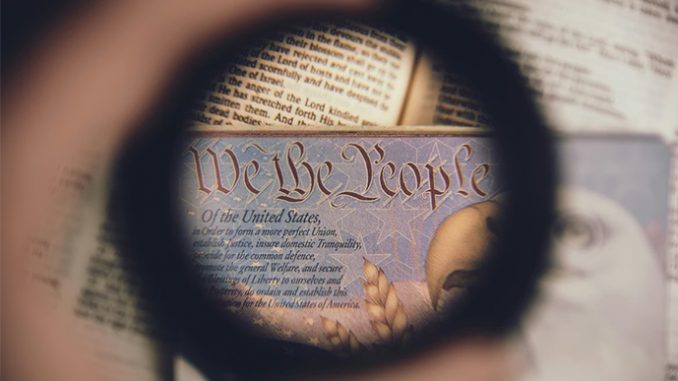
“All men are created equal!” Perhaps more than any other principle, this phrase captures the transcendent ideal that inspired the Founders to declare their independence from Great Britain. The triumph of the principle of equality in modern Western politics has dulled the contemporary mind to the radicalism of this assertion.
Despite the claim of the Declaration of Independence, this principle was by no means “self-evident.” The stalemate with Parliament over the meaning of the “rights of Englishmen” forced the colonists to appeal to principles beyond the English tradition, principles over which Parliament could claim no interpretive authority.
The imperfect pursuit of equality
Who would, then, have such authority? No doubt Thomas Jefferson had his own particular ideas concerning equality when he wrote those words, yet the political unity demanded of the moment did not allow him the luxury of engaging his fellow colonists in a deep philosophical debate over the true meaning of equality. In this third and last instalment in my response to Hillsdale College’s “The Great American Story: A Land of Hope” project, I will consider the history of the American ideal of equality from a Catholic perspective.
Again, the Catholic difference lies in the Church’s insistence on limits to equality rooted in traditional hierarchies, and the insistence on the subordination of individual rights to a common good rooted in love.
The Hillsdale project arose in large part as a response to mainstream academia’s condemnation of America for its failure to live up to its own stated principle of equality. The most glaring failure lies, of course, in the area of slavery. Professor McClay tackles this issue head-on, going so far as to invoke the conservative English writer Samuel Johnson’s famous, dismissive quip about the colonists: “How is it that we hear the loudest yelps for liberty among the drivers of Negroes?” McClay rightly notes that many, if not most, of the Founders, including slaveholders such as Jefferson, Madison, and Washington, fully understood this contradiction. He also correctly notes that the Founders evaded rather than affirmed slavery, and this largely for the practical reason that acceptance of the status quo was essential to retaining the support of the southern colonies, where slavery was essential to the economy. I agree with McClay’s insistence that America was not founded on slavery, but rather on the ideals of liberty, equality, and self-rule. Much of the “Story of America” focuses on the efforts to realize, however imperfectly, these founding ideals.
To concede imperfection implies some concept of perfection. What exactly is perfect equality? That the abolition of slavery required the most destructive war in American history suggests that the answer to this question is hardly self-evident. The Southerners who broke from the Union claimed slavery as the “cornerstone” of the Confederacy, yet insisted that their new political order embodied the purest expression of the ideals of liberty and equality that had inspired the Founders. When one considers that the Founders themselves were inspired by ancient pagan republics that were themselves slave societies, the Confederate position is not irrational.
I have no sympathy for the Confederacy, but to criticize them for affirming both equality and slavery assumes there is some clear and distinct, self-evident understanding of the essence of equality itself. Whatever philosophers, even philosophers who are Catholic, may have to say about this essence, history shows us precious little beyond a constantly shifting set of understandings about the meaning of equality.
The confusion over the meaning of equality was self-evident even before the signing of the Declaration of Independence. In the months following the first shots at Lexington and Concord, the idea of equality spread like wildfire throughout the colonies. In a playful yet serious correspondence, Abigail Adams famously admonished her husband John to “Remember the Ladies,” who, in the name of equality in marriage, would have their husbands trade the name of “Master” for that of “Friend.” John laughs and charges that men are the true victims in marriage, subject to the “Despotism of the Peticoat [sic].” Somewhat more seriously, he acknowledges that “our Struggle has loosened the bonds of Government every where [sic]. That Children and Apprentices were disobedient—that schools and Colledges [sic] were grown turbulent—that Indians slighted their Guardians and that Negroes grew insolent to their Masters.”
This refusal of subordination plagued the Articles of Confederation that governed the United States through the Revolution and the first years of the new nation. States that had voted for independence were loath to pay taxes—even with representation!—to the national government to fund Washington’s army. After the war, the political dysfunction of state equality ultimately led to the drafting and ratification of the new constitution that granted greater authority to the federal government.
Practical wisdom and the limitations of the Constitution
Reverence for the Constitution animates much of the “Story of America.” Every American should indeed respect and admire the achievement of the Constitution at its time and its endurance over nearly two-and-a-half centuries. Respect, yes—but reverence?
Professor McClay states, I believe correctly, that the Constitution is intrinsic to our identity, that it makes Americans who we are. At the same time, he concedes that the Constitution is, in the end, merely a “functional” document. Looking out at the power struggles among the states and those within the states, the Founders offered no clarifying interpretation of the true meaning of liberty, equality, and self-rule. McClay notes, again correctly, that the Founders accepted conflict as part of the essence or nature of society and understood the purpose of government to channel that conflict, to make it work toward some sort of positive good.
Writing on the other side of a revolution in political thought that began with Machiavelli, the Founders rejected ancient pagan and traditional Christian ideals of a properly ordered body politic; in its place, they offered a vision of politics as the distribution of power through a range of checks and balances that would ensure no one group gained dominance over others. The Hillsdale historians praise this practical wisdom, which they attribute to the Founders’ chastened, realistic view of human nature.
Again, there is much to admire in this practical wisdom. It created a political order that has certainly stood the test of time. Good governance indeed requires checks and balances—yet even the medieval understood this. During the Middle Ages, the nobles and the Church served as checks on royal power, while the king could check the power of ambitious nobles and prelates. This acknowledgment of inevitable conflict did not, however, preclude the affirmation of an order beyond conflict, a body politic/Body of Christ in which all the distinct members worked in cooperation to achieve a common good that transcended their differences.
John Winthrop invoked a version of this social ideal in his “Model of Christian Charity.” Aside from creating a political order with no established Church, hereditary king, or landed nobility, the Constitution rejected this ideal, at least at the national level. States, however, were free to forge more robust, less purely functional, political orders, even to the point of retaining established churches. One could argue that the very thinness of the Constitution with respect to substantive principles reflects the assumption that much of life, and much of politics, would be lived at the state and local level.
To understand the meaning of the Constitution in history is to confront the fact that the whole social and economic world of the Founders, overwhelmingly local and agrarian, would begin to disappear in the generation after the Founding. A Constitution created to channel political conflicts regarding state and federal authority would prove totally inadequate to the task of managing the unforeseen economic conflicts attendant upon the rise of industrial capitalism.
The problem of the new aristocracy
In highlighting economic forces, I am only following the wisdom of the Founders themselves. The Hillsdale historians note Madison’s clear-eyed recognition of the inevitability of conflict; they are less forthcoming about Madison’s understanding of the primary source of conflict. In the oft-quoted Federalist, no. 10, Madison lays out his understanding of group or “faction” conflict in the political order: “The latent causes of faction are sown in the nature of man . . . . But the most common and durable source of factions has been the various and unequal distribution of property.”
Was Madison a Marxist? Of course not. Rather, Madison and Marx both drew on a common font of 18th-century thought (e.g., Adam Smith) that held economic interests as the driving force of social and political life. Property was, in fact, a precondition for participation in politics. This elite conception of politics did indeed clash with more inclusive ideals of equality spreading through the young nation. The Founders initially dealt with this contradiction by expanding property ownership through the redistribution of Indian lands ceded by the British at the Peace of Paris. Fears that this land would soon run out led Jefferson to purchase Louisiana from the French. No amount of land seemed capable of holding off the conflicts that came with unequal distribution; by the 1830s, Jacksonian Democracy “solved” the problem by dropping all property restrictions for voting.
The prior existence of property restrictions reflected the Founders’ belief that political equality depended on a roughly equal distribution of property. The notion of political power without economic power would have struck them as nonsensical. The Age of Jackson bore out this understanding, as political power without property resulted in a growing and fearful economic inequality that would have horrified the Founders. Alexis de Tocqueville, the French writer generally understood as a cautious admirer of American democracy, observed with great concern the rise of an “industrial Aristocracy.” Already in the 1830s, the factory system had begun to emerge. The Founders’ ideal of a nation of small property owners seemed to be giving way to an English-style industrial nation of propertyless wage earners (or “wage slaves” as they would come to be known), ruled over by a new economic elite of factory owners.
Tocqueville noted that this new aristocracy seemed to embody all the vices and none of the virtues of the old aristocracy. It achieved power without responsibility:
The territorial aristocracy of past centuries was obliged by law or believed itself to be obliged by mores to come to the aid of its servants and to relieve their miseries. But the manufacturing aristocracy of our day, after having impoverished and brutalized the men whom it uses, leaves them to be nourished by public charity in times of crisis.
Concerned as he clearly was for the basic material deprivation of the workers, Tocqueville was even more troubled by the lack of “genuine association” between the worker and his employer. As with his more famous account of “individualism,” Tocqueville sees in this situation a distressing absence of a sense of “society at large” that formed a basis for social cohesion in the Old World. Despite each faction possessing the political “equality” of “one man, one vote,” the “self-rule” of the new elite came at the expense of the “self-rule” of factory workers. In adjudicating this conflict, the Constitution was no substitute for the common bonds of “society at large.”
Justice and the proper ordering of society
The shocking inequality Tocqueville observed only worsened over the next fifty years. The Church’s first authoritative response to this situation, Leo XIII’s Rerum Novarum (1891), addressed a wide range of issues. I wish only to focus on one oft-neglected aspect of that teaching, one that addresses the deficiency in the American political tradition I have been examining. Leo called for far more than “social justice” in the material sense; he called also for justice in the sense of a proper ordering of society.
Just as the symmetry of the human frame is the result of the suitable arrangement of the different parts of the body, so in a State is it ordained by nature that these two classes should dwell in harmony and agreement, to maintain the balance of the body politic.
Leo rejected socialism because it insisted on the primacy of class conflict. Curiously, he offered more qualified criticisms of capitalism despite its own self-understanding of the market economy as a ceaseless, competitive clash of individual self-interest. Similarly, American Catholics too often ignore the centrality of conflict to the Constitution, which offers no harmony, but only checks and balances on the endless clash of factions.
Faithful Catholics may certainly respect and honor the Constitution for the relative prosperity and freedom it has enabled. But I do not think we can properly love it. Hillsdale’s “Story of America” is a labor of love that invites its viewers to love America and the Constitution it claims defines America. Can one really love a social contract? The Church, since Vatican II, has affirmed many of the functional principles found in the U.S. Constitution, yet it has also consistently called for the creation of a “civilization of love.”
This love is not a vague sympathy for others or a commitment to charitable works. It is public, not private. It is a recognition of mutual dependence and mutual obligation stemming from the fact that we are one body. It is the opposite of self-rule.
Related at CWR:
• “The 1531 Project: A distinct and Catholic view of American history” (Sept 22, 2025) by Christopher Shannon
• “Charity, liberty, and the contested history of the American story” (Oct 26, 2025) by Christopher Shannon
• “Catholicism and the American Founding: A further response to ‘The Great American Story’” (Nov 13, 2025) by Christopher Shannon
If you value the news and views Catholic World Report provides, please consider donating to support our efforts. Your contribution will help us continue to make CWR available to all readers worldwide for free, without a subscription. Thank you for your generosity!
Click here for more information on donating to CWR. Click here to sign up for our newsletter.

Thank you, Dr. Shannon, for this analysis partly of the difference between the ideals of the Declaration of Independence (a “revolution”?) and the tri-partite mechanics of the connected Constitution.
A few more concurrent perspectives and a question:
FIRST, as part of the founding, we note that the Constitution actually offered a rebuke to the southern colonies: “Let the compromising expedient of the Constitution be mutually adopted which regards them [slaves] as inhabitants, but as debased by servitude below the equal level of free inhabitants; which regards the ‘slave’ as divested of two fifths of the ‘man’” (James Madison, “Federalist Papers,” no.54).
SECOND, the aristocratic and “conservative” Erik von Kuehnelt-Leddihn (who proposed constitutional monarchies vs American political “amateurism”) examines the genealogy of Lutheran individualism (etc.) leading toward national socialism in the secularizing context (“Liberty OR Equality,” 1952) and finds/claims in his other writings that the term “democracy” barely shows up, or not at all, in Jefferson’s writings, but rather a “republic.”
THIRD, my coursework in a secular graduate school included a dive into the neo-Marxist Barrington Moore who attributes bad stuff more to social factors than human nature (“Social Origins of Dictatorship and Democracy,” 1966, hailed as the cornerstone to what is now called comparative historic in the social sciences). He traces the path from various agrarian societies into industrialization and toward those varied national outcomes that clashed in the 20th Century: centralized Communism, Bushido militarism in Japan, uniquely German Fascism, and multiple other outcomes including the exceptional and liberal balance achieved in the United States, but only after the Civil War and (he says) as the South drifted more into modern capitalism.
QUESTION: About Shannon’s and Vatican II’s “civilization of love,” is this really only possible, sometimes, within the sacramental and supernatural Mystical Body of Christ?
And, if so, in our 21st Century what is to be better understood about this Christian proposition (the transcendent dignity of each human person) and a lesser “equality” as asserted under Sharia Law and within the alternative umma: the more-or-less natural brotherhood within the transnational family of Islam?
Not even Moore’s varied transitions from agrarian beginnings, but instead a blunt coupling of 7th-century Arabia with modern industry—ranging from weaponized oil, to strap-on bomb packs (Bushido suicide bombers in a turban?), and almost parity (equality!) in nuclear weapons.
Surely a cross-cultural and worthy topic for a navel-gazing synodal roundtable or two, or maybe one of those “expert” Study Groups on “hot-button issues.”
I think at the end of the day most of us are a product of our time & culture. That goes for the US Founders & the rest of us. Few people are visionaries who can see beyond their era’s accepted morality.
One day our descendants may look back at us & shake their heads, too.
G.K. Chesterton: “The Catholic Church is the one thing that protects a person from being a child of his age [time and culture]..”
Yes. That’s one of his greatest quips.
That should be true Mr. Peter, assuming everything’s working correctly & we’re actually being informed by Catholic teaching.
Although we all are created equal by God, that does not confer equality in merit or prominence. The socioeconomic difference between the poor and the prominent isn’t always a matter of injustice, rather it’s often the development of skills and one’s natural competence.
In a just society these differences are reasonably compensated never equalized.
Fr. Morello, are we created equal by God in the common use of the term? Wouldn’t it be better to say we are all created with equal human dignity or something similar? The fact that there are two very different genders seems to say we are not equal. I’m struggling to understand the whole idea of equality as a faithful “Joe Catholic.”
Equal but not identical.
mrscracker you always [almost] manage beat me to the punch. Good on you as the Aussies say.
I’m not really that quick on the draw, but thank you Father.
🙂
Perfectly distilled, well said.
Yes Joe, the universal statement is best understood as qualified by nature of our human dignity, as created in the image of God.
The intellectual spiritual features of Man, his capacity to distinguish between moral good and evil is what makes him like God.
One could say that we are all created equal in the sense that all inherit original sin and its consequences. Only one human person was created without original sin.
Perhaps the best scriptural reference Joe is Saint Paul in Galatians 3:28, There is neither Jew nor Greek [Gentile], there is neither slave nor free, there is no male and female, for you are all one in Christ Jesus.
Thank you, Father. That’s helpful.
This applies only to the baptized, yes?
No. All are created in God’s image and as such all men and women possess that equality inherently.
Original sin, a sinful life doesn’t remove this [for example it’s illicit to desecrate any human body, or torture a sinner], which is why when a person dies, whether in sin and condemned to Hell, or glorified in heaven, live eternally. The human soul, with intellect and free will, remains eternal because of that.
Our unity in Christ fully realizes that unity, it doesn’t, as Athanasius [not the Alexandrian doctor of the Church rather our internet Athanasius] suggests, we all possess it ontologically – create it.
It should be added DiogenesdRedux that while the human person retains this ontological dignity even if among the damned, his moral dignity as a person is forfeited.
For example, DDF prefect Victor Fernandez based his argument for blessing homosexuals on the false premise that a person never loses that dignity, an argument which Pope Francis also held. What is ontologically true is not necessarily morally true. Blessing a homosexual is tantamount to blessing his homosexuality.
Fr. Morello, re what you’ve written below regarding what applies to only the baptized:
I am here referring to your quote of Paul: “There is neither Jew nor Greek [Gentile], there is neither slave nor free, there is no male and female, for you are all one in Christ Jesus.”
The non-baptized are NOT one in Christ Jesus. If everyone were ‘one in Christ Jesus’, there’d be no reason for baptism.
Yes DiogenesRedux, you’re correct in reference to the quote from Saint Paul. My intent wasn’t to contradict you, rather to expand the notion of equality, which I should have clarified, in reference to the opening sentence of this article, that “All men are created equal!” taken from our Declaration of Independence.
We are all equal, prior to baptism insofar as all are created in God’s image. That goes to God’s intent in creating us in his image for the teleological purpose of becoming like him in our moral choices. I wished to address the problem of homosexuality becoming a morally acceptable ‘life choice’ as apparently alluded to by Leo XIV.
From birth, therefore, we were created to become men and women in the likeness of God. Whereas homosexuality is antithetical to our creation in the image of God, specified in the revelation of God in Jesus Christ.
Also DiogenesRedux, see my response to Dr Rice below for further clarification.
Men and women are ontological equal but functionally different.
Dictionary.com defines equality: the state or quality of being equal; correspondence in quantity, degree, value, rank, or ability. It defines equal: like or alike in quantity, degree, value, etc.; of the same rank, ability, merit, etc.
Given these definitions have been substantially in place since the latter part of the fourteenth century it’s clear that to say “all men are created equal” is a manipulation of truth if not an utter falsehood. We are not created equal which implies sameness. This idea has led to one of the most heinous lies of modernity: men and women are equal, were created equal. One needs only observe physical differences to see they are not. However genetics also proves they are not equal. No, all “men” are not equal nor are they created equal. That they are created with equal human dignity is true as St Paul testifies. But equal? No.
The United States was settled and established by heretics, people who rejected the truth of Catholicism. In other words it was founded on lies and we are reaping the fruits of those lies.
I can hear many of you now: “That’s in-American,” “If you don’t like it then leave,” etc. But there is nothing more patriotic (in the Catholic sense of the term) than recognizing the truth about one’s country and working to better it. There’s nothing patriotic about believing and furthering the lie.
Light your torches.
Facinating and informative Americana for a humble Aussie to read.
Could anyone from ‘downunder’ add anything to this good article and the wonderfully perceptive comments . . ?
Just maybe: by incorporation of some words of Our LORD Jesus Christ –
“From everyone to whom much has been given, much will be required, and from the one to whom much has been entrusted, even more will be demanded.” Luke 12:48b
Jesus tells us: under the universally ambivalent circumstances of our reality, there’ll always be major differences between people. Yet, this is fully discerned by GOD, who takes these differences into account in justly judging the worthiness of each soul.
[Also, of course, every biologist will recognise that inherent differences between individuals are essential for natural selection to occur; and for richly diverse cultures to function.]
This truth is then brought home to each of us where Jesus exhorts us all to:
“Be perfect, therefore, as your Heavenly Father is perfect.” Matthew 5:48
Our Church and our society are divinely instructed: “relate in proportion to what each person is endowed with”. The New-Born Church took that literally, as Saint Luke reports in Acts 4:32-35.
One worries that any belief in humans all being born equal – other than that we will all be judged by GOD for our ethical choices – is illusory.
Ever seeking to hear & follow King Jesus Christ; love & blessings from marty
Dr Rice, it’s not illusory to understand that all men, prior baptism, are born with the natural law within. The natural law, a reflexion of the eternal law. All men, created by God in his own image, possess by nature of the natural law equal rights of justice. That includes the cardinal virtues, Justice, Prudence, Fortitude, and Temperance.
As Cicero said in Re Publica the laws of nature are the same in Rome as they are in Athens. Our US Constitution, Declaration of Independence contains reflexions on Catholic doctrine borrowed from Saint Robert Bellarmine.
Because of our creation in God’s image we are certainly born with certain inalienable rights, the very first principle of the natural law, the right to life.
Thanks for your clear and instructive presentation of an important aspect of traditional Catholic philosophical anthropology, dear Dr Fr Peter Morello.
The ancient concept that all humans are created in GOD’s image & likeness could, of course, mean that every human being is obligated to be perfectly holy and good, as GOD is (e.g. Matthew 5:48); loving our enemies rather than insisting on our own equality and rights. That requires us to depend on GOD to justify us, following the faith of Jesus in His Blessed Incarnation, His Life among us, and His Most Holy Passion.
To thoughtful Catholic theologians who are also instructed in Biology and Paleoanthropology, Genesis 1:27 refers to the First Peoples who populated the earth from hundreds of thousands of years ago.
In Australia some of these genuinely First People survive and inform us of the ancient and very ecologically-benificial Genesis 1 lifestyle.
Genesis 2:4 to 4:22 is taken as an obvious reflection on the loss of that original Divine Image by those who disobeyed GOD’s instructions and began the Neolithic Revolution that, as it murderously colonised the world with unmitigated selfishness, made the majority of men into domestic slaves, agricultural serfs, and/or sacrificial hordes of soldiers. Incidentally, requiring women to lose their Genesis 1 equality so as to become home-bound breeders of slaves, serfs, and soldiers; disregarded as little better than stock animals.
The Image of The Imortal GOD was exchanged for man-made images (Romans 1:23, etc.), along with the Genesis 1 natural environment being colonised with articial man-made cities, etc. What was habitually call ‘progress’!
About 2,000 year ago, with the fiat of Our Most Blessed Mother Mary, the Image of The Unseen GOD was restored among us, in The Person of our LORD Jesus Christ (see 2 Corinthians 4:4; Colossians 1:15; etc.).
If the world will stop thinking of The Divine Image as bestowing rights and, in Christ, embrace The Divine Image as the blessing of godly, self-giving, responsibilities [authoritatively listed in the Mosaic commandments as completed by Jesus] then, truly, GOD’s Kingdom will come and GOD’s Will will be done. ‘Tis always there, waiting for us . . !
It’s an addictive mirage to think the Genesis 1 Imago Deo is a blanket cover for every human. By GOD’s grace it is a wonderful reality for all those who have a sincere & persevering conversion to CHRIST.
It is a good Catholic insight to see this updated biblical theology, informed by the sciences, reflected in our John 6 compulsion to eat The Holy Flesh of Christ (Real Food) and to drink The Precious Blood of Christ (Real Drink). NOW we, together, are Image. By the daily help of The Holy Spirit we will, personally & collectively, also gradually become Likeness. Was it St Irenaeus who taught us that truth . . ?
My apologies for these wandering thoughts, dear Fr Dr Peter.
Hoping there is at least something of use in it somewhere.
In the grace & mercy of The Lamb of GOD; love & blessings from marty
Perhaps, where you say:
“Because of our creation in God’s image we are certainly born with certain inalienable rights, the very first principle of the natural law, the right to life.”;
we might, as 21st Century biblical theologians exegete that truth in the following way.
“Every human being has the GOD-given potential to become an Image of GOD in CHRIST & so inherit eternal life as part of GOD’s heavenly family. This potential bestows inalienable dignity on all humans because their freedom to choose the unlimited goodness of GOD inheres from their conception until their death. This awesome potential is the core of what it means to be a human among humans under GOD.”
“This unique, GOD-given potential demands respect by every human for every human, upon pain of mortal sin. That is: a person’s own future with GOD is jeopardised by any actions that impede the path of another human to GOD in Christ.”
Seeing human rights as a GOD-given responsibility of every person – indeed, as definitive of our own humanity – may help avoid the problems of imposed societal or ecclesial legalisms . . ?
Dr., my own thoughts on that, train like this, that in faith we have the peace and the witness of Redemption; our Lord Himself reminding us that the Kingdom suffers violence from time to time.
“My Kingdom is not of this world ….. ” to not read that out of the historical unfolding, we are Christians after all.
I always thank God for that train, else where would I be!
Good one, dear Elias!
Thank you Dr Rice. Have a blessed Christmas.
And to you, too, dear Fr Peter.
Hope you enjoy this short Christmas presentation:
https://www.bing.com/videos/riverview/relatedvideo?q=matt+redman+christmas+songs&&mid=71A75249A2F11FF2661671A75249A2F11FF26616&FORM=VAMGZC