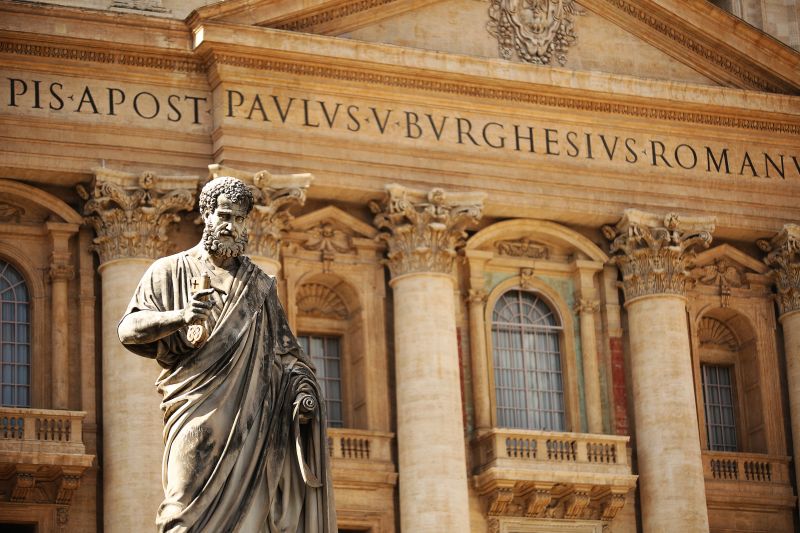
 Statue of St. Peter in front of St. Peter’s Basilica. / Credit: Vatican Media
National Catholic Register, Oct 2, 2023 / 02:34 am (CNA).
Five cardinals have sent a set of questions to Pope Francis to express their concerns and seek clarification on points of doctrine and discipline ahead of this week’s opening of the Synod on Synodality at the Vatican.
The cardinals said they submitted five questions, called “dubia,” on Aug. 21 requesting clarity on topics relating to doctrinal development, the blessing of same-sex unions, the authority of the Synod on Synodality, women’s ordination, and sacramental absolution.
Dubia are formal questions brought before the pope and the Dicastery for the Doctrine of the Faith (DDF) aimed at eliciting a “yes” or “no” response, without theological argumentation. The word “dubia” is the plural form of “dubium,” which means “doubt” in Latin. They are typically raised by cardinals or other high-ranking members of the Church and are meant to seek clarification on matters of doctrine or Church teaching.
The dubia were signed by German Cardinal Walter Brandmüller, 94, president of the Pontifical Committee for Historical Sciences; American Cardinal Raymond Burke, 75, prefect emeritus of the Apostolic Signatura; Chinese Cardinal Zen Ze-Kiun, 90, bishop emeritus of Hong Kong; Mexican Cardinal Juan Sandoval Íñiguez, 90, archbishop emeritus of Guadalajara; and Guinean Cardinal Robert Sarah, 78, prefect emeritus of the Dicastery for Divine Worship and the Discipline of the Sacraments.
The same group of senior prelates say they submitted a previous version of the dubia on these topics on July 10 and received a reply from Pope Francis the following day.
But they said that the pope responded in full answers rather than in the customary form of “yes” and “no” replies, which made it necessary to submit a revised request for clarification.
Pope Francis’ responses “have not resolved the doubts we had raised, but have, if anything, deepened them,” they said in a statement to the National Catholic Register, CNA’s partner news outlet. They therefore sent the reformulated dubia on Aug. 21, rephrasing them partly so they would elicit “yes” or “no” replies.
The cardinals declined the Register’s requests to review the pope’s July 11 response, as they say the response was addressed only to them and so not meant for the public.
They say they have not yet received a response to the reformulated dubia sent to the pope on Aug. 21.
The Register sought comment from the Vatican on Sept. 29 and again on Oct. 1 but had not received a response by publication time.
The cardinals explained in a “Notification to Christ’s Faithful” dated Oct. 2 that they decided to submit the dubia “in view of various declarations of highly placed prelates” made in relation to the upcoming synod that have been “openly contrary to the constant doctrine and discipline of the Church.”
Those declarations, they said, “have generated and continue to generate great confusion and the falling into error among the faithful and other persons of goodwill, have manifested our deepest concern to the Roman pontiff.”
The initiative, the cardinals added, was taken in line with canon 212 § 3, which states it is a duty of all the faithful “to manifest to the sacred pastors their opinion on matters which pertain to the good of the Church.”
The practice of issuing dubia has come to the fore during this pontificate. In 2016, Cardinals Burke and Brandmüller along with late Cardinals Carlo Caffarra and Joachim Meisner submitted a set of five dubium to Pope Francis seeking clarification on the interpretation of Francis’ apostolic exhortation Amoris Laetitia, particularly regarding the admission of divorced and remarried Catholics to the sacraments. They did not receive a direct response to their questions.
In 2021, the DDF issued a “responsa ad dubium” giving a simple “no” to a dubium on whether the Church has “the power to give the blessing to unions of persons of the same sex.” That same year, the Dicastery for Divine Worship issued a responsa ad dubia on various questions relating to the implementation of Traditionis Custodes, Pope Francis’ motu proprio restricting the Traditional Latin Mass.
Then in January of this year, Jesuit Father James Martin directly sent Pope Francis a set of three dubium seeking clarification of comments the Holy Father had given the Associated Press on the issue of homosexuality. The pope replied to the questions with a handwritten letter two days later.
What both dubia contain
The first dubium (question) concerns development of doctrine and the claim made by some bishops that divine revelation “should be reinterpreted according to the cultural changes of our time and according to the new anthropological vision that these changes promote; or whether divine revelation is binding forever, immutable and therefore not to be contradicted.”
The cardinals said the pope responded July 11 by saying that the Church “can deepen her understanding of the deposit of faith,” which they agreed with, but that the response did “not capture our concern.” They reinstated their concern that many Christians today argue that “cultural and anthropological changes of our time should push the Church to teach the opposite of what it has always taught. This concerns essential, not secondary, questions for our salvation, like the confession of faith, subjective conditions for access to the sacraments, and observance of the moral law,” they said.
They therefore rephrased their dubium to say: “Is it possible for the Church today to teach doctrines contrary to those she has previously taught in matters of faith and morals, whether by the pope ex cathedra, or in the definitions of an Ecumenical Council, or in the ordinary universal magisterium of the bishops dispersed throughout the world (cf. Lumen Gentium, 25)?”
In the second dubium on blessing same-sex unions, they underscored the Church’s teaching based on divine revelation and Scripture that “God created man in his own image, male and female he created them and blessed them, that they might be fruitful” (Gen 1:27-28), and St. Paul’s teaching that to deny sexual difference is the consequence of the denial of the Creator (Rom 1:24-32). They then asked the pope if the Church can deviate from such teaching and accept “as a ‘possible good’ objectively sinful situations, such as same-sex unions, without betraying revealed doctrine?”
The pope responded July 11, the cardinals said, by saying that equating marriage to blessing same-sex couples would give rise to confusion and so should be avoided. But the cardinals said their concern is different, namely “that the blessing of same-sex couples might create confusion in any case, not only in that it might make them seem analogous to marriage, but also in that homosexual acts would be presented practically as a good, or at least as the possible good that God asks of people in their journey toward him.”
They therefore rephrased their dubium to ask if it were possible in “some circumstances” for a priest to bless same-sex unions “thus suggesting that homosexual behavior as such would not be contrary to God’s law and the person’s journey toward God?” Linked to that dubium, they asked if the Church’s teaching continues to be valid that “every sexual act outside of marriage, and in particular homosexual acts, constitutes an objectively grave sin against God’s law, regardless of the circumstances in which it takes place and the intention with which it is carried out.”
Question about synodality
In the third dubium, the cardinals asked whether synodality can be the highest criterion of Church governance without jeopardizing “her constitutive order willed by her Founder,” given that the Synod of Bishops does not represent the college of bishops but is “merely a consultative organ of the pope.” They stressed: “The supreme and full authority of the Church is exercised both by the pope by virtue of his office and by the college of bishops together with its head the Roman pontiff (Lumen Gentium, 22).”
The cardinals said Pope Francis responded by insisting on a “synodal dimension to the Church” that includes all the lay faithful, but the cardinals said they are concerned that “synodality” is being presented as if it “represents the supreme authority of the Church” in communion with the pope. They therefore sought clarity on whether the synod can act as the supreme authority on crucial issues. Their reformulated dubium asked: “Will the Synod of Bishops to be held in Rome, and which includes only a chosen representation of pastors and faithful, exercise, in the doctrinal or pastoral matters on which it will be called to express itself, the supreme authority of the Church, which belongs exclusively to the Roman pontiff and, una cum capite suo, to the college of bishops (cf. can. 336 C.I.C.)?”
Holy Orders and forgiveness
In the fourth dubium, the cardinals addressed statements from some prelates, again “neither corrected nor retracted,” which say that as the “theology of the Church has changed,” so therefore women can be ordained priests. They therefore asked the pope if the teaching of the Second Vatican Council and St. John Paul II’s apostolic letter Ordinatio Sacerdotalis, which “definitively held the impossibility of conferring priestly ordination on women, is still valid.” They also sought clarification on whether or not this teaching “is no longer subject to change nor to the free discussion of pastors or theologians.”
In their reformulated dubium, the cardinals said the pope reiterated that Ordinatio Sacerdotalis is to be held definitively and “that it is necessary to understand the priesthood, not in terms of power, but in terms of service, in order to understand correctly Our Lord’s decision to reserve holy orders to men only.” But they took issue with his response that said the question “can still be further explored.”
“We are concerned that some may interpret this statement to mean that the matter has not yet been decided in a definitive manner,” they said, adding that Ordinatio Sacerdotalis belongs to the deposit of faith. Their reformulated dubium therefore comprised: “Could the Church in the future have the faculty to confer priestly ordination on women, thus contradicting that the exclusive reservation of this sacrament to baptized males belongs to the very substance of the sacrament of orders, which the Church cannot change?”
Their final dubium concerned the Holy Father’s frequent insistence that there’s a duty to absolve everyone and always, so that repentance would not be a necessary condition for sacramental absolution. The cardinals asked whether the contrition of the penitent remains necessary for the validity of sacramental confession, “so that the priest must postpone absolution when it is clear that this condition is not fulfilled.”
In their reformulated dubium, they note that the pope confirmed the teaching of the Council of Trent on this issue, that absolution requires the sinner’s repentance, which includes the resolve not to sin again. “And you invited us not to doubt God’s infinite mercy,” they noted, but added: “We would like to reiterate that our question does not arise from doubting the greatness of God’s mercy, but, on the contrary, it arises from our awareness that this mercy is so great that we are able to convert to him, to confess our guilt, and to live as he has taught us. In turn, some might interpret your answer as meaning that merely approaching confession is a sufficient condition for receiving absolution, inasmuch as it could implicitly include confession of sins and repentance.” They therefore rephrased their dubium to read: “Can a penitent who, while admitting a sin, refuses to make, in any way, the intention not to commit it again, validly receive sacramental absolution?”
Vatican context
The public release of the documents, obtained by the Register and other news outlets, comes two days before the opening of the 16th Ordinary General Assembly of the Synod of Bishops, a pivotal and highly controversial event in the Catholic Church.
The gathering in Rome marks a historic moment for the Church because for the first time in its history, laypeople, women, and other non-bishops will participate as full voting synod delegates, though the pope will ultimately decide whether to accept any of the assembly’s recommendations.
Pope Francis, either directly or through the Roman Curia, has previously addressed the topics brought up by the five cardinals and their dubia.
On the issue of the development of doctrine and possible contradictions, Pope Francis has frequently described a vision of doctrinal expansion grounded in a particular understanding of St. Vincent of Lerins’ maxim that Christian dogma “progresses, consolidating over the years, developing with time, deepening with age.” The pope has said doctrine expands “upward” from the roots of the faith as “our understanding of the human person changes with time, and our consciousness deepens.”
For instance, the Holy Father has said that while the death penalty was accepted and even called for by previous Catholic doctrine, it is “now a sin.” “The other sciences and their evolution also help the Church in this growth of understanding,” the pope said. In Evangelii Gaudium, Pope Francis said that this kind of approach might be considered “imperfect” by those who “dream of a monolithic doctrine defended by all without nuance,” but “the reality is that such variety helps us to better manifest and develop the different aspects of the inexhaustible richness of the Gospel.”
On the topic of blessing same-sex unions, which have been pushed for in places like Germany, the Vatican’s chief doctrinal office, the Dicastery for the Doctrine of the Faith, weighed in on the matter in 2021, clarifying that “the Church does not have, and cannot have, the power to bless unions of persons of the same sex.” However, some have speculated that, in spite of the DDF text referencing his approval, Pope Francis was displeased by the document. Relatedly, Antwerp’s Bishop Johan Bonny claimed in March that the pope did not disapprove of the Flemish-speaking Belgian bishops plan to introduce a related blessing, although this claim has not been substantiated and it is not clear that the Flemish blessing is, in fact, the kind explicitly disapproved by the DDF guidance.
Regarding the DDF text, Vatican Secretary of State Cardinal Pietro Parolin cited it in his criticism of the German Synodal Way’s decision to move forward with attempted blessings of same-sex unions, but he also added that the topic would require further discussion at the upcoming universal synod. More significantly, new DDF prefect Cardinal Victor Manuel Fernández, a close confidant of Pope Francis, stated in July that while he was opposed to any blessing that would confuse same-sex unions with marriage, the 2021 DDF guidance “lacked the smell of Francisco” and could be revisited during his tenure.
Regarding the authority of the forthcoming synod, although Pope Francis has expanded voting rights in the Synod of Bishops beyond the episcopacy, he has also repeatedly emphasized that the synod “is not a parliament” but a consultative, spiritual gathering meant to advise the pope. The pope did adjust canon law in 2018 to allow for the final document approved by a Synod of Bishops to “participate in the ordinary magisterium of the successor of Peter,” though only if “expressly approved by the Roman pontiff.”
On the possibility of the sacramental ordination of women, Pope Francis reaffirmed in 2016 that St. John Paul II’s clear “no” via Ordinato Sacederdotalis (1994) was the “final word” on the subject. In 2018, then-DDF prefect Cardinal Luis Ladaria confirmed that the male-only priesthood is “definitive.” In a 2022 interview with America magazine, Pope Francis again affirmed that women cannot enter ordained ministry and said that this should not be seen as a “deprivation.”
The pope has established two separate commissions to consider the question of a female diaconate, but the first, historically-based commission did not come to any definitive consensus and the second, focusing on the issue from a theological perspective, seems similarly unlikely to offer univocal support for a female diaconate. However, the synod’s Instrumentum Laboris does ask if “it is possible to envisage” women’s inclusion in the diaconate “and in what way?”
Finally, regarding withholding absolution in the confessional, the pope has previously referred to priests who refrain from offering absolution for certain moral sins without the bishop’s permission as “criminals” and told the Congolese bishops in February that they must “always forgive in the sacrament of reconciliation,” going beyond the Code of Canon Law to “risk on the side of forgiveness.”
Jonathan Liedl, senior editor of the National Catholic Register, contributed to this story.
[…]







At least do not use the Virgin Mary as a “bridge” to other religions, as is now sometimes done in some Catholic circles. A hadith of the religion of peace tells the faithful that the Prophet will marry and deflower the Virgin Mary in Paradise. See the details on this belief of the religion of peace below in an article by scholar R. Ibrahim. So, yes, the religion of peace has a high regard for the Virgin Mary, but not in the way Christians do. See
Is Mary a Bridge between Islam and Christianity?
https://www.raymondibrahim.com/2024/09/23/is-mary-a-bridge-between-islam-and-christianity/
As in your link—thank you—the Islamic angle calls for greater clarity than is provided by pretending to reconcile the chasm between Christian faith and natural religion only with fraternity.
Two further points:
FIRST, the Qur’an redefines the Triune One as a sort of pagan triad—the Father, the Son—and Mary. “How can He have a son as He has no consort?” (Q 6:101/ 102)? Heterogenous Islam is monotheistic but still views Christianity through the compound eyes of paganism.
SECOND, the link reports that Muhammad will wed Mary in Paradise. Surely so, since Islam replaces the eternal Christ with the Qur’an, and then the “uncreated” Qur’an has the prophet Christ foretelling the coming of only Muhammad—and not the Holy Spirit.
Under Islam, the Holy Spirit does not exist/subsist. Instead, the Holy Spirit is the accidental fiction of non-Islamic scribes under whom the Greek term “Paraclete” is ineptly substituted for the Islamic term “periclyte”—which translated from Arabic is another term for Ahmad and which, in turn, is another term for Muhammad. So, clearly, rather than Christ becoming incarnate in Mary under the cloud of the Holy Spirit who later descends at Pentecost, instead, the prophet Christ foretells another prophet Muhammad, and Mary will become Muhammad’s bride in a flat-universe Paradise according to foggy of Islamic and circular “scholarship” (see Abdullah Yusuf Ali, “The Holy Qur’an: Text, Translation and Commentary” [Lahore: Sh. Muhammad Ashraf, 1983/1938], Q 7:157, fn. 1127,p.388).
THIRD, blending, confusing and adulterating the supernatural within the natural, Islam simply abhors the reasoned distinctions of which the human mind is capable. A lay theologian paints a broad portrait:
“Islam has not wanted to choose between Heaven and Earth. It proposed instead a blending of heaven and earth, sex and mysticism, war and proselytism, conquest and apostolate. In more general terms, Islam proposed a blending of the spiritual and the temporal worlds which neither in Islam nor among the pagans have ever been divided” (Jean Guitton, “Great Heresies and Church Councils,” 1965, p. 116).
SUMMARY: As Theotokos, Mary’s fiat is the bridge between unredeemed humanity and the incomprehensible immensity of the Triune One; NOT between the supernatural “faith” of Christians and, yes, monotheistic “belief” as cobbled into the natural religion of Islam.
It must be understood that Islam is a voluntaristic construct. In this regard, the Quranic version of the Annunciation neglects Mary’s response entirely, because Allah can do whatever he wants with his creatures. Muslims, therefore, believe in the Virgin birth, but not because of Mary’s acquiescence (which Muhammed believed to be irrelevant) but because Allah is free to show his power without regard to the freedom of creatures. Quran 3:47 states “Maryam expressed astonishment, asking, ‘How can I have a child when no man has touched me and I have not been unchaste?’ to which the angel replied that God creates what He wills, and when He decrees a matter, He only says, ‘Be,’ and it is.”
When I highlighted this difference (between the Lucan and Quranic accounts, particularly Our Lady’s fiat) at a talk I gave at Yale, I was shouted vociferously down by the Muslims in the room. We cannot assume their “love for Mary/Maryam” has anything to do with her agency. That she remained a virgin not as “singular vessel of devotion’ but that she might remain intact as a gift for Mo in the afterlife should make any sane Christian retch.
What, so now Ayatollah Ahmad Moballeghi has adopted the language and imagery of “bridge building”. This concept is getting so kicked around the place James Martin et al, it would be best for me to disavow working with it!
Mohammed would have declared such a thing to project into the afterlife the role of marriage in gaining power over underlings, in this case, letting everyone know that he was destined by his own claim by “first dibs” to reign over the prophet who would judge everyone in the end.
What he meant by “spirituality”.
Is this socio-emotive outlook-spirituality written into Amoris Laetitia?
Someone in CWR comboxes suggested that Mohammed was not a real individual but a fiction developed by some writer or writers to advance anti-Christ culture. Even were that so, the use of the “marry” image comes to the same thing. But to remark as well, if it is Mohammed were not real, the Church would affirm it.
Pope Francis already went and declared a brotherhood in Abu Dhabi without making distinctions respective to anything. If to begin with we want to be identifying what we mean at all by “One God”, making blanket-subjective-objective statements about other things will only complicate or stymie or undermine our own efforts -surely.
Similarly, some people try to direct attention to the word Fatima -as in our Lady of Fatima- and Mohammed’s daughter.
Our Lady at Fatima has demonstrated by the most obvious of manner, to everyone, what she is about, who she is and what is expected of her true children whom she already knows come only through the Spirit of the Crucified and Risen Lord.
Thank you for the learned comments, Peter D., and for citing the actual words in the holy book of the religion of peace. It is incomprehensible how the recent Popes, and the hierarchs of the CC in general, accept the god of the religion of peace as the same as that of Christians and embrace the religion of peace as being in the same category as Christianity.
In his also learned comments, Galy mentions the name Fatima as another erroneous “bridge” created by some Catholics. The area of Portugal named Fatima takes that name because it was conquered and colonized by the religion of peace for many centuries! Tradition has it that a Muslim princess in the area, named Fatima (a well-known Arabic name, and the name of one of the Prophet’s wives) fell in love with a Christian leader during the Christians’ Re-conquest of their land from the religion of peace and she converted to Christianity. The present-day Fatima area is named after her. For the history of the brutal conquest of Spain and the arduous and long Re-conquest of their land by the Christian warriors, see the book reviewed here:
https://www.meforum.org/middle-east-quarterly/book-reviews/myth-of-the-andalusian-paradise
BTW, the Third Secret of Fatima may hold the key to why recent Popes and Catholic hierarchs act the way they do. See the learned analysis of the Third Secret in the Fatima Center and the analogous revelations by the Virgin’s apparition in Akita, Japan:
https://fatima.org/suppression-of-the-third-secret/
OUR LADY’S MESSAGE IN AKITA JAPAN:
https://schooloffaith.com/rosary-archive/akita
Jesus said in the next life they do not marry.
Mohammed directly contradicts the one he claims will judge everyone.
While Cdl Fernández and theologians mentioned may arrive at a suitable response to the title of Mary as co redemptrix, mediaeval theologians were using the terminology meruit de congruo regarding Mary’s assumed role as co redemptrix. Irenaeus during the 2nd century used weightier wording attributing causality by her obedience.
Although the later theology gained acceptance, Mary de congruo realized the title by her unique participation in salvation. Not by justice rather by her Son’s love for her. Only the Son is the unique savior, that is, de condigno, by right. Pius X has previously given approval of Mary’s title as co redemptrix de congruo in his encyclical Ad diem illum.
Whether the title will be acknowledged, it cannot be denied that the revelation of the Father in the humanness of the Son could not have occurred absent the cooperative assent of Mary.
Think costar or copilot. “Co” means “with”, not “equal to”.
Thanks for the heads up. Although De condigno [con meaning with digno, meaning by right] actually translates merit due to justice. As would be for God. Whereas De congruo translates congruous in English, which means in agreement or with harmony, not by necessity. As would be for God’s creature Mary.
Good analogy!, Outis
Oh boy…isn’t it simply wondrous and exciting that the celebrity-hierarch and psycho-sexually-absorbed author of “Heal Me With Your Mouth” will be contributing his personal deposit onto the magisterium…of The Blessed Mother?
Surely we are blessed to live in the anticipation of it all.
We read “with proponents calling for Mary’s role in redemption to be declared a dogma but critics saying it exaggerates her importance and could damage efforts for unity with other Christian denominations.” So Christian unity demands we make compromises with those who believe in error.
Francis said while Christians had always given Mary beautiful titles, it was important to remember that Christ is the only redeemer, and that Mary was entrusted to us “as a mother, not as a goddess, not as co-redeemer.”
Perfect example of how to gas light and insult Catholics at the same time.
Wrong answer. Francois Mauriac believed this would be a disaster. Are Trads going to get all excited about this title, so they will not mind losing the Latin Mass. Once again, Catholics arguing how many angels can dance on the head of a pin.
Mary as co-redemprrix, a new dogma for her, harms our faith among ourselves instead of enhancing it. As important, this quiet, loving mother of our Lord never asked for the over abundance of honors, devotions, titles, and names for her. We have been and continue to be accused of worshipping Mary, even as we insist we do do not. That is laughable to some others inside and outside of our faith who know otherwise from what has been seen and heard from Marian devotees. If we are being honest here among ourselves, we know this! Being careful of unintended consequences given the current chaotic and dangerous world is prudent/wise.
We honour Mary because God honoured her first. It’s a sad day in the church when the poison of Protestantism leaks in..
Hopefully this will discourage excessive marian piety and clear things up for the marian fanatics. There is a group at my parish that has taken it upon themselves to add “mediatrix of all graces” to the Hail Mary prayer after the words “mother of God” when they pray the rosary in church.
EWTN has an article about Mediatrix of All Graces:
*
https://www.ewtn.com/catholicism/teachings/mediatrix-of-all-graces-143
The members of the group you mention are clearly in the wrong and the pastor should put a stop to it immediately. They are not wrong because of “excessive marian (sic) piety” but because they change the words of the Ave Maria in the public praying of the Rosary. It’s important to understand this. As countless saints and the Magisterium have taught for two thousand years faithful Catholics cannot be excessive in their devotion to Our Lady. If they truly are excessive—that can only be determined by talking with them—they are not faithful to Catholicism. A faithful Catholic will have neither excessive nor inadequate devotion to the Mother of God. Both err. Those who have inadequate or no devotion to Mary are as much in error as those whose devotion is excessive. Saint Alphonsus Liguori, Doctoris Ecclesiae, said that it is morally impossible to be saved without devotion to Mary.
De Maria numquam satis.
In the Fall it wasn’t until Adam and Eve had both eaten of the forbidden fruit that their eyes were opened. Suggesting that Original Sin was a one flesh sin. Would not the redemption be a one flesh redemption? Adam was the priest of Eden. Jesus is the Eternal High Priest. We call Original Sin the sin of Adam, even though Adam and Eve had both sinned. The same could be said for our redemption. Jesus takes primacy in the redemption like Adam takes primacy in Original Sin. Adam failed in his priestly duties, whereas Christ fulfilled His priestly duties with His self sacrifice on the Cross. Remember Mary is known as Our Lady of Sorrows with her Seven Sorrows depicted as swords piercing her Immaculate Heart. Through her fiat and her Seven Sorrows Mary shared in Christ’s Passion and Death. We call Mary the Undoer of Knots, reversing Eve’s sin. Co-redemption could mean together or with and not necessarily equal.
An exceptionally lucid and Scripturally grounded reflection — one that beautifully restores the patristic sense of the ‘one flesh’ mystery in both the Fall and the Redemption. This vision, where Mary stands beside the New Adam as the New Eve, embodies the very kind of theological reasoning that deserves renewed attention today. It’s the sort of insight that can fruitfully underpin deeper reflection on the title of Co-Redemptrix, understood not as rivalry but as participation — the cooperation of the handmaid in the work of the High Priest. My sincere thanks for expressing it with such clarity and fidelity to the Fathers.
Laurels today belong with Fastiggi. GregB is only repeating what others have said many times before this century. Paolo Giosuè, it’s like you’re blowing your gaskets so you could go out and get new ones and have those put in, when to start with there was nothing wrong with the ones you had in there.
Or perhaps something was indeed wrong. Pope Francis has said “co-redemptrix” is discardable; you have to come to some overt reconciliation on that. See Nick above here, October 30, 2025 at 4:49 pm. Why did Pope Francis do such a thing when it was Paul VI who had made the call for deeper study?
Thank you, Elias. My reflections aim not to challenge the Magisterium but to explore, in continuity with Paul VI and John Paul II, the theological meaning of Marian cooperation in the work of Redemption.
As St. John Henry Newman—who, as Fr. Hermann Geissler recalled yesterday at the Gregorian University, is to be proclaimed Doctor of the Church—beautifully showed in his Essay on the Development of Christian Doctrine, authentic development always preserves its type, continues its principles, assimilates what is new without losing its essence, follows a logical sequence, anticipates its future, conserves its past, and shows enduring vitality.
Within this framework, the reflection on Co-Redemption seeks not innovation, but fidelity: a deepening of what the Church already believes about Mary’s unique cooperation in her Son’s redemptive act.
Sincerely,
Paolo Giosuè Gasparini
Understood kindly professor.
But what if the new document is going to position “harmonization” of many contradictions and conundrums already in process ….. in the name of the BVM and Newman-development. With Rahner thrown in for balance.
Well. It might even be worse than a series of catch-phrases.
Paolo Giosuè, allow another perspective for the moment now. Not directed at you or anybody, just generally speaking.
Speaking with an mind to avert temperamentality, innovation, challenge to Magisterium, distrust, self-serving, skepticism, incrementality, sensationalism and what have you -completely willing; what you say there is not resolving some of the conundrums we have been put into and that have been thrown upon everyone, through no plan of our own.
Newman echoes Vincent Lerins; but in present day real life some obvious problems persist insisting on their validity.
Further, let us imagine a taciturn individual meets a temperamental spiritual director priest: well then the relations happening for them easy or hard might have nothing to do with development of doctrine. Surely.
Here is the “temperamental” as sometimes used in English –
https://www.merriam-webster.com/dictionary/temperamental
AI Overview
“Temperamental” means a person or thing is prone to sudden, unpredictable changes in mood or behavior. For a person, it describes someone who is moody, irritable, and easily upset. When applied to a machine or object, it means it is unreliable and doesn’t always work correctly.
For people
Moody and irritable: Someone who has frequent and sudden mood swings.
Unpredictable: Their emotional reactions may be out of proportion to the situation.
Examples: A “temperamental” artist might have erratic behavior, or a “temperamental” person may be difficult to deal with because of their unpredictable nature.
For objects, machines, or systems
Unreliable: An object that doesn’t always work as it should.
Erratic or unpredictable: A machine that sometimes works and sometimes doesn’t.
Examples: An old car that breaks down frequently, or a temperamental computer that has unpredictable performance.
Thanks. My views on Mary’s role in redemption are part of my mystical analysis of the lives of Jesus and Mary that have striking parallels.
*
Based on contemplative formation the normal progression of the mystic is to start with purgation with the endpoint being the prayer of union. In the lives of both Jesus and Mary there is a mirror image of this progression. The Incarnation is a Prayer of Union between the Holy Spirit and Mary where Jesus as Son of God enters into the perfect Union of His Hypostatic Union. Mary need to be sin free to give herself in a pure fiat at the Annunciation in order for the Incarnation to be a supreme act of pure love and union between Jesus, Mary, and the Holy Spirit. Sin would have made the Incarnation an act of domination and conquest and not a loving act. Both Jesus and Mary are in the state of Original Righteousness that they never lost. To me before the Fall Adam and Eve were soulmates, two hearts beating as one. A relationship that was broken by Original Sin and the loss of Original Righteousness. The special relationship between the Sacred Heart of Jesus and the Immaculate Heart of Mary is based on their intact relationship with God.
*
From the Annunciation/Incarnation Jesus and Mary’s lives follow a path that ends in the Purgation of Christ’s perfect offering on the Cross. Starting in union and ending in purgation, Christ on the Cross and Mary at the foot of the Cross. They both live lives that are the mirror image of normal contemplative formation. It is the Cross that defines both of their lives in mortal flesh. This agrees fully with the way that Mary received the Immaculate Conception in the same mirror image process. A mystical life lived backwards with the Cross as the point of origin. Mary filled up in her own flesh what was lacking in the offering of Christ on the Cross. What was lacking was her response to Christ’s sacrificial offering on the Cross. Christ did His part, Mary did her part, we have to do ours by how we respond to His offering of Himself on the Cross.
The fact that, almost half a year into his papacy, the current Pope has not replaced the head of the Congregation (Dicastery) for the Doctrine of the Faith is unfortunately very telling.
Perhaps he is not rash, D.K!
Fr. Paolo Siano, an Italian priest, has noted that it was actually Leo XIII who first gave magisterial approval to the Marian title coredemptrix. On July 18, 1885, Pope Leo XIII approved a prayer of praises (laudes) to Jesus and Mary with an indulgence of 100 days granted by the Congregation for Indulgences and Sacred Relics. In the Italian version of the praises to Mary, she is referred to as “coredemptrix of the world” (corredentrice del mondo). In the Latin version, she is referred to as the “mundo redimendo coadiutrix). Leo XIII approved both the Italian and Latin versions of the prayer (Acta Sanctae Sedis [ASS] 18 [1885] p. 93).
I say that Pachamama is the Mediatrix of all graces. There, you have it.
With all my talk about marriages and wives I made a mistake: Fatima was not one of the Prophet many wives or concubines but one of his daughters. Here is another review of the book on the brutal conquest and domination of Spain by the religion of peace and the Christian warriors long effort to re-conquer their land.
https://scholarsarchive.byu.edu/cgi/viewcontent.cgi?article=1990&context=ccr