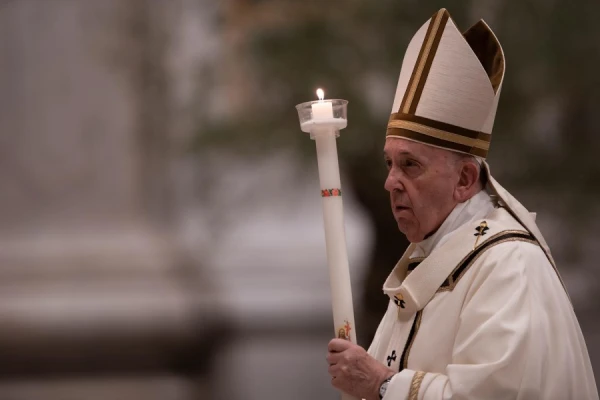
Vatican City, Apr 11, 2020 / 03:40 pm (CNA).- Here is the full text of the Easter Vigil homily of Pope Francis, delivered April 11 at St. Peter’s Basilica.
“After the Sabbath” (Mt 28:1), the women went to the tomb. This is how the Gospel of this holy Vigil began: with the Sabbath. It is the day of the Easter Triduum that we tend to neglect as we eagerly await the passage from Friday’s cross to Easter Sunday’s Alleluia. This year however, we are experiencing, more than ever, the great silence of Holy Saturday. We can imagine ourselves in the position of the women on that day. They, like us, had before their eyes the drama of suffering, of an unexpected tragedy that happened all too suddenly. They had seen death and it weighed on their hearts. Pain was mixed with fear: would they suffer the same fate as the Master? Then too there was fear about the future and all that would need to be rebuilt. A painful memory, a hope cut short. For them, as for us, it was the darkest hour.
Yet in this situation the women did not allow themselves to be paralyzed. They did not give in to the gloom of sorrow and regret, they did not morosely close in on themselves, or flee from reality. On the Sabbath they were doing something simple yet extraordinary: preparing at home the spices to anoint the body of Jesus. They did not stop loving; in the darkness of their hearts, they lit a flame of mercy. Our Lady spent that Saturday, the day that would be dedicated to her, in prayer and hope. She responded to sorrow with trust in the Lord. Unbeknownst to these women, they were making preparations, in the darkness of that Sabbath, for “the dawn of the first day of the week”, the day that would change history. Jesus, like a seed buried in the ground, was about to make new life blossom in the world; and these women, by prayer and love, were helping to make that hope flower. How many people, in these sad days, have done and are still doing what those women did, sowing seeds of hope! With small gestures of care, affection and prayer.
At dawn the women went to the tomb. There the angel says to them: “Do not be afraid. He is not here; for he has risen” (vv. 5-6). They hear the words of life even as they stand before a tomb… And then they meet Jesus, the giver of all hope, who confirms the message and says: “Do not be afraid” (v. 10). Do not be afraid, do not yield to fear: This is the message of hope. It is addressed to us, today. Today. These are the words that God repeats to us this very night.
Tonight we acquire a fundamental right that can never be taken away from us: the right to hope. It is a new and living hope that comes from God. It is not mere optimism; it is not a pat on the back or an empty word of encouragement, with a passing smile. No. It is a gift from heaven, which we could not have earned on our own. Over these weeks, we have kept repeating, “All will be well”, clinging to the beauty of our humanity and allowing words of encouragement to rise up from our hearts. But as the days go by and fears grow, even the boldest hope can dissipate. Jesus’ hope is different. He plants in our hearts the conviction that God is able to make everything work unto good, because even from the grave he brings life.
The grave is the place where no one who enters ever leaves. But Jesus emerged for us; he rose for us, to bring life where there was death, to begin a new story in the very place where a stone had been placed. He, who rolled away the stone that sealed the entrance of the tomb, can also remove the stones in our hearts. So, let us not give in to resignation; let us not place a stone before hope. We can and must hope, because God is faithful. He did not abandon us; he visited us and entered into our situations of pain, anguish and death. His light dispelled the darkness of the tomb: today he wants that light to penetrate even to the darkest corners of our lives. Dear sister, dear brother, even if in your heart you have buried hope, do not give up: God is greater. Darkness and death do not have the last word. Be strong, for with God nothing is lost!
Courage. This is a word often spoken by Jesus in the Gospels. Only once do others say it, to encourage a person in need: “Courage; rise, [Jesus] is calling you!” (Mk 10:49). It is he, the Risen One, who raises us up from our neediness. If, on your journey, you feel weak and frail, or fall, do not be afraid, God holds out a helping hand and says to you: “Courage!”. You might say, as did Don Abbondio (in Manzoni’s novel), “Courage is not something you can give yourself” (I Promessi Sposi, XXV). True, you cannot give it to yourself, but you can receive it as a gift. All you have to do is open your heart in prayer and roll away, however slightly, that stone placed at the entrance to your heart so that Jesus’ light can enter. You only need to ask him: “Jesus, come to me amid my fears and tell me too: Courage!” With you, Lord, we will be tested but not shaken. And, whatever sadness may dwell in us, we will be strengthened in hope, since with you the cross leads to the resurrection, because you are with us in the darkness of our nights; you are certainty amid our uncertainties, the word that speaks in our silence, and nothing can ever rob us of the love you have for us.
This is the Easter message, a message of hope. It contains a second part, the sending forth. “Go and tell my brethren to go to Galilee” (Mt 28:10), Jesus says. “He is going before you to Galilee” (v. 7), the angel says. The Lord goes before us. He always goes before us. It is encouraging to know that he walks ahead of us in life and in death; he goes before us to Galilee, that is, to the place which for him and his disciples evoked the idea of daily life, family and work. Jesus wants us to bring hope there, to our everyday life. For the disciples, Galilee was also the place of remembrance, for it was the place where they were first called. Returning to Galilee means remembering that we have been loved and called by God. Each of us has our own Galilee. We need to resume the journey, reminding ourselves that we are born and reborn thanks to an invitation given gratuitously to us out of love. This is always the point from which we can set out anew, especially in times of crisis and trial.
But there is more. Galilee was the farthest region from where they were: from Jerusalem. And not only geographically. Galilee was also the farthest place from the sacredness of the Holy City. It was an area where people of different religions lived: it was the “Galilee of the Gentiles” (Mt 4:15). Jesus sends them there and asks them to start again from there. What does this tell us? That the message of hope should not be confined to our sacred places, but should be brought to everyone. For everyone is in need of reassurance, and if we, who have touched “the Word of life” (1 Jn 1:1) do not give it, who will? How beautiful it is to be Christians who offer consolation, who bear the burdens of others and who offer encouragement: messengers of life in a time of death! In every Galilee, in every area of the human family to which we all belong and which is part of us – for we are all brothers and sisters – may we bring the song of life! Let us silence the cries of death, no more wars! May we stop the production and trade of weapons, since we need bread, not guns. Let the abortion and killing of innocent lives end. May the hearts of those who have enough be open to filling the empty hands of those who do not have the bare necessities.
Those women, in the end, “took hold” of Jesus’ feet (Mt 28:9); feet that had travelled so far to meet us, to the point of entering and emerging from the tomb. The women embraced the feet that had trampled death and opened the way of hope. Today, as pilgrims in search of hope, we cling to you, Risen Jesus. We turn our backs on death and open our hearts to you, for you are Life itself.
 […]
[…]






At least do not use the Virgin Mary as a “bridge” to other religions, as is now sometimes done in some Catholic circles. A hadith of the religion of peace tells the faithful that the Prophet will marry and deflower the Virgin Mary in Paradise. See the details on this belief of the religion of peace below in an article by scholar R. Ibrahim. So, yes, the religion of peace has a high regard for the Virgin Mary, but not in the way Christians do. See
Is Mary a Bridge between Islam and Christianity?
https://www.raymondibrahim.com/2024/09/23/is-mary-a-bridge-between-islam-and-christianity/
As in your link—thank you—the Islamic angle calls for greater clarity than is provided by pretending to reconcile the chasm between Christian faith and natural religion only with fraternity.
Two further points:
FIRST, the Qur’an redefines the Triune One as a sort of pagan triad—the Father, the Son—and Mary. “How can He have a son as He has no consort?” (Q 6:101/ 102)? Heterogenous Islam is monotheistic but still views Christianity through the compound eyes of paganism.
SECOND, the link reports that Muhammad will wed Mary in Paradise. Surely so, since Islam replaces the eternal Christ with the Qur’an, and then the “uncreated” Qur’an has the prophet Christ foretelling the coming of only Muhammad—and not the Holy Spirit.
Under Islam, the Holy Spirit does not exist/subsist. Instead, the Holy Spirit is the accidental fiction of non-Islamic scribes under whom the Greek term “Paraclete” is ineptly substituted for the Islamic term “periclyte”—which translated from Arabic is another term for Ahmad and which, in turn, is another term for Muhammad. So, clearly, rather than Christ becoming incarnate in Mary under the cloud of the Holy Spirit who later descends at Pentecost, instead, the prophet Christ foretells another prophet Muhammad, and Mary will become Muhammad’s bride in a flat-universe Paradise according to foggy of Islamic and circular “scholarship” (see Abdullah Yusuf Ali, “The Holy Qur’an: Text, Translation and Commentary” [Lahore: Sh. Muhammad Ashraf, 1983/1938], Q 7:157, fn. 1127,p.388).
THIRD, blending, confusing and adulterating the supernatural within the natural, Islam simply abhors the reasoned distinctions of which the human mind is capable. A lay theologian paints a broad portrait:
“Islam has not wanted to choose between Heaven and Earth. It proposed instead a blending of heaven and earth, sex and mysticism, war and proselytism, conquest and apostolate. In more general terms, Islam proposed a blending of the spiritual and the temporal worlds which neither in Islam nor among the pagans have ever been divided” (Jean Guitton, “Great Heresies and Church Councils,” 1965, p. 116).
SUMMARY: As Theotokos, Mary’s fiat is the bridge between unredeemed humanity and the incomprehensible immensity of the Triune One; NOT between the supernatural “faith” of Christians and, yes, monotheistic “belief” as cobbled into the natural religion of Islam.
It must be understood that Islam is a voluntaristic construct. In this regard, the Quranic version of the Annunciation neglects Mary’s response entirely, because Allah can do whatever he wants with his creatures. Muslims, therefore, believe in the Virgin birth, but not because of Mary’s acquiescence (which Muhammed believed to be irrelevant) but because Allah is free to show his power without regard to the freedom of creatures. Quran 3:47 states “Maryam expressed astonishment, asking, ‘How can I have a child when no man has touched me and I have not been unchaste?’ to which the angel replied that God creates what He wills, and when He decrees a matter, He only says, ‘Be,’ and it is.”
When I highlighted this difference (between the Lucan and Quranic accounts, particularly Our Lady’s fiat) at a talk I gave at Yale, I was shouted vociferously down by the Muslims in the room. We cannot assume their “love for Mary/Maryam” has anything to do with her agency. That she remained a virgin not as “singular vessel of devotion’ but that she might remain intact as a gift for Mo in the afterlife should make any sane Christian retch.
What, so now Ayatollah Ahmad Moballeghi has adopted the language and imagery of “bridge building”. This concept is getting so kicked around the place James Martin et al, it would be best for me to disavow working with it!
Mohammed would have declared such a thing to project into the afterlife the role of marriage in gaining power over underlings, in this case, letting everyone know that he was destined by his own claim by “first dibs” to reign over the prophet who would judge everyone in the end.
What he meant by “spirituality”.
Is this socio-emotive outlook-spirituality written into Amoris Laetitia?
Someone in CWR comboxes suggested that Mohammed was not a real individual but a fiction developed by some writer or writers to advance anti-Christ culture. Even were that so, the use of the “marry” image comes to the same thing. But to remark as well, if it is Mohammed were not real, the Church would affirm it.
Pope Francis already went and declared a brotherhood in Abu Dhabi without making distinctions respective to anything. If to begin with we want to be identifying what we mean at all by “One God”, making blanket-subjective-objective statements about other things will only complicate or stymie or undermine our own efforts -surely.
Similarly, some people try to direct attention to the word Fatima -as in our Lady of Fatima- and Mohammed’s daughter.
Our Lady at Fatima has demonstrated by the most obvious of manner, to everyone, what she is about, who she is and what is expected of her true children whom she already knows come only through the Spirit of the Crucified and Risen Lord.
Thank you for the learned comments, Peter D., and for citing the actual words in the holy book of the religion of peace. It is incomprehensible how the recent Popes, and the hierarchs of the CC in general, accept the god of the religion of peace as the same as that of Christians and embrace the religion of peace as being in the same category as Christianity.
In his also learned comments, Galy mentions the name Fatima as another erroneous “bridge” created by some Catholics. The area of Portugal named Fatima takes that name because it was conquered and colonized by the religion of peace for many centuries! Tradition has it that a Muslim princess in the area, named Fatima (a well-known Arabic name, and the name of one of the Prophet’s wives) fell in love with a Christian leader during the Christians’ Re-conquest of their land from the religion of peace and she converted to Christianity. The present-day Fatima area is named after her. For the history of the brutal conquest of Spain and the arduous and long Re-conquest of their land by the Christian warriors, see the book reviewed here:
https://www.meforum.org/middle-east-quarterly/book-reviews/myth-of-the-andalusian-paradise
BTW, the Third Secret of Fatima may hold the key to why recent Popes and Catholic hierarchs act the way they do. See the learned analysis of the Third Secret in the Fatima Center and the analogous revelations by the Virgin’s apparition in Akita, Japan:
https://fatima.org/suppression-of-the-third-secret/
OUR LADY’S MESSAGE IN AKITA JAPAN:
https://schooloffaith.com/rosary-archive/akita
Jesus said in the next life they do not marry.
Mohammed directly contradicts the one he claims will judge everyone.
While Cdl Fernández and theologians mentioned may arrive at a suitable response to the title of Mary as co redemptrix, mediaeval theologians were using the terminology meruit de congruo regarding Mary’s assumed role as co redemptrix. Irenaeus during the 2nd century used weightier wording attributing causality by her obedience.
Although the later theology gained acceptance, Mary de congruo realized the title by her unique participation in salvation. Not by justice rather by her Son’s love for her. Only the Son is the unique savior, that is, de condigno, by right. Pius X has previously given approval of Mary’s title as co redemptrix de congruo in his encyclical Ad diem illum.
Whether the title will be acknowledged, it cannot be denied that the revelation of the Father in the humanness of the Son could not have occurred absent the cooperative assent of Mary.
Think costar or copilot. “Co” means “with”, not “equal to”.
Thanks for the heads up. Although De condigno [con meaning with digno, meaning by right] actually translates merit due to justice. As would be for God. Whereas De congruo translates congruous in English, which means in agreement or with harmony, not by necessity. As would be for God’s creature Mary.
Good analogy!, Outis
Oh boy…isn’t it simply wondrous and exciting that the celebrity-hierarch and psycho-sexually-absorbed author of “Heal Me With Your Mouth” will be contributing his personal deposit onto the magisterium…of The Blessed Mother?
Surely we are blessed to live in the anticipation of it all.
We read “with proponents calling for Mary’s role in redemption to be declared a dogma but critics saying it exaggerates her importance and could damage efforts for unity with other Christian denominations.” So Christian unity demands we make compromises with those who believe in error.
Francis said while Christians had always given Mary beautiful titles, it was important to remember that Christ is the only redeemer, and that Mary was entrusted to us “as a mother, not as a goddess, not as co-redeemer.”
Perfect example of how to gas light and insult Catholics at the same time.
Wrong answer. Francois Mauriac believed this would be a disaster. Are Trads going to get all excited about this title, so they will not mind losing the Latin Mass. Once again, Catholics arguing how many angels can dance on the head of a pin.
Mary as co-redemprrix, a new dogma for her, harms our faith among ourselves instead of enhancing it. As important, this quiet, loving mother of our Lord never asked for the over abundance of honors, devotions, titles, and names for her. We have been and continue to be accused of worshipping Mary, even as we insist we do do not. That is laughable to some others inside and outside of our faith who know otherwise from what has been seen and heard from Marian devotees. If we are being honest here among ourselves, we know this! Being careful of unintended consequences given the current chaotic and dangerous world is prudent/wise.
We honour Mary because God honoured her first. It’s a sad day in the church when the poison of Protestantism leaks in..
Hopefully this will discourage excessive marian piety and clear things up for the marian fanatics. There is a group at my parish that has taken it upon themselves to add “mediatrix of all graces” to the Hail Mary prayer after the words “mother of God” when they pray the rosary in church.
EWTN has an article about Mediatrix of All Graces:
*
https://www.ewtn.com/catholicism/teachings/mediatrix-of-all-graces-143
The members of the group you mention are clearly in the wrong and the pastor should put a stop to it immediately. They are not wrong because of “excessive marian (sic) piety” but because they change the words of the Ave Maria in the public praying of the Rosary. It’s important to understand this. As countless saints and the Magisterium have taught for two thousand years faithful Catholics cannot be excessive in their devotion to Our Lady. If they truly are excessive—that can only be determined by talking with them—they are not faithful to Catholicism. A faithful Catholic will have neither excessive nor inadequate devotion to the Mother of God. Both err. Those who have inadequate or no devotion to Mary are as much in error as those whose devotion is excessive. Saint Alphonsus Liguori, Doctoris Ecclesiae, said that it is morally impossible to be saved without devotion to Mary.
De Maria numquam satis.
In the Fall it wasn’t until Adam and Eve had both eaten of the forbidden fruit that their eyes were opened. Suggesting that Original Sin was a one flesh sin. Would not the redemption be a one flesh redemption? Adam was the priest of Eden. Jesus is the Eternal High Priest. We call Original Sin the sin of Adam, even though Adam and Eve had both sinned. The same could be said for our redemption. Jesus takes primacy in the redemption like Adam takes primacy in Original Sin. Adam failed in his priestly duties, whereas Christ fulfilled His priestly duties with His self sacrifice on the Cross. Remember Mary is known as Our Lady of Sorrows with her Seven Sorrows depicted as swords piercing her Immaculate Heart. Through her fiat and her Seven Sorrows Mary shared in Christ’s Passion and Death. We call Mary the Undoer of Knots, reversing Eve’s sin. Co-redemption could mean together or with and not necessarily equal.
An exceptionally lucid and Scripturally grounded reflection — one that beautifully restores the patristic sense of the ‘one flesh’ mystery in both the Fall and the Redemption. This vision, where Mary stands beside the New Adam as the New Eve, embodies the very kind of theological reasoning that deserves renewed attention today. It’s the sort of insight that can fruitfully underpin deeper reflection on the title of Co-Redemptrix, understood not as rivalry but as participation — the cooperation of the handmaid in the work of the High Priest. My sincere thanks for expressing it with such clarity and fidelity to the Fathers.
Laurels today belong with Fastiggi. GregB is only repeating what others have said many times before this century. Paolo Giosuè, it’s like you’re blowing your gaskets so you could go out and get new ones and have those put in, when to start with there was nothing wrong with the ones you had in there.
Or perhaps something was indeed wrong. Pope Francis has said “co-redemptrix” is discardable; you have to come to some overt reconciliation on that. See Nick above here, October 30, 2025 at 4:49 pm. Why did Pope Francis do such a thing when it was Paul VI who had made the call for deeper study?
Thank you, Elias. My reflections aim not to challenge the Magisterium but to explore, in continuity with Paul VI and John Paul II, the theological meaning of Marian cooperation in the work of Redemption.
As St. John Henry Newman—who, as Fr. Hermann Geissler recalled yesterday at the Gregorian University, is to be proclaimed Doctor of the Church—beautifully showed in his Essay on the Development of Christian Doctrine, authentic development always preserves its type, continues its principles, assimilates what is new without losing its essence, follows a logical sequence, anticipates its future, conserves its past, and shows enduring vitality.
Within this framework, the reflection on Co-Redemption seeks not innovation, but fidelity: a deepening of what the Church already believes about Mary’s unique cooperation in her Son’s redemptive act.
Sincerely,
Paolo Giosuè Gasparini
Understood kindly professor.
But what if the new document is going to position “harmonization” of many contradictions and conundrums already in process ….. in the name of the BVM and Newman-development. With Rahner thrown in for balance.
Well. It might even be worse than a series of catch-phrases.
Paolo Giosuè, allow another perspective for the moment now. Not directed at you or anybody, just generally speaking.
Speaking with an mind to avert temperamentality, innovation, challenge to Magisterium, distrust, self-serving, skepticism, incrementality, sensationalism and what have you -completely willing; what you say there is not resolving some of the conundrums we have been put into and that have been thrown upon everyone, through no plan of our own.
Newman echoes Vincent Lerins; but in present day real life some obvious problems persist insisting on their validity.
Further, let us imagine a taciturn individual meets a temperamental spiritual director priest: well then the relations happening for them easy or hard might have nothing to do with development of doctrine. Surely.
Here is the “temperamental” as sometimes used in English –
https://www.merriam-webster.com/dictionary/temperamental
AI Overview
“Temperamental” means a person or thing is prone to sudden, unpredictable changes in mood or behavior. For a person, it describes someone who is moody, irritable, and easily upset. When applied to a machine or object, it means it is unreliable and doesn’t always work correctly.
For people
Moody and irritable: Someone who has frequent and sudden mood swings.
Unpredictable: Their emotional reactions may be out of proportion to the situation.
Examples: A “temperamental” artist might have erratic behavior, or a “temperamental” person may be difficult to deal with because of their unpredictable nature.
For objects, machines, or systems
Unreliable: An object that doesn’t always work as it should.
Erratic or unpredictable: A machine that sometimes works and sometimes doesn’t.
Examples: An old car that breaks down frequently, or a temperamental computer that has unpredictable performance.
Thanks. My views on Mary’s role in redemption are part of my mystical analysis of the lives of Jesus and Mary that have striking parallels.
*
Based on contemplative formation the normal progression of the mystic is to start with purgation with the endpoint being the prayer of union. In the lives of both Jesus and Mary there is a mirror image of this progression. The Incarnation is a Prayer of Union between the Holy Spirit and Mary where Jesus as Son of God enters into the perfect Union of His Hypostatic Union. Mary need to be sin free to give herself in a pure fiat at the Annunciation in order for the Incarnation to be a supreme act of pure love and union between Jesus, Mary, and the Holy Spirit. Sin would have made the Incarnation an act of domination and conquest and not a loving act. Both Jesus and Mary are in the state of Original Righteousness that they never lost. To me before the Fall Adam and Eve were soulmates, two hearts beating as one. A relationship that was broken by Original Sin and the loss of Original Righteousness. The special relationship between the Sacred Heart of Jesus and the Immaculate Heart of Mary is based on their intact relationship with God.
*
From the Annunciation/Incarnation Jesus and Mary’s lives follow a path that ends in the Purgation of Christ’s perfect offering on the Cross. Starting in union and ending in purgation, Christ on the Cross and Mary at the foot of the Cross. They both live lives that are the mirror image of normal contemplative formation. It is the Cross that defines both of their lives in mortal flesh. This agrees fully with the way that Mary received the Immaculate Conception in the same mirror image process. A mystical life lived backwards with the Cross as the point of origin. Mary filled up in her own flesh what was lacking in the offering of Christ on the Cross. What was lacking was her response to Christ’s sacrificial offering on the Cross. Christ did His part, Mary did her part, we have to do ours by how we respond to His offering of Himself on the Cross.
The fact that, almost half a year into his papacy, the current Pope has not replaced the head of the Congregation (Dicastery) for the Doctrine of the Faith is unfortunately very telling.
Perhaps he is not rash, D.K!
Fr. Paolo Siano, an Italian priest, has noted that it was actually Leo XIII who first gave magisterial approval to the Marian title coredemptrix. On July 18, 1885, Pope Leo XIII approved a prayer of praises (laudes) to Jesus and Mary with an indulgence of 100 days granted by the Congregation for Indulgences and Sacred Relics. In the Italian version of the praises to Mary, she is referred to as “coredemptrix of the world” (corredentrice del mondo). In the Latin version, she is referred to as the “mundo redimendo coadiutrix). Leo XIII approved both the Italian and Latin versions of the prayer (Acta Sanctae Sedis [ASS] 18 [1885] p. 93).
I say that Pachamama is the Mediatrix of all graces. There, you have it.
With all my talk about marriages and wives I made a mistake: Fatima was not one of the Prophet many wives or concubines but one of his daughters. Here is another review of the book on the brutal conquest and domination of Spain by the religion of peace and the Christian warriors long effort to re-conquer their land.
https://scholarsarchive.byu.edu/cgi/viewcontent.cgi?article=1990&context=ccr