


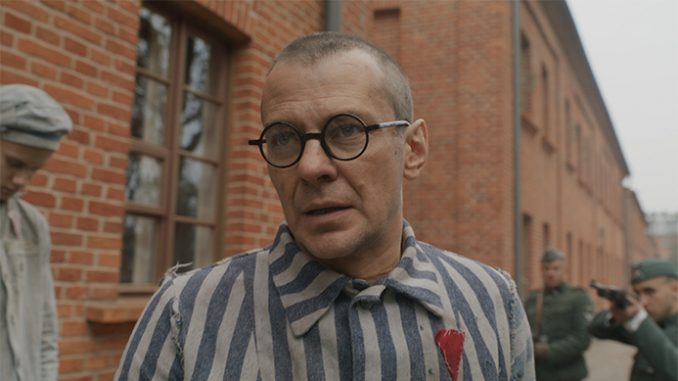
The horrors of twentieth-century totalitarianism caused many to ask the ancient question of how a loving God could allow His children to suffer. Writer and director Anthony D’Ambrosio’s new film, Triumph of the Heart, depicts the last days of the life of St. Maximilian Kolbe, who proved that in Auschwitz God was present in acts of heroic kindness.
The story of St. Maximilian Kolbe is well known. This Franciscan friar, known for his devotion to the Blessed Mother and entrepreneurial evangelism, was something of a Polish Mother Angelica. Having founded one of the world’s biggest monasteries in Niepokalanów (“The City of the Immaculate”), Kolbe spread the Good News through Radio Niepokalanów and popular newspapers such as Rycerz Niepokalanej (“Knight of the Immaculate”). In the 1930s, Kolbe came to Japan to evangelize; he even printed a Japanese edition of The Knight of the Immaculate. Miraculously, the friary he founded (The Garden of the Immaculate) survived the atomic bombing of Nagasaki.
Before Auschwitz became the world’s biggest Jewish cemetery, it was built by Nazi Germany to terrorize the conquered Polish population. In 1941, Niepokalanów was shut down, while Kolbe was sent to Auschwitz. As a punishment for the escape of one prisoner, at roll call, German SS men selected ten random prisoners to be killed. Among them was Franciszek Gajowniczek, who pleaded to be spared, as he had a wife and children. Maximilian Kolbe offered himself in place of Gajowniczek, saying he was a celibate Catholic priest. The SS consented to Kolbe’s request and sent him to the starvation bunker with nine other inmates; ultimately, an SS man killed the priest with an injection of carbolic acid.
Because the survival rate in the Auschwitz starvation bunker was zero percent, we have no testimonies of Kolbe’s final days. While the end credits acknowledge that the other prisoners in the starvation bunker are fictional, Anthony D’Ambrosio based the characters on groups of Auschwitz inmates. They include a Jewish father and son, Herschel and Chaim; Piotr, a communist; Albert, who is plagued by guilt after leaving his fiancée to fight the Germans when Poland is invaded; and Jonasz, who grieves his presumably murdered son.
Kolbe is played convincingly by Polish actor Marcin Kwaśny, who nevertheless looks little like the saint, especially once his trademark perfect circle glasses are removed. Probably incidentally, Jonasz, who mourns his son, is played by the Ukrainian actor Oleg Karpenko, in one of the film’s stronger performances; today, many Ukrainians mourn their children killed or kidnapped amidst Russian aggression. Another outstanding performance is English actor Christopher Sherwood’s depiction of Auschwitz commandant Karl Fritzsch, driven to madness by Kolbe’s witness and orders his murder, a powerful illustration of how many try to drown out their consciences.
Similarly, Piotr the communist initially responds to Kolbe with cynicism; he scoffs at the notion that one can be foolish enough to believe in God in Auschwitz. Over time, however, we learn that Piotr has a dark secret and even asks for confession. When Kolbe proposes that the men in the starvation bunker pray, Hershel skeptically asks: “With a priest?” But then Maximilian holds Herschel’s hand and says a Marian prayer, while his new friend sings Shema Yisrael.
When Maximilian Kolbe was canonized, some accused him of antisemitism, as his newspapers had published articles associating Jews with Freemasonry or calling for the boycott of Jewish businesses. However, Maximilian’s views on the Jews changed over time. Before his arrest, Kolbe sheltered hundreds of Jewish refugees in Niepokalanów, where he even held Hanukkah celebrations for them. Many Jewish survivors of Auschwitz recalled Kolbe as kind and helpful, as noted by André Frossard in his fine book Forget Not Love: The Passion of Maximilian Kolbe . The scene with Herschel depicts Kolbe’s evolving views well.
In the starvation bunker, Kolbe helps his fellow inmates through prayer, kindness, and forgiveness—and even shares with them the extremely scarce food and water (a dead rat and rainwater falling through the barred window). In Triumph of the Heart, the starving men set aside their ethnic and ideological differences and support one another. The inmates sing patriotic and religious songs, provoking the ire of the SS and Fritzsch; similarly, another Polish saint, Pope John Paul II, joined the Rhapsodic Theater during the German occupation of Krakow, performing plays by banned Polish national poets, a reminder that killing a nation’s soul is much trickier than causing physical death.
Despite its numerous strengths, some aspects of Triumph of the Heart are deficient. Before entering the starvation bunker, Auschwitz prisoners–performing backbreaking physical labor on a diet of watery soup and moldy bread–would have already been emaciated. Yet the BMI of the actors in Triumph of the Heart were certainly healthy. Jared Leto, who lost much weight and refrained from eating sugar for months to play a drug addict in Darren Aronofsky’s Requiem for a Dream, proves that actors can go through profound physical changes to add realism. Meanwhile, in another biopic of St. Maximilian Kolbe, Life for Life, Krzysztof Zanussi hired a man with muscular dystrophy as an extra for the starvation bunker scene.
Likewise, the scene in which Maximilian bludgeons a rat with a rock and feeds its meat to his fellow prisoners is unconvincing. Apart from the fact that the Franciscan friar treating the creature as “Brother Rat” seems more likely, due to the appalling sanitary conditions at Auschwitz and other camps, typhus and countless other diseases spread quickly. Would St. Maximilian endanger his fellow inmates by feeding them uncooked vermin?
Also, it is unfortunate that Triumph of the Heart did not mention the later fate of Franciszek Gajowniczek. Gajowniczek survived Auschwitz and lived to be ninety-three. He attended Kolbe’s canonization and was forever grateful, travelling all over the world to tell of the Franciscan’s sacrifice.
Nevertheless, Triumph of the Heart is an inspiring reminder to a world once more scarred by war that Christian love can triumph over even the mightiest evil fortress.
If you value the news and views Catholic World Report provides, please consider donating to support our efforts. Your contribution will help us continue to make CWR available to all readers worldwide for free, without a subscription. Thank you for your generosity!
Click here for more information on donating to CWR. Click here to sign up for our newsletter.

“Life for Life” was the 1991 Maximilian Kolbe film which covered the same ground. How do these films compare, one wonders.
Re: the film not mentioning the later fate of Franciszek Gajowniczek – I think this is a rather trivial objection (as are the others). We must let the film be what it is, and not expect it to do things that would destroy its own structure. It is not a biopic, it knows what it is about: the men in the starvation cell. There would really be no coherent way to incorporate the later life of the man Kolbe saved. And then we might have to mention that he returned to his wife only to find out that his sons were dead – and then we have a whole new dramatic question to ask, what was the point of Kolbe’s sacrifice for the man with a family if the man’s family ended up being dead by the time he got out of the camp (a question explored in the Sono Ayako novel Miracles).
Re: the commenter wondering about Life for Life – I haven’t seen it, but based on the descriptions I read, it is not really covering the same ground. Life for Life is about the man who escaped Auschwitz piecing together St. Maximilian’s story. Triumph of the Heart is not about St. Maximilian’s whole story, but almost entirely about the men in the starvation cell. Insofar as it leaves the cell in flashbacks etc, it is to inform our understanding of what is happening in the cell.
Also, it is far from *normal* for actors to starve themselves for a role, like Jared Leto – it is exceptional and freakish. As Catholics we should recognize that it is actually immoral to expect people to damage their health for the sake of art! It is impressive enough that the cast of this film did a water fast while shooting.