


Madrid, Spain, Apr 30, 2025 / 15:49 pm (CNA).
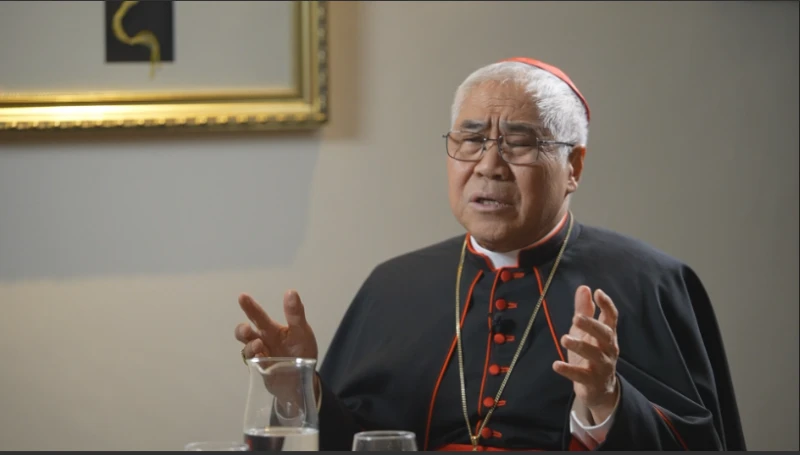
In a pastoral letter published by the Archdiocese of Singapore, Cardinal William Goh called on the faithful to pray for the cardinals involved in electing the successor to St. Peter.
Goh first noted that the members of the College of Cardinals are holding general congregations “to hear the views and assessment” of the current situation and “what the Church needs to do after Pope Francis.”
“Hence, it is urgent and important that you all pray for us so that we can discern what kind of pope the Church needs in this present day, because every pope brings with him his own charisms,” the prelate emphasized.
The cardinal asked for prayers “that we will choose the right candidate to be the successor of St. Peter to lead the Church in this complex world.”
Specifically, the cardinal encouraged the organization of “novenas, rosary, and divine mercy devotions to pray fervently, unceasingly, for the cardinals to be guided by the Holy Spirit to elect a good, holy, compassionate, wise, and strong pope.”
A pontiff who, he added, “will not only be a shepherd after the heart of Christ but also courageous in defending the deposit of faith handed down to the Church through the ages.”
This story was first published by ACI Prensa, CNA’s Spanish-language news partner. It has been translated and adapted by CNA.
If you value the news and views Catholic World Report provides, please consider donating to support our efforts. Your contribution will help us continue to make CWR available to all readers worldwide for free, without a subscription. Thank you for your generosity!
Click here for more information on donating to CWR. Click here to sign up for our newsletter.



A Catholic pope will do very well.
About “discern[ing] what kind of pope the Church needs in this present day,” a healthy minimum would be a pope who preaches the whole gospel (mercy and conversion) and who restores the difference between a town hall meeting and a “synod of bishops” as successors to the Apostles. About which, check out this April 2024 interview with Cardinal Goh: https://www.catholicworldreport.com/2024/05/03/cardinal-goh-of-singapore-deep-encounter-with-jesus-is-key-to-passing-on-the-faith/. Cardinal Goh:
“But I don’t believe that we should try to compromise the Gospel. And that is my fear: that, today, even Church leaders are compromising the Gospel. I don’t think Jesus ever compromised the Gospel, even for the adulterous woman. He says, ‘I do not judge you, I do not condemn you, but please sin no more.’ I think that has to be mentioned. This is where the importance of truthfulness, mercy, and compassion [comes in].”
“…as has often been said, or some bishops are suggesting, perhaps there should be another level where it is really a Synod of Bishops, after hearing the laypeople, after journeying with them; there should be that level of bishop synods, where the bishops can come together, because that synod [with laity] cannot really be considered a theological dogmatic synod, because not all are theologically trained.”
The diocese of crossroads Singapore also hails from a deeply multicultural setting, celebrates four national languages, is near 21st century’s atheistic Chinese regime, and is roughly and refreshingly almost equidistant from (central to?) Europe and North and South America. (And, yet, continental Africa also has much to offer, in its clear-eyed rejection to Fernandez’ anti-binary Fiducia Supplicans.)
Singapore, not big geographically, but neither were synodaler Cardinal Hollerich’s Luxembourg nor synodaler Cardinal Grech’s Malta….After all, at 284 square miles, the Singapore city-state is still 1700 times as big as the Vatican’s 109 acres…an interesting numerology as we enter the 1700th anniversary of Nicaea!