Members of the Episcopal Conference of Benin. / Credit: Episcopal Conference of Benin
ACI Africa, Jan 18, 2025 / 07:00 am (CNA).
Members of the Episcopal Conference of Benin (CEB) have appealed for calm ahead of the West African country’s 2026 general elections.
In a statement issued at the end of their four-day plenary assembly that ended Jan. 10, Benin’s Catholic bishops said that diversity in opinions should be a “source of strength” for the country’s democracy and called for unity amid what they describe as “diverse interests and political differences in the country.”
“As our country heads towards the general elections of 2026, the bishops of Benin once again make an urgent appeal for the political atmosphere to be eased,” they said in their statement shared with ACI Africa, CNA’s news partner in Africa, on Jan. 14.
“Diversity of opinions and parties should never be a source of division, but rather a source of strength for our democracy,” CEB members added. “Indeed, beyond partisan interests and political differences, what unites us as Beninese people is much stronger than what could divide us.”
Scheduled for April 2026, Benin’s general elections are to include municipal, legislative, and presidential votes. Presidential candidates must submit their applications by October 2025, six months before the election.
President Patrice Talon, currently serving his second and final constitutional term, has reportedly said that he does not intend to amend the constitution to seek reelection.
Benin’s Catholic bishops have urged political leaders, opinion-makers, and all Beninese citizens to commit themselves resolutely to a spirit of sincere dialogue, mutual listening, and national reconciliation.
In their latest statement, they stressed the importance of a climate of peace and trust, which they say is essential to guarantee the smooth running of the country’s planned elections.
“This climate must be underpinned by inclusive governance and fair management of electoral processes so that everyone feels part of the construction of our common future,” they said, inviting everyone, whatever their position or political affiliation, “to demonstrate great responsibility and sincere commitment to serving the supreme interest of the nation.”
Reminding the Beninese of the country’s motto, “Fraternity, Justice, Work,” CEB members said: “This unity, rooted in our shared history and cultural heritage, is the foundation on which we must build a strong and prosperous nation.”
The bishops prayed that the peace of Christ will enlighten the hearts and guide the actions of all those in charge of the destiny of Benin.
The bishops further expressed their closeness with families bereaved by the loss of soldiers killed in the jihadist attack that took place on Jan. 8 near the triple border between Benin, Niger, and Burkina Faso.
A jihadist formation from Burkina Faso reportedly attacked the border post, killing at least 28 Beninese soldiers. The attack was claimed by the Group for the Support of Islam and Muslims, which is affiliated with al-Qaida.
In their collective statement, the bishops noted that the soldiers who were killed “fell at the front in the performance of their duty” and implored: “May the God of infinite mercies welcome their souls into his light and console the hearts that have been tested by this tragedy.”
Meanwhile, Benin’s bishops have expressed their concern about the growth of cybercrime in the country, which they say attracts many young people with “the promise of easy profits.”
“In their quest for easy money, many young people continue to swindle, posing a permanent threat to the security and peace of mind of our peaceful citizens,” CEB members said, expressing their “urgent call to conversion” and reminding youths in Benin that ill-gotten gains never pay off.
The Catholic Church leaders invited educators at various levels — parents, chaplains, and youth group leaders — to assume their full responsibility and to work each according to his or her charisma and specific mission so that urgent measures can be taken to save the young people, who they say are “on the road to perdition.”
The bishops also urged the country’s authorities to strengthen legal and technological measures to eradicate cybercrime while promoting digital education and the responsible use of technology.
This story was first published by ACI Africa, CNA’s news partner in Africa, and has been adapted by CNA.
If you value the news and views Catholic World Report provides, please consider donating to support our efforts. Your contribution will help us continue to make CWR available to all readers worldwide for free, without a subscription. Thank you for your generosity!
Click here for more information on donating to CWR. Click here to sign up for our newsletter.
Wau, South Sudan, Feb 19, 2021 / 10:45 am (CNA).- A Catholic health centre of the Diocese of Wau has temporarily shut down after all three doctors at the facility tested positive for Covid-19.
The administrator of Sika Hadid Primary Health Centre, Sr…. […]
Monica Biboso and her employer, Ester Rot, while celebrating Rosh Hashanah (the Jewish New Year) in the dining room of Kibbutz Be’eri in 2022. “I don’t feel like a hero because I saved Ester” during the Oct. 7, 2023, massacre, Biboso told CNA. “I would do anything to save her. I just treated her like my mother. Every child would do the same.” / Credit: Photo courtesy of Monica Biboso
Jerusalem, Oct 7, 2024 / 05:00 am (CNA).
One year has passed since Monica Biboso, a 36-year-old Filipino woman who has worked as a caregiver in Israel for over 10 years, was suddenly awakened by the noise of bombs and gunfire in Kibbutz Be’eri, close to the Gaza border.
In a conversation with CNA, Biboso’s eyes moistened as she recalled that day. Hamas fighters surrounded the house, shattered the windows, and set the home ablaze. She still has nightmares and jumps whenever someone knocks on the door of her room at the David Dead Sea Resort by the Dead Sea, where she has been displaced for the past year.
An outing in Sderot of the caregivers who worked at Kibbutz Be’eri on Sept. 5, 2023. Biboso and her employer were transferred to a hotel on the Dead Sea, along with the surviving residents of Kibbutz Be’eri, after the attack on Oct. 7, 2023. About 10 of Biboso’s colleagues joined them, while two died in the attack and five returned to the Philippines. Credit: Monica Biboso
During the Oct. 7, 2023, massacre in Israel that took the lives of almost 1,200 people, 101 civilians were killed in Be’eri and 30 hostages were taken to Gaza, 11 of whom are still being held in captivity.
Biboso not only survived, but she also managed to protect the elderly lady she was caring for — Ester Rot, who is 81 and has dementia. They were the only two survivors from their neighborhood.
“I have never stopped praying because I have always believed that God was there,” Biboso, a Catholic, told CNA. “All the time, I prayed to God and asked him that if my time had come, he would at least protect my children. But God did not want to call me yet, and I survived.”
Biboso is married to a fellow countryman she met in Israel who had returned to the Philippines just a few days before Oct. 7. The couple has two children, ages 7 and 5, who are growing up in the Philippines under the care of Biboso’s sister.
Monica Biboso with her family in the Philippines in April 2024: her husband, Roberto; her daughter, Sofya; and her son, Clarence. In the first few hours of the Oct. 7, 2023, massacre by Hamas, she managed to stay in touch with them, then her cellphone ran out of power. “When I was able to turn my phone back on, I found video messages from my children, crying, kissing and telling me to take care of myself.” Credit: Photo courtesy of Monica Biboso
In the first few hours of being locked in the house’s safe room, Biboso stayed in touch with her family, her Filipino colleagues in the kibbutz, and Rot’s children, but then her cellphone battery died.
“When I was able to turn my phone back on, I found video messages from my children, crying, kissing, and telling me to take care of myself,” she recalled.
Biboso, who was locked in the shelter with Rot for 16 hours, has been trying to forget the experience, but from the start it was clear it would never be possible.
“All the time, I carry my bag with my documents and important things. I am afraid of losing them again. Every night before going to sleep, I need to check outside and lock the door.”
For the past year, Biboso has been undergoing psychological therapy, which is helping her cope with the memories, fear, anguish, and nightmares — and to talk about what she went through.
“When I heard the sirens, I woke Mrs. Ester up, changed her, and dressed her quickly. I gave her her medicine and something to help her sleep, and we took refuge in the safe room of the house. I understood that the situation was serious, as I could hear the gunshots getting closer and closer,” Biboso recounted to CNA.
The closed caption television cameras that Rot’s children had previously installed in the house showed Hamas militants coming and going until they managed to break into the house.
Screenshot of camera footage from Ester Rot’s home at 10:51 a.m. on Oct. 7, 2023, in Kibbutz Be’eri, where Monica Biboso lived and worked as a caregiver for the elderly woman. Two armed men can be seen in the lower left of the screen near the home. Around 11 a.m., Hamas fighters managed to break into the house by blasting a hole with explosives. Shortly afterward they set fire to the house. Credit: Courtesy of Monica Biboso
“For the entire time I was locked in the shelter, I kept praying and saying to God, ‘Help us, I know it’s impossible to save us, but I know you can save us.’”
Around 11 a.m., the Hamas fighters broke into the house by blasting a hole with explosives.
“Maybe God heard me because they couldn’t open the shelter door. I was holding the handle from the inside. He gave me incredible strength.”
The door to the shelter where Monica Biboso and her employer, Ester Rot, were barricaded for 16 hours during the Hamas attack on Kibbutz Be’eri, Oct. 7, 2023. The photo was taken by Biboso when she had the chance to return and check the situation in January 2024. “For the entire time I was locked in the shelter, I kept praying and saying to God, ‘Help us, I know it’s impossible to save us, but I know you can save us,’” Biboso told CNA. “Maybe God heard me because they couldn’t open the shelter door. I was holding the handle from the inside. He gave me incredible strength.” Credit: Photo courtesy of Monica Biboso
Then they set fire to the house.
“We could barely breathe, it was so hot. We had no water, no food, nothing. I thought we were going to die, but I kept praying.”
When asked how she was able to survive, Biboso said: “God saved me. No one was able to help us. I was weak, I couldn’t breathe, my body was shaking, and I was lying on the floor, but I kept praying. Because of him, I survived. I truly believe that. He was with me the entire time I was in the shelter. I could feel it. Without God, I wouldn’t be here.”
The living room of Ester Rot’s home in Kibbutz Be’eri, where Monica Biboso lived and worked as a caregiver for the elderly woman. The house was completely burned down during the Hamas attack on Oct. 7, 2023. The photo was taken by Biboso when she had the chance to return in January 2024. Credit: Photo courtesy of Monica Biboso
Biboso and Rot spent a day in the hospital, then they were transferred to a hotel on the Dead Sea along with the surviving residents of Kibbutz Be’eri. About 10 of Biboso’s colleagues were among them. (Two others died in the attack and five returned to the Philippines.)
“Together with my husband, we decided it was best for me to stay, at least for the time being. I could never have left Mrs. Ester or allowed her to end up in a nursing home after surviving all this. She is like a mother to me,” said Biboso, who lost her own mother at the age of 16.
“I don’t feel like a hero because I saved Mrs. Ester,” Biboso added. “I would do anything to save her. I just treated her like my mother. Every child would do the same.”
“I knew that if I wanted to have any chance of healing and overcoming this trauma, I could only do it here,” she said. “In Israel, psychologists could help me because they understand the context.”
Ultimately, economic reasons also motivated Biboso to stay. Currently, her salary is the only stable income for her family, whom she was able to reunite with for some weeks in April.
Life at the hotel follows a fairly regular routine. “When we get up, I help Mrs. Ester with breakfast, give her a bath, take her for a walk, and do exercises. After lunch, we rest. When I can’t sleep, I crochet. It helps me relax.” Sometimes the two walk along the sea, take a swim, and spend time with friends.
Four months after Oct. 7, Biboso visited Kibbutz Be’eri together with Rot’s children. “It was very hard. I couldn’t stay there for long.” The house was completely destroyed by the flames.
“All my things were burned, everything was reduced to ashes,” Biboso recounted, “But my rosary didn’t burn. I found it beside my bed. It was a little burnt, but the beads were intact, and the cross was still a cross. My husband gave it to me and I used to pray with it every day before sleeping. I know I’m safe because of it.”
Monica Biboso’s rosary, the only one of her belongings left intact after the home of Ester Rot, the elderly woman she cared for and where she also lived in Kibbutz Be’eri, was set on fire by Hamas fighters during the Oct. 7, 2023, attack. “All my things were reduced to ashes,” Biboso recounted, “but my rosary didn’t burn. My husband gave it to me and I used to pray with it every day before sleeping. I know I’m safe because of it.” Credit: Photo courtesy of Monica Biboso
To this day, every night, Bibosa prays the rosary before bedtime. “In the Philippines, when my mother was alive, every day at 6 o’clock we prayed the rosary together before having dinner. I kept doing it.”
After Oct. 7, a nun living in Tel Aviv called Biboso every day, and they prayed together. “She’s helped me a lot. If I can’t sleep, I call her, and we pray together over the phone.”
“Prayer is a big help to me in healing, lightening the burden on my heart, and freeing my mind from negative thoughts,” Biboso said.
Ester Rot, the elderly woman with whom Monica Biboso works as a caregiver, on the shore of the Dead Sea. After surviving the massacre carried out by Hamas on Oct. 7, 2023, the two were displaced to the David Dead Sea Resort along with the other surviving residents of Kibbutz Be’eri. Credit: Photo courtesy of Monica Biboso
In mid-October, Biboso and Rot are expected to move to Kibbutz Hatzerim, where new housing units have been built for the Be’eri survivors.
“First, you need to have faith in God and be thankful for everything,” Biboso said. “You just need to trust him, and he will make a way to save you. This war will also end because of him. He will find a way to bring good out of it all.”
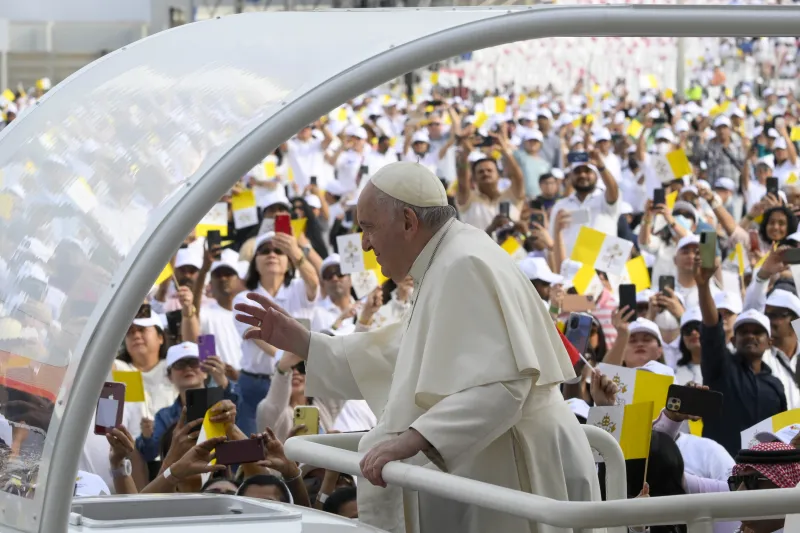
Pope Francis greets the crowd in Bahrain’s national soccer stadium before offering Mass on Nov. 5, 2022. / Vatican Media
Rome Newsroom, Nov 5, 2022 / 05:00 am (CNA).
About 30,000 people crowded into a soccer stadium on Saturday morning to attend the first public papal Mass in the Kingdom of Bahrain, a Muslim-majority island country in the Persian Gulf.
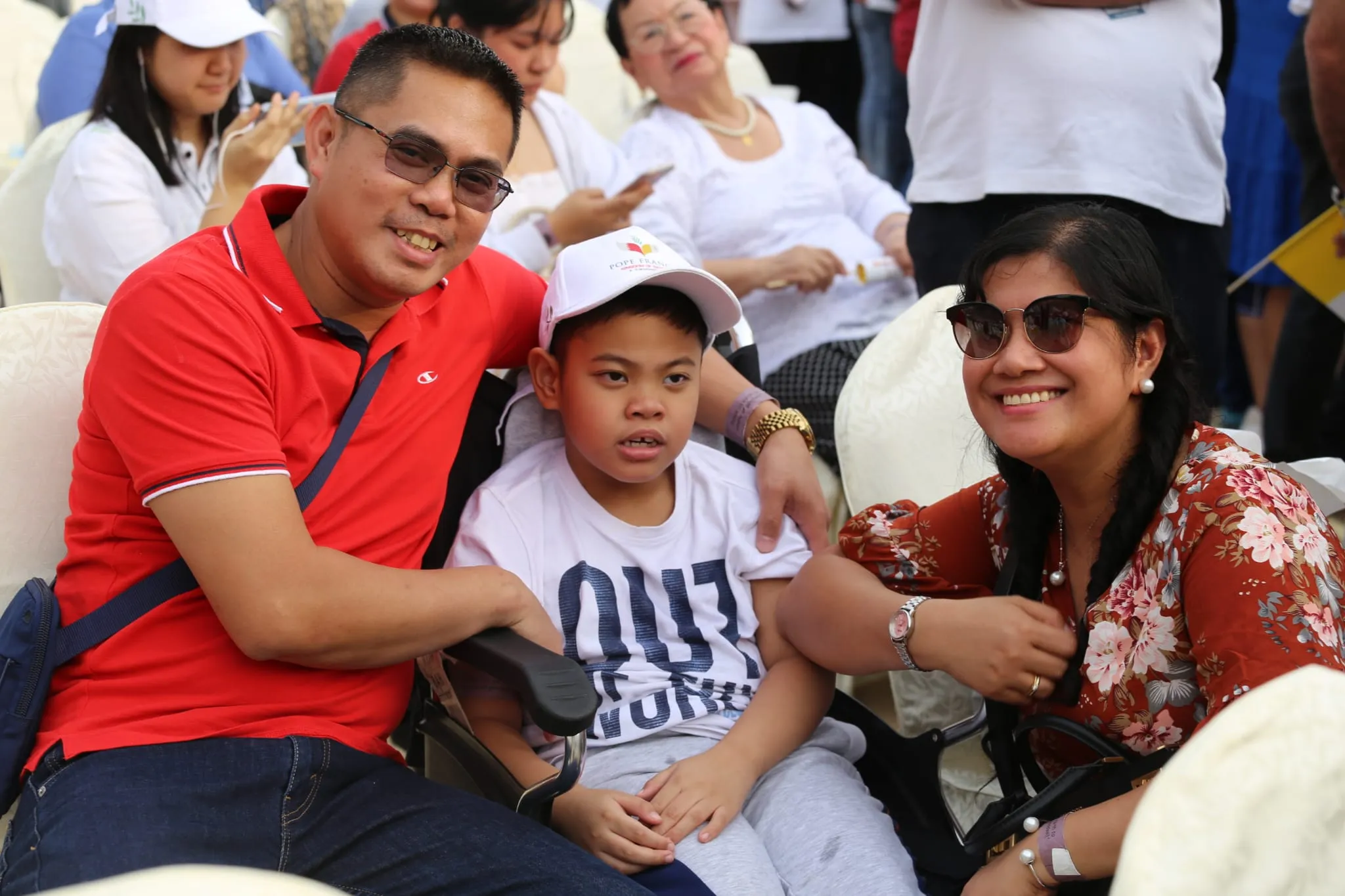
In the crowd was Julius Rhe, who traveled with his wife and son from Riyadh, Saudi Arabia, where restrictions prohibit the celebration of Catholic Masses in public.
“We are very honored to be part of this very, very memorable event. . . . We are very blessed,” Rhe told EWTN on Nov. 5.
The Rhe family traveled from Riyadh, Saudi Arabia to attend Mass with the pope in Bahrain. Alexey Gotovsky/EWTN
The Rhe family practices the Catholic faith at home and has attended a private Mass in an apartment while living in Saudi Arabia.
According to Bahrain’s Daily Tribune, around 2,900 of the registered attendees at the stadium Mass with Pope Francis came from neighboring Saudi Arabia.
Reuters reported that foreign workers living in Saudi Arabia were bussed in for the Mass over the King Fahd Causeway that connects the two countries.
Many of the Gulf region’s foreign workers come from the Philippines, India, Pakistan, and other South Asian countries.
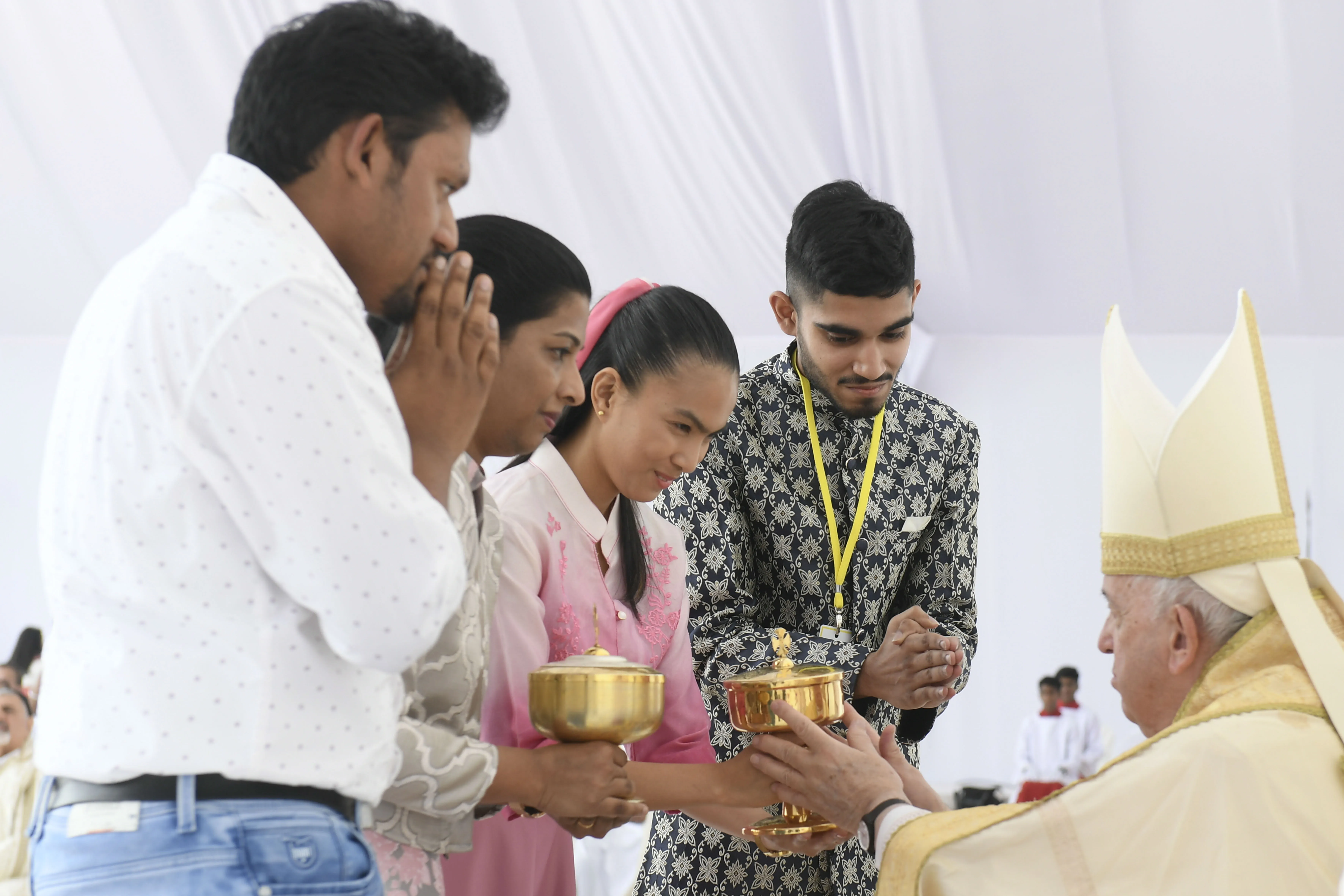
Pope Francis receives the gifts during Mass in Bahrain on Nov. 5, 2022. Vatican Media
Catholic foreign workers living in Kuwait, Qatar, Oman, and the United Arab Emirates also traveled for the Mass.
Pope Francis arrived to cheers at Bahrain’s national soccer stadium as he greeted the enthusiastic crowd from the popemobile.
In his homily, the pope repeated the words of St. Paul’s Letter to the Romans: “Do not be overcome by evil, but overcome evil with good.”
Pope Francis said that Jesus “suffers when he sees in our own day and in many parts of the world, ways of exercising power that feed on oppression and violence, seeking to expand their own space by restricting that of others, imposing their own domination and restricting basic freedoms, and in this way oppressing the weak.”
In the face of the oppression and enmity that exist today, the Gospel calls Christians to “love everyone, even our enemies,” the pope said.
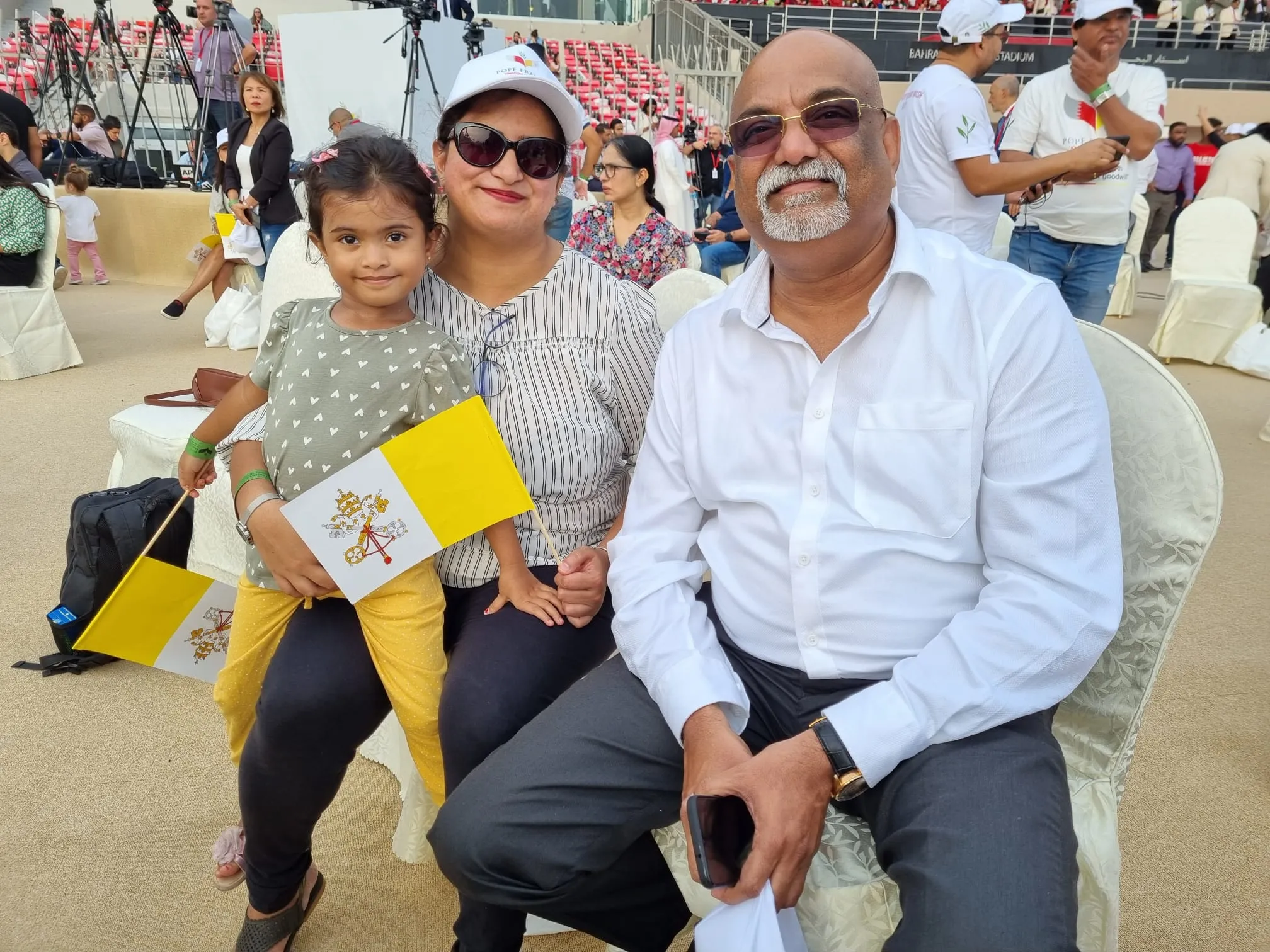
A family waits for Pope Francis’ arrival in Bahrain’s National Stadium on Nov. 5, 2022. Alexey Gotovsky/EWTN
Christians make a small minority in Bahrain. While it is more than 70% of Bahrain’s total population of 1.5 million is Muslim, there are about 161,000 Catholics living in the country, according to 2020 Vatican statistics. The country is home to two Catholic churches and 20 Catholic priests.
Pope Francis described Bahrain as “a living image of coexistence in diversity” and “an image of our world, increasingly marked by the constant migration of peoples and by a pluralism of ideas, customs and traditions.”
He added: “It is important, then, to embrace Jesus’ challenge: ‘If you love those who love you, what reward have you? Do not even the tax collectors do the same?’”
At the end of the Mass, Bishop Paul Hinder, the apostolic administrator of the Apostolic Vicariate of Northern Arabia thanked Pope Francis for showing “pastoral care for a tiny Church in a tiny country.”
The bishop said: “Like your patron Saint Francis of Assisi, you are not afraid to build bridges with the Muslim world and to show your fraternal closeness to all people of goodwill regardless of their cultural background and religious belief.”
“We Christians in the Middle East—those of ancient Oriental tradition and those who as migrants temporarily live in this part of the world—try to implement the invitation of Saint Francis to his brothers to ‘live spiritually among the Muslims … not to engage in arguments and [simply] to acknowledge that [we] are Christians.’”
Pope Francis expressed his gratitude to the Catholics who had traveled from Saudi Arabia and other countries in the region to attend the Mass. He said: “I bring today the affection and closeness of the universal Church, which looks to you and embraces you, which loves you and encourages you.”
“May the Blessed Virgin, Our Lady of Arabia, accompany you on your journey and preserve you constantly in love towards all.”





Leave a Reply