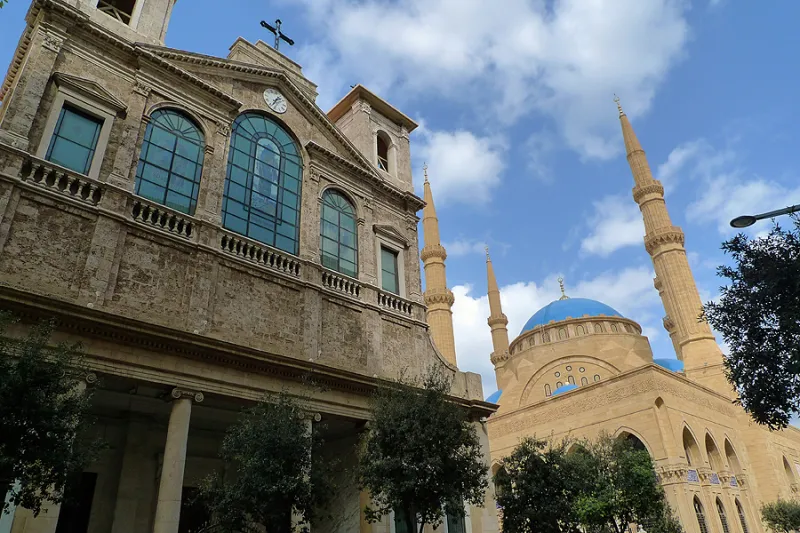
St. George Maronite cathedral beside the Mohammad Al-Amin mosque in Beirut, the Lebanese capital. / Credit: Patrick Donovan via Flickr (CC BY-NC 2.0)
ACI Prensa Staff, Sep 25, 2024 / 18:25 pm (CNA).
The large-scale bombings Israel unleashed this week against Hezbollah in Lebanon are affecting all of Lebanon’s residents, including Christians, according to the pontifical foundation Aid to the Church in Need (ACN).
ACN’s project coordinator in Lebanon, Marielle Boutros, indicated that many Christian families residing in the bombed areas have been affected.
“Some have lost their homes and are now moving from the south to other places in Beirut, Mount Lebanon, and the north to find safety,” she said.
Boutros explained that even Beirut, the country’s capital, has been the target of attacks mainly confined to the areas with the largest Muslim population, where Hezbollah has most of its support.
“But Beirut is not a big city, so if a part of Beirut is targeted, all of Beirut will feel it, and all day people hear the sound of military aircraft or drones,” she said.
“I am 37 years old and I have lived through more than five wars in Lebanon. It is not easy to live in a country where one day you are OK and the next you are hiding from missiles. It’s not the kind of life young people like to live. The trauma that people are experiencing now, and the trauma of having yet another war, will not be easily forgotten,” Boutros added.
Boutros said that despite the bombing, projects carried out by the Catholic Church through ACN have not stopped and that “they are now more necessary than ever.”
“People are now living in church halls so they will need food, sanitary products, mattresses, blankets, and if it continues we will need heating for the winter, though of course we hope it won’t last that long,” said Boutros, who also called on all believers to pray for peace in Lebanon and the entire region.
‘No one wants war’
Another prominent Catholic voice who is speaking out about the situation is the Maronite archbishop of Tyre, Charbel Abdallah, who stated in an interview with Vatican News that the Lebanese are worried and “fearful for the future.”
“Everyone seeks peace. Nobody wants war,” he reiterated. “If the situation worsens, the war would not only affect the south, but it is all of Lebanon that is affected by the war. In October, children and young people will start school. We spent an entire year without school, and if schools do not open this year, we risk losing a lot, because people and families will be forced to leave the region.”
Finally, the archbishop highlighted that the Catholics of Lebanon have made the decision to pray fervently for an end to the conflict.
“All the priests in the parishes have taken steps to pray. The rosary is prayed every day. There is an hour of worship with the people, and we always try to encourage the spirit in prayer to ask for the peace of the Lord,” he said.
This story was first published by ACI Prensa, CNA’s Spanish-language news partner. It has been translated and adapted by CNA.
If you value the news and views Catholic World Report provides, please consider donating to support our efforts. Your contribution will help us continue to make CWR available to all readers worldwide for free, without a subscription. Thank you for your generosity!
Click here for more information on donating to CWR. Click here to sign up for our newsletter.
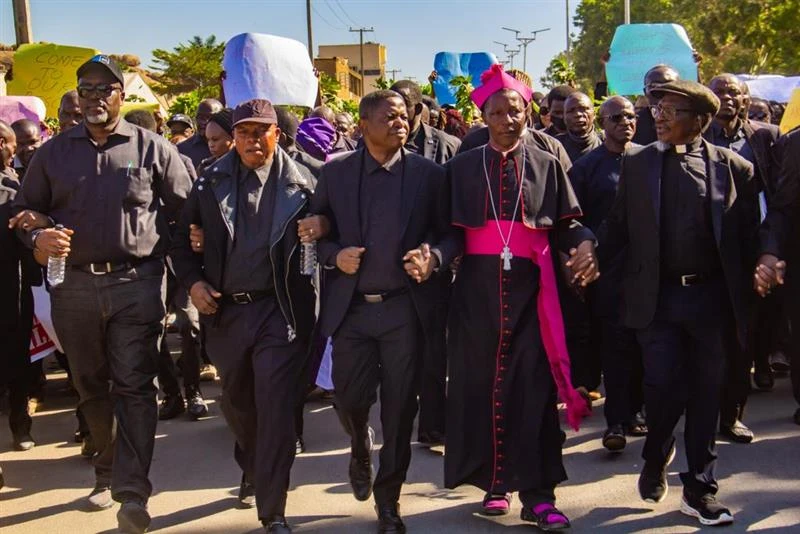
Catholic Archbishop Matthew Ishaya Audu of Jos marches alongside evangelical leader Rev. Dr. Gideon Para-Mallam in front of the Plateau state governor’s office building in Jos, Nigeria, Jan. 8, 2024. / Credit: Photo courtesy of Rev. Dr. Gideon Para-Mallam, photo by Plateau State Government Media Team.
Washington, D.C. Newsroom, Jan 9, 2024 / 15:30 pm (CNA).
Thousands of Christians rallied yesterday in front of the governor’s office in Nigeria’s Plateau state to demand action after more than 200 were killed in a series of Christmas massacres.
The attacks, which targeted Christian villages beginning Dec. 23 and continuing through Christmas day, left Christian communities in Nigeria’s Plateau state reeling. Photos obtained by CNA after the attack showed villagers burying their slain relatives and loved ones in mass graves.
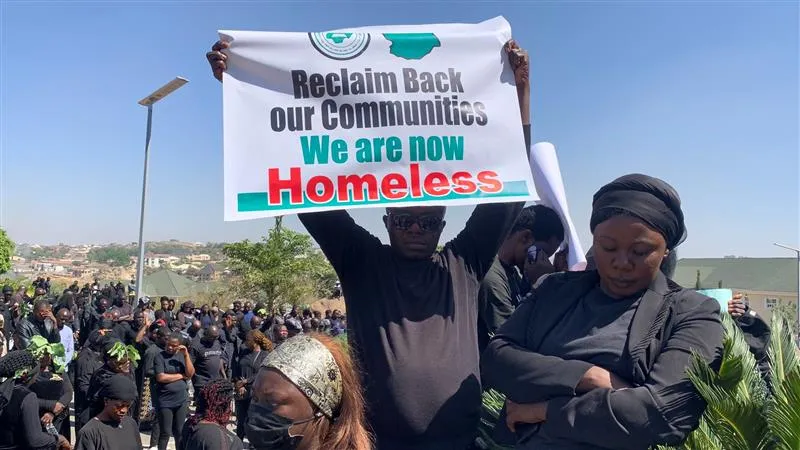
According to Rev. Dr. Gideon Para-Mallam, an evangelical leader who helped to organize the rally, the attacks also left 15,000 people displaced without homes.
Among the demands being made by the protestors, Para-Mallam said that they asked for an “urgent humanitarian relief material response by the state and federal government” and for the arrest of the perpetrators of the Christmas massacre, which he called a “genocidal,” “terrorist” attack.
Thousands of Christians peacefully and prayerfully march to a rally in front of the Nigerian Plateau state governor’s office building in protest of the 2023 Christmas massacre that left over 200 Christian Nigerians dead, Jan. 8, 2024. Credit: Photo courtesy of Rev. Dr. Gideon Para-Mallam, photo by Plateau State Government Media Team.
The attack marks the latest instance of terrorists targeting Christian Nigerians on significant Christian feast days. In 2022, on Pentecost Sunday, 39 Catholic worshippers were killed at the St. Francis Xavier Owo Catholic Parish in Ondo Diocese.
Religious freedom advocates believe that militant Muslim Fulani herdsmen were responsible for the Christmas attacks. In Nigeria as a whole, at least 60,000 Christians have been killed in the past two decades. An estimated 3,462 Christians were killed in Nigeria in the first 200 days of 2021, or 17 per day, according to a new study.
Due to continued attacks, Nigeria is one of the most dangerous countries in the world to be a Christian, according to a 2023 report by the advocacy group International Christian Concern.
Para-Mallam told CNA that Nigeria’s middle belt region, of which Plateau state is a part, has “suffered sustained attacks for over a decade now with destruction of lives and properties.”
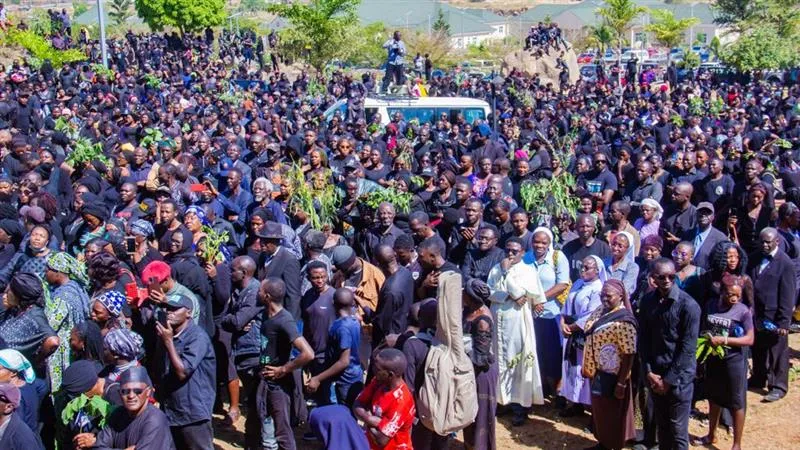
The thousands of protestors at the rally, he said, were “mournful, angry, but surprisingly joyful.”
Their “central objective,” he explained, was “to ask for an end to the killings not just in Plateau but Nigeria and seek justice for the people.”
Just-In: CAN Plateau State Chapter is having a Peaceful Walk to Government House pic.twitter.com/YbFRqtFI9J
“Above all, it was very peaceful and prayerful,” he added. “The old, the young all together felt that we had to do what we had to do to get our message across.”
According to Para-Mallam, the crowd numbered about 5,000 and included both Catholics and Protestants. Together, he said, they peacefully and prayerfully marched, ending in front of the governor’s office building in the city of Jos. Archbishop Matthew Ishaya Audu of Jos and several Catholic priests also took part in the march and rally, according to Para-Mallam.
The demonstration was “mournful, angry, and surprisingly joyful,” according to Rev. Dr. Gideon Para-Mallam. Credit: Photos by Nigerian multimedia journalist Jœy Shèkwônúzhïbó, used with permission.
The rally was organized with the help of the Christian Association of Nigeria (CAN), a coalition of Nigerian Christian Churches and groups that includes the Catholic Church in Nigeria.
Para-Mallam said the purpose of the demonstration was to “mourn in solidarity” with the devastated communities as well as to show them that the Church “cares” and “identify with them in the moment of suffering and mourning.”
A secondary purpose for the rally, Para-Mallam said, was to “get the Church on the Plateau to unite and to speak with one voice around the issues of social justice” and to “create awareness nationally and globally about the Christmas season attack.”
Para-Mallam said that Plateau’s governor, Caleb Mutfwang, addressed the crowds at the rally and was “sympathetic and understanding and spoke well on the pains of his people.”
Mutfwang condemned the attacks shortly after they occurred in a Dec. 26 statement in which he said: “This has indeed been a gory Christmas for us.”
“He promised to relay our concerns to the president and committed to work with the president to end the killings in the Plateau state,” Para-Mallam said.
Despite the governor and president voicing their support for the impacted communities, several religious freedom advocates have been critical of the lack of government response to the growing terrorist attacks.
Maria Lozano, a representative for the papal relief group Aid to the Church in Need, told CNA after the attacks that tangible government support was largely absent after the Christmas massacre and that a “lack of response from the government” over the years has worsened the situation in the region. The absence of government support, Lozano said, has forced Christian churches to take on the “primary responsibility of providing assistance.”
Para-Mallam asked for Christians outside of Nigeria to help by offering prayer, advocacy, and humanitarian intervention.
“We also want fellow believers to encourage policymakers to encourage the Nigerian government to do more to end the killings in general and particularly those targeted at Christians,” he said.
For several years now, religious freedom advocates have criticized the U.S. government for failing to include Nigeria in the State Department’s “Countries of Particular Concern” list, which some consider to be America’s most effective tool to encourage foreign governments to address the persecutions in their countries.
“There is no justification as to why the State Department did not designate Nigeria or India as a Country of Particular Concern,” said U.S. Commission on International Religious Freedom chair Abraham Cooper and vice chair Frederick Davie in a Jan. 4 statement.
Cooper and Davie mentioned the Christmas massacre as “just the latest example of deadly violence against religious communities in Nigeria.”
Speaking on “EWTN News Nightly” on Monday, Davie said that the decision to leave Nigeria off the list was “particularly” concerning and a “huge mistake.”
Davie told EWTN that “there are some who are saying that the government [of Nigeria] if it is not actively participating in some of this religious persecution is actually standing by and not doing what it can to prevent it.”
“We just believe,” Davie explained, “that by designating Nigeria a Country of Particular Concern, the United States puts itself in a position to work more closely with the government of Nigeria to address some of those fundamental security issues that are going unattended to.”
Despite this, the State Department has left Nigeria off the Countries of Particular Concern list since 2021.
The logo of ACI MENA, EWTN’s new Arabic-language news agency, based in Erbil, Iraq. / EWTN
Irondale, Ala., Mar 25, 2022 / 07:28 am (CNA).
EWTN Global Catholic Network has launched an Arabic-language news service headquartered in Erbil, Iraq, Michael P. Warsaw, EWTN’s chairman and CEO, announced March 25, on the Solemnity of the Annunciation.
The Association for Catholic Information Middle East and North Africa, or ACI MENA, will publish original news content in Arabic using a network of correspondents across the region. The news agency will operate from the campus of Erbil’s Catholic University (CUE.) A ceremony marking the occasion was held in Erbil, which included Archbishop Bashar Warda of the Chaldean Catholic Archdiocese of Erbil.
“I am pleased to announce that EWTN has begun a service reporting news from the embattled and underserved Christian communities in the Middle East,” Warsaw said.
“This is an important milestone in the growth of EWTN News around the globe, and I am pleased that we are taking this significant step to better serve our courageous brothers and sisters in the region who have endured so much,” he said.
“Because it is published in Arabic, this agency will also augment the service offered by ACI-Africa, our Nairobi, Kenya-based Catholic news agency, which EWTN launched in 2019 and which publishes content in English, French and Portuguese,” Warsaw added. “ACI MENA will provide a new voice to help spread the Gospel and news of the Church to these Christian communities in their own language.”
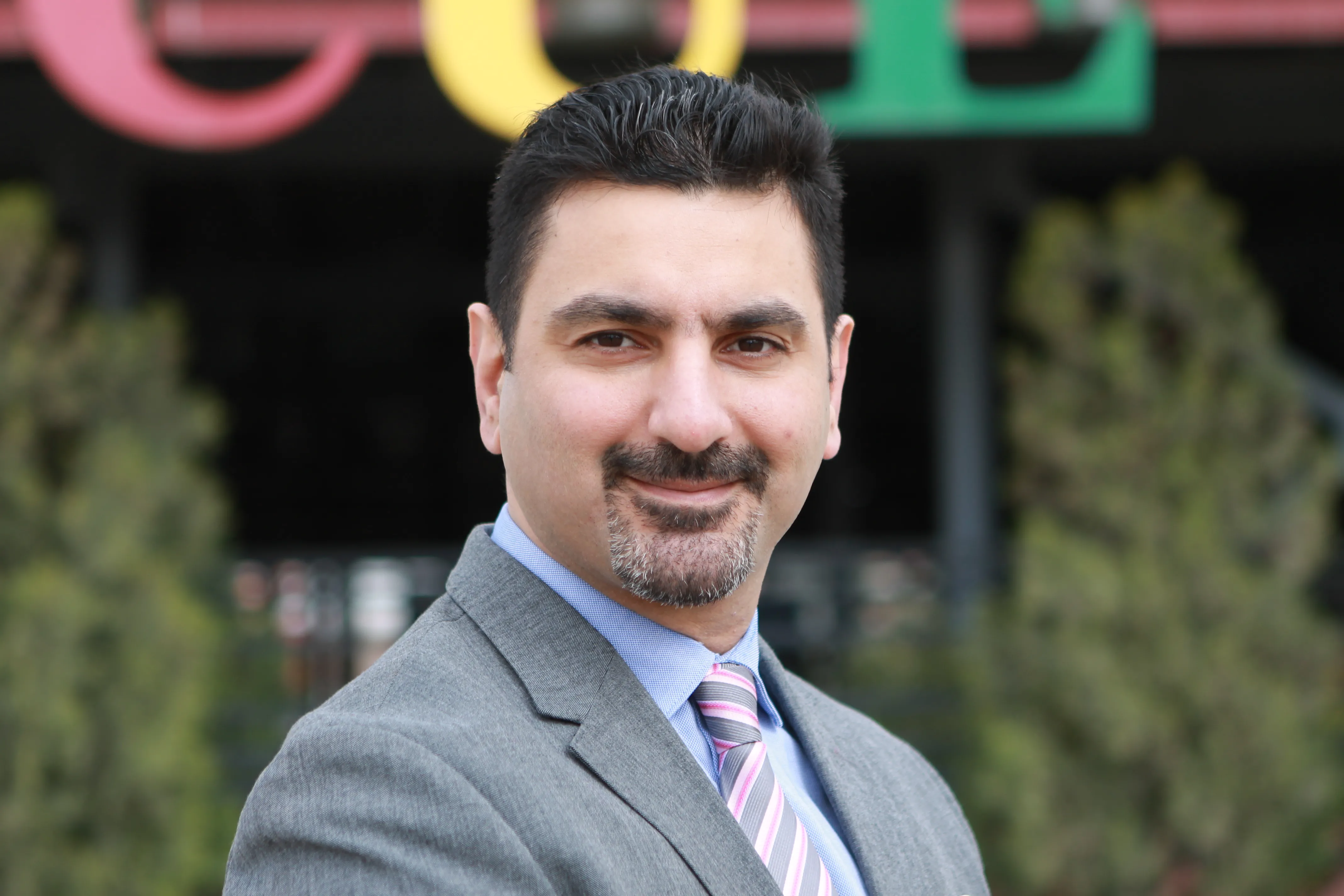
Bashar Jameel Hanna, a Chaldean Catholic layman originally from Baghdad, will head EWTN’s newly launched Arabic-language news service, ACI-MENA. The service will provide a new voice to help spread the Gospel and news of the Church to Christian communities in the Middle East and North Africa. EWTN
Hanna studied philosophy and theology for nine years at the Babel College in Iraq and graduated with a degree in civil engineering from the University of Nantes in France. Hanna speaks Arabic, French, English, and Aramaic fluently, and has a significant understanding of classic Arabic.
“When war came around to Iraq, I lost friends and relatives and became a political refugee in Europe,” Hanna said. “Ten years later, I received a call to work on the reconstruction in the Nineveh plains, to rebuild the church of Mosul. Then, late last year, I received a call for the position of Editor-in-Chief with ACI MENA. And I heard the Lord say: ‘I took you from the ends of the earth; from its farthest corners I called you. I said, you are my servant; I have chosen you and have not rejected you’ (Isaiah 41:9.)”
“Becoming ACI MENA’s Editor-in-Chief, to carry the message of love to the Arabic world still submerged in conflicts and persecution, may be a heavy cross … but He has risen!” Hanna added.
Alejandro Bermudez, executive director of the ACI Group, of which ACI MENA is now a part, called the news agency’s launch “a major step forward for the ACI Group as well as for the larger EWTN News family.”
“We are honored to expand our news coverage of the ancient and heroic communities in this region, providing them local, Vatican and world news in Arabic,” Bermudez said. “ACI MENA will not be a simple translation of news in Arabic, but a local news agency written in Arabic for the Arabic-speaking world, which will also bring stories of local Christian communities to the rest of the world.”
ACI MENA is the latest addition to the ACI Group, which includes ACI Prensa, the world’s largest Spanish-language Catholic news organization with headquarters in Lima, Peru; ACI Digital, the São Paulo, Brazil-based news organization, which serves the Portuguese-speaking world; ACI Stampa, the Italian-language news organization based in Rome; and ACI Africa, which covers news from the African continent in English, French, and Portuguese.
ACI Group is part of the larger EWTN News, Inc. division, which also includes Catholic News Agency (CNA), the German-language news service CNA Deutsch, and several other Catholic news outlets, including the National Catholic Register, “EWTN News Nightly,” “EWTN News In Depth,” and several other television news programs.
In its 41st year, EWTN is the largest religious media network in the world. EWTN’s 11 global TV channels are broadcast in multiple languages 24 hours a day, seven days a week to over 390 million television households in more than 150 countries and territories.
EWTN platforms also include radio services transmitted through SIRIUS/XM, iHeart Radio, and over 500 domestic and international AM and FM radio affiliates; a worldwide shortwave radio service; one of the largest Catholic websites in the U.S.; and EWTN News; as well as EWTN Publishing, its book publishing division.





Leave a Reply